The B Corp Journey Revealed by newly certified B Corps
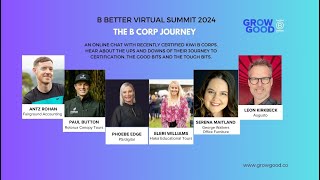
A recorded panel (YouTube) discussion hosted by Tim Jones with newly certified B Corps (participants include Phoebe of PS Digital, Serena of a secondhand office furniture business, Paul Button of Rotorua Canopy Tours, Anthony Rowland of Fairground Accounting, Leon of Augusto, and Ellery of Haka Educational Tours). Participants describe motivations for seeking B Corp certification, timelines (examples: Phoebe ~18 months; Serena ~6 months; Paul started April 2021 and took ~21 months; Ellery began assessment Nov 2022, submitted July 2023, certified the following month), the administrative burden (data-gathering, spreadsheets, verification), benefits (validation, community, marketing, funding advantages), and tips (use bookmarks, involve leadership and team, gather evidence during wait time).
Chapters
Hey team.
Hello.
Good to see everybody. Oh, there you are. I was going, Leon.
How are you guys?
And with that I am going to stumble my way through this as well.
Apologies to anyone who really speaks to Ray. Good to have everybody here excited about talking to you guys. Congratulations for recently getting certified. On a scale of 1 to 10, how excited are you by that? Phoebe?
We're delighted. Yeah, absolutely wrapped. Yeah, it felt like a long time coming and yeah, to get it over the line was awesome.
How long did it take you to get out of interest? I was going to get to that later, but I'll ask now.
Yeah, so we worked it out that it was 18 months and we set up a dedicated meeting weekly and we worked out that it'll probably be about two or three days a month. There were two beekeepers and multiple spreadsheets and we scheduled in kind of like, sort of like directors meetings to get some of those nitty gritty kind of questions sorted. But yeah, definitely quite a bit of work.
Yeah, that's a very disciplined, like, well done. That's a disciplined approach to going through the certification process. That, that's kind of gold standard. That's how it should be done. And how many companies don't do it? But yeah, yeah.
And interestingly enough, just on that shout out to Claire who was working at Springload at the time, Wellington based B Corp company who had actually given us that bison in advance and that was through the like the Wellington based B Corp community. And so that was some advice from her, which was awesome right from the start.
Oh, that's actually something I should ask. You're coming at us from Wellington, Phoebe.
Yes, yes, coming from Wellington. So we PS Digital, which is a creative digital agency offering services in strategy, design, marketing, web design and web development.
Nice, thank you. Actually, yes, I'll go to Paul, I'll go to you and yeah, if you could introduce yourself and then also 0 to 10 how excited you are about being a new newly certified vehicle.
Kia ora. Paul Button, General manager of Rotorua Canopy tours out of 10 to be a B Corp. Pretty high. Pretty, you know, in the eights and the nines.
Nice. I very much enjoyed the fact that you got. Was it the first B Corp in Rotorua and that got you that lovely, lovely piece of coverage in the local papers and also a bit of regional papers actually.
Yeah, we got great coverage through that. Eh? We were through the Herald, the Dominion and through the local rag. Yeah, no, we were the first in road to do a first business and we're the first zipline business in the Southern hemisphere to get a B Corp certification.
Nice. Yeah, well done. Good stuff. Serena particularly proud of Serena because she did the cohort program with me. So she did the big.
The.
The we had. We ran a cohort where we kind of go through the B Corp certification as a group for small businesses. And Serena hit, hit submit not long after going through that. So yes. Well done you. How.
We'Re super stoked. I think it's something that we needed to do.
We've been. Sustainability has been the core of what our business has been for 15 years but we've never actually pushed the matter or had it on paper.
Oh, sorry.
Just kind of breath it.
Tell everyone what. I know what you do, but yeah, perfect.
So we do office furniture. So we sell secondhand ex corporate furniture. It generally comes from banks and big corporate companies and then we resell it to expanding business or new business.
Yeah.
As a sustainable way of furnishing office spaces. Pretty much.
And how long have you been doing it? We are now.
Isn't it about 15 years?
Yeah, yeah.
And the business is in its current form doing office furniture has been. Yeah, about 15 years.
And you work with your s. Is it your sister and you that started the business?
No, it is my mum. So my mum started it and she retired a couple of years ago and then I've been at the rain since then.
Great stuff. Thanks Serena. And do you want to tell us about Fairground Accounting? Yeah.
Tanakoto katoa so.
Dr. Tahio Ho core Anthony Rowland Tokalimua yeah. Fairground Accounting based here in Christchurch and in Wellington. So really we support purpose driven people to create amazing impact driven enterprises to help make the world a better place. And 1 to 10 on the B Corp excitement scale. I've got to be honest, I'm at the start I was putting on the fake tin mask for a little bit because once you get through the. Finally get through the whole process, I just felt that kind of like big wave of relief and just like exhaustion and then, and then they're like yeah, you're certified.
You're like yeah, I'm really excited about it.
But actually, actually getting out and talking about it and telling people has genuinely made me feel like really uplifted. So yeah, I'm pretty, I'm pretty up there at the 910.
Genuinely I know what you're. Well I kind of know it. I have an analogy similar. Back in, before I turned 30 I decided I wanted to run a marathon. So I went to run the London marathon. When I was age 29. And at the end of that, I had all these people at the end of the marathon and yay. Which they had champagne bottles waiting for me. And I basically dragged myself across the last line of the London Marathon, and I really didn't care at that point about anything, but lying under a tree, wasn't excited until a couple of days later I could walk in. So, yeah, I. I get that it can be exhausting to get across the line, can't it.
Ellery? Very recent.
Oh, Ellery, I think you might be muted or is it just me?
Oh, no, now you're muted.
Try.
Try talking again. Can anyone hear? Ellery, it's not just me, is it? No. Ellery, I'll come back to you in a minute. Hopefully you can find out what's going on there. And Leon, Augusto. Tell us about Augusto.
How are you? All apologies if I've got a little bit of dodgy Internet and also wind in the microphone. I'm outside, I'm over filming in the Barossa Valley.
Making wine. Well, I'm not. I'm filming somebody else making wine. So it's a tough job. Augusto is a group of five companies, actually. It's an advertising agency, a fast turnaround video production company called Cornerstore, documentary production company called Dark Doris, and also a technology company developing apps and, and the like. And we're purpose driven company. My wife and I started it 15 years ago and there's about 40, 40 odd staff and up in Auckland and a little satellite office over in New York of all places. And we started our B Corp journey a little while ago whilst we're over in the States and a CEO who we had at the time was taking care of the process. So I was blissfully ignorant as to the pain that she was going through at the time. Just in the board meetings, you go B Corp thing going, and she'd be like, yeah, it's hard. And then when we. We moved back during COVID and she took another job somewhere, so we took the reins again and I was tasked with taking on the B Corp, finishing it up. And I naively thought, ah, this be easy. I'll just get in and smash it out. And then sort of six months later, of tears and blood and grime, and, you know, it was, we finally got it done and very much similar story of just relief more than anything. And we haven't yet gone out and really told our story. We haven't sort of done the marketing push yet to tell everybody that we are B Corp. We sort of feel that it's a little bit more.
Getting the certification sort of to us feels more like a. A stamp of approval or something for what we have become or what we are currently. What we're looking to do now before we really go out and make a bit of too much of a big of a song and dance about it, we kind of want the where B Corp and we're going to do or what we. We sort of need. We're finding that we don't want to just turn it into a marketing ploy. We sort of want to a little bit more now that we've got the accreditation we're sort of looking for now, just what that means and how we're going to go forward. So we've got relief and we're excited, but we're probably more excited about finding out what the mix, what the next phase means for us and what it means in a meaningful, practical sense.
Yeah. Yeah. I didn't realize Augusto had that many.
Arms to its operations.
Oh, sorry. Sorry. How are you doing? Can we hear you yet?
Yes.
Can you guys hear me?
Yes. Fabulous. You want to tell us about Haka Educational Tours? Yeah.
Kia ora, everyone. Awesome to be here. So I'm co founder and GM of Hacker Educational Tours. And our mission is to broaden young minds through impact travel experiences. So basically how we do that is we run high impact trips and camps for school groups, university groups and sports teams all over the world. We are very new in our B Corp journey. We received a certification just last month. So we've sort of done a soft launch and we haven't had a full hard launch or celebration yet. So I think, yeah, definitely feeling pretty stoked, but can't wait to get the team together, which hasn't happened yet, and.
Properly celebrate it.
In appropriate fashion. Yes, yes.
Yes. Great. Thank you everyone. So first thing, I wanted to just ask everyone. Oh, and just a small thing. This doesn't have to be. We can run this conversation however you guys want to. So I, I can just ask questions and you can answer or we can discuss amongst yourselves. If someone says something you want to speak to, please feel free.
But the first thing I wanted to know was what motivated you all to begin this process? And from first deciding and then getting. How long was that? I think Phoebe's already said it was 18 months. But for the rest of you.
How was it? Paul, shall I start with you? Where did. Why did you do it? When did you first hear about it and how long did it take?
We first heard about it by a gentleman named Ben Mayall, who runs an SEO company we were using. But Canopy Tools has probably always been a B Corp because we do tons of conservation work. We do tons of stuff for the community and for our staff. And we just. We're kind of famous because we lead with our conservation. So we kind of wanted something that would show the other stuff we do, like accreditation that actually show you how well we look after our community and our people. And so when I heard about the B Corp, it was awesome. It's just like the next step. And also in the tourism industry, like, you know, Canopy tours live with sustainability. First 12 years ago when we opened, and people thought it was strange, and now everybody kind of plants a tree or tracks of pests, but it's kind of the norm. So we wanted to do something where we could raise the bar in industry to allow the industry to keep rising, the tide to keep up.
That was kind of our drive. And we, you know, like, for the other tourism folk, o', Leary, it's pretty cool that you're up there too. And now you don't want to be the last person. Right. You want to be the next person. So for us, we jumped on, I think, in April 2021, and it took us two years to 21 months to get it certified. And it only took us six weeks to do the certification or three weeks. And then we pushed the button. We didn't really have to do much apart from just work with Timmy and find out if we could prove what we did. And then we just waited in line for that 21 months. I guess we kind of caught the crest of the wave where the demand was really high.
I think you did. I think you just. Yeah. You must have kind of hit submit. Just as B Lab were having the really long queues for verification, we got the big corpus.
Just relief. It's just like, oh, that's over. Sweet. You know, like. But, you know, in retrospect, it's like you say about the marathon a few days later, you're like, that's so cool. You got it.
Yeah, yeah, yeah. Looking at. I have obviously not been to Rose World Canopy Tours yet, but looking at your website and looking at what you do, I can't wait. Looks amazing what you guys get up to up there.
It's a cool product, and we're definitely doing a lot of stuff that people don't, you know, so it was really. It's quite cutting edge in a lot of ways.
Yeah. And I love that you're showing your B Corp poster right there on your disc. Bulb. Nice.
B Corp is on the door of the building.
It's.
We've sent our emails to all of our database, you know, so there's 50 odd thousand people that have been exposed to it.
We're pretty stocked.
Yeah. No, that's fantastic because that also lifts our hearts here at growgood, because we really want B Corps to shout about being a B Corp because ultimately that's what's going to grow the movement. That's what's going to drive the influence and drive the change in the way the world does business.
Yeah. So, Phoebe, what was your motivation for taking on the B Corp journey?
Yeah, so we've always been quite an ethical and ethic, you know, ethically based. And.
So Pearce Digital was set up by my husband and I 16 years ago and we had worked in a number of different countries and different types of agencies, I guess, and we wanted to set up a really cool agency that.
Things kind of the right way, the better way, a way that was going to be a great experience for the workers. So we knew that we would qualify for a lot of, I guess, the requirements. And I think for us it was like, hey, we just need to document all this stuff that we do, all this amazing, great stuff. We do have really high staff retention and we have a great business and this amazing accreditation, you know, really aligned with our values and we were just like, wow. So for us it was really motivating to I guess, go through that documentation process which also kind of has shaped up our business because, you know, you say you do these things, but actually to prove that you do these things is another thing entirely. So, yeah, we were really motivated because we knew that we would get over the line. And I think that, you know, whilst, yes, it's a marathon to get over the line, it's really just the beginning of the journey. Because I agree with Leon that it's really important for your vision to keep growing because you're almost ticking off all these good things that you have and you do and you say all these things that you're ticking off, but you're kind of like there's all those things that you can't tick off or don't tick off that I'm really excited to get into. So whilst the marathon happened, the journey's just begun.
Yeah, no, 100%, that continuous improvement piece, and I often say this to anyone who listen, is that in the process of working with clients on their B Corp journey, and especially ones that have just come to it, the moment I love one of the best Moments for me is when I see that aha. Moment when they kind of get it. It's like, oh, business as a force for good. Because you can say those words a million times, but. But there's a point where you get them. They kind of sink in. And now you're. And you get addicted to the. To doing more good. It becomes like this addiction almost. And. And that's the. The minute when I see a client that just kind of. The penny drops. That's the moment I love. Anyhow, I was just.
I was just going to add to that. Phoebe. I totally agree with all of that, that it's that measurement. The other thing that I've actually really found, and I even find it now on this call with all of you, it's actually more about other suppliers and what have you. The community. You instantly start looking for other people who are B Corp certified to work with. Inasmuch that we've just bought a building and we're needing to do renovations to it and stuff in the IT thing. And I instantly now start looking, oh, which B Corp IT companies can I work with for the new foot out of the building or, you know, Phoebe, we need web work done. I'm like, oh, awesome. Got a cool fee. We need office furniture and, you know, like, finding yourself kind of going, oh, I got to catch up with Serena, you know, and that's largely because, you know, you're going to be buying from somebody who has the same ethical standards as you or at least cares in a similar way to you and that. And I've found that as helpful as anything else. Just, you know, being part of that community feels like that's been the biggest benefit for us so far.
Nice. Yeah, actually, that's the point. I want to ask about the biggest benefits later, but let's continue with motivation for doing it in the first place. Answer. What was your motivation?
Yeah, I think when we. We kicked off back in 2012, and I think maybe a couple years after that, we'd come across B Corp. And I think back then there was Eagle, and I think Tim had just been like, the freshest B Corp. He was about number three or number four at the time. And I remember just vibing with it straight away and going, yeah, this is like, what we're about. This sounds really awesome. I think it was just one of those, you know, when you're in startup phase and you're just trying to get the business off the ground, you just think, yep, something I'd like to do, but we'll get to It. So we did give it a shot in 2016, but I think maybe being a little bit naive at the time, we think we had the right answers to the questions, but back then it was probably a little bit more Americanized. So when they came back and took some of our points away, we felt a bit like, sad about that, but always been with the support of Tim and Catherine Eagle. They've been great advocates and kept me really motivated for going. Yep, we think it's time to do it just more because it helps validate some of the values and the internal ways. We think anyway. And we're already working with like amazing clients that are doing great things out there. So when we, when we announced it, the. The flood of sort of.
Of well wishes from clients who. And some of them just going, yeah, you know, of course, it just makes sense for you guys, you know. So I feel like the motivation was really just to have a nice one, just to have a bit of an external validation of what we do, but more so that we can. We're not just talking the talk with our clients and talking about their impact and how they can be doing something better, but we're actually walking the talk ourselves so we can be a bit of an example for them and say, hey, look, why don't you think about, you know, your impact journey could be caught that you could look at as well.
Yeah, nice, nice.
Ellery, I haven't asked you, have I, the. Your. The motivation for Haka or I might have asked you, but not today, now. No.
Yeah, yeah, look, I guess for us, impacts in our DNA, it's obviously in our. In our mission. B Corp, I guess, provided a tool to measure that impact, which I hadn't come across before. So I particularly love the framework in the sense of it being very holistic and it unpacks, as we know, every single aspect of your business and your business activity. And I love how transparent that is, which is something that's really important to us. I think the fact also, as we've all talked about, it's not just a certificate and poster that you put on your wall and it gathers dust. It is a lifelong commitment to doing better as a business. So that, I guess, was a huge difference to other certifications that we looked at. And when you work through that assessment, you just unpack so much in terms of future impact opportunities, like that bookmark function. I can't remember how many times I would press it because it's just inspirational to think of, okay, well, what's next for us? What does that look like digging into the supply chain and working with our partners like Canopy Tours. That's just one of hopefully many, many more organizations in. In the tourism space that we can get on board. But I particularly found that. Yeah. Quite aspirational, I guess, in thinking long term.
What.
What could that look like? And then finally it's. It's globally recognized. So that's really important for us as we work in many, many different markets all over the world, and to have that recognized globally, you know, alongside some of the fantastic sustainability certificates that we've got here in tourism in New Zealand, that, again, just adds that extra layer of validation, if you want to call it that.
Yeah, yeah.
The validations are really important piece. And also, as you spoke to. It offers a. A road map for businesses who may not have. I mean, I know I. Until I started getting into the bia, I'd never really considered. Oh, supply chain. Oh, it's good to get into that. Is it? Okay. Yeah. So it. Yeah. Gives pointers to businesses that just wouldn't have thought of it otherwise.
Thank you. Serena. I don't think I've asked you the motive. Well, again, I know. I think I probably asked at some point today. Motivation for George Walkers going down this road.
Yeah. I think for us it was. We wanted to prove that it is, you know, we are a sustainable business, that we. It's the core of what we do and always has been. I think we got into a bit of a rut where, because it is just what we do, we didn't think that it needed to be explained or talked about. So when we were looking at ways that we can, you know, put something behind us, that just proves that we are who we are.
B Corp really jumped out to us and just how transparent the whole thing is. There's. There's no hiding from anything. Like everything is on the table, which I really, really liked. I think for us, the. The framework that it's provided as well has been invaluable to just how we proceed going forward as well. And we can always get better and there's things we can improve on and.
Yeah, yeah, yeah, absolutely.
Yeah.
I think. And it's just, you know, it's strengthened our reputation as well. Like, people know what we do and we, you know, but having the backing of it and just that little bit of proof, I think.
Yeah. I remember in this ex. This little. My next question. We've lost Leon, which is a shame. It could be the Barossa Valley, Wi Fi. Who knows the. So I also want to. Because I remember because you're against you. You haven't. It was quite recently, you've done it as well. And I remember you saying that the last couple of months or getting all the evidence and was actually a lot of work. Some late hours, some. Some headaches, quite frankly.
So, yeah, my next question to everyone is, so the process itself, on the. On the pain scale, and how did you manage the pain, like, Serena, I think most of it was yours, to be honest. But in the other businesses, did you manage to sprinkle this pain around the team a little bit more?
Yeah.
So I think for us, it was. I'm. I'm not the best at admin. That's not my forte. So the spreadsheets and the gathering of.
Information.
And all that kind of stuff, I did struggle with. But I was like, we've got a pretty nice little team here who. We all chipped away at it together, which was nice.
And everything stored in our heads. So for us, getting it on paper was a massive task, but it's one that's really paid off for us as well because it's something that should have been done, to be quite frank, that hadn't been done.
So. Yeah, it was.
It was.
Once we got into the certification part of it and they'd come back with questions and we were going like. I think there was one question in particular that we completely misunderstood. And so what they were asking about information about our customers. And so we went through and did, like, this massive spreadsheet about all of our customers. And then they were like, oh, no, we didn't actually need that. And I was just like, oh, no. Oh, no, we've just spent hours. And what they needed was really simple, and I could have given it to them in five minutes, but I think I just overlooked because some of it was so in depth. I then started looking at everything really closely and probably could have saved us a few hours.
But it was still a good opportunity. I learned a whole lot about my customers that I didn't know either.
So great exercise.
Silver linings.
Ah, yeah. So a bit painful.
Just remind me, Serena, how big is your team?
There's. We've got a team of six.
Okay. Yeah. Yeah. Okay. Phoebe, what was the. The pain, Pain, pain scale for you? And.
Yeah, I'm.
I think initially.
You know, you're kind of like, whoa, look at these five sections. Look at all these questions. And you're kind of a bit like. We sort of. I felt like we sprinkled through the questions and then we went, oh, hang on a minute. What have we done? What haven't we done? And I don't think we were utilizing the bookmark feature. So that would be my one huge hack for anyone doing it, is to use that bookmark feature because it was just invaluable, became so, so good. And then, yeah, spreadsheets were really, really helpful to try and get things sorted. But I think also, too.
It was obviously working with Tim and Tamara that was really encouraging for us in a way that there was definitely some things we didn't understand. I agree, Serena. There's definitely a couple of things where you misinterpret, or maybe the wording is just kind of. It's. It's said in a way that you're not quite clear what they actually really want from you. And so you just kind of go, oh, no, we can't do that.
Or we.
We. We don't want to say, we don't want to be clicking anything that we can't qualify. Or that's not true. But then it was like you guys were able to clarify, oh, no, that just means this, this and this. And then we're like, ah. And it. It sort of unlocks, you know, the. It's kind of a game of Pokemon in a way where you're, like, unlocking these little things where you're like, oh, we're in there, we're in there, we're in there. And so I think, you know, there was probably a little. We were held back a little bit by maybe not understanding everything properly, but then once you kind of get in, yeah, I think it was really good. I do think that.
Another challenge, I think, could be anybody that tries to do it in isolation. And I'm a big believer that getting the whole team on board. We're a team of 10, and everybody was on board and everybody knew. And we had. When we have our.
Particular weekly meeting, we would give an update on where we were at and how people could help. And I think. So the whole company became quite invested. And so that was really encouraging for the people who were the beekeepers who were specifically working on it. And again, I think, you know, I'm one of the directors of our company, but I have spoken to other people on the journey who maybe they're not the owners or directors of a company. And it's quite hard work because there's a lot of big decisions or a lot of big questions that need to come from the owners of the company. So I think having regular meetings with the directors is probably a really good idea as well.
Yeah, no, you touched on two of our key pieces of advice here. Get your whole team on board. Like, everyone needs to be invested and excited and engaged and involved in this process.
And leadership. Buy in. Yeah, there's just no point if you don't have buy in and enthusiasm from the highest parts of your company. So, yeah, yeah, gold standard. Phoebe, you're doing so great.
Paul.
And what about you? How painful? I think you might have said a little bit about this before, but how long drawn out. And I said don't. No, for this round, we'll just focus on the pain. We'll come to the pleasure part of it later. So was it onerous or whatever the challenging bits for you?
I don't really. We didn't find it too onerous. We were pretty excited at the start. You know, we could. We. We had a presentation, Timmy, for the whole team, but we just worked. Our leadership group of five did it, but it was just ensuring we could prove what we said. But our initial submission was we're at 165 points. Like we kind of smashed it in a lot of ways because we were already doing that stuff. And then during those 21 months, I'd email and I'd just reply and, you know, you'd see a bit of data here and there. And then we hired an accountant, put full time accountant just as we came up to be certified. So she kind of sent a bit of the stuff in the auditing, you know, staff list, the labor, bit of data proof. But it was pretty chill.
Nice.
I wasn't too overcome by many emotions. You know, I kind of got excited. Then I got over it. I was just like, you know, because it was so long, it's just like, whatever isn't going to happen. Who cares? But then when we came into the sticky end, it was good. And actually there's a bit of pressure because we're taking out a bank line just straight afterwards and there's a bit of pressure to get this, the big corp from the bank so we get access to sustainability lines.
Oh, nice.
We saved 27 grand in our first year. Just like B Corp. Wow.
Wow, that's great.
Yeah, we probably got five or eight thousand dollars of pra. And then. And then, you know, chunk of our loan. It was, it was awesome.
Good stuff. Yeah. Leverage that B Corp certification, Paul. Well done.
Yeah, we didn't do it for that, but you do everything for marketing benefits. It's definitely helping.
Yeah. As well. Leverage the benefits. Absolutely. Ellery, how was it for your team?
Yeah, I mean, we're quite A very small team. So it's myself and Annika, we were the beekeepers and we did have support from two or three other team members as well. But I guess because we're small, we're very agile and we're pretty, I guess, sort of set up from a process and systems point of view. So we actually didn't find it too onerous. Most of the data was there. It was just gathering it. And I think if you are quite agile in that sense, then it makes things easier. There definitely were some curveballs thrown with validating the data and yeah, we were knocking our heads against the wall a few times. But honestly, for me, I was just like, this is hard for a reason. That's all. I kept saying to myself, if it was this easy, then every company would be doing it. So I was just like, this is the process, we need to go through it. If this is what it takes, then I'm glad that it's this difficult because it's going to be worth it in the end. So I just try to keep a positive mindset around it and yeah, it kind of got us through, I think.
Yeah, yeah, no, nice. Exactly. Yeah, no, that's exactly what we say too. It's kind of like if it was easy, it wouldn't mean anything. So. So you know what, just out of interest, what were the, if you remember, what were the curveball moments?
We.
Well, one particular moment jumps to mind where we. Our track changed from a provider with minor environmental footprint to major. And that unlocked a whole heap of questions with regards to where we operate with what are we doing in order to protect. Yeah, the environment that we're operating in. And that required a lot more information. So, yeah, we, we obviously had to, yeah. Find that information and it wasn't easy and it did take time and that's probably what slowed us down in the end with being able to get the assessment completed.
But yeah, we got that there in the end. Yeah, yeah, yeah. And.
Ants. How was the process for you?
Yeah, I think we went about it thinking, going through the B impact assessment, thinking. Yep. These are things that we're definitely doing and with a mindset of like, ah, look, that definitely is something that we should be doing or can easily be doing. So it really forced us to think a little bit more around the processes and go, yeah, well, why don't we have a process around that? Or what couldn't we be doing better? I think the. Once we pushed submit on the application, I think we kind of thought we had a bit of a gap Because I thought there was quite a long queue, and we thought it could be up to nine months until they get to you to start doing the verification. So we sort of thought, okay, we'll have a bit of a breather. But I think for anyone doing it.
Even if you think you've got that time, spend that time just gathering your evidence together. Because when they do, when B lab does reach out and say, okay, it's time for verification, how are you placed next week? And you're like, oh, you know, you've kind of got to. Whether, you know, that's your opportunity or. You mean. You can obviously reschedule, but, yeah, just have everything in place ready to go so that you can just jump on and start going through that verification. But, yeah, it was interesting. There were a few. Like, Ellery, there are a few little curveballs that made us think. But I think what it did is it really challenged us to think a lot deeper about the answers that we'd given. And it sort of going, oh, yeah, we. We can actually give a proper answer now, as opposed to just ticking the box and saying, yep, we do that.
Yeah. Yeah, absolutely. And as Serena mentioned before, what we hear a lot from clients is, yeah, we do all that, but all the information's in our head or we've just never written it down before. And that process of collating things, getting stuff that just people know in their heads because they've been doing it so long, getting those processes down, that's part of the.
Yeah, the. The. I don't want to keep using the word pain, but part of the process, that can be a challenge. But. But once you've done it, like, super worth it, because you get to kind of assess things and. And rethink. And we've been doing it this way for this long, but is this the best way? We could always do it this way. Yeah. Great. Thank you, everybody.
I kind of want to know as well.
Were you. Was the process.
What you expected it to be? And if not, how was it not? And also just going to add in. In here again as well. If you want to ask each other questions, please just jump in and do that too. I'm gonna. Serena, I'll start with you. So was this. Was the process. Oh, and I have to apologize. Can't feel responsible for you misunderstanding that question that made you spend three months doing a pd.
Sorry about that.
No, that totally. That all happened during the validation process, so it didn't happen when we were going through the B impact assessment. I think I was a little I was. We went to the assessment. I was flying through it. I was just like, we've got this, We've got this, We've got this, we've got this. This is easy. Like, what is this? You know, like, we've got all.
Everyone going on about.
Yeah, what's everyone going on about? And then I was like, at the end of the cohort, I'd pretty much just before the end of it, had already submitted the assessment. And I was thinking in my. In my mind, I was just going, oh, this is. This is it. We're done. Like, they'll just check all my answers, tick it off, and that's that. No, no, no, no, no, no, no. That's not what happens.
Then they go through it all.
Ask.
You for some extra stuff, which was totally fine. I probably exaggerate. It wasn't as hard as it. As I made it sound. I think it took us about six months all up.
From the assessment to certification. But it was just that when they were coming back and the spreadsheets and things like that.
Yeah.
Sort of struggled with, I guess, but it really wasn't that difficult. Yeah, it wasn't that difficult.
Six months is a really short amount of time. Serena, you. You. We went through it at quite the pace, to be honest.
Yeah.
That's not long at all.
No. I keep hearing all this, and I'm.
Like, oh, two years, three years. Yeah, yeah, yeah. Some companies. More complicated and all the rest of it. Yeah, yeah, yeah. Okay. So. Yeah. All right, cool. It wasn't that bad. Cool.
I think everyone should do it.
Yeah, exactly. Yes. You want to do it? Yeah.
Phoebe, was it what you expected it to be, or was there any.
Yeah, I mean, I personally, I think it was.
This kind of, like, all over the show. Like, I think it was way better. I think it was way longer, and I think it was way more involved than I imagined. I really enjoyed it, and I think that probably the bigger picture of it is that I really enjoyed working on the business and not just in the business, which I think we all are really guilty of. And I think that is really lovely to work on the business. And my husband and I are really passionate about our business and what we do. Um, so to. To be. To allocate some time to kind of making it better and documenting, that was just. Was awesome. I really loved it, and I found that really fulfilling. And the beekeeper that I worked with has been incredible. And I think that, you know, like, it was quite a bonding exercise for us, and I probably didn't I didn't, you know, sort of didn't. That was not part of my expectation and yeah, I really enjoyed it and I. Wellington has a really amazing network of people that help each other and get together and have these get togethers and I've met so many people on the journey and yeah, I just. Yeah, it, it was better and longer and harder and more involved. It was. Yeah, it was probably not what I expected.
Yeah. Amazing. Yeah. No, seriously, you're just leveraging all the benefits that we like businesses to leverage from it. So go you. Are you part of the B local Wellington community? Do you go?
Yeah, yeah. So I go to all the events and everything.
Yep.
Yeah, I'm not part of, not part of the organization of it, but.
But you. Yeah, yeah, you've met the other local B corp.
Yes, definitely.
Yeah, yeah, yep, yep.
And yes. No, they have a really great series of get togethers and yeah, the people running it have been super supportive and helpful before we certified and. And then obviously going forward and um, yeah, I mean anyone Wellington based that wants to have a peppermint tea with me, I'm happy to chat about it. Help anyone on their journey too.
Nice. Thanks for that. Yes. Yeah, exactly. Paul, was it everything you thought it would be?
I don't know.
It was kind of just. It was just such a non event. Right. You get excited, you submit and then you wait nearly two years. You know, the. And when we got verified, that was really sort of uneventful to it. It's very dull. Like the. I think we got a new person. And so we had this panel of six and nobody spoke except for this one person that kind of had no idea what she was doing. And.
She asked a lot of questions that would kind of felt like you would know if you knew New Zealand, like about public health care and things like that. So it's quite confusing. It was kind of like, yeah, we got public health care. Yep. Okay, can you give me proof you love? Okay, yeah, like here's the website, you know, the government acc for it.
And then.
And then we didn't actually realize that was our assessment, our verification chat. It was kind of like, oh, is that it? Oh, okay, cool.
Thanks. Wow.
And then we got verified soon after that. It was a couple of pieces, but it was. Yeah, I guess it was just a journey right through the assignment of the original assessment. You know, a few weeks, whatever it was. And then push submit you. Oh yeah, it's gonna take a few months. I can't wait till two years later and be like, hey, whatever. Cares. This is. And then, yeah, then the dullness of the actual verification. But most of the verification has been done, I think, because we've been tapping away a little bit here and there.
But.
Yeah, I guess just the elation, you know, once we get the big corp, then you could leverage it and do fun stuff with it and then, you know, share amongst our industry, which we're relatively proud of, you know.
Yeah, yeah, Great, great. Well, that's one of the more unusual verification stories I've heard, to be honest.
But.
Much emotion at all. I was just like, oh, was that. Was that it? Oh, okay, cool.
No, no, the fact that you had somebody. You said you had six verifiers on your call.
Maybe four.
Six. Four.
Four.
Maybe four. Timmy. Timmy was on the call. He jumped on helmets out. He texted me. He's texting. You know, he texts on the old video call under the table and he said, I think we've got the weekend girl. I didn't quite understand what he meant by that, but when we got off the call, he said, yeah, that person's brand new, man. They listen to us with their first one. That's.
That. Yeah, yeah, that's. Yeah, that's unusual. So maybe you did get someone who's only just become a verifier and she was being. Yeah, don't know.
Anyway, but we weren't quite sure. Like, I. I genuinely did not know there was a verification call.
Wow. Okay.
Okay, sweet. Call 9 o'.
Clock.
Okay, jump on.
Yeah, yeah.
Not that prepared at the best of times.
Oh, okay. Anyway, gosh, Ellery, Nance, I need to get to you as far as. Was the process what you. What you expected of it? And I might have to throw my other question because I didn't realize it was already called fun. I'm wanting to also know from you guys.
Your biggest tips and for others who are doing it. And also the. The benefit. If. If you've seen a benefit yet, what is the biggest benefit so far? So tips, benefits. And I also wanted to touch on. Okay, now I almost feel guilty even mentioning this. Yet you've just got your new lovely certificate and now I'm like. And so recertification. Have you thought about that?
What's.
What's the plan for the next three years? Are you. Is. Is it part of. I'm not going to think about this again for another two and a half years and then I'll do it all in the last six months, or is it a case of you're going to kind of progress it over the Next three years. So.
All at once. Yeah.
Was it what we were expecting? I would say yes. I had sort of spoken to a lot of B Corps and obviously, yeah, we had Tim and Jess from Grow. Good. They talked us through that process. I asked a lot of questions. So I think I, yeah, went in there knowing this is going to be a journey.
And for us it took I guess two years in total. We started.
The process in early 2022 and then we started the assessment in November 2022. We submitted the assessment in July 2023 and obviously we were certified last month, so. So yeah, two years in total. The wait times in between, I think probably similar to pool and canopy tours. We were in the thick of long wait time so I maybe didn't expect as much of a delay in terms of communications. Like we were kind of having itchy feet, wanting to move and that process took a while but yeah, obviously just patient and yeah, get there in the end.
Any tips? Oh, my tips would be.
I guess in terms of data collection and verification. We've talked about it before, just using that time in between the verification process to gather that data and don't feel like you sort of have to do everything yourself and take it all on yourself. So bringing the team on board to make that process, process as easy as possible. And yeah, I think for me just sort of really logically working through that, that assessment, trying not to get too overwhelmed with all of the questions using the bookmark function. That was my favorite button. And yeah, just having a really logical process of like, okay, let's just take this one step at a time, work through it and try not to get sort of too overwhelmed.
In terms of recertification. I'll be honest, we haven't thought about that yet. But we have a lot of flagged impact improvement aspects of the certification that we are starting to think about now. So that will come in due course. But first we fully need to celebrate.
Yeah, absolutely.
Ants, can I come to you? And TIPS benefits. How was it for you? Recertification, any of those?
Yeah, cool. I think B Corp do a lot.
They.
The process is all quite documented out so you can sort of see the steps and where you are in the process. I think you just. I think the biggest thing for us was just didn't understand like the context of how big or important or how long each step would be. It's a bit like you, Paul. I kind of got on there. We were all getting nervous leading up to that verification call going, oh, this is going to be so. And I Think it was like 40 minutes, some basic questions and like, yeah, it's all good. We geared ourselves up for it a bit too much. But, yeah, look, don't go alone, you know, talk to other B Corps. You know, you've got some amazing. Like Tim and Tam, just amazing people to tap into.
I think for us, we've taken some ideas from it as well, so it helped to do things like get all that knowledge out of our head and do things like create an employee handbook. We knew all this stuff, we were doing it all, but we actually put it all together into one handbook. And now we've been doing things like we've had some new staff start, had some interns, and we've been able to actually go to that handbook and go through it with them. It's really good to internally have those sort of resources now. But we have picked things a bit like Ellery, like, we're going to work on between now and the next one, but we're only one month in, so we're not. We're not too focused on the recertification just yet, thankfully.
Yeah, yeah. No, fair enough. Brilliant. Thanks, Anne. Serena.
You'Ve already talked about how it was for you, but what about biggest tip, biggest benefit? Noticed anything?
Biggest tip would probably be. Probably be to just engage your stakeholders, involve your employees and your customers and suppliers. Their import input and support is super important and really helpful. It gives you a bit of perspective as well in seeing where other people are or view things.
In regards to certification, I think we've picked out some things that we need to improve on or implement.
We haven't started working on those yet. We're just getting our feet wet.
But it'll be stuff that we look at doing over the next 12 months, probably 12 to 18 months.
Okay, thanks. And, Phoebe, have you noticed, I know it's early days to be noticing any benefits, but if you have. Or if you have a tip.
Yeah, I mean, I think the bookmarks, you know, agree with Ellery. It's very, very much like once we got onto the book bookmark world, we were like, wow, this is great. I think just also too, someone had said to me back in the sort of earlier days is just start. Just. Just start doing it. Because it's almost like you initially feel almost timid to crack into certain areas or you're not sure of the answer or maybe what the. What answers required. But I think just get going. And I also think that, you know, the journey is the great bit, the learning more and understanding more about your business and Qualifying more about your business and how it works is actually really beneficial. So just. Yeah, enjoy, enjoy the journey. I guess. In terms of recertifying, we've talked about it. We are a service based business. So unlike a product based business, we have different challenges. So in terms of the environment, there's obviously things we can work on and we did work on, but there are some things that we kind of have left and so I'm looking forward to cracking into some of those things because I think you do just tend to tick off what you can tick off and, but it's left the, the sort of gaps that we want to look into, like you know, your carbon footprint for example, and maybe doing some carbon invoicing with clients and. Yeah, I mean, I think that, Yeah, I, yeah, I just think that it's an exciting opportunity to continue the marathon.
Yeah, yeah, yeah, yeah. Great. Thank you so much. And Paul, if I could ask you about any advice you might have for other wannabes, if you've noticed any benefits yet and what are your plans for recertification if it's not too early?
No plans for recertification, really. We, we, we submitted on what was at the time the highest score in New Zealand and then we only passed by like 2% by. We passed with 82 points and we submitted 165. We unlocked three impact models but during the process they removed them and we just couldn't be bothered even like.
They'D add them in the verification court. We just couldn't be bothered dealing with it. So whatever we're passing here, so we've got that stuff. But we sort of do this, a lot of conservation work and we didn't even include that in our application in there. So we feel for the recertification we should be relatively fine. Yeah, but definitely benefits. I kind of feel like if you're not first, you last. Like this is gonna, I think this will sweep the world. Right. And this will be the standard and I think probably an early adopter as opposed to the one trailing. You know, we're visitor facing international business are sort of 60% of our business. And I think over time people really start, you know, there will be a marketing piece in terms of people being attracted to the business. But I think if you can message this and lead it within that brand positioning, I think you're always gonna, you do well and other businesses will follow. And I guess for us now it's like, what's next?
Like what's next?
Cool.
Certificate, certification, accreditation, we can get to then keep driving the organization or keep driving industry forwards.
Yeah, yeah, yeah. And. And I think. Well, obviously we've already spoken to it already, but the big benefit for you is getting that big piece in the New Zealand Herald. So.
Yeah, Herald Post. Yeah, there's a bunch of stuff. 27,000 bucks off the line, you know, 2.6% off the E Bank loans. Like.
Yeah.
The bank manager was chasing us down because he wanted to be us first. Big old client.
Wow, that is interesting. Just out of interest, is anybody else in that space where they're looking for funding or is that. Or.
Does that. Is that something that could be. No, not. Okay, yeah. No, it's not. It's not for every company. Ah, lovely.
Right, how are we doing? Six minutes to five.
Do.
Is there anything that I haven't asked you or that you think it's worth that you want to bring up or do you have any questions for each other? Anything else you want to say about being a newborn B Corp?
Well, I'd like to just to say something, I guess my mindset or my experiences and with people that you talk to, you know, in our industry at least I'd say don't be afraid to doing it because you're going to be closer than you think. Don't be intimidated by the process because a lot of tourism businesses, and I can only speak to tourism, they do a ton of cool stuff. I think in some ways tourism's kind of. We've got this moral position where we're supposed to do good because people feel we take from the environment, from the regions. And so a lot of tourism businesses do a lot of really cool stuff for the environment, community, you know, for their team, but they don't really sing out because it's just normal. It's considered the expectations, I think in our industry at least, I think a lot of businesses would get it quite easily. They just have to go through the process.
Nice. Yeah, I think we hear a lot of rustling in the tourism world. Like we being me and Tim at Grow Good, we hear a lot of interest, definitely some. Yeah, there's more interest in B Corp certification within your industry.
And you know, they've got their standards that you adhere to and you know, you don't have to. You know, there's no accountability where this is actually like voluntary. You pay for it, you get it. Like it's just not a tick box.
It's.
It's actually raising the bar in that sense.
Yeah. And I think if the New Zealand tourism industry really embraced B Corp, that would actually help us, you know.
Roads and region should be the most big course per capita of the country. Right? Or the world or whatever, you know.
Yeah, yeah. I think a lot of tourists look to New Zealand for that reason. They want to.
They think we clean the green.
Exactly, exactly.
Yeah. Yeah, yeah, yeah. Thanks, Paul. So, yeah. Anyone else, Any final kind of thoughts or comments or anything, anything you want to talk about before we.
I think if you're, if you're thinking about B Corp, like if you're on this call, if you've been at the summit throughout the day, you're probably, like Paul said, you're probably more closer, closer aligned to getting those 80 points than you think because you're probably fundamentally, if you already connect with what the whole B Corp movement is about, your values are probably already intertwined into your organization. I mean if you're like a bit more of an owner, operator organization. So I'd say even if you don't want to go down the B Corp certification route, even just doing the impact assessment, which is free to do, is you'll get so much benefit out of just doing that. Even if you don't want to continue on with the process because you'd be like, ah, those are some good ideas. I could do that.
Hundred percent ants. Yes. Yeah, I mean I say that to this because the reality is that the really small businesses like sole traders or just two people businesses, the barrier to entry is the annual certification cost. So I would, I say those businesses don't worry about Cinema, just use the free tool as an ESG framework, as a blueprint and maybe in five years or so and at that. But this is, it's a blueprint for being a bit of business and by better we mean more prosperous as well as more sustainable. So just use the, just use the tool.
I'm interested actually. Okay, so I'm going to ask all of you, your favorite B Corp that isn't yours and isn't in this meeting. So do you have a favorite B Corp or an inspirational B Corp?
Oh, I feel like that's a really tough question.
I'll just put it out there. Being a good Wellington based girl, I really admire Fix and Fog. They were early on and I think that I'm a service based business and so I know what it's like to qualify under that sort of criteria or you know. Yeah, and they're a product based business and I can't begin to imagine how complicated and how many other kind of things they've had to kind of factor in and they've recertified And I think they are a really great example of the ethos, the culture, the mentality. Yeah, I think they're a great. I think they're a great.
No, I love them too. I have some of them almond. Some of the almond butter in my pantry right now, so. Yeah.
Yeah, agreed.
Yeah. Anyone else want to shout out to their favorite B corps that aren't in this room?
I like Sawmill Brewery. Brewery, awesome location up Mudakkana. And I went there and I actually asked one of their employees randomly if people go there because of the B corp status and he said he didn't know if they did, but he knew all about the B corp. He's really engaged. He talked about the leadership and how the leadership engaged everybody and I was like wow, that's really cool. Like it's really part of the business. And that leader can, which I think is really cool.
What was that last thing, Paul?
They lead the brand on their can but they allow their product space to have the big cool brand.
Yeah, no, I love Silverbrew. They're doing such a great money up there, aren't they? Any other shout out big talks before we say good night?
Yes. Aspirational business and visionary leader for me would be Eth and probably. Yeah, I think she has built.
Just an empire and is just a testament to how a business can be a force for good globally. So super aspirational what they've been able to achieve from an environmental and social impact side. And yes, seeing that. Yeah that the impact that she's created not just in the beauty industry but holistically now obviously going into the drink space.
Yeah, I think pretty aspirational nature, isn't she? No, I'm.
Yeah, totally. And the Cheer sisters, first solar powered juicery up there in Nelson. Yeah, there's some really amazing even just here. Not even just, but here right here in Aotearo. There's some just amazing Mahi being done by B corpse in our country which makes me very proud. Proud. And now you guys are in that family so just feel said so proud.
Okay guys, if that's. It's now 5 o' clock so you probably want to go home and have your dinner and stuff like that or whatever. So but please let me sincerely thank you for your time, for your energy, for your positivity, your work in, in the space, your influence, everything else. Thank you so much and just in general, but also thank you for being part of this hour long chat. It's been brilliant and we appreciate it very much.