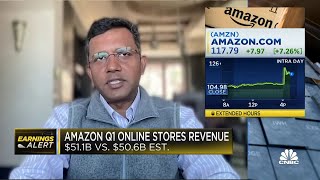
CommerceIQ CEO Guru Hariharan breaks down Amazon's earnings beat, driven by retail and advertising. Retail media is shifting ad spend from Facebook and Google to the point of purchase, where Amazon, Walmart, and CVS act as media companies. Smaller DTC brands face pressure as larger retailers dominate this new advertising landscape.
Joining us now is Guru Hariharan, CommerceIQ CEO. Guru, great to have you on. We've talked a lot about cloud and AWS. We've even touched on advertising. What we haven't really dug down deep into is the retail unit, which when you look at the top line and the sales beat, it was the outperformance in retail that really drove a lot of that.
Yeah, it looks like this time it was— we've always talked about cloud quite a bit, but this time there were two heroes that emerged. One is the retail. Emergence of reemergence of retail business. They clearly overdelivered on, on some of the expectations and advertising continues to be a growth machine for them. Advertising is super interesting, right? If you look at it, there's a— now this is a pretty large opportunity for retailers. Every retailer, including Amazon or Walmart or Walgreens, CVS, everybody's becoming a media company. Why? Because they have shopper eyeballs. And the shoppers are there to make a purchase. It's a moment of truth and it's a perfect opportunity for them to provide and provide the brands an ability to advertise their products when consumers are just about to make a purchase. So a lot of the media dollars that were in the top of funnel media per se, which is Facebook, Google, or even like TV ads, like Super Bowl ads and things like that, are now starting to move into more what we call accountable media. Which is retail media. And that's been really impactful and helping a lot of companies. And of course, Amazon seeing a huge tailwind from that entire movement from top-of-funnel media to bottom-of-funnel media.
Okay, Guru, what is the message to smaller retailers who in the past might have tried to go DTC? They've increasingly these days been trying to do business with Shopify and gain more control of their destiny. Do they still need Amazon? Is this kind of bigger companies succeeding playing out in that way for the smaller players?
If you look at it, John, it's the VC money has completely drained off. A lot of sins used to be just covered up by VC money in direct-to-consumer. And that's now— that air cover is gone. The market valuations are down. So even if it's a— whether it's venture capital money, whether it's public markets, The money or the dry powder has dried up from that, from the direct-to-consumer business. And you're starting to see impact of two cost drivers. The first cost driver is cost of customer acquisition. Cost of customer acquisition is through the roof, especially after the changes that have been— that have pushed through to the latest Apple changes and things like that. That has gone through the roof. Second thing that has happened is supply chain costs, especially coming out of the pandemic. And as we, as we look at the look at the entire P&L, supply chains are huge costs. Now, when you when there is a company that is trying to acquire customers by paying through the nose, they don't have advantages like 60 million shoppers being Prime members to, to, to, to supply chain. Which again, they don't have the scale of Amazon or Walmart, it starts to become extremely challenging to, to drive a P&L like a direct-to-consumer. So many of these smaller brands are actually moving to Amazon, moving to marketplaces so that they can make a dime and move revenue.