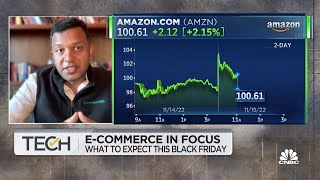
CommerceIQ CEO Guru Hariharan says seasonal sales lift collapsed from 20-30% to 3% this year. Customer-acquisition costs have tripled on Facebook over two years, driven by Apple and Google privacy changes. He predicts retail platforms like Walmart.com will capture e-commerce growth at D2C brands' expense.
Chapters
And let us bring in CommerceIQ CEO and former Amazon executive Guru Hariharan. Guru, good to have you. Is this going to be a season of discounting to deal with inventory? And how are so many retailers positioned to handle that?
Yeah, John, thanks for having me. We are getting into a very interesting season this time into as we get into the Q4. Typically what we see, John, is as we get into the month of October, pre-holiday sales start to take up. And last time, for instance, September to October on Amazon and other e-commerce websites, we used to see about a 20 to 30% bump in e-commerce volumes. This year it was just 3%. What that tells us is that there is a recessionary impact or potentially some discretionary spending, which is coming down, or some of those elements are starting to play in that e-commerce volumes may actually be soft this time as compared to, say, the last 2 years or even the last decade as it relates to because of the, because of the recession that we're getting in.
Mm-hmm. So, so you end up perhaps with e-commerce powers versus department stores, right? So the online folks versus the return of the physical folks in a discounting war that could turn Black Friday into something closer to break-even or Red Friday, right? Could put pressure on profits. And then at the same time, there's the danger that even if that doesn't happen, we end up with an inventory overhang which carries into '23, right?
Almost every retailer right now has a supply chain problem and And not to mention, there is a huge cost of customer acquisition that has actually skyrocketed at this point, where because of the, because of the changes that, say, Apple did with AT&T, their pushout where they stopped advertisers from sharing cookies from third-party websites. Same with Google Chrome as well. And so what has happened at this point is The cost of doing e-commerce has suddenly year over year gone up dramatically. Facebook ad prices, for instance, in the last 2 years have tripled. And with that in mind, there is a disequilibrium at this point in the market when it comes to D2C or say direct-to-consumer websites versus say the retail e-commerce websites. Retail e-commerce, when I say this is the non-D2C element, these are Walmart.com, Kroger.coms or BestBuy.coms. There is a disequilibrium in the market at this time. We do expect to see that the retail e-commerce side of the equation is going to take the lion's share of the e-commerce growth, and that's going to be at the expense of B2C companies like, say, the traditional Allbirds.com or Dollar Shave Club and all that. You're going to see that disequilibrium sort of start to settle in into the market.
Yeah, that more specialty retail. But, you know, Guru, pretty much everyone from Amazon to Shopify to Walmart, they thought that that pandemic e-commerce line growth would continue to go up and to the right at a faster clip than it actually is. There's been more of this reversion to the mean, more muted growth. So as they accommodate that and Amazon in particular kind of scales back that plan, that's weighing on gross margins. How do you see that playing out over the next year or so? Hasn't Amazon and Shopify sort of taken that medicine to revert costs, or is that going to continue to play out over the next few quarters?
Let's unravel that in sort of two areas. One is like, look at the top line, top line growth, and let's look at the bottom line pressure. That are happening.