Million Dollar Weekend with Noah Kagan
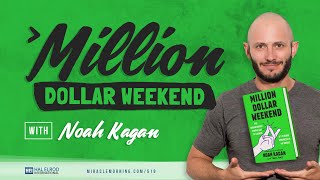
Noah Kagan, early Facebook employee and founder of AppSumo, walks through his Million Dollar Weekend method for validating business ideas in 48 hours on a shoestring budget. He explains how to test ideas through pre-sales and ads, why the law of 100 matters for building an audience, and shares what he learned launching AppSumo.
Chapters
3, 2, 1. Noah Kagan, welcome to the podcast.
What up, Hal Elrod? I had a miracle lunch.
Good to see you.
I was thinking about you.
Oh, we should co author. We should co author the book. The miracle lunch, miracle breakfast, the miracle. Yeah, no, I got miracle morning, miracle evening. Hey, man. So I want to talk about you. And this is, I mentioned this to you before we started recording that depending on when I have an author on, a lot of times I will really like it depends on how much the book resonates with me in terms of how much I really want to talk about it. So a lot of times, you know, I'll read a book and I'm like, it's okay, right? And then I end up talking to the author, like, not about the book so much. And then at the end of the interview, I'm like, by the way, you have a new book. Mention that, right? And your book. And I'm only, I'm a few chapters in, I got it a few days ago and. And I'm in the middle of my book launch and all the excuses I have. But I love the book. I love the title, I love the concept. I love how you deliver on the promise of the title, like in an extraordinary way. And yeah, you buddy, you Million Dollar Weekend, right? That's the name of the like, what a great dude. I mean, that's like, hey, four hour work week. That was cool back then, but now we're talking the million dollar weekend, man. So I love that. And I want, before we dive into the book, I want our listeners to get to know you a little bit. And because a few things, you're more qualified than most business authors to write about starting and growing a million dollar or multimillion dollar business because you've started not just one or like even two or four, like you've started $8 million businesses, right? Can you count at least on two hands. And so walk us through. Like, you were the number 30 employee at Facebook, which is really cool if you want to weave in you. I'm like, I think that's a curiosity. I'm curious, like, what was that like? Right? But I'd love to hear your journey from being the number 30 employee at Facebook. And even before that, if you want to go back into like your childhood, whatever you feel good about, and then how you got into starting these businesses and writing this book, man, to spend as long as you want, man. I'm here for it, dude.
Awesome. Thank you for having me. And you know, like a lot of, a lot of people out there, they, they have a dream to be, to be an author, to be an entrepreneur, to be whatever that is. And the idea with Million Dollar Weekend is you can all do that and change your life in 48 hours, which everyone has a weekend to be able to change their life. I started out, let's just go back to the womb. I remember being in the womb, how I'm thinking, you know, it's just not that cozy. I got to get out of here.
I got to start a business, I.
Got, I haven't made money and I'm already eight weeks old now. And so, you know, I was very blessed to be grown up in the Silicon Valley and be around all these elite people. I had a biological dad who was this non English speaking immigrant who just sold cold, called people and hustled really hard and taught me a lot about entrepreneurship, what I liked and didn't like. And then I had these straight edge parents on the other side, you know, a nurse and a software engineer that didn't drink home on time, showed up on time, very clean, told me to stay the safe path and had a lot of good things that got me really into computers as well. And I was very blessed to be in that environment that led me to entrepreneurship and technology. And I always dreamed of being rich. I was like, I just, I didn't know how it was going to happen. And so this is a book I wish I had when I was 8 years old that it's like, hey, you don't need investors, you don't need a lot of time, you don't even need really special ability, if at all. A lot of ordinary people get rich every day. And the steps to feel good, mentally, to be able to get there, as well as the tactics once you're ready to do that, which everyone is, to be able to make sure your idea is successful, how to get ideas and then how to get customers and beyond. And for myself in my own entrepreneurship journey, I want to get rich. But I never knew how.
And I was always trying things. I was always just tinkering and starting businesses, failing most of the time. And I ended up getting a day job out of college at Intel.
And for the, for the people who know that sound, shout out. And I just hate it every day. It was the worst thing ever. And it just was more motivation to finally have my dream of being an entrepreneur. And along the way I was able to get a job at Facebook, not through any special network, but through some grit, which we can talk about, which is interesting for others.
What year Was that, by the way.
How I got the job or when.
You know, what year did you get the job?
2005. 2005. So we had about 10 million users on the site. No one knew really about it. And I just saw that this is going to be a million, if not billion, if not now, trillion dollar opportunity that I wanted to be a part of. And I was part of Facebook early. I was a part of helping start mint.com I was number four. We sold for 200 million. And then I went on to start a lot of different businesses. Some worked out pretty well. And then to this day, Now I started appsumo.com, which is the number one site online for software deals for entrepreneurs. We do around $80 million a year. I'm the CEO of that. And so I've definitely had. I've been in the trenches.
Yeah.
And I feel very qualified and excited to now see and meet other people that are excited to have their own entrepreneurship journeys and be able to support them. I literally. I just got off a call an hour ago with seven people just workshopping their own business journeys. So it's something I'm really excited about. I'm excited to see people change their lives, which everyone can do.
Yeah. For me, the way that I look at entrepreneurship, or one of many, many ways that I look at it is, is having multiple sources of income, I feel like, is the responsible thing to do. You know, we've seen, you know, like, if you have, especially, I mean, for ourselves, but if you have people that are relying on you to, like, provide for them, I feel like if you put all your eggs in one basket, we've seen whether it's, you know, you get laid off or a company goes out of business or, you know, I just feel like for me, and I had that happen in.
The economy crashed, and I was a coach, and I lost over half of my clients and half of my income, and I couldn't pay the bills. And I was like, oh, never again. Right. Like, I'm. I need to build more than one source of income so that if. If one industry that I'm in, like, you know, tanks or if one business goes under. Right. Like, I have other options to invest my. My energy into. Right. So I think that's the important part of entrepreneurship is you can then create these different streams of income and different product lines and. And so on and so forth. I want to start.
You.
Can I comment on something on that?
Please, Please.
Thanks, man. I've always thought it's riskier to have A day job that you hate.
Thank you.
You don't like doing things you don't want to do. Making not as much as you think you can or deserve. I felt that was always riskier than wondering what if, like if I ever tried it. And the risk really like you called out probably before that. Sometimes though, for almost everyone that's listening, if you're not an entrepreneur, is that you're really not in control of your destiny. You have one person decision that can impact your entire livelihood and your family's livelihood. And so I'm not actually saying people need to take a big risk to be an entrepreneur. I never took a risk to be an entrepreneur and create millions of dollars, which is unreal, is that it felt that I should create this. So if I want to, I have that option, I have that ability. And if you like your data, we have a lot of people that appsumo.com that have day jobs but with they've started their own entrepreneurship things on the side. So if they want to do that, great. If not, they get both. And I think I would encourage everyone to be considering that. Especially, you know, if you want more time with your kids, if you want to be out there running, or if you want to be traveling, Entrepreneurship gives you that flexibility.
Now when you say that you never took any risk, what do you mean?
I never spent money. The real businesses that have become seven figures never spend a lot of money. Never spend a lot of time. Now most people, I just got a guy, his name is Cesar, he was messaging me, hey, I have this domain but I can't get any investors. And I was like, well, do you have any customers? Because those are my favorite investors. And he's like, no. I was like, okay. He's like, I just need a ton of money. I was like, well, let's, let's try to understand your problem. Okay, now let's try to see what this problem you're solving. How can you actually get someone to pay you today? How can we validate it? It's a business so that when you go to investors, maybe if you want to later you can prove it's successful thing. And for me, let me just give you an example. With appsumo.com I was really excited to solve the problem of how do you get software creators customers. I felt like it was such a valuable problem that I was, I felt, wow, that's something I've always wanted for myself because I love, I love deals, I still do. And I was like, oh man, how do I try to prove this is a real business and validate it so I can invest more in it that I don't have to quit my day job. And the one way you can do that for everyone out there is think about your freedom number. And so my freedom number is 3,000 bucks. And I said, if I can make $3,000 on my side hustle, I'll quit my day job or quit my. Yeah, I was consulting at the time at a dating website and I was like, oh, if I can get this going and get to 3,000, everyone should think about what is my freedom number. And if I get this going and it gets that number, I'll quit. And so with AppSumo.com, it was truly the million dollar weekend framework where I didn't spend a lot of money. I didn't spend a lot of time. I spent $48 on a developer with me putting a PayPal button on a website. I gotta admit, I spent another $12 on the domain. And I'm sorry, you know, I wanted to. It spent 60 bucks. My bad.
Yeah.
And in a week and I had a PayPal button on a website. I cold emailed a guy to see, hey, can you give me your software at a discount? That was Imgur. And then I posted on Reddit, said, hey, I have the software deal. I'm paying this guy seven bucks, put it out there, and 200 people bought it. And the reality was that that took a weekend, that was not a lot of money, that was almost no time. And I was able to find out very quickly that this is a business that people were excited to give me money for. And then within two months, I was able to quit my day job. And so literally, the risk was not taking the chance, not starting. The risk was not sitting on the sidelines wondering what kind of life I could live. And thank God I started then. And I'm able to really enjoy all the fruits of that now.
Well, and you talked about that the risk is not starting. And I love how you open your book with frequently made excuses instead of frequently asked questions, because I think it really is a reality check that there's nothing holding us back. Except for us, right? Except for our excuses. And I have to admit that as I'm reading these, I'm like, oh, man. Not only have I made those excuses, like in the early days, like, I'm still making those excuses to not do the next thing that I want to do or could do. So those aren't just for like someone that's brand new. It's like Even a seasoned entrepreneur, it's like, oh, these excuses still potentially hold me back. From your experience, what are some of the biggest excuses that we tell ourselves that hold us back from starting a business, Taking that chance, you know, creating that side hustle, whatever it is.
Yeah. One thing I would. What's something that you are afraid of or you're making an excuse on?
Let me look. I made a list here. I have too many ideas. That's for sure. One, I have too many ideas. How will it scale? I think that for me, I often have trouble seeing how it's going to scale because I have a unique thing where I haven't really scaled businesses. I've written books, created a keynote speaking career, which I can't. You know, I don't scale my keynote. It's like, I have to go speak. So I think that for me, like, we have an app now, and now it's like, okay, we got to scale this out, but. Oh, I've never done that before, really. So I think a lot of it's just the limitation of, like, if there was a high arching, limiting belief or excuses. Well, if I've never done it before, you know, what if I. What if I fail trying to do it now?
Yeah. Thanks for sharing that.
Yeah.
So breaking even. Let's just take your example. I have too many ideas and I don't know how it'll scale. Not necessarily you, but a lot of people, when they say I have too many ideas, it's because they're afraid of doing any of them.
Yeah.
And that's a way of avoiding starting. And so the first part of the book is, how do we just get going now? Right now? Not how. For instance, let's say you have an idea for some type of business. Great. How can you just email? You have an audience. You could literally send an email right now. You could text your audience. You could post on your social media literally today. Hey, y', all, I'm working on this idea. I got ten slots, a hundred dollars each. Send me PayPal, Venmo, Stripe, cash app, crypto, whatever that is. And you could find out right now if that's something that people actually want. That's literally any for any business idea instantly and find out the truth and, you know, zooming out to higher level. Like, you have a business. I don't. I don't know if it's eight figures. Six, Seven. Eight.
Seven.
How does it scale?
Yeah.
Sorry, what was that?
Oh, seven, dude.
Awesome. Most people never get one. That's how they never get to seven. All these big tech companies buy. Not even tech companies. Every big company started with one or two people getting going with one customer. And I think that's what's missed out on. They're like, how did I scale it? It's like, well, did you get even one customer? They're like, no. I'm like, let's just start with that.
Yeah.
Then we'll build those things up. But now the second part for yourself. And this is something we do@appsumo.com. two pieces. One. How do you double down what's working? Most successful entrepreneurs there were. How do I scale it? It's like, well, what did you do to get to where you are? Yeah, well, for you, you spoke a lot, you promoted your book, you went on shows. What else?
Mostly interviews. It's word of mouth. I don't know how you.
Yeah, word of mouth was a big course. Do you have a course thing?
I don't have a course.
Okay. There's kind of like a standard, like influencer playbook that can be repeated. But what I would say for almost every single business operator out there, especially as we run appsumo.com, and I've been able to help a lot of others. How much are you not doing what you used to do that was working? And everyone's like, oh, yeah, actually, I'm not going on as many shows as possible. You maybe I'm not keynoting as much as possible, and maybe there's another revenue stream that's out there that you used to do. That was like, shit, I could do that again. So that's part one I would say I want to worry about. Scale is like, just keep revisiting what was working and what has been working. Sumo. It's a really basic model. It's go find the best software tools out there in the planet, negotiate an insane deal and send an email. And we just do that over and over again. Now, the second part of it where you're thinking, all right, I got an app, but I can only do so many keynotes. I can only do so many things. And I like to scale. The reality is like, don't go really fast up the wrong river. And I do this all the time. I still do this to this day. I did it last year and I lost a million bucks cash. And what I mean by that is you can test a lot of things out very quickly using the million dollar framework to find the thing that actually could be a million or billion dollar opportunity for yourself. So it could be an app. It could be a course, it could be in person, like program. It could be a lot of different things, but it's testing them out very quickly to see what actually people are excited and you can help them with. Then we can worry about how to actually get more people in that.
Got it. Got it. And it really, like, I love the way you talk about it. It is, it's so, it's simple, it's simplifying, not overcomplicating it. In fact, like, that's the flow of the book I really liked. As soon as I opened up the book and I was like, oh, part one, start it, part two, build it, part three, grow it. Right. And then, you know, and each of the chapters are organized in that. Where it's like, okay, here's how you started, here's how you get the idea, so on and so forth. Tell us just what is the million dollar weekend process? Because I know you've got your frameworks, but the big picture, million doll process.
Yeah, yeah, great. It's insane. I have, there's a guy named Jake who I've got to work with and he read, he gone. He went through a million dollar weekend. And what he did, what he's been talking about, which is what's very common, I need to get. I'm not ready yet. Which is another excuse most people make sure I don't have enough funding. Another excuse people make, and those are all solvable. What he's been thinking about for two years, we were able to do in 48 hours. And that's the power of just getting going and figuring out, okay, what's the problem and how do I solve this as quickly as possible to understand the true essence. So breaking that down, there's start it, build it, grow it now, start it. Really this is the most shocking thing, is that people, the two biggest problems that's holding people back is starting and asking. But they don't, they don't realize that people are never. No, no. It's like my, my stuff is unique, Noah. Trust me. Like, okay, that's fine. But if you've never started, you're never going to get anywhere.
Yeah.
So for you and for everyone out there, how many things have they started that led them to finally get success? Like you started your Cutco thing.
Yeah.
You started in another thing. And then you finally, you're like, oh, I'm into this book thing. And then it didn't work again. And then you did it again and again. And eventually though, it does work. And most people just never start. They never get off the finish line.
Yeah.
Yeah. They never get off the starting line.
Yeah.
It's like trying to learn to cook, but you never go in the kitchen. You have to actually be in the kitchen a little bit. And how do we make it a fun thing that you get going right now? Yeah. And keep going with these things because it does take some time. It might take two weekends, but that's why it's a process. Now, the second part is really, how do you get better at asking? So how you're doing a book tour, you're asking people to come on their shows, you're asking people to pay for you to be like, how much is your keynote fee?
30,000.
Do.
Like, you're asking someone that they're asking you to speak, or you're asking them like, hey, I want 30k to give. You have a great speech. I do. I have seen it.
Thank you.
To be on stage, that's an ask. And you start, you kind of zoom out of the picture. You're like, wow, everything in life is asking. And the more I get better at asking, the more I get better at getting.
Yeah.
And that's. We have practices. We have the coffee challenge where you go and ask for 10% off when you. When you buy coffee and they say no, and they reject you. And you realize, like, okay, I practiced asking. I got rejected. That's not so bad. Let me do it again. And then you start thinking, I could apply this to speaking fees, to e commerce products, to service businesses, to whatever it is you're building, a software product, a lawn care business, whatever that is, the more you post and say, hey, I'm looking to see if five people want to buy my cookies. Anyone can do that right now. Not how. They can just post on their social media. They can post it in their WhatsApp groups, post in their text groups, post them in their community groups. And then the second and third part of the book, after you've really gotten going and you've gotten the mindset and the confidence, really, they're realizing like, holy shit, I can get going. And the book, I would say, is simplified because you only have a weekend. It's. People teach this stuff in four years. And I'm like, I don't know why you're spending all that money in time when you could find out in 48 hours whether it's a real business that could be a million dollars and beyond. And I've done it time and time again, and I'm helping other people do the same exact thing. Now, the second Part build it is how do you make sure you have a million dollar opportunity? So let's say for yourself another great example, Hey, I could do this business. All right, well, if you want to do a app business that you're doing, how many people can buy the app and how much do you think they'll spend? Very, very basic. And there's ways you can look at Google and Facebook ads, which I have tutorials on milliondollarweekend.com that people can get and that'll help you walk through it. But let's even do it a quick experiment now, like, how many people you think should have can have your app potentially, and how much would they spend on the app?
I mean, the app's been out for a While, so it's 59.99 a year, and we've got 12,000 users right now.
So do you really paying 60 bucks a month or 60 bucks a year? A year, Yeah, a year, dude. Good job.
Thank you.
$720,000 a year on the app. That's awesome. How many people do you think are out? So let's say you never had an app. How many people do you think could be potentially on the app?
I mean, I think, you know, I look at calm and I look at headspace, and I don't remember their numbers, but I just. Our goal was like, make an app that rivals the quality and the experience of calm and headspace. And I feel like we did that. So now it's just really about. Yeah, scaling is reaching those people.
Yeah. I mean, my specific point, and we can talk about marketing advanced strategies, which I don't even get. I get a lot of my marketing plan in the book, but advanced stuff we do at Appsumo is Billion Dollar Month. That's the sequel. So, you know, the second part is.
That's so fun.
The second part of this is really build it. And what I was trying to highlight with your app is you want to make sure you're working in a million dollar opportunity. So the belief and the clarity in that. All right, if I'm going to work on something and I only have 48 hours, I want to make sure I can make at least a million dollars. So are there at least a million dollars worth of money in this market? Then you do a quick business model like the app. How much does it sell for? What does it cost? Not much, probably. Besides, after you build it and some maintenance and my profit. All right, how many do I have to sell to make a million dollars? So ideally, in the build it phase, You've, you've worked through our. We have 10, I think, 10 different ways of coming up with business ideas. And I'll give you one of them, which is literally go through your entire day and write down everything you're complaining about or what you want to avoid doing. Those are all business opportunities.
Nice.
Those are my favorite. Solving problems for people, solving for yourself.
Yeah.
And then checking the market size, checking your one minute business model to see the profitability of it. And now let's go to the validation part. Okay, let's actually see. And there's three validation methods that work on every single business universally, whether someone actually wants to buy it or not. And I can find out really quickly in one day or less if this business has hope. So let's take your app, for instance. I have a different app. I think 100,000 people will buy it. 60 bucks each. That's at least a million dollars of people that I can sell to. That's great. Now in validation, there's three ways. So with your app, I would message a few people that have read your book or been interested in your book and said, hey, I'm building an app. Will you pay me today? $60 for this app. It's gonna come out in six months. You can do that literally right now. And people will be like, yeah, just when it comes out, I'll pay. Okay, well how come you don't wanna pay right now? You know.
I want to see a preview. Okay, well here's a mock up. I just drew it on a page and then. Do you want to pay now? Well, I want to try it out. Okay, well I'll text you, I'll send you a Google form so you can actually do an example of it. Do you want to pay right now? You see what I'm doing? There's no, I haven't built an app in shit. I haven't built zero. And people are like, no, no, no. This is what everyone does, Hal. Mine is unique. I'm a butterfly. And I'm like, we're all butterflies in the world. Everyone. But I've built $100,000 software projects that no one wanted twice. And I spent six months doing it. And I could have in 24 hours just texted message called, gone to my neighbor and been, hey, I think this is something you want and think about. Build businesses in things that you have problems with and within your zone of influence. And you could find out very quickly if this is a problem that people want. There's other two ways of doing it. One is through putting it on marketplaces. So people, where people are raising their hand and saying they want to spend money. Etsy, Facebook, Craigslist, Amazon. And then lastly, you can do ads and landing pages, which is, hey, I have an idea for an app. Let me buy ads targeted people on Facebook, send them to a landing page, see if they'll buy or give me their email. And that is a lighter form of validation, but that takes time and money, which I hate. And the last part of the book is the grow it. So now that you have three customers, 48 hours, that's the golden rule of validation.
Yeah.
How do we get a lot more? So we break it down to social media is how you get them for free. Email is how you profit. And then lastly, how do you turn it into more of a growth machine, which is the same playbook I've used time and time again that's worked in these businesses.
Talk about the social media piece for a minute. Because that's obviously a huge part of anybody who's growing a business typically is their audience, their social media audience. And you've grown. I mean, you've got well over a million social media followers. In fact, you've almost a million just on YouTube alone. Right now, I think you're at 967,000. How have you built such a grand social media following and what tips do you have?
Yeah. And so we break it down very detailed in the book, what I'd recommend for people and I'll tell them from me and what I've seen from others. Let me tell another person's story, which his name is Trent. He's part of a million dollar weekend. Trent has a day job in sales in Chicago. Just a 24 year old kid, I would say. And he wanted to get popular on YouTube. And so I went and looked at his channel and he was doing all these different videos. I was like, all right, well, there's nothing unique about you. What's your unfair advantage? He's like, well, I'm a date. My day job's in sales and I'm pretty good at sales. I'm like, okay, well that's at least something you have that no one else has. How many videos have you done about that? I did one. How to do the. It did actually best of all my videos. All right. Only do sales videos. Trent. I talk very quickly. I'm like.
So with Trent, I said, okay, that's your unfair advantage. Do the law of 100, meaning do 100 videos. Talk to me after you do 100 videos. And now he has this is a few months ago. He's at 34,000 subscribers, and I believe he's making pretty good money. I don't think he's quit his day job, nor do I think he wants to. But just focusing on something he had an unfair advantage on, and he picked one platform to succeed in. And so that's the playbook I'd recommend for everyone else that's out there, which is what's the one platform you want to succeed on? So there's. And you can succeed on any platform. I think people are like, what I see a lot of newbies do, and this is a common mistake, is, well, I'm going to post on YouTube and I'm going to chop it up and put it on Twitter and take it on Twitter and chop it on this and chop it.
Chop, chop, repurpose.
And I'm like, well, guess what? None of them are going to work because you have to be an expert in one. Yeah. And just go all in on that one. And then when you're an expert in that one, then you can move to a different platform. And most people want to do all the platforms and that's why they're not succeeding. Yeah. Pick one. So Twitter, LinkedIn, Instagram, TikTok, blogging, YouTube, whatever this is. And you know, for myself, I did try all of them at once, and I wasn't having any success. Yeah, I was trying LinkedIn, I was trying Twitter, and I noticed that relative to the amount of work and the amount of enjoyment, I was getting a lot of results on YouTube. And it's kind of harder to make a video. Anyone can post text, but to make a video takes some effort. And so I picked one platform, YouTube. And I think this is one of the most important things for everyone out there. I didn't have a big studio, so right now I'm in my home studio. You were here. It's a $20,000 studio that I had custom set up. And so I started my, you know, YouTube channel. It's got a million subscribers today. It makes. I actually don't know how much it makes it. I don't really pay attention to that. But we put out two videos a month. And I can talk a little bit about that, but it was just me and my phone. Most of the videos were just me and my phone. And this is a phone everyone has. It's not a special phone. Yeah, it's like iPhone 10 or whatever the hell it was. But coming back to Million Dollar Weekend, I got started. And by getting started, committing to a hundred law of 100. I was able to eventually get after almost a hundred videos, none of them were really doing super well. But I stuck with it. And I was like, okay, I like it. I'm getting some responses. I'm talking to all the commenters. I tried a different type of video which was knocking on doors. And then I found out like, oh, no one else is willing. One, that video went viral and two, no one else is willing to do those kind of videos.
Well, what did you knock on a door for?
Oh, to ask the people what they did for a living.
Okay.
So I just went up to the richest houses I liked in Austin and I said, hey, I'm doing a documentary. I love to ask you. I love your house. Compliment them. And I said, I'd love to know what you do for a living because a lot of people are curious. And then we blot out their address and things like that. But it was through sticking with it, getting going and then finding that's our unique advantage. Where I'm like, okay, no one else is willing to do what I'll do there. Yeah, I'm going to do these kind of videos. But for. So for everyone has their own unique story and their own unfair advantage is just recognizing that, embracing it. And now I'm moving content more to like things about running appsumo.com no one else is running an $80 million year business.
Yeah.
That. That they're sharing publicly. Like most of them are talking about their fake businesses. But not a lot of people can run appsum except me because there's only one and everyone has this out there. So I would say if I had to break it down to a few things and we go much more detail into the book and step by step with. With videos and tutorials@millionaire weekend.com pick one platform and you don't have to be in public. Pick one platform, think about unique advantage and then stick to at least 100 pieces of content before you quit.
Yeah.
And that is a way of really figuring out how to dominate in any type of social media. And that is how you build an audience that you can turn from an audience in the next chapter seven into customers.
Now let me ask you a question on YouTube as a social media platform because to my knowledge. Right. It doesn't have the same sharing ability that like a Facebook or an Instagram has. Like you can share the link and then text it to somebody or email it to somebody. Right. But you can't share it on your page just with. With a click of a button Right. Am I, am I wrong about that or what? What about that is like, is that a limitation? Is that a con? You know, in terms of pros and cons. Curious.
90% of YouTube traffic comes from recommended. So it's not actually worried about sharing. It's more that people see some type of content. And the one, you know, we spend a lot of times, like almost all of our content. We come up with a thousand topics and we pick two. And we found the strategy that works for us. We used to do three videos a week every week. And we found that if we just did two really high quality videos a week. A month.
A month.
Just to. Just two videos a month.
Wow.
That they mostly almost every time, bang. And to us a bang is about a million videos, million views. You know, maybe another thing in passing for people out there that are creating content is who are you making the content for? So every one of our videos is for underdogs. So I don't put bouncy balls in houses. I don't blow up Ferraris. I'm not here to like, you know, it's entertaining and I think it's fun. I like watching my. I'm probably the biggest watcher of my own content and I think we should all do it for our own content.
Yeah.
And it's just doing the stuff that's towards that specific audience that you also enjoy. Now in terms of sharing and things like that, I found that YouTube has literally the biggest market. Right. There's 2 billion people, I believe, a month that watch YouTube, which is crazy. 155 million people a day watch YouTube, which I believe is one of the biggest sites out there, period. And I do find if you can create content and stick with it, even with your phone, whatever category you're in, like local lawn care. Austin, if you're doing inspirational coaching you, whatever it is, there's a lot of different niches. Even if you're doing maybe faith based, like there's a guy, Ryan Panetta, he does faith based business on YouTube, which I love.
Ryan's huge, huge following.
Yeah, yeah. I'm Jewish. I wouldn't talk about Christians. So that's an advantage for him.
Yeah.
So it's just the biggest thing out there. I think Twitter and for me it was Twitter's not big enough. LinkedIn's too, too noisy and there's too many like coaches competing against each other. I'm not a big photographer, so I don't do Instagram. TikTok to me is garbage. So I don't give a Shit. Twitter. Yeah, Twitter wasn't growing. Blogging was declining in terms of volume. And so it was like, well, I'm going to just pick one and then stick with it for some time to get the benefits of that. And that was YouTube.
I am taking notes. So hold on.
Good. I mean we can break down more of the YouTube specific strategy. I don't think people are doing it enough. And regardless of your.
Yeah, do it. Because I actually, what I just wrote to myself is to model Noah Kagan's YouTube strategy. He posts two high quality videos per month, watches videos to model them. Choose one niche in parentheses mornings and stick with that because people find videos via recommendations. What other tips can you give me, Noah?
Yeah, I got you. So what I would personally look for is I would try to look in other people. So the way we approach it, we have, we put it, think of it like a TV show. Like if you're creating content, it's a TV show, you're trying to create entertainment. So the way I like to think about is how do I test? This is again, I'm coming back to everything. That's Million Dollar Weekend. How do you test and invest? How do you test out things to see, okay, is this really popular or not? So when I create the content, if I invest, like each of our videos costs around $30,000 cash to make.
Wow.
Yeah, yeah. So if we're only doing two, they better be fucking good. I swear here, Hal, Is this like.
A p. We don't usually curse, but. No, I'll curse.
Yeah, I'll take it back. If I'm doing two friggin videos a month that cost me 30,000 bucks each.
Two dar. Gone. Can you do dog Gone. Can you throw a dog on? Yeah.
Gosh, Garnet. Gosh darn it. And so taking a step back here, within YouTube specifically, the number one thing that matters is your topic. Number one by far, everything is topic. If you could spend 90% on something, just pick a topic and we have a thousand ideas. We have a sheet of a thousand ideas and we only pick two each month. And those things are constantly by one. Look at your tweets that are popular. So I'll tweet about real estate and losing money. I'll tweet different, like small things to see if, like for the book, even though we can. Again, this is the same process. How do you test things before you go and invest more? So I try a lot of tweets and I'm like, oh, that's interesting. Maybe we put that, make that as A video. So one of the videos is about how I start a lot of businesses that didn't work. Okay. People really like that. That's interesting. Then other things is look on other YouTubers. So what? Other YouTubers go to their channels, click video, click popular and see, they'll tell you what people want to watch. And so what I would encourage in the beginning is have a lot of ideas and really thinking about how do I create one to two content buckets that are repeatable. So again, if you think about me and YouTube, I did 50 videos and almost none of them worked. And I did their quick videos. They're all like for underdogs. One video which was knocking on doors that went crazy and the other one that went crazy was I asked rich old people their regrets and those two videos were the only ones that got a million views.
That's cool.
Almost a hundred.
Wow.
And then now all of our videos in there are those two buckets. That's it. It's asking billionaires now not just regrets, but like how they got rich. And me doing challenges. So going up to houses, going up to yachts, asking first class passengers, asking rich people where I'm putting myself out there to find out how they got rich. And so coming back for yourself, I would go look at your most popular videos already out there. Like you have a video where you got 4 million views on someone else's channel. Just repeat that. That video for your channel.
Yeah, that's a great point.
I would copy that and then I would go look at certain, I think people. Oh, keyword research. I wouldn't keyword research. I'm looking for what is big topics that are available. So mornings. Maybe it's mornings of certain people. Maybe it's like.
You know, I'm trying to think of like what are the other morning related activities that you can go over and then look it over all the stuff you've ever done and then have as a list and then really fight to say what are the if we're only doing two. But again, I would probably try to have higher frequency of putting ones out there to find the two that are actually going to work.
Meaning in the beginning do more than more than two videos a month.
Dude, I did three a week for a year.
Okay.
So the point there was just like if you're don't go invest in a lot of these things. It's just like million dollar weekend. Don't go spend six months and a lot of money building an app that no one wants go validate it in 24 hours. So an idea for you is instead of making videos, you could put out tweets or stream live streams or shorts with a lot of different ideas and look for the one that gets the most. Popular. Be like, all right, these are the two we're going to do.
Got it. Really cool, man. Thanks, brother. Little live coaching from Noah Kagan on the podcast. I love it. All right, so, hey, I know you talked in the book about emailing for profit, like you said. You also talk about using systems and routines to design the business and life that you want, which I'm a big systems and routine guy, so I love that, man. What is your biggest hope for people that read Million Dollar Weekend? What's the mission? Why did you write the book?
My biggest hope is people realizing how much more capable of themselves they are. That's my hope, is that people realizing like, holy shit, I can do a lot more than I realized.
Yeah.
And.
I was thinking about it this morning with this book where I'm so proud of it. I am really proud of it. It's something I worked really hard on and we're all of it that's available to everyone to find something they want to do and work really hard in it. And almost every time, you'll be proud of that. Every time, actually. Guaranteed.
Yeah.
I always dreamed of having a book and I felt ready to be able to help other people at this point. Yeah, I felt grounded. I felt I've started seven, eight different million dollar companies. I've been a part of the most successful businesses on earth. I've helped thousands, tens of thousands of people with their own. I felt, okay, if I'm only going to do one book, which that's my plan. I want to give it everything to be able to make a big impact. So I also hired one of the best business writers in the world, Tal raz, who's written two other top 10 best selling business books to collaborate on making sure that the writing is phenomenal. And I do believe it is.
Yeah. Because it is one thing. Right. You can have brilliant concepts and ideas, but, you know, there is. There's definitely. It's an art and a skill to be a really good writer, to be able to translate somebody's ideas in a way that like, oh, this actually resonates.
You know, big time. Yeah. I want to see people change their lives and everyone can do it in 48 hours. And that's amazing.
Yeah.
I didn't want someone to live their life and not know that they could actually be a lot more than they Realize and then what they actually want, which is that. And so I never found a book that could do that for me. Yeah. And I was frustrated. I was a little annoyed. I was like, there's all these charlatans out there. So these people like talking these things that, that I was like, I can actually put it all together for them.
Awesome. And I think you did, man. Phenomenal job. It's really helping me even as somebody that's been an entrepreneur for many, many years. So thank you, brother, for putting it out there.
Yeah, man, it's been fun. I'm glad.
So this episode will come out on January 31st, I believe that's the day after the book comes out. What is the best place for people to buy the book and then also to keep learning from you?
Yeah. Go to milliondollarweeking.com you can grab the book there. There's tutorials, videos, checklist templates. You can take the 48 hour challenge where you'll be supported with other people and get going on your own 48 hour journey to change your life. So, yeah, everything's@milliondollarweekend.com it's gonna be crazy how this comes out. Then that's.
You know, for everyone out there, you know, find something that people actually want to pay you for, which is exciting. And then, you know, do. I think you've done a great job of this? How I gotta give you a compliment where, you know, our part of the book is being out there. It's starting right now and then asking. And so, you know, for me, it's being out here asking, like, hey, I'm proud of this book. I want to talk about it. I think you've done a great job of that as well with your material, like consistently showing up for very long periods of time.
Yeah, well, I appreciate that. And I can, I mean, I can tell that you like me. Like, you believe in the book, you believe in the message. You know, it will help people. And so you're, you know, you want to get it in as many hands as you can, dude. So thank you, Noah, for doing things. Excellent, man.
Yeah, man. Well, one thing I was gonna share. Sorry, I was just.
I gotta keep going.
Keep going all day. A lot of people have a great book in them. A lot of people have great stories in them. They have great businesses in them. And they're all, they can all do that and find out really quickly. And I would say most of them are like, I don't know, who am I?
Yeah. Oh, yeah, right.
All of us ask that and there's no certificate for life. Right? And that's the beauty of just go help one person right now. Don't overthink about. Well, you know who, who says I could be a life coach? Who says I could be a business coach? Who says I could be anything? And I give you permission. Give yourself permission. Permission granted. You can go get going on that right now. And you know that that is what this book where because I've seen people read it and change their lives, I'm like, wow, I feel good to go and share that message. And you've sold before. That's one of the best skills in life. Find something you're excited to sell, create it yourself or go work for it. And that's definitely how I feel with this book.
Amen.
Thank you for having me on. And I look to seeing people change their lives at $9 weekend.
You got it. Everybody listening. Goal achievers, members of the Miracle Morning community, if you have dreamt of starting a business, of creating, becoming an entrepreneur, of creating a side hustle, however you want to define it, I really encourage you to get this book. I think it is just a really, really simple, detailed, effective roadmap from obviously someone who has done this not once or twice, but eight times and runs an 80 million dollar company. So milliondollarweekend.com and goalachievers, I love you all. Thank you so much. Noah. Thank you everybody for listening and I will talk to you all next week.
More from Hal


Hal Elrod shares the most effective tool he’s learned to quickly handle anything life throws at you.







Jim Kwik: How 5 Minutes Each Morning Can Rewire Your Brain and Change Your Life
