
Best Glass Food Storage Containers with Glass Lids
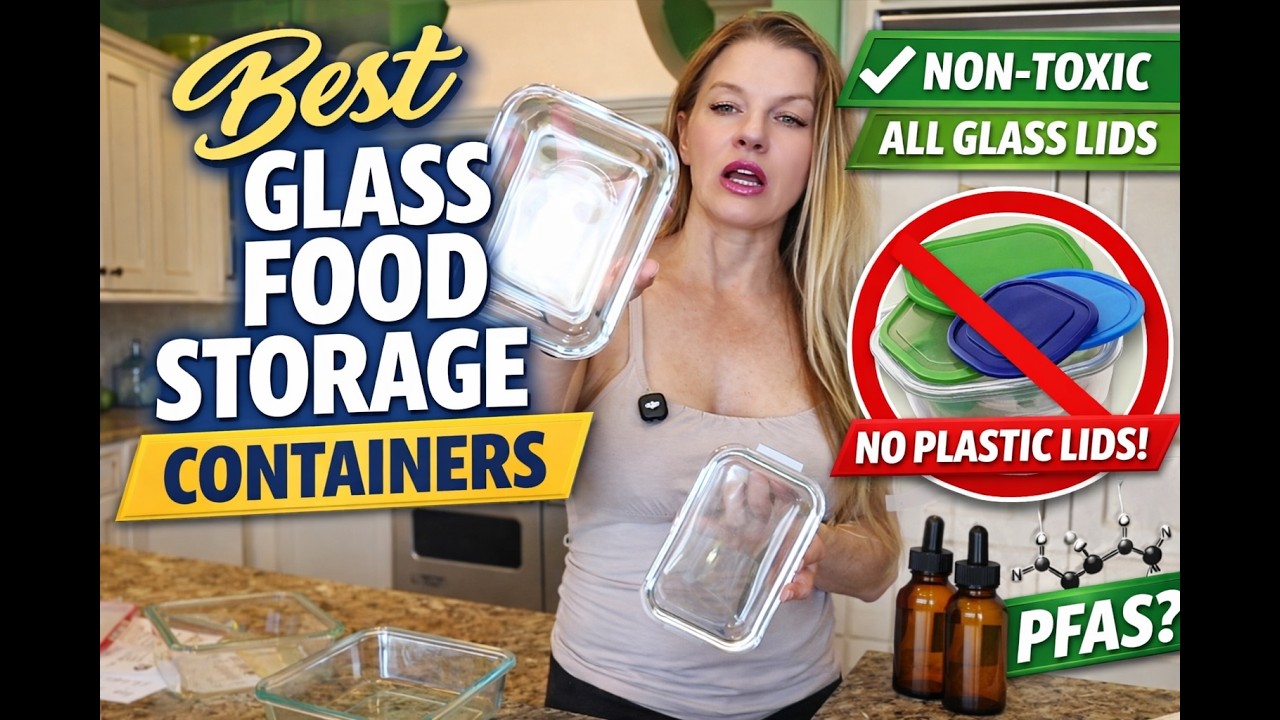
In this solo video, Cheryl McColgan, founder of Feel Nourish Grow, explains her long‑term mission to eliminate kitchen toxins such as PFAS, BPA, and other endocrine‑disrupting chemicals. She describes how plastic lids and containers can leach harmful substances, especially when heated, and why glass containers paired with food‑grade silicone are a safer alternative. Cheryl outlines the importance of certifications (U.S. FDA food‑safe silicone, European LFGB/Platinum) to ensure silicone quality. She then reviews five glass‑container brands—Caraway, Bentgo, EcoPreps, Urban Green, and Zeruma—detailing each product’s material (borosilicate glass, silicone type), design features (vents, seals, bamboo lids), durability, microwave‑safe capability, and price. She notes drawbacks such as plastic components, weak seals, or difficult cleaning. Zeruma emerges as her top pick due to its robust glass, high‑quality silicone seal, airtight valve, and easy cleaning. Cheryl directs viewers to a linked article for deeper toxin education, offers discount codes for the featured products, and invites the audience to subscribe to her newsletter for future non‑toxic living content.
Chapters
Hey everyone, I'm Cheryl McColgan, founder of Feel Nourish Grow, coming to you today from my kitchen. It has been a little while since I've been solo on the camera other than podcast, so bear with me. We'll try to get back in the swing of things here, but I wanted to share with you something that I've been working on for a while. So I've been getting rid of toxins in my life for several years now, whether it's skincare, whether it's cookware, whether it's Tupperware. All of those sorts of things. Like, I've been slowly replacing things over time so that I end up with a much more non-toxic environment. And when I say toxins, you might be wondering what that is. Well, I think at this point most people have heard of PFAS. They're forever chemicals. There's lots of things in plastics and some of these other things that cause endocrine disruption. And so suffice it to say, they are not good for you. I always like to say control the controllables. So whenever I can, if, you know, if I need to replace something in my kitchen I just go ahead and replace it with the absolute cleanest version possible because you want to overwhelm yourself with this stuff and make yourself crazy. But at the same time, we're in such an environment where we're exposed to so many of them. It would be one thing if you just had one in your environment that you were exposed to, you know, not very often. But these days we're literally exposed to these things every— everything we have. If you get a thing at Starbucks, the cup is lined. With plastic, and so you get BPA from that. BPA is one of those things, it's the plastics that has these forever chemicals, and you do have to be careful about that too because a lot of things will say BPA-free and they actually just use a different variation of plastic that has a chemically different name, but it's actually just as bad for you. So even BPA-free is not good enough. Um, so back to the Starbucks thing, so you, you know, when you wake up in the morning, when you shower, things that are in your soaps or your creams that you're using, things that you're using on your face. All of these things can have those kind of chemicals in it. So anyway, I've been on a mission to get rid of those things for quite a while. And the latest thing that I've been working on is I do have already glass containers, and I just wanted to show you. These are kind of, um, very basic. They're Pyrex. They have a plastic lid though, and so this lid still has forever chemicals, BPA. So if you were to, you know, put your food in this plastic and fill it to a point where the plastic touches the food, that's not good. Probably being in that close proximity with the food is not good either, but it's far better than being in a complete plastic container. Um, and then if you happen to put this in the microwave, you're releasing tons of chemicals into your food. If you actually go to the article at the website, and I will link that down below, about pifas and things like that. It's amazing how much heat affects these things and how much it makes them release it, and it's right next to your food if you're heating things in a microwave. So we definitely want to avoid that. I also just want to show you that over time, um, I don't keep them around when this happens, but sometimes the edges of glass containers will break a little bit more often if you're not careful with them or you're stacking them a certain way. And then also this Pyrex stuff has not been very durable over time. You can see, like, again, I've got one that's got the crack right there. On the top, and then these lids are very cheap plastic, and you can see that that is already broken. So not one of my better purchases. I think this was like at, um, you know, or not HomeGoods, but Big Lots or something like that, where it's really cheap, and it was glass. And at the time, I was just like, really wanted to get on the glass thing for sure, because most of the time I'm not really having the food touch the container. But the more I've learned about it, the more I just want to completely eliminate that. So these will be being replaced. And as I always do, and I'm trying to be better about this. I go down rabbit holes all the time about researching things and learning more about why these things are a certain way. And I did this with plastics and these endocrine disruptors a long time ago, but I'm just now finally starting to get all that information on the website where I've actually put it into article form and share what I've learned over the years with you. And then when I went to replace these containers, I'm like, okay, this is the most amazing opportunity. Because containers that have glass lids do exist. And, but what I wanna share about that is they're not all made the same, and they're not all necessarily, just because it has a glass lid, that does not mean that it belongs in your kitchen. So all of these ones I ordered were ones that I did the research on, and that I really am just super happy. I think you couldn't go wrong really with any of these choices, but I'm gonna explain why some are a little better than others. And also why you wanna stay away from the temptation is, of course, we go onto Amazon, we find some product that suits our needs, but the problem is a lot of these are cheaply made in China, for example, and the materials are questionable, right? So even when you get silicone, which silicone does not, it's not the same as plastic. It does not have the same health concerns as plastic does, and it's actually considered a very safe and good replacement for plastic. So silicone, there's a couple of things. Not all silicone is food-grade silicone. So you have to be a little bit worried when you find those cheap items on Amazon, for example. Are they actually using food-grade silicone? If you can find it and if they mention it, do we trust that company, right? So there are a couple of certifications. There's US certification. I think it's an FDA that's food-safe silicone. And then there's a very high standard in Europe, and that one is called— I wanted to write this down to make sure I get it right— the LFGB silicone. It's out of Germany. Europe, Europe does this so much better than we do as far as ingredients in our foods and ingredients in our skincare and stuff like that. So if you look for the LFGB certification on silicones, you'll ensure that you're getting the highest quality food-safe optimal silicone that there is. And I'll have more content on that later 'cause I actually am also using silicone bags for storage instead of plastic. But that's a really awesome certification. So if you can find those products, those are the best. Um, and they'll hopefully last you a lot longer too because you're not just going with the inexpensive replacement. And the cost difference honestly is not that much at all when you look for these certifications. So all that being said, let's get on to these containers because I think that this is a super interesting thing. I thought, oh, they're all going to be kind of the same, but not true, my friends. So first we have the Caraway, which Caraway is a highly tested, highly regarded brand for being non-toxic and very clean, and I've used them for years. I have a lot of their, um, skillets, and you'll see that in my PIFAS-free cookware review. And I love their colors, are so amazing. So like, I got the green to test this out, but I'll show you my, um, yellow— well, it might not be clean right now, but I'll show you this yellow pan that I have. So this, you can see they're yellow. I absolutely love their yellow. And this is one of my saucepans that I've been using. I've had this for probably I don't know, 4 years at this point or something like that. Um, so what I appreciate them for is their design, their colors. They are— all their coatings are completely toxin-free, so that's awesome. So that's why this one little thing about this beautiful container gets me, because you'll notice, first of all, it does seal really well. It's got the ceramic interior, which is amazing, so we know that that's all toxin-free. We know the glass is toxin-free. However, this little thing is plastic. And when you buy this, it does say do not heat. So, you know, usually these things, um, like this top, you could put it in the microwave and it wouldn't melt, but apparently this one's not, which is not a good sign. So unfortunately, I, I love the look of this. They're also a little more pricey, but I can get you a good discount. Um, but my, my main concern with this is it doesn't like suit the purpose for what I'm using. Now, if you were going to use this for dried beans or some other kind of storage where your food is not really— number one, it's not going to contact the plastic, and number two, you're not going to heat anything up in it. Or it's actually just— when I say it's more pricey, you'll notice this is like a really nice ceramic. Like, you could use this as a baking dish. I mean, this is a beautiful dish, so you don't have to just use it for the purpose with the lid. But again, that would just be my one little thing about this choice, why it's not my favorite. But otherwise, look of it, everything about it, love. Second, we'll go to the Bentgo. So here you can see this is completely glass, glass top. But what is this? This is a high-quality silicone, and we've got here the vent so it can go straight in the microwave. You can vent it like that and comes off really easily. You can see all of the, the bottoms are roughly the same, and I think I might have already mentioned that you want to look for borosilicate glass. Because that's the kind that can go from cold to hot with no issues, with not cracking. If it's a cheaper glass or it doesn't say that it's that kind, you're going to have issues with it if you're using it to heat. And since a lot of us are using this for meal prep or freezing things and then we want to get it out and be able to heat it up again, you want to make sure that it is the kind of glass that can do that. So no, no problems with this design. Love this. Love that this little thing is attached. You're never going to lose that. And seals really well. So that would be definitely one of my picks, just depending on like what sizes you're looking for, what price point you would look for. If you go over to the article, it does have like a price breakdown comparing the different brands too. So that's the Mango, and I'll go ahead and go to the EcoPreps. Love this bamboo top, it's very pretty. It's got the same glass bottom. And seal-wise on here, I did find it's like a little bit harder to get it to seal really tightly. Um, so if you're looking for airtight storage, that might be a bit of a concern. It also has the built-in vent that comes all the way off for cleaning. Again, this is a food-grade, high-quality silicone on this one. And I'm just showing you, like, should be relatively easy to get this back in, but it does take a like a little bit of effort if you happen to pull it out like that. If you're using it for heating in the microwave, my other concern slightly about this, you could lose one of these, right? Um, it's been known to happen somehow, especially if you have a lot of kids in the house. Um, but yeah, it's not as easy to get back in as I would like. And, but you can hear that the air went out of it. And I think this time, this time we got a really good seal on that one. So that's the Echo Prep. The other caution about this, Because this top is bamboo, um, when you wash it, you want it to be 100% dried and allowed to air dry, not put it in the dishwasher or anything so it gets super wet. So once you wash it, let it completely dry before you use it again, just to keep everything very sanitary. Okay, so then we have the one that's called Urban Green, and this one I brought out the lids because I did want to show you this. So if space is a concern in your kitchen, I do like that these lids stack together really tight. So if you don't mind having all different sizes and these are the sizes you're looking for, the fact that the lids stack so nicely I think is a big plus. And then we have— here's the lid again. This is all full food-grade silicone or the certification from Europe that I mentioned. In the US, I think the other one's called like Platinum certification as well. You can see this got a little tab here to help break the seal. It's got also the vent, so if you're using the microwave you can easily vent that, and this one's not going to get lost. So I like that about that. And then let's see the seal. So got it on here, and like I said, this side has a little tab, so if you need help breaking it— but actually, that one didn't seal very well either. This is part of the reason you want to test these in person. I can hear the air going out when I seal it, so I do think it's fairly airtight. Let me go see if I can I don't know if you can hear that. It's pretty close to the mic, so maybe. So if you get all the air out, you want to just make sure that it's sealed as tight as possible. Like if you're using this for freezer purposes, um, that one doesn't seal quite as well as I'd like. So again, it just depends on what you're using for. If you're planning on using this one mostly in the fridge for leftovers for a couple days, probably totally fine, but that seal is not as good as I would like. So now I saved the best for last. I saved the one that I have personally decided that I'm going to stick with going forward, and that is the Zeruma. So again, we have the highest quality silicone here. And this one, you'll notice I had to play with this before I got on video because I was like, I couldn't believe how tight this is. And the reason for that is they put in this little valve that you actually have to pull up to get it to unseal. And then it opens really easily. And then you can see that the bottom of this is much more substantial than the other ones. Again, it's the glass top but the silicone seal. And so when I do this and I seal it, and then you press the button to like really seal it, like that is not— I mean, I could force it out, but that is really not coming out. So that is one thing I do love about this. Now for cleaning, This does come all the way out actually super easily, and that hole is a lot bigger, so that was super easy to put back in. And so this is actually the ones that I'm going to be keeping. Um, I think most of these I did try to get a discount for you if I could. I think the Zeruma does have the discount. The only thing I would like to look— and I'm going to look at this after I get off the video— but if they had different colors in the silicone, that would be really fun. And I think they would add a lot to the kitchen. But as far as functionality, I mean, this one is the tightest seal by far of all of them. And so that is my top pick. So if you want to learn more about why you would go nuts doing this in your kitchen, go read the article about what are PFAS, what do they do. I have the other one that's on endocrine disruption and about how that affects you. Again, suffice it to say, it's not good, but I don't want you to freak out. I just want you to make smarter purchases as you go forward. And maybe if you're in a kitchen like mine where I've been cooking now for, gosh, like 30 years, and I do have some cookware that I know is that old, I do have some silicone that I bought back in the day that I have no idea if it's certified or not. So just as you go through those, as you move through them, like, and you replace things, um, maybe something's been around 30 years, we don't necessarily need to have it in our house anymore, especially if it's got some toxins in it. So, um, just make those changes over time. Use the discount codes that I got for you. And yeah, that'll be it until next time. So we'll talk more about some other toxin things here going forward. I have a lot of content around that planned, so if you're into that, definitely sign up for the newsletter and then you'll know when I have the next thing out. So anyway, I will see you again.
More from Cheryl









30 Day Challenge Series, Day 30: Choose Your Three Habits to Continue for 90 Days

30 Day Challenge Series, Day 28: Schedule Connection (Put It on the Calendar)