
Creating a Healthy Relationship with Food
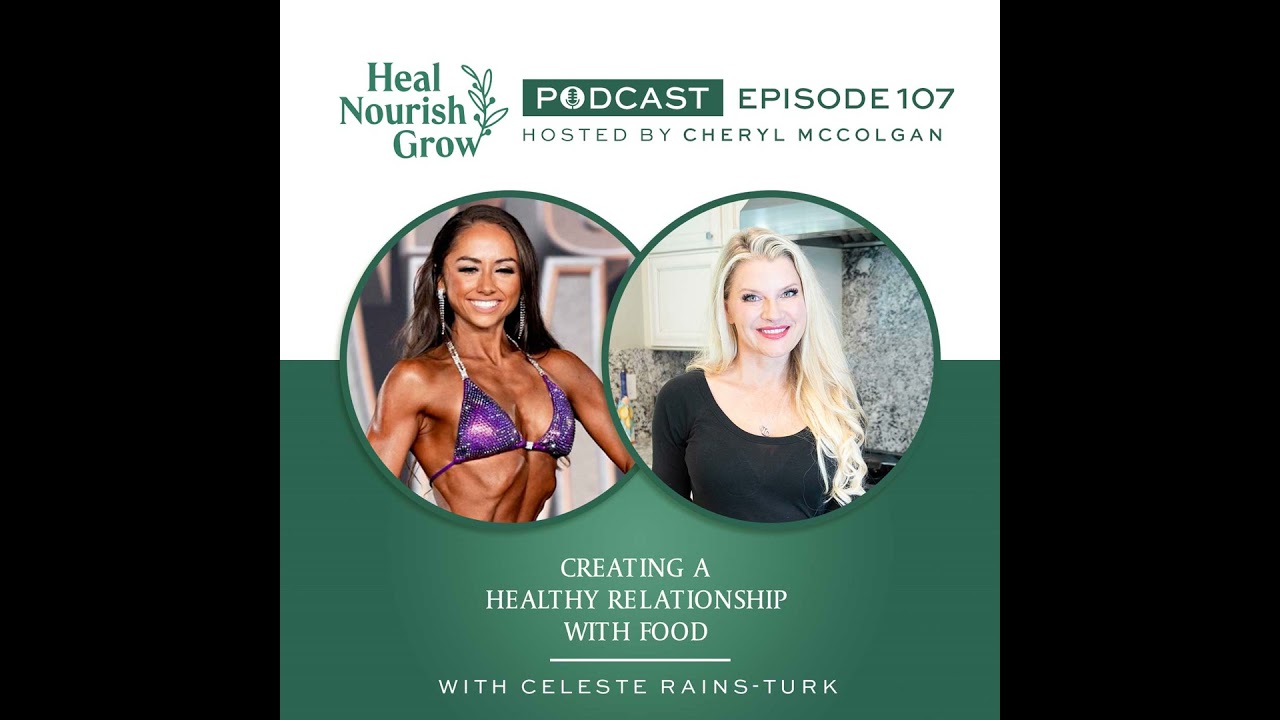
In this episode of the Heal, Nourish, Grow podcast, host Cheryl McColgan interviews mental‑health professional and nutrition coach Celeste Raines Turk. Celeste shares her personal journey from a competitive bikini‑pro who struggled with binge‑eating and body‑image issues to a therapist who now helps competitors and everyday people heal their relationship with food. The conversation covers the limits of traditional “all‑or‑nothing” diet advice, the role of mindset and intentional choice, exposure‑therapy techniques for “forbidden” foods, the value of diet breaks and flexible eating, critiques of the Health‑at‑Every‑Size movement, and how cultural, social, and spiritual values intersect with nutrition. Celeste outlines her practical client workflow—assessing ideal vs. current food relationships, uncovering belief systems, and using exposure hierarchies to re‑condition food cues. The hosts also discuss the importance of balance versus extremes, the psychological impact of diet breaks, and the concept that balance is the “sister of perfection.” Toward the end, Celeste promotes her free 8‑day food‑relationship coaching series, a Mindless Snacking workshop, a Post‑Show Blues program, her book Believe Your Way to Badass, and an upcoming women‑only fitness retreat in Greenville, SC. The episode includes sponsor spots for a sleep‑mask and a collagen‑coffee product, but the core content focuses on actionable mental‑health‑informed nutrition strategies.
Chapters
Welcome to the Heal, Nourish, Grow podcast. I'm Cheryl McColgan, founder of Heal, Nourish, Grow. The website, this show, and our newsletter all focus on making the science of advanced nutrition and greater overall health accessible to everyone. Buckle up for our latest episode to get ideas, tools, and practical knowledge you can use to improve your health and move towards your perfect version of ultimate wellness. The Heal, Nourish, Grow podcast shares interviews with nutrition experts, health researchers, and everyday people that have changed their lifestyle and nutrition to support greater health. You'll learn how to implement lasting change and create new habits that support greater wellness and a happier, healthier life. Please visit healnourishgrowpodcast.com for full show notes and links to our guests.
Celeste Raines Turk, specializing in helping people make peace with food, their body, and their goals using psychology, personal development, mindfulness, and her signature PTG process. Throughout her time earning her bachelor's degree in psychology, she focused her research reports and studies on eating disorders, body image, self-concept, mindfulness, and personal growth. While studying, she became a sought-after coach in the personal development world and went on to write a number one best-selling self-help book, Believe Your Way to Badass. She then obtained her master's degree in clinical mental health counseling to bring even greater support, knowledge, and education to people so they can receive even deeper help. Celeste is particularly passionate about changing the bodybuilding industry so that competitors can have fulfilling journeys both on prep and in the improvement season. Although some of Celeste's work focuses on the bodybuilding industry, she works with anyone who needs to improve their relationship with food and find a way to meet their goals without struggle.
Hi everyone, welcome to the Heal, Nourish, Grow podcast. Today I am joined by the lovely and very smiley Celeste Raines Turk, and I am really excited to chat with her today because she is a mental health professional. Um, she specifically deals a lot with helping people with their relationship with food, has so many free resources for that and so many programs. And in addition to that, she is a prolific podcaster, and I've basically been pod-stalking her for the last 2 or 3 months. So I know a lot about Celeste, um, but now I'm going to share that with you guys because I just think she is a really amazing source of information and really a light in the world of health and fitness. So Celeste, all that being said, welcome to the show, and could you just share with people a little bit about yourself? How did become attracted to this mental health work and, and what lights you up about doing this kind of work?
Definitely. Well, first of all, thank you for having me. I like your vocabulary usage. It's great. Uh, so what— I'll start with what lights me up about this work because I think that lends insight into what got me into it. So what lights me up most about the work that I do is seeing people achieve something they didn't think was possible. So a lot of the people that I work with, they come to me almost on a last hope, a last resort, thinking, is there any way I can actually heal my relationship with food and my body without sacrificing my fitness and physique goals? Because so many of them have been told by fitness professionals or mental health professionals that they cannot do both. And I want them to know that they can. So it is incredibly rewarding for me to see them actually achieve that goal. That is amazing because they don't expect to do that. Now, as far as what got me into it was I personally started competing in 2015, and prior to that I had struggled with my relationship with food and my body image. A lot of disordered eating pathways for me where I would force myself to work out after anything that I ate. I would restrict heavily if I ate off plan. I would have like a free meal or a cheat meal, but that was really more like a cheat day. And I would literally wake up from— I would wake up at midnight just to eat until the midnight the next day. Like it was my all-out binge fest. And I feel awful the next day to the point where I'd be doing things like drainage massages and than restricting food and trying to drink as much water as I could, and my skin would feel like it was bruised. So I had seriously struggled with binge eating. And you could argue bulimia nervosa because I engaged in compensatory behaviors. And when I started the podcast in 2018, Confessions of a Bikini Pro, and I started talking to bikini competitors, I realized, oh my gosh, my message of build more than just a body is for bodybuilders. Why am I not serving this niche? And I launched my first program, which was a post-show blues program. I still have it. And I remember I got 2 people signed up and I was like, that's it. I'm going to do it. It's going to be successful. Now, granted, I had been running a business at that point 3 years as an online fitness coach, but I was so fascinated by the mindset behind things that I changed my degree from dietetics to psychology. And then in working on building my own psychology up and then having the podcast, I'm like, there's so much more here that I can do that I'm not doing. And in 2018, I graduated with my bachelor's in psychology. So I decided, let's apply this because I put so much of my research efforts and so much of the work that I did in school to these concepts. And I started serving people in this niche and it really just took off and I'm really glad that it did because now I've helped competitors globally to achieve a relationship with food that they're happy with without actually giving up their competition goals. Or for those of them who did give up competing, it was because they chose to, not because they were forced to or felt that they had to. It was because they were finally at peace with letting that go. So that's the, that's the kind of stuff that lights me up and that's what got me there really.
Yeah, that's— thank you so much for sharing your personal background, number one, because I think I quite often when I talk to people on here, I find most of the people that got into a certain kind of work has to do with some personal either struggle or passion that they had. And so that matches really well with what everything that you just said. And then the second thing that people might be thinking about listening to this, um, interview, there might be like, well, why are you talking to somebody that just works with competitors, you know, or bikini pros? And it's because I think, I think that the information that you have, like, you know, you mentioned your struggle when you were a young woman in high school and going into college, and that is not uncommon. I have, you know, I experienced it. I know others that have experienced it to whatever degree it is, whether it's a full-blown eating disorder or just body dysmorphia. And I say, quote unquote, just body dysmorphia, but that is a very serious struggle as well for a lot of people. And so I think the fact that you've primarily worked with bikini competitors isn't your scope of knowledge because obviously this really applies to everyone. So I was so happy when you agreed to come on the show because I know it's not exactly specifically competitor-related, but I also have a little bit of a personal interest in that. So, um, so anyway, all that being said, Let's just chat about a little bit, just so people understand where you're coming from, that I think your personal interest in how you kind of moved through that, is that what really allowed you to think that, oh, these professionals that are in the tradition that think if you have any kind of disordered eating that you shouldn't put, you know, obviously what you're doing for competition, you're doing some restriction, you're doing a lot of exercising, you're doing, you're changing your body composition in not just a, hey, I need to lose 10 pounds kind of way, but in a very significant, structured way. And so somebody might say on the surface, I can see why they don't think that's a good idea. But what was it that clicked for you when you moved through these things that you thought, wait, I don't think they're quite right, and I know I can help people do the same thing that I did?
That's a really great question, and I'll even go back to your previous point. I have been honored to actually work with a lot of different types of teams, like even rock climbing teams, weight loss teams. So I serve a lot of people. The language your listeners might see on my website and stuff will be competitor-geared, but I work with all sorts of people. So if someone's listening to this and they end up going, wait, I could use that help, feel free to reach out to me. Just know, um, even if it looks like competitor language, I do help others as well. Um, and as far as how I came to that realization. Well, when we look at a lot of mental conditions or disorders, we have to consider that it's a disorder because it's having a very negative impact on their daily life. And in considering food relationship and body image, I got to thinking, well, a lot of people who compete in sports or who pursue a fitness goal, it's actually having a very positive impact on their life. Interestingly, this is why a lot of times eating disorders go undiagnosed unless a family member brings somebody in for it or tells them, hey, you've got a problem, or points it out because disordered eating is one of those things that can appear to be creating a positive impact on someone's life, but actually be very negative. So it's interesting because the psyche goes, well, this is fine, it's healthy for me, even though it's really not. But what I realized was food is not really to blame for this, nor is the goal of the physique you're going for. If we put all the blame on that, then that would mean there's no other reason that these behaviors are happening. And that's oftentimes not the case. We have to take it a step further and go, well, is there a way to pursue those goals and do so that it doesn't trigger some sort of disordered eating, or it doesn't trigger you to feel a certain way about your body? And I think that people were implementing this all-in approach, right? You've got to completely give up competing, or you've got to completely immerse yourself into having any and all foods that you want. But when you do that, you don't actually get the insight that you need into what's guiding your decisions. You remove the possibility for learning and for mindfulness. If we can implement mindfulness, we're also more likely to create a higher self-esteem. So when I was really stepping back and looking at this, I'm like, if someone says that you can't do both, what they're saying is it's this is all to blame for this. It's usually the intention behind what we're doing that's to blame. I can tell you there are competitors who I've worked with and I mean, even other sports, but let's, let's say competitors, they have a very similar approach. Let's say both of them are following macros. One of them is feeling they've got a lot of flexibility. It's been really helpful for them. It's great. One of them feels it's very restrictive. They're still fixated on how much they can fit in their plan or not fit in their plan. Same plan, different mindset. So that's when I'm kind of coming to terms with the fact that the problem is not fixable with meal plans, it's not fixable with macro plans, it's not fixable with an all-in approach. So what is the thing to be fixed or worked on? It's going to be the mindset, the intention. And that's what I really aim to help people with, is create more mindfulness around how they view their body, how they view food, and making sure that we're really reinforcing the process versus the product and getting caught up in that outcome of how much weight you have to lose, how you gotta look, how you're supposed to eat, and instead be very intentional about every decision that's made.
If you're like most people, you may have trouble sleeping on a regular basis. This can be so frustrating since sleep is maybe the most underappreciated and most important important part of health. Over the years, I've tried many different biohacks to improve my sleep. If you're looking for more ideas on this, be sure to check out healnourishgrow.com/bettersleep where you can find my 6 best tips for better sleep along with a free sleep challenge. However, if you feel like you've already tried everything, I discovered a new tool that may be able to help— the Beas Sleep Mask. This innovative new tool harnesses the power of neurofeedback to give you a gift of great night's sleep without you having to do anything but simply put it on. The sleep mask uses the power of Neuromusic and Spheric Sound to calm your vagus nerve and impact brainwaves. One group of participants using Neuromusic for sleep over 14 days were able to fall asleep faster and double the amount of restorative deep sleep each night. There are numerous studies on using neurofeedback for sleep, and now you can use it yourself outside of the lab. It's designed to be comfortable for side sleepers and doesn't radiate EMF. Place an early bird order to get a steep discount as well as a free lifetime subscription. You can get this deal by going to healnourishgrow.com/bia. The mask is on pre-order but will be shipping very soon.
And when you're describing that, for some reason it's really making me think of putting it in a perspective of a non-competitor. Let's just say it's somebody that has personal physique goals. They just don't feel good in their body. They'd like to lose some weight. Somehow in the last several years, and I'm sure you've seen this trend as well on social media, but, you know, the whole body positivity movement, and it almost made it for a while there that it made— it definitely made me feel like, and being, you know, in this space and stuff and being always kind of concerned with my health for sure. But also, just to be very frank, you know, I never felt good in my body if I started to get, you know, more weight on my body. And it was just a personal thing for me. I never judged other people that had more weight. And if they were happy with it, I'm all for it. But it almost became a conversation that we couldn't have. And so I would love to hear your perspective on that in relation to what you just said about mindset and how, how you kind of reconcile health and the kind of need for feeling a certain way in your body and the need for, you know, even looking a certain way. I don't know if I'm asking that quite right, but I think there's like a connection there that is interesting with mindset that I would love to hear you talk about.
Definitely. Well, it's interesting you say this because when I was looking for internship placement, uh, through my master's in clinical mental health counseling, I thought I would go to an eating disorder clinic. I was very interested in this until I was invited to attend one of their like meetings, um, with their staff. And I was really disappointed in the language that they used regarding like health at every size and that movement. And I realized that me being a person who prioritizes her health and fitness, it was demonized, and it could potentially be seen as triggering. And I thought, well, this is really unfortunate, because there are people who deserve to be healthy, want to be healthy, want to be able to use their body. And now they're being told that they can't focus on that, they can't prioritize that, because then it means they don't love and accept their body. At the surface level, Health at Every Size seemed like a good healthy movement, right? You think, okay, any of us at any size can pursue health. But what it turned into was anyone at any size is healthy. Where is the evidence to back that? There isn't evidence to back that. Sure, you have some outliers of people who are obese but incredibly capable of completing wonderful athletic feats. But are they healthy in all regards?
No.
And so when we look at this from a body image perspective, there's a fine line between accepting and loving your body and— action. A lot of times, the self-love movement gets blown out of proportion and it becomes self-destruction. Well, I love myself, so I can eat whatever I want. But then you're facing being pre-diabetic at the age of 32. And so what are we really promoting when we say that you don't have to worry about your body? Now, should we be mindful of how we talk about it and how we promote it? Yes. It shouldn't be, well, if you were less swage, then you would be more admirable and more valuable and more loved and attractive. I don't know that that's the best language. I think that can actually be quite detrimental and harmful and why we see a lot of young women struggle and young men. But this is why I think a lot of them struggle is because it becomes connected to identity and worth. What we really need to be focused on is what is the value of taking care of your body? If we really were to love ourselves, then naturally we would be inspired to care for ourselves. Similarly, if we think we are really, really intelligent, we're going to be more likely to go after the difficult puzzle, the difficult crossword, the difficult Sudoku. Like, we think we're— we can manage that. Now then, you put someone over here who doesn't see themselves that way, they might limit their potential. So this is why I think how we view ourselves, it does matter, and how we talk about health and how we talk about fitness matters. Because it's going to drive what someone ends up doing. There's nothing wrong with wanting to look better, because let's be honest, when someone feels comfortable and confident in their skin, they're more likely to project the better version of themselves out into the world, the version God has called them to be. We are called to take care of our bodies. Does that mean it should become our idol, or Vanity? No. But should we use it to glorify God? Should we use it to put our mission out into the world and be able to serve our kids and our family and the people we love and do a good job at work? Yes. Yes. So if our body's impeding on our ability to fulfill our values in life, shouldn't we address it? And then we are begging the questions versus forcing. Answers on people.
I love so much the way that you think about this and talk about this. One of the reasons I was so excited to have you on here, because sometimes I go on tangents, so I— no, not at all. I mean, that was a better answer than you got into my brain and pulled it out of there. That's awesome. No, but I— it's just, it's so important for people to— it's And again, like, I think it goes back to what I said about it, just how I felt in my body and what I was able to do and what I wanted to accomplish. Like, I couldn't accomplish the goals that I wanted in my life when I felt like that. And so, um, and I like the way that you said, you know, not about letting your body become an idol, but that we are— we should be called to care for ourselves. And so I think bringing that home, I would love to say You know, if you have people that you're working with that don't have this great relationship with food, what's the first kind of— I mean, first of all, I think what you just said would, would be like a mind-blowingly good start to that conversation with the person.
But what—
how do you approach that with them? And like, how do you get them thinking in that direction? Because we've had this health at all sizes thing and because we've had some of that stuff, how do you get them thinking in that way that you just described? Like, what's some of your first steps with a person that has this let's say, you ever heard that saying like stinking thinking? Has stinking thinking around food. Like, how do you start to work on that with them?
Well, that, that's so true. First of all, I pose my questions to clients in a way that gets their insight and perspective without projecting mine. So instead of me saying something like, Um, would you like to be able— wouldn't you like to be able to eat any and all foods? Like, sure, you know, for some people that, that might be true, and that is a good question to ask at some point. But in my initial deep dives with clients, I'm actually having them explore what is my ideal relationship with food, what's my current relationship with food, what are the beliefs I have about different foods. I want to get a big picture of how they actually think. If I can understand what they know or believe about food and their body, I get immediate insight into what drives them, what was behind that drive, maybe past experiences that led to that too. And then that allows me to create a conversation or communication that goes, okay, we, we I see that you want this relationship with food. Right now, this is the relationship with food that you have. Now we identify what the gap is, and they're able to start to see, oh, maybe these extreme expectations I have of myself are not great. Oh yes, I've always identified as a dieter. That's why I only associate these foods or these choices with dieting. And if I'm not in dieter mentality, then it's out the window. Oh, I recognize that I do label these foods as bad and these ones as good, even though I didn't know that consciously before. I'm seeing that now because these foods scare me and these ones don't, or these foods I think I'm allowed to have on a diet and these ones I don't. So by getting to how they attach expectations to an identity, I'm then better able to work with them to unravel those expectations and decide what's fair to expect given the outcomes that I want, what's unfair to expect given the longevity that I want.
And you brought up a real key factor there, I think, longevity and overall, like, long-term health, which can often be at odds with some practices in the competitor world, which is a topic for a whole different podcast. But if we're focused on health and longevity, At some point, do you have the conversation about what they're actually eating? Because we don't want to say any foods are bad or good. Completely, 100% agree with that. And it's actually funny because a lot of my content is around low-carb keto approach, and there's a lot of reasons for that. I don't want to go into a whole bunch of details, but the, the primary thing that I've always promoted and I've always believed in is just eat mostly whole foods. And I think that that's the most nourishing food that you can eat. So, you have that on one side. You have creating some kind of balance in the middle. And then, on the other side, you have people that are truly eating things that really aren't food and that probably at some point should be addressed if their goal is health and longevity. And I always say, "Hey, it depends on your goals, right?" Like, for example, when you're eating to fuel training, serious training, that's a way different goal than eating to lose 20 pounds. Anyway, I would love to have your thoughts on that. How do you— how do you or do you begin to approach that with people at some point, given that their goal is health and longevity? Do you start to actually look at what they're eating a little bit, even though we're not calling it bad or good? I would just love to hear your perspective.
Yeah, what a great question. I love this conversation because a lot of the times people, when they're working with me, they're like surprised shocked when I tell them we're going to do some exposure therapy with foods that would be considered not food.
Do you know what I mean?
Like, let's say Oreos or something, or cookies. They're like shocked, you know? And I'm like, okay, I'm not telling you that this has to become a normal part of your diet, nor am I promoting it being a normal part of your diet. But the fact of the matter is, most of these interactions you've had with this food have been associated with overeating or binge eating. If we can change the association you have with that food, and we allow it to become a choice, you're going to be less likely to actually binge and overeat on it. So as naturally then, because we've practiced exposure, and we've changed your association with that food, we've changed it from this is a food that's scary, and I binge on it, and it's bad for me to This is a food I can control myself around and I recognize how it makes me feel versus other foods. And therefore, if I want to have birthday cake at my son's birthday party, it's fine. I can trust myself to have that one. And also I can have the other things that make me feel good there. I'm good with that.
Like what you hear so far? Make sure you never miss a show by clicking the subscribe button now. We'd also love it if you could post a review on iTunes. It helps us so much by allowing others to more easily find us. The Heal, Nourish, Grow podcast wouldn't be possible without listeners like you. Thank you so much for your support. Now back to the show.
Versus it turning into a free-for-all. So do we talk about what people are eating or do I have that conversation? Yes, because oftentimes clients are worried, well, I don't want to put that food in my body. I don't feel good eating sugar. And I'm like, of course you don't feel good because usually when you eat sugar, you're having way too much of it at once. So you don't feel good. And then you get scared of it. And this cycle repeats because you restrict. And then because you restrict, you're basically telling yourself it's okay to eat that way. And then you do it again and again and again. Instead, we interrupt that cycle. We say, okay, I can trust myself with these foods by integrating them in, in an exposure hierarchy, which that's a whole other explanation, but we figure out what's the best way to expose them to it. We take it like a mental vitamin, essentially. And then by the end of it, they're like, oh, I'm not even thinking about that cereal anymore. Oh, I, I don't even care about the ice cream that's in my fridge. So we're not saying eat all the ice cream. We're saying instead of doing an all-in approach where you eat whatever you want, let's do slow exposure that actually changes how you view that food. So you're less likely to overconsume it and more likely to feel that you have the power to choose. When you have the power to choose, you would be surprised at how much more likely you are to choose the best most nourishing option for yourself. But it's when you restrict yourself and you tell yourself no, no, no, you turn into that toddler who's like looking at the candy bowl like, okay, I really want it and mom said to wait until I come back in the room. And, or you become the person in COVID who— that all the toilet paper is about to go out, so you buy all of it and you don't need to. And then you become fixated because anything we restrict, we end up fixating on. Now we remove the restriction, we also remove fixation. Therefore, we remove the consumption.
Yeah, no, I love that explanation. And it's interesting because, um, over the years people have said that to me, like, oh, you can't have that, or something like that. Oh, I know you don't like bread, or something like— I'm like, no, I love bread.
You know, give me that bread. I like sourdough, put it in the air fryer, cover it in real butter. Oh, that's money.
And a little salt on top too. Oh, So good. But anyway, I know. But so when I say that, I'm like, no, I just choose not to have that because, you know, XYZ, it's, you know, I gotta get in my protein for the day. I choose that because I know that that's a priority for me and other reasons. I put it— I've always put it in the frame of choice. So I would love if you could share more about that because I think that is such a powerful mindset shift. And I've talked about it in the past, but I think it's It's always awesome to hear it from somebody else's mouth because you have a different way of saying things. You have a different way of connecting with people. So the power of choice, I think that is a huge, hugely great topic in food.
Definitely. I mean, I, I know, Cheryl, I could go tomorrow and get a slice of pizza if I wanted to and I wouldn't binge. I'd be able to stop at one and I'd be able to move on. There's so much power in knowing I could do that. So much power. There was a version of me that would have been like, I need to get the whole box and I gotta eat all of it. And then since I already ate the pizza, now I gotta get the donuts. And since I got the donuts, now I gotta eat the— and then tomorrow I'll get back on it. I'll be better. I'll be better. So there's power in knowing you can choose to have something and not have it turn into a free-for-all. This is what then equips me to choose the most nourishing thing to my goals and to my body. So how I like to look at it is we wanna make a choice that satisfies our goals and satisfies our values and satisfies nutrition. Sometimes fellowship, let's say, or connection or culture is going to be more fulfilled in that choice than say nutrient value. That's okay. Um, similarly, me being deep in prep, I'm sacrificing some nutrient value for what? For an extreme physique. But will I continue that forever? No. Do I know that after this we're going to be building up food again and I get to push that food up and we get to incorporate a variety? Yes. And what's so beautiful about that is I get to choose how I fulfill that. And so when I think about choice, I think about choice is what creates your tomorrow. So what you're choosing now is gonna create what happens tomorrow. And then when you are 80 years old and you look back on all the choices you've made every day, all the habits, food aside, any habit, that is what actually made up your life. So if we can take a zoom out approach like that, it, I think it can snap us into reality of, okay, this choice actually does matter. And sometimes the choice that matters more is my health and my nutrition and my longevity and my confidence and my, my energy. And sometimes the choice that matters is, like I told a client yesterday, I'm like, why don't you just have a pizza day with your family? Why? You know, like, what is so wrong about that? What is so bad? About doing that every once in a while. And it— and if she would give herself the freedom to choose that, I don't think she'd be thinking about it or wanting it as much. So choice to me is knowing there's a lot of influential factors, but— and they're all going to— that all those choices will make up your life at the end of the day.
Yeah, and I think you mentioned about the cultural and connection and other goals are arguably just as or maybe even more important. Important in some situations. And I think, again, there's that idea of finding balance. But when you were just describing PrEP, what occurred to me is like, okay, well, that's— it's basically an extreme diet. But what I love about it is that there are some parameters around it. And I think this is what happens to people that just get in the diet mentality, like they quit having parameters. So, whether it's a date goal or a weight loss goal, like after I lose 10 pounds, maybe I just stay at maintenance for a while, something like that. In the book I had, that I said something about, you know, take diet breaks. And the research behind diet breaks shows that people kind of lose the same amount of weight. But I think what they fail to realize is the psychological aspect of diet breaks. And I'll just give you an example. Like, I've been in a fat loss phase myself for several weeks now, and we just went to Cabo for the weekend. And so I did still track, and I did still, um, I was mindful of still getting my protein and stuff. But to me, that mental break and that time away with my husband and experiencing a new place and experiencing new food was more valuable than sticking to a strict diet for really what reason? For I'm healthy, I'm just having a physique goal. It's 'cause the goal is not as important as that. Does that make any sense? Sense. And, and I think, yeah, I think some professionals miss that point with the diet break or with the stay at maintenance for a while and just quit dieting for a little bit, you know. So I'd love to hear your perspective on that. Have you had people have success with that, or do some people— is it just harder for them because they, they, they either kind of have an all-or-nothing mentality? I'd love to hear your experience with clients on that.
That's exactly what I was about to say. People are scared to do it because they associate dieting with extremes And so that pendulum swing from, I'm dieting, so I'm here. The thought of even implementing a diet break is too much of a gray area because they're like, well, if I'm not dieting, but I'm dieting, what am I doing? I might as well just go crazy. And then now I'll, I'll diet harder. Extremes are very predictable for people, which is why they're attractive. But when you go to Cabo and you only track maybe a little bit, the outcome of that is unpredictable compared to if you had this strict data set that you manipulated very perfectly and you would know exactly what happened. 2 2 4. So what people miss though is the gray area is where your life is going to be establishing like that longevity, the ability to— like, I was on prep, early prep. I went on a cruise, brought my food scale, and I did eat like appropriately, but it was awesome that I could do that while on prep and weigh things out. And then my scale, I don't know where it went, lost it. And I was like, but I trust myself enough, like I can get through these last couple days without issues. And in my improvement season, we went to Austria and I was like, I am not tracking. Like, I have more important things to do here in Austria. Like, I'm gonna go hike mountains for 5 hours a day. Like, that's what we're gonna do. Or I'm gonna hang out at the hotel at the spa and that's what I'm gonna do. So. Tracking wasn't even on my radar then. And what that does is it shows me, and I think it will show others, psychologically they can actually still achieve their goals, still feel good, and satisfy other life areas. And the world doesn't stop, their diet doesn't stop, their body keeps responding and probably responds even better. And then you're more excited to get back at it or get into that zone again because you've experienced this relief, and it wasn't just a one-day thing where you had a free-for-all and now you're like, I feel so bad, I need to get back on track. It's more like, okay, I really enjoyed that time away with my husband, I feel fulfilled, and now— and I made choices that I feel really confident in, so this is no problem.
Yeah, and I— it's just for some reason it's really hard to transfer that to some people, but I think it is more of a mindset thing, and I kind of feel like it goes back to that all-or-nothing, the extremes that you talked about, because I think you're right. I think people can wrap their head around that, but it's maybe more difficult when you actually try to, you know, because there's always a vacation, there's always an event, there's always a birthday, there's always an opportunity to have drinks with friends at night. So, and I think some of us have kind of cracked the nut on this at least a little bit, how to figure out how to balance it, and then others it's like it just keeps repeating the cycle because there's always that next excuse. Can you maybe speak to that and how you work with people to more easily find balance or to— I don't know if you'd say it's like mitigate the extremes a little bit. And with competitors, it kind of is extreme because they'll be like prep, prep, prep, and it'll be build, build, build. And so it's kind of like that in that way, that is kind of similar to the extreme. So I don't know, are you kind of— do you feel where I'm going? Thoughts on it because I, I think, I think you're really on to something there, that it's hard for, or it's easier for people to understand the extremes, harder to understand this in-between space.
Definitely. Well, from a competitor's standpoint, what's strange is even in your improvement season, you're still on, you know, you're still tracking, you're still being mindful of how much you're eating, and you're focused on that. And maybe it's not as strict Maybe there's some days where it's more intuition behind it, or there's more flexibility.
It's time to talk more about what we're putting into our bodies. You won't believe what I've uncovered about some wellness products with collagen and coffee. Those seemingly harmless products might be loaded with heavy metals and pesticides like glyphosate. While it can be just a little or a lot in any given product, these toxins can accumulate in your body over time, wreaking havoc on your health. Even your go-to collagen brands might be sourcing from questionable places. Now let's move on to coffee. Most of us drink it every single day, but did you know it's one of the most pesticide-laden crops out there? And a lot of coffee is also riddled with mycotoxins, harmful substances produced by fungi. I know from experience adjusting dietary habits can feel like a daunting task. I also know that's a driving factor for people coming to the podcast and visitors to the Heal Nourish Grow website. It's because, you know, I always delve into the health research so we can all thrive on our health journeys. That's why I want to introduce you to one of my best finds, Yonder Collagen and Coffee. It's a game changer for your daily routine. It was created by two amazing women who battled health issues and emerged triumphant. They spent 5 whole years researching and sourcing the cleanest, purest, and most potent coffee and collagen available. They use only 100% grass-fed, glyphosate-free collagen sourced from quality organic farmers, and it's a high-potency formula that supports your skin, hair, nails, fascia, bones, joints, and gut health. Goodbye inflammation! And the coffee, it's a true innovation. It's 100% organic coffee infused with nootropic mushrooms like lion's mane and chaga, which makes a smooth, rich, and toxin-free delight with over 600 milligrams of lion's mane and chaga per serving. It's awesome for your brain. They're also all about the planet. They source ethically. They work with organic family farms and even give back to the planet by planting trees through the One Tree Planted initiative. Finally, their products meet the very strict California Prop 65 standards and FDA standards. You're getting the best of quality, safety, and performance in every sip. So if you're ready to reduce your daily toxin load, head over to healnourishgrow.com/yonderfood to learn more and use code CLEAN10 for 10% off your first order. That's healnourishgrow.com/yonder, Y-O-N-D-E-R, food, F-O-O-D, to learn more.
But there is still that level of, well, there is going to be a prep in the future. And when you're in prep, there's really— I mean, there is no birthday cake, you know. There's just not, unless you feel very confident in the cake that you bought or made and you can track it and you feel good about using your macros for it. Great. Um, but oftentimes that's not gonna be the case. So this is what makes it difficult also for people to come out of prep because then they're like, well, how do I start enjoying those things? Or I should only prep when it's during the XYZ time of year because then I'm not dealing with the holidays and having to miss that. I've prepped through holidays so many times and generally speaking, like my coach is like, just enjoy. Your day. It's not a big deal, you know, like, just eat normal and move on and check in and we'll be good. But when you tell someone that who's so used to associating results with dieting, that's very scary. And that also highlights that many of them are too focused on the result and not on the process. So when we think about balance I oftentimes will say I believe balance is the sister of perfection, and perfectionism disguises itself in the name of balance. Balance makes us believe that if you put all the things of our life on a scale, it will be like this. But sometimes it is going to be like this, and sometimes it's going to be like this. And technically, this is balanced as well at times because maybe 20% of your energy is going here and 80% of your energy is going here, but that's actually good for the circumstances of your life right now. Okay, your family member's in the hospital and 20% of your energy is going to food and movement, 80% of your energy is going to that family member in the hospital. We're not going to try to strive for 50/50 during a circumstance like that. So why do we expect that when we go on vacation? Or why do we expect that when We're at a nice outing with family or friends, or we go even to a restaurant. You think that they're going to weigh everything perfectly for you back there? No. So as far as like the extremes go, I think it generally just shows people are way too focused on the outcome, the outcome, the outcome. They don't want to sacrifice the outcome. But what they miss is that if you don't engage in some sort of flexibility and sometimes breaks or taking time away, then all you're doing is sacrificing the long-term ability to maintain that outcome. We want to do the least amount of work to get the most amount of result, right? So if you have to extreme, extreme diet and remove everything else from your life in order to get a result, and then you pendulum swing back, was that really a successful approach? No. If you always have to say, I gotta get back on track, The track is probably broken. So it's better to say, what kind of track could I follow? What kind of plan could I follow that allows me to push myself enough that I gain more confidence and self-esteem and belief in my ability to do difficult things, but also isn't so challenging that I couldn't see myself growing and sustaining it or feeling good if I had a bad day. So it's almost essential in my opinion to have time away from the extremes. In order to then actually see results for your life long term.
Yeah, that was a— I love that thought process and I hope that that helps people think about in terms of, well, that we're talking kind of more about dieting specifically there. But I think it kind of applies to your relationship to food as well, because if you make good choices most of the time and this seems kind of intuitive to most people, I think if you make good choices most of the time,, you're going to probably get closer to your goals. If you make poor choices most of the time, you're going to be further away from your goals. So not to oversimplify it. I mean, it's a simple concept, but in practice, pretty challenging, right? So Celeste, this has been so wonderful. And I know some of this conversation, some of it we talked about diet, some of it we talked about relationship to food. But one of the things I love about your website is you have all of great free resources that are talking about how to improve your relationship with food, how to, you know, make it more easy to reach your goals, whatever those are, whether it's a physical, whether it's a, you know, health and longevity goal. Can you share with people about some of your free resources? And then in addition, I know you also do some speaking. You have a book. Just any ways that people can like get the knowledge out of your brain and into their own.
You're so sweet. Yes. So Celestial.fit, that's my website, www.Celestial.fit. Um, if you're not on Instagram or Facebook, I post all my blog posts onto that website too. So if you prefer to stay off social media, you can read all the blogs there. Um, as far as the free resources go, I have a free food relationship coaching series. It's an 8-day series. You will get a psychoeducational video in your inbox every day along with an entire workbook to work through the process, and you can send me your work as you go, and I will provide feedback. I give feedback to everybody on their stuff. I mean, I don't know why I do that. It's a very time-consuming process with everything else I have going on, and sometimes I'm like, oh my gosh, but, um, it's great. I love, I love supporting people through that process. And then I have some other freebies. As you mentioned, I have a free Mindless Snacking workshop that's for anybody. Um, I have a free Post-Show Blues coaching program if you're a competitor struggling with that. And then the podcast is lit on there and my book is Believe Your Way to Badass. So I wrote that years and years ago now. Um, but I highly recommend it if you're looking for ways to change the way you think about yourself and allow that to change your behaviors. That's a good book to start. And I have, something in there called Operation Badass where I basically walk you through a process for goal setting that will allow you to, in the book I say manifest what it is that you want for your reality. I would've maybe said that differently now, but I was 19 when I wrote it. So yeah, visit www.celestial.fit. You'll see everything there and you can contact me if that's to come on your podcast and speak or it's Do you come do a speaking engagement? Whatever it is, ask a question, you can reach me there.
Oh, and you forgot to mention one other thing. See, I told you I was stalking you, but, um, you sent out that you're having a wellness retreat, um, for people that are into fitness, and you only had a couple spots left. So maybe you should just shout that out there.
Yes, I'm so glad that you said that because literally someone just told me like, you should talk about this on the podcast that you go on and that you host because That's how I found out about it. I'm like, duh. So yes, thank you. I am hosting a retreat August 1st through 4th this year, 2025, in Greenville, South Carolina. It's going to be an intimate experience at my home. We are going to have— I say we're gonna have a private chef. My husband is the private chef, but he is actually— he went to school for culinary arts, so he's gonna be, um, doing a private chef experience for us. We're gonna have a really fun time with workouts. Obviously there's gonna be mental health workshops throughout the entire event. We're gonna have like time for pool or pickleball or bocce ball and relaxation as well. And then I have some surprise activities in store. If you want more information on that, the best way to get in touch is by either social media or email. The contact information is on my website. Site for that, or you can email Celeste at Celestial.fit. Let me know you're interested in coming and I'll send you all the information on how we do that. It's for females only and females who are interested in fitness or competing.
Awesome. Well, Celeste, thank you so much again for taking the time to do this today. I love the conversation. I could talk to you all day, but I want to be respectful of your time. So thank you so much and I hope we stay in touch.
Thank you.
This has been the Heal, Nourish, Grow podcast. Again, I'm Cheryl McColgan, founder of Heal, Nourish, Grow. You can find show notes for this episode at healnourishgrowpodcast.com. If you have feedback on today's episode or questions about the content, please email us at podcast@healnourishgrow.com. We'd love to hear from you. Be sure to sign up for our email list at healnourishgrow.com and subscribe to the show with your favorite favorite podcast player so you never miss an episode. Join us next time for more information that helps you live your best and healthiest life. Thanks for listening. Content on the Heal, Nourish, Grow podcast does not constitute medical advice. Content contained in the Heal, Nourish, Grow podcast is not intended as medical diagnosis or treatment. Neither the company nor its owner, Heal, Nourish, Grow LLC, nor any of the company's employees, agents, or guest speakers provide medical advice. The content provided on Heal, Nourish, Grow podcast is for educational and entertainment purposes only. Please consult your medical provider with any questions about what health practices are right for you.
More from Cheryl









30 Day Challenge Series, Day 30: Choose Your Three Habits to Continue for 90 Days

30 Day Challenge Series, Day 28: Schedule Connection (Put It on the Calendar)