
Evidence-Based Recommendations to Optimize Nutrition and Workouts: 55
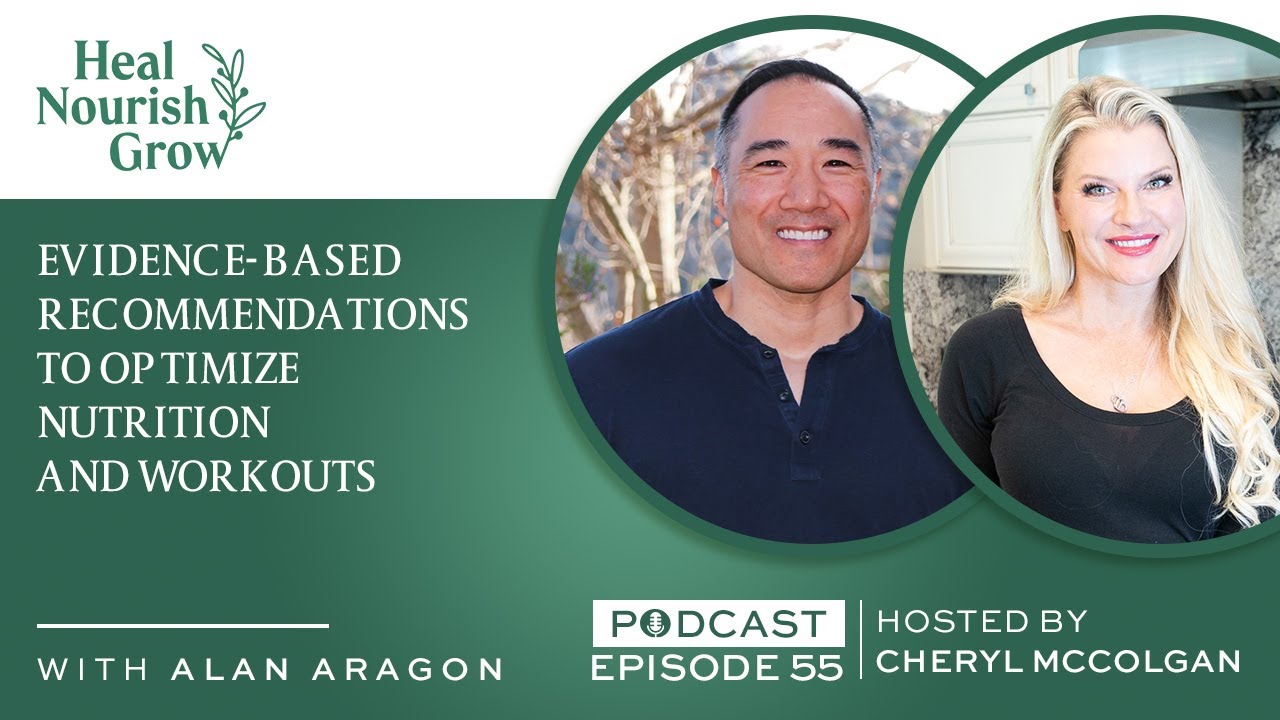
In this episode of the Heal, Nourish, Grow podcast, host Cheryl McColgan interviews nutrition researcher Alan Aragon about his recent paper on age‑related muscle anabolic resistance. Aragon explains that the loss of muscle mass and strength with age (sarcopenia and dynapenia) is driven more by disuse and excess body fat than by chronological age alone. He describes "sarcopenic obesity" as a state where inflammatory adipokines from excess fat blunt muscle protein synthesis. The conversation turns to protein recommendations: the current RDA (0.8 g·kg⁻¹) is insufficient; a practical minimum is ~1.2 g·kg⁻¹, with an optimal range of 1.6–2.2 g·kg⁻¹ (≈0.7–1.0 g·lb⁻¹) for active and older adults. Per‑meal protein should be at least 0.4–0.6 g·kg⁻¹ (≈30 g) to maximize muscle protein synthesis, though distribution is secondary for most people. Aragon then outlines a minimalist resistance‑training prescription: 3–5 sets per muscle group per week, performed as whole‑body sessions twice weekly, focusing on push, pull, and squat movements. He provides body‑fat thresholds (≈30 % for women, ≈20 % for men) where concern should rise, and defines metabolic health as normal blood markers, body‑fat within those ranges, and the ability to perform daily and recreational activities. The interview ends with Aragon sharing his online platforms (Instagram @thealanaragon, website alanaragon.com) for further information.
Chapters
Hello everyone and welcome back to the Heal, Nourish, Grow podcast. Today I am joined by Alan Aragon, who generously agreed to have this conversation with us here today. Uh, he recently had a paper out on, and I'm just going to go ahead and read it so I get it perfect, Age-Related Muscle Anabolic Resistance: Inevitable or Preventable? So don't click away just because you're hearing that topic, because we're also going to talk a lot about protein intake and improving body composition. And this has really been Alan's life's work and he does so many good papers and education on this topic. So really excited to talk to you, Alan. Can you share with people a little bit how you got into this work and what made you wanna write about this topic on age-related anabolic resistance?
Well, first of all, thank you so much, Cheryl, for having me on. It's a real pleasure to be here. And the way I got started in the industry was just having just basic, regular guy interests of just, you know, looking better and being stronger. And, and as you get older, you kind of want to be healthier. So there is that health thing that, that eventually catches up. And I just spent a lot of my time in the fitness space, in the personal training space in the early '90s. And then that just kind of graduated on to the nutrition space through the through the 2000s, 2010s. And so like the last, the previous decade has mainly been sort of doing it all, but maybe like 80% education and research and 20% keeping my foot in the trenches with clients. And so, yeah, that was sort of the evolution, personal training, nutritional counseling, and now publishing research. And everything kind of happened by accident except for the personal training part, 'cause that was my original interest. So, so yeah, so here we are, my colleagues and I have published the, I would say the majority of the nutrition research for the non-clinical space. So the majority of the research for athletes and physically active people And also the guidelines actually that dietitians and strength and conditioning coaches and personal trainers use for practice. So I'm pretty proud of, you know, the work of my buddies and I as far as the research we've put out there to help the professionals in the field to help the lay people in the field.
Yeah, and I think it's very accessible. And even though I have a research background from graduate school, I still thought that reading the paper was very easy and also that you gave some kind of practical application sort of things at the end. So why don't we just dive right into that one first? Because I think one of the things that was very interesting, you were talking about kind of providing more information for professionals to implement into their practice. And why is this topic of protein? It seems like all of a sudden, at least in this very small, like, kind of health and wellness space, people are starting to realize that the dietary guidelines are really only the minimum, and they're not for optimal body composition, not for optimal health. Is this part of the thing that spurred you on to want to write this paper, or what was the reason?
Yeah, it's like, okay, well, I've always had an interest in maintaining lifelong health. I mean, it's never been a thing where I want to feel really awesome and look really great for about you know, this particular point for this high school reunion or for this other thing or that. And, uh, I actually, even though I hang out with dudes who love the competitive aspect of, um, fitness, physique sport, bodybuilding, I've never had the, the remote, um, well, I don't know, maybe it crossed my mind fleetingly, but I've never seriously considered competing in the whole physique thing, even though those are all my friends. And I'm like, I just I just like to watch them suffer, I guess, you know. And so, um, uh, I, I just think of this as, you know, if you can't maintain a certain lifestyle and enjoy it for several decades, then, you know, then you, you haven't gotten it together yet. And so, and, and also age comes into play. So I turned 50 in January and most of my friends in this space are, you know, we're getting up there in the age brackets, but my cohorts and I noticed that there is very little difference between the strength levels and the energy levels and functionality of just, you know, the body and the mind now versus 25 years ago. And it really is a special thing. And we kind of want to get the word out that you can actually preserve the vigor and the strength and the functionality of youth, even as you, you know, get up into middle age and older age. And, you know, we're hoping to really hold it together when we're in our older, older age. And the good news is that the research does support the, in quotes, magic of a combination of Getting enough, well, good nutrition overall, and getting enough protein, and keeping body composition favorable. And that's, you know, that's a whole topic. What is good body composition? And resistance training. So cardio, obviously that plays a role in there as well. And some people have enough non-exercise activity to preclude them from needing to do formal cardio, because some people just have very physically active lives and schedules to the point that they, they don't need to go on these dedicated, um, bouts on the treadmill or dedicated runs or even dedicated walks. Some people have just very physical, physical jobs and hobbies. So, um, yeah, the age-related anabolic resistance paper is something I collaborated on with a friend of mine named Brad Schoenfeld, who's done a lot of the very, very important research in the exercise science realm. And so whenever he has a nutrition project, I get the honor of getting a call from Brad because he always pulls me onto the project. So with this particular paper, he, it was, you know, it was Brad's idea. Like, I'll just be, I can't, you know, like give you the heroic news that, hey, you know what, I've thought of this paper and I wanted to do it. So Brad just literally, called me and said, hey, Alan, I really need you to write this paper, and, you know, let's get together on it and let's get this thing published. And it was a great opportunity because I was already interested in the topic, and I don't think that there are a lot of papers on this topic that have gotten circulated out to the general public. Like, the general public just— they've almost resigned to thinking, you know, you get old you get weak, you slow down, and then eventually you die, and hopefully you don't catch a chronic disease. That's, that's kind of the subconscious narrative that's going on in the back of people's minds, and we wanted to get it out there. It's like, no, you fight, you become harder to kill, as, as the saying goes. Um, that, that's, um, my friend Jamie Seaman. She, she wrote a book called Hard to Kill, and it's really kind of a cool way to put it. You know, you you fight Father Time, you become harder to kill, and you just become a better super soldier in that sense. And you can get— you can accumulate enough armor to the point where you don't just prolong your life, but you increase the length of time that you are at firing at all 12 cylinders. And, and that was the idea. So age-related muscle anabolic resistance, as described in the paper, is an age-related loss of muscle mass and strength. And that's kind of the definition of sarcopenia. And then that other, that other less known term, dynapenia, that's specifically loss of muscle strength, whereas sarcopenia is loss of muscle mass with age. And these two things fall under the umbrella of frailty, which is sort of this systemic breakdown of lean tissues that's associated with older age. And the interesting finding, as I dug through the research, is that this loss of muscle mass is not necessarily an age-related phenomenon. It's not exclusively an age-related phenomenon, but it's more of a disuse-related phenomenon. So you can take a 30-year-old, immobilize them, keep them bedridden, and their muscle changes will be very, very similar to this sort of age-related anabolic resistance we see in elderly people. And the mechanisms of anabolic resistance related to disuse and/or just the aging process, um, we're still trying to figure them all out. There's a bunch of possibilities, um, But before I go on to that ramble, I'll just kind of— I'll let you ask the next question.
Yeah, pause and collect your thoughts because I have a— there's a lot of questions in my mind about that because, you know, obviously not having written a paper like this, I haven't dug totally into like a whole review of the research. But I think it's interesting in that some of the things that I have read that there are a lot of studies on older adults and they show that if they put them on a strength training program, they gain muscle. So it's not impossible and it's And it's not something where you have to start out as a bodybuilder and then kind of maintain that your whole life. Like, if the good message is here, if you are older and you get on a strength training program now, you can improve your body composition even at an older age. But the thing that I find that kind of contradicts that, maybe you can speak to this from some of the research you've done on this paper, is that there's idea that this muscle protein synthesis, that it actually requires more protein as we age because they think that the body is not as efficient at breaking down amino acids. That's at least a couple of the things that I've seen. Uh, when you're digging into this more, do you think that that does play a part in it, that our bodies become more inefficient, or do you think it's just this lack of use thing more than that lack of amino acid excess?
It's, it's probably a combination in, in most people, but I think the, the dominant part is, is the disuse, because trained muscle becomes sensitive, becomes receptive to protein and amino acid feeding. And this is regardless, regardless of age, which is the really cool thing that you mentioned. You can take an 80-year-old, 85-year-old who hasn't trained in decades and then put them on a progressive resistance training program, and then the the changes in their muscle at the macro and the micro level are very similar to the changes that happen in people of much younger age brackets. And so it's not necessarily a chronological thing, although with age, there are certain physiological changes that might inhibit muscle protein synthesis. So, but we— that stuff is difficult to measure, these, these supposed changes that may happen in the gut microbiome or that may happen at the level of the myocytes. But it's tough to measure in humans. But what we do see is this very robust reversal of old muscle turning into new muscle or trained muscle. And becoming once again receptive to protein feeding and receptive to progressive resistance training. And it is a, it is a beautiful thing. Um, there is a factor that creeps in with age that does inhibit muscle protein synthesis, and this is the accumulation of excess body fat. So obesity is, is kind of this antithetical vector as far as muscle growth goes, only because at the level of the tissues, there seems to be an overproduction of inflammatory adipokines from the adipose tissue and the muscle— and this is proposed and speculated that this process interferes with muscle protein synthesis because at the same time, the muscle tissue is producing certain cytokines, myokines, kinds that are in some way inhibiting the process of muscle protein synthesis. And this has been seen and this has been measured. And this isn't a huge, deep and broad body of studies, but apparently excess body fat hinders to whatever degree it might hinder it. It does hinder muscle protein synthesis. And so this is how the term sarcopenic obesity came about. And it's a combination of excess body fat plus this age or disuse-related loss of muscle tissue. And that's a bad combination. And that's what we kind of need people to gradually step by step steer away from in order to preserve health.
So to kind of refine that for a little bit for people that aren't as familiar with that. You threw out some— people probably are familiar with the term cytokines now due to the virus that's been going around for the last couple years, but it's, you know, it's an immune function process that creates inflammation in the body. So they're probably familiar with that. You mentioned fat cells, lipocytes, being a proponent or kind of preventing this muscle protein synthesis. I guess what I want to ask about that is, do we have any idea what amount of body fat? Because I think when people think of— when they think of having too much body fat, they'll definitely think of somebody obese. But in some cases, if you think of older, like, frail little old ladies, they could actually be— they could actually have that improper body composition you just described where they have mostly fat, not muscle, even though they appear on the outside thin, like that kind of thin on the outside, toffee model. So what percent would that kind of correlate to? When do you have to start getting worried? Is it like, if you're— let's take women for example, because they typically have more body fat anyway— is it over when you get over 25%? Is it when you get over 35%? Do we have any idea, you know, when people need to be like, okay, put on the brakes, I gotta do something here?
Yeah, the ballpark appears to be around 30% as an upper end of, of healthy. So when you start getting into, you know, low 30s, crossover 30, that appears to be kind of a statistical threshold. Everybody's different. I mean, you're going to find people who are in their low 30s and just fine, but, um, on average the threshold is right around 30-ish for women. And, um, yeah, and for men it's, it's lower, it's right around 20-ish. So, so yeah, if you want like a ballpark, then that would be, that would be the ballpark to start kind of paying attention.
Okay. And that's, and most people to be fair, don't actually know their body fat percentage because we don't have any easily accessible measures for that. I, luckily DEXA is becoming more common. I'm a big proponent of that. I think, you know, knowing your body fat percentage is a much better marker of health than really worrying about your weight. So to the extent people have access to that, I would, I would seek that out because I also think that when you have that knowledge, I mean, I mean, you might have the sense like, oh, I'm getting a little fluffier now that I'm nearly 50 here, but you don't have a sense of how much that is or if it's something that you need to really start to be worried about. And I think, I don't know, you should probably always worry a little bit, right? Just to maintain.
Yeah, I think it's healthy. I think it's healthy to not be, not totally be like nestled on your laurels, you know? But yeah, there's still gonna be some gray area there. 'cause when you look at rates of chronic disease and stuff, there is a phenotype called metabolically healthy obese. And these are folks who are technically obese by BMI standards, which have their own set of problems, especially for people who carry a lot of muscle mass, 'cause it's just a height-weight ratio. But if people are in like class 1 of obesity, which is, BMI of 30 to 35. Then the metabolically healthy obese would exhibit like good, you know, blood markers of health, good activity levels. And of course, a certain amount of muscle mass. And that's, you know, they're just carrying some extra body fat, but theoretically they're not in, any sort of urgent trouble, you know. However, when you start getting into BMI 35 to 40, even if you fit the metabolically healthy obese profile where you've got good blood markers of health, you're physically active, but you just happen to be carrying on this body fat, then you statistically, you're still at risk, especially if you're on this particular trajectory over years and decades to keep accumulating body fat and Yeah, it just gets tougher for the body to deal with. And it, per our topic at hand, it would get tougher for the body to elicit robust muscle protein synthesis responses. So yeah.
Based on that research that you mentioned before, just because you have more fat, it's preventing that.
Yes.
That's correct.
Can you—
okay. So I guess just because you just kind of described that Based on all your years of research and your personal experience, then what would be your personal definition of metabolically healthy? Because there's like an accepted definition in the literature of metabolically healthy, which includes things like your waist circumference and your blood pressure, and there's 5 of them. But what would be your personal definition of just being an overall healthy individual, including metabolic health?
Mm, yes. I think, well, I think both the The blood lab values have to be within normal ranges. There is a raging debate over lipid profile, you know, LDL, HDL, ApoB, etc. I think that the position stands, the current existing position stands in that area are pretty, pretty reliable. So blood markers of health in normal ranges. Body fat percent as, as a woman, uh, somewhere between low 20s to low 30s, and you, you should be just fine. Uh, women whose body fat percent is in the high to mid-teens, you're, you're looking at competitive athletes or serious recreational athletes who are highly competitive with themselves and their body composition. But, um, anywhere low 20s, high 30s, you're fine. If everything is, in quotes, working on you, then you're healthy. You know, if you're able to do everything you were able to do in your 20s while you're in your 40s, 50s, 60s, 70s, 80s, you're healthy. So that, that's my definition of metabolically healthy and just physically functional, available to complete the activities of daily living, as well as recreational activities, as well as training, then you're metabolically healthy.
All right, love that. As far as training, since you mentioned it, I did— I think of one thing when you were speaking before that, you know, we said that obviously any age group can suddenly kind of transform and create more muscle mass. So if somebody wanted to do that, I mean, I think that there's probably two primary things. One, we need to touch on What is the actual proper amount of protein that people should be getting, which again is higher than that RDA. And you did talk about that in the paper. And then the second part of that is resistance training. So, and just to be like, I've said this before on this, I've, I've always been a very healthy, active individual, but I hate weight training. I just don't like it, even though I know I need it, especially now that I'm gonna be, you know, 50 here shortly myself. What are the things, what's the minimum time, the minimum that you can do to get away and to build some muscle mass. Obviously, if you want to be in the gym every day, those people are going to take care of themselves. That's easy. But for those people that aren't so into resistance training, what would your recommendation be?
Yeah, totally. Okay. So I'll cover the protein first and then just, you know, kind of, kind of nudge me if I, if I forget about the resistance training part.
Okay. So I need to know this part, Alan.
Yeah, so you'll get, you know, you'll give me a swift kick if, if I move on to something else. Um, so protein-wise, the RDA is, is not enough, and it was put out into the public health guidelines in 1980, which, if my math is correct, that's almost 43 years ago, and they haven't changed it. They haven't upped it, nothing. And so, and this is in spite of research showing that the RDA is insufficient at every level of energy balance and at— for most of the population. I mean, the human organism is really incredible. We can subsist and limp by on the worst possible diets with just such insufficient macronutrition and micronutrition, just horrible dietary profiles. We can survive it. We can just subsist. But in order to actually be healthy, the RDA is not enough. The RDA is not enough for people who are dieting. The RDA is not enough for the elderly. And frankly, the RDA is not even enough for sedentary people at, you know, zero, like, maintenance energy balance. And so it needs to be raised to a minimum of, like, 50% ish. So, like instead of 0.8 grams per kilogram of body weight, it really should be raised to a minimum of 1.2 grams per kilogram of body weight. And if we want to, if we wanna optimize things, then really the convergence of an optimal dose that works for athletes, as well as an optimal dose that works for active people, and an optimal dose that works for elderly folks or older folks trying to hang on to muscle would be 1.6 grams per kilogram of body weight, which is double the RDA. And in imperial terms, that's 0.7 grams per pound of body weight. And I prefer to direct people to just, when you're targeting protein, base it on target or goal body weight. And if you're at your goal body weight, then you can base it on current body weight. But otherwise, if you base protein on current body weight, regardless of whether or not it's your goal, then you can either overprescribe or underprescribe. So base it on target body weight. That's 0.7 grams per pound of target or ideal or goal body weight. And then you, you're pretty much doing everything we know in nutritional science at this point to optimize protein intake. Now, there are certain certain populations on the fringe who have more specialized goals, who want to gain as much muscle as possible, or they're pushing the athletic envelope. And for those populations, it's perfectly fine to go all the way up to a gram per pound of body weight instead of that 0.7-ish, you know? So that's total daily protein intake. And we can nitpick about how to distribute that protein through the day. But that is of secondary importance. So the 3 levels of importance for protein would be at the very top is total daily amount, and then second, of distant second importance, is meal frequency and distribution. How are you going to spread that out or concentrate it out through the day? That, that almost doesn't matter for, you know, the majority of people on the planet. The, the only folks for whom the distribution of protein matters, um, might be for people who are specifically trying to expedite the process of muscle gain. So, um, there's tactics that could be employed there for how to maximize muscle protein synthesis per dose of protein. And that dose, per the weight of the evidence, appears to be at least 0.4 grams per kilogram of body weight. So any— that's gonna be for most people, that's gonna be around, oh, you know, 30-ish or so grams. And so protein significantly below that dose is not going to maximize the anabolic or anti-catabolic effect of each protein feeding. So, You know, if you really want to get into the weeds, I wrote another paper. Um, I co-authored it with Brad, and, and it's called, uh, How Much Protein in a Single Meal Maximizes Muscle Building, or something like that. I always forget the titles of our, of our stuff. Is that— titles are just long and complex. I always mess them up, right? But how much protein— how much protein in a single meal can be used for muscle building? And this is, this is another, um, open access paper that I think you, you would, you would enjoy actually.
And so I might have read that one actually, because I've been on this kick, or at least heard you interviewed before where you've spoken about this, and you and, you and Layne Norton, because I've, I've strived now for a minimum of 30 grams of protein every meal that I eat. So like, otherwise it's a waste.
Perfect.
Yeah. So have heard of this before and keep I think people on this podcast have heard it, but I would love to hear what you learned in that. Did you— was it anything with the leucine or did you just find it was total protein?
It's kind of both. Everything's always so complicated and it's a challenge to simplify it. So we basically start from the top and kind of work our way down as far as optimizing the distribution of the stuff. So starting from the top, we've got total daily protein being optimized at somewhere between 1.6 to 2.2 grams per kilogram of body weight. So 0.7 to 1.0 grams per pound. That's the total daily protein that would optimize various, you know, resistance training adaptations and just, you know, health in general and preserving muscle tissue as you get older. And so the, maximum amount of protein per meal that hits that ceiling of muscle protein synthesis is somewhere between 0.4 to 0.5, well, 0.55, believe it or not. I just like to say 0.6, okay? So round up to 0.6. So between 0.4 to 0.6 grams per kilogram of body weight is the protein dose per meal that would maximize muscle protein synthesis. And this is all age groups inclusive, including the older guys who are slower to wake up and warm and get the muscle protein synthesis going. So yes. And so if you, if you have that dose 4 times a day, then that would equal the golden sweet spot of 1.6 to 2.2 grams per kilogram of body weight as a total daily protein target. And once again, you don't have to eat the full, gram per pound. You can go 0.7 grams per pound of target body weight. And the full gram per pound is more for bros and folks like me who, you know, just want to take up as much space as we can.
So, so having said that, now, now we've got people to where they need to be on protein. And obviously, if people have trouble with this, go to the calculator that's on my website. I actually did a higher protein version that is more in line with the macros that you just described. To help people get to this proper protein level because the traditional, you know, you don't necessarily prescribe to any specific dietary guideline, but a lot of people that listen to this show or that know my work are kind of into keto or low carb. And the traditional low carb macros for ketosis are, the protein level is far under that number. So I have this other calculator that's the high protein version of that that takes into account this kind of 1 gram per pound idea. Slightly less. Um, but so say we got the protein down now, we got that dialed in, we're— but we're a lazy weightlifter. What is the minimum amount that we need to do? Yeah, to try to maintain. And what are the best exercises? Like, if people just want to keep it super simple, what would your recommendations be for that?
You know, there's a surprisingly low amount of volume required to, um, make you know, to be healthy as far as just musculoskeletal strength and integrity and functional capacity. I mean, on the low end, Cheryl, we're looking at— and this is for people who are really trying to lowball it— but 3 to 5 sets per muscle group per week. Like, literally freaking as low as 3 sets per week, and then you can maintain your muscle mass. And keep in mind that this is granted that you take those sets to fatigue. You know, I'm not talking— you don't have to take them to like grindy failure and, you know, like you're passed out at the end of the set. But I mean, you don't leave like, you know, a ton of reps in the tank per set. I mean, you take each set until, until you're fatigued. And, uh, you can go as low as 3 to 5 sets per muscle group per week. And, and so therefore, um, what usually works out for people who want to take a minimalist approach to the lifting part, the resistance training part, is you can just train the whole body, uh, twice a week. And honestly, it comes down to how, um, how much in the weeds you want to get, how fancy you want to get. And how obsessive you want to get with refining your, your physique. And so without— if, if you don't want to get, um, obsessive or, um, into the weeds or nitpicky about refining the physique, then it's honestly push, pull, squat. You're done. You work the whole body. Like any sort of squatting or hip hinge, sort of this multi multijoint movement for the lower body where it looks like a squat or a leg press, you're training everything you need to train in the lower body. Upper body, pick a couple pushing movements, pick a couple pulling movements, and then you're done. You've worked everything you need to work in the upper body. So push, pull, squat, and you're done. Now, If you want to get cute with it, then there are things that you can specialize in. Like, you know, we've got the isolation movements that can train the biceps and the triceps. You have the elbow flexors, elbow extensors. You can specialize on the shoulders with various movements. But truly, I mean, the shoulders are getting hit with your pushing and pulling movements. They're getting hit pretty darn sufficiently for most people's purposes who don't want to get into the weeds with the whole physique thing. And of course, if you do want to get into the weeds, then you can train calves, you know, on their own. Gosh, you can even train tibialis, the front of the calf, on its own. And you can train forearms, you can train traps. And, um, I mean, that, that's one of the, the reasons people have, uh, so many days of resistance training in a given week, because they're training the whole body in sort of a specialized type of way. But if you're not about that and you want to be minimalist, it's push, pull, squat, baby. That's it.
Love it. Okay, even I can handle that. So just to get real specific for people here that aren't as familiar with this, so for me, for me, what that would mean— and you can tell me if this— okay, squat, I know, I know how to do that. You could throw some, you know, lunges in there too if you wanted to, to hit some of the big muscles in the lower body. Push-ups, super easy, that's a push. And then pull, just get a resistance band and literally pull. And then we're done. I can do that.
Yes, you could do that. That's true. And we're talking minimal stuff. It's tough, man. It's tough to stay interested in a workout unless you have a few little bits of equipment. So for the pulling parts, it does help to have a bench so you can do like single dumbbell rows. Um, and it does help to have sort of a bar and maybe a band for assistance so you can do assisted pull-ups. Um, what if you find yourself getting tired of, of rows? And even, you know, you don't even necessarily need a bench to do the rows. You can literally just stay hip-hinged with the back, with the back stable and straight, and just do like, you know, um, bilateral type of rows with the dumbbell. Or you can use bands. Um, and the, the, you know, a lot of times like people hate the gym. They hate the idea of going to the gym and dealing with the drive to the gym and dealing with the people at the gym and stuff. And I totally get that. But, um, you can get some really decent, uh, workouts just at home or even at the park. Um, and yeah, as long as you, you cover just those basic movements, then, then you, you will be just fine because a lot A lot of times with, as people age, those are the basic things that they lose functionality in. Even just getting up out of a chair is an issue, or getting up from sitting on the floor is an issue. But as long as you keep the body strong from top to bottom, um, then, then you don't have to do a ton, a ton of volume. Although, you know, if you talked to me enough, um, then I, I would gradually convince you to get to a point where you want to flex in the mirror and, and train every little bit.
So not to say that I don't— I, I mean, there have been times in my life where I've been much better about that, but I just, I just know from experience, and I know from the way, the way people's lives are, and from my personal experience of being a woman— like, for a woman, going into a gym can be very intimidating. It's like, well, I don't know what to do, or you feel like you're in the way because the guys that know what they're doing and that are serious about, you know, doing the kind of training that you talked about, it just, it has a feeling, I think, especially to women that can be quite intimidating. So, I think just, and I'm kind of being joking about this, but it's just to show people that really you don't need a lot of special equipment. You can do this at home. You can do, like you said, 3 simple things and you're going to improve your longevity. You're going to improve the quality of life that you have every day because like I'll notice, when I go snowboarding in the winter, if I've trained more leading up to that, it makes the whole thing so much easier because snowboarding is pretty much everything that you just described. It's push-pull, pushing yourself off the ground. Perfect. So, yeah. Yeah. So, Alan, I don't want to take up any more of your time because I know you're a very busy man and you're on to the next research project. I just want to thank you so much for taking the time to do this today. And I would love if you could share with people where are the best places to find you online if people have questions or want to learn more about your work? Are you active on social? All those kind of good things.
Yeah, my biggest audience is on Instagram, so my Instagram handle is @thealanaragon, and my website is alanaragon.com. That's where you can find all my, my stuff. And Yeah, that's, that's, those are the best places to find me. I, I will have to admit that I am on Twitter sometimes, and I try to avoid the— I try to avoid political Twitter with all my might.
It's difficult.
Nutrition.
It's difficult.
Yeah, man, it's a full contact sport in there, man. People are hurting each other.
Um, it's the truth. I Twitter if people want to see some entertaining things about nutrition, they should definitely like check out some of these Twitter conversations. I try to— I avoid that place like the plague, honestly. But all of your links will be in the show notes as well. So again, Alan, thank you so much, and try to protect yourself out there on Twitter.
I will, I will. And thank you so much, Cheryl. It was really a pleasure.
More from Cheryl









30 Day Challenge Series, Day 30: Choose Your Three Habits to Continue for 90 Days

30 Day Challenge Series, Day 28: Schedule Connection (Put It on the Calendar)