
Foot Health to Combat Full Body Aches and Pains, Tips and Exercises: 93
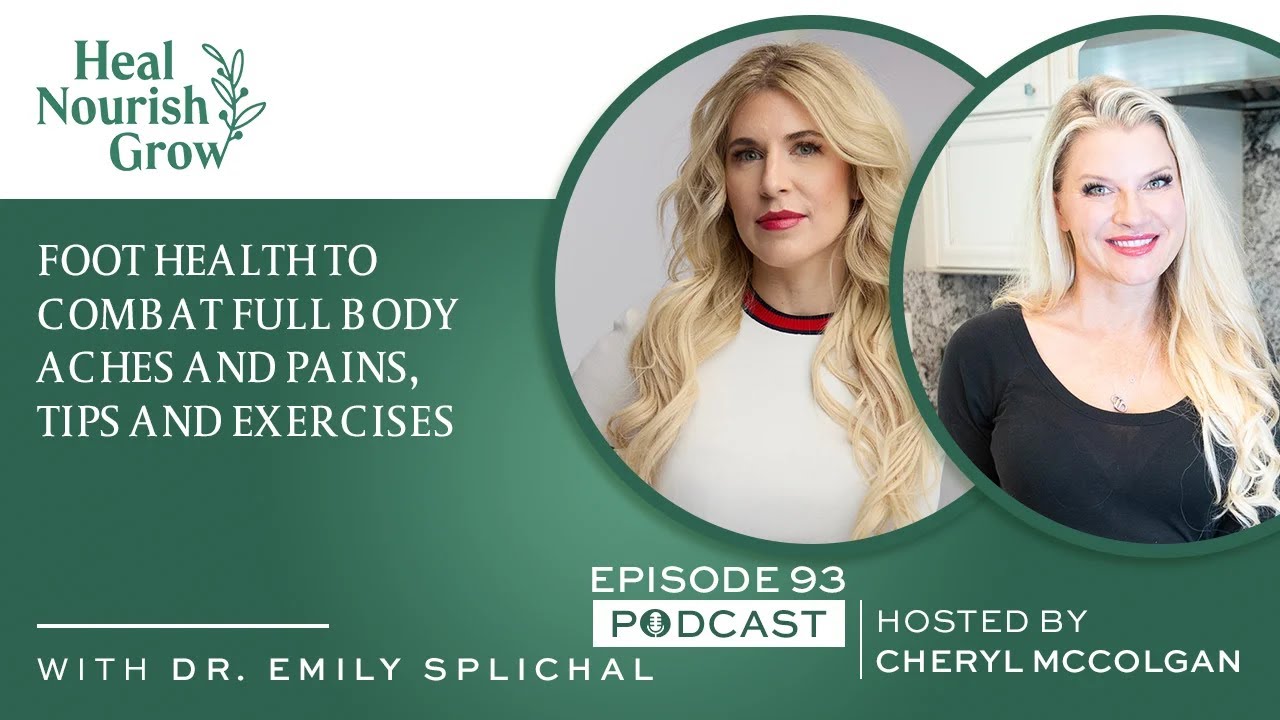
In this episode of the Hear and Learn with Cheryl podcast, host Cheryl McColgan interviews Dr. Emily Splichal, a functional podiatrist and founder of the sensory‑based product line Naboso. Dr. Splichal explains her holistic, functional‑medicine‑inspired approach to foot health, emphasizing the foot as a gateway to the brain and whole‑body movement. She describes the sensory anatomy of the foot, focusing on mechanoreceptors that detect two‑point discrimination and vibration, and how Naboso’s textured products (e.g., Neural Ball, Splay toe spacers) stimulate these nerves to improve foot awareness, circulation, and neuro‑rehab outcomes. The conversation covers footwear trends—from minimalist barefoot‑running shoes to maximalist Hoka platforms—highlighting the trade‑offs between sensory input and support, and offering guidance on selecting shoes for specific conditions such as plantar fasciitis, Morton's neuroma, and bunions. Dr. Splichal walks listeners through a simple foot‑posture assessment, the “foot tripod” concept, and practical daily habits (toe‑spreading, forward lean, external hip rotation) to set a stable base and improve kinetic‑chain alignment. She discusses the therapeutic benefits of toe spacers, vibration tools, and rehab shoes for chronic pain, and notes their relevance for neuropathy, post‑stroke, Parkinson’s, and other neuro‑degenerative conditions. The interview also promotes her two books—Barefoot Strong and the upcoming Sensory Sapiens—which synthesize her movement‑longevity philosophy and provide actionable guidance for readers. Throughout, Dr. Splichal stresses that foot health is foundational to knee, hip, spine, and overall longevity, and encourages daily foot‑release practices as a simple preventive measure.
Chapters
Hey everyone, welcome back to the Hear and Learn with Cheryl podcast. Today I'm already tongue twisting myself because I'm already thinking about Dr. Emily's name. It is Dr. Emily Slickel, and we were just chatting before the podcast. I was hoping not to butcher that, but I think I got it right. So, uh, Dr. Emily, welcome. I am so excited to chat with you today about all things foot because we have had not had that subject on the podcast yet. And, um, I think what you're doing with your— the way that you treat people virtually and the products that you have brought to market to really help people with their foot health pretty incredible. So all that being said, I would love for you to just kind of introduce yourself and tell us how you got into this line of work.
Of course. Well, thank you for having me on, Dr. Emily. I am a functional podiatrist, so that's— to me, that's very important to have that distinction. So that means that I treat feet, but I treat feet in a very integrated way. I think very much about complex human movement, but also stress, sleep, inflammation, diet, um, how do people breathe. So a lot of stuff that I bring into it, almost like functional medicine, functional movement into my podiatry. And then I'm also a human movement specialist where I focus primarily out of my practice on chronic, chronic patients. Maybe it's chronic pain, chronic movement disorders, chronic movement dysfunction. And I'm trying to look at them from an outside of the box perspective. I teach people how to empower themselves by understanding their body and how they move and their feet. And then finally, in addition to that, I'm the founder of Naboso, which is a sensory-based product line. I'm very much into the sensory side of the foot versus thinking of it very biomechanical. I'm fascinated on how our feet are the gateway into our brain, and that's how we control our movements. And then my final passion is movement longevity.
I love that you just covered all of that because everybody that hears that is going to know exactly why I wanted to have you on, because I love having people on that really take a whole body perspective and a functional perspective because I think so much of medicine, as you well know these days, is, you know, putting a bandaid on something without getting to the root cause. And I think it's really amazing what you've done to try to like promote this idea of a very holistic thing with your feet because they're something that are so important to us and you usually don't think about them too much until you have a problem with them, right?
Sadly, yes.
So you mentioned your functional products. I'm guessing that this became kind of a thing because you kept seeing people and were maybe seeing some consistent issues that you were thinking, oh, how can I better help these people? And maybe it's like a little tool or something to help get their foot stronger or, you know, all those sorts of things. I'm guessing you were just seeing a lack in the market. So I'd love if you could just talk about what you were seeing in your practice that then led you to produce these certain tools and products that you have now.
Absolutely. So I will share first. Let me find what I can show you. So this is, this is an example of the texture. So all of the products at Naboso, which is my products company, features this texture to stimulate the nerves in the bottom of the feet. And we have a patent around the texture. Now, what I was starting to see, or really avoid in the market, this was back in 2008, 9, 10, if you remember the barefoot running boom and the 5-finger shoes and that whole time. Is that it was bringing in awareness to the feet, to foot health, to movement, and how the shoes that we wear might actually be doing more harm than good, that there's a lot of cushion, lot of structure that just naturally our feet probably don't need. So people were moving more minimal, which is great. Similar around that whole thing is that people then started also saying like, oh, what if I take my shoes off entirely? And I work out barefoot, I run barefoot, I go around my house, and there's just this attention around the barefoot. One thing I didn't mention in the beginning is that I've been in the fitness industry for over 23 years. So being intertwined in coaching and athletic training and strength and conditioning, that's another big part of what I was doing. So I would speak and educate about the feet, minimal shoes, getting out of your shoes, And then I started to realize, well, that's not the end of the story. It's not just if we take off our shoes, therefore we are optimizing the sensory side of the human foot. There's more because there's special nerves in the bottom of the feet that are sensitive to very specific stimuli and texture. This is actually two-point discrimination. Texture is like a consumer word, but it's two-point discrimination like Braille. There's a very specific nerve in the bottom of their feet that reads two-point discrimination. So I started to get into research of that. One of the other nerves in the bottom of the feet is sensitive to vibration. So I started to get into vibration and really understanding how do we target these nerves to get a little bit more out of our foot function besides just take off your shoes and that's all you need to do and now you're optimizing your foot activation, awareness, strength, circulation. How do we get even further into that? And that's really what led to Naboso and then just my specialty in the neurosensory side of the foot.
That's so interesting because I've never heard about those specific receptors in the bottom of the foot that you described. So that's really cool. And for those of you that were listening and not watching on video, she was holding up a yellow cylinder that you could basically like put under your foot to kind of, I'm guessing, like roll back and forth on it. But before we move on with the technology, because I know you have some other things. And I want to get into that part where you talked about the vibration, but you mentioned shoes, and I have to go there because I was a runner for 17 years and the shoes kept getting more and more padded. And this is what we thought before I read, um, you know, you mentioned the book, The Barefoot Runner. That was such a great book. I'll have to put a link for that in the show notes because I think even if you don't run, it's a really just a good, great read. Um, but for years I, and I have like really bad knee problems and stuff now, and I really think it was a factor of kept I kept wearing more and more padded and padded shoes. And now I see this trend right now. Have you seen the Hoka shoes? They're like, they look like 3-inch heels on tennis shoes, running shoes. I would love to hear your perspective. I'm guessing there's a balance because then I think, you know, running barefoot or running in very minimalist shoes kind of creates its own problems, especially when our bodies have been used to a certain other way for 50 years. So could you just talk about that a little bit and what you recommend for people as far as footwear, particularly if you're doing something like a lot of running in your life?
Yeah, one thing that I would say at the start of any footwear conversation is that we have to remember that footwear is still part of fashion. And that's really important, that fashion, all aspects of fashion, have trends. And that includes the footwear industry, is that there are trends that you will see in the footwear industry, some athletic, some not. But for the listeners, I'm sure that they remember, remember Shape Up? So the rocker shoes. Oh yes, the trend, right? So there was this trend within the footwear market that had to do with like, um, shoes that get you in shape, let's say, like the gym in the shoe. Then there was Crocs, there was UGGs, right? There was Doc Martens. Remember TOMS? So there's all these footwear trends, and then that's important because right now we are in a super shoe, maximal, Hoka-esque trend within the footwear industry. And a lot of people thought that the minimal shoe during the barefoot running boom was a trend and then they would completely go away. However, that's not the case because there is a need and a justification and there's science and evidence behind minimal-based shoes. Obviously, it's still trendy. So now Hoka is totally trending in these super shoes. But when, when we think of them, is a Hoka shoe with a lot of stack or cushion is essentially taking away the important sensory stimulation that we need when we move, whether it's walking, running, jumping, etc. We need that information to create accurate movements. And if you don't have the information, your movement accuracy, your movement efficiency, just the preciseness and the quality of how you move will just not be as high because of less information coming in. Now, can you still move? Absolutely. You're just disconnected. Now, the one thing that I do like about Hoka, which is just a little disclaimer on the side because sometimes I do recommend it to my patients, is that they actually have a rocker in them. And there's a time and place for a rocker, a forefoot rocker in the front of the shoe that is based off of this carbon fiber interlay that's in the shoe. And if you have severe bunions, maybe you have arthritis in your big toe, you have a neuroma, you have a plantar plate tear or something going on with the second joint, something going on with the forefoot, it's actually a really good benefit to get into a forefoot rocker such as a Hoka. So that you can still get an optimal step length and you can still walk as close to the right way as possible because there's a lot of compensations that happen when we can't move through our big toe and our forefoot the right way. So it's always a balance. So I love the footwear conversation. I do try to look at it very objectively and not say that everyone should be minimal or no one should ever wear Hoka, but let's just be educated. On the appropriateness of all the different shoes.
Yeah, and I think that's a great point because since I've recently started having these couple of foot issues, and I guess this is the time to chat about that because I think it's really in relation to what you just said about the functionality of footwear. So I had, I had two things happen kind of close succession, and one was I started having this pain. I Google diagnosed it. I have not been to the doctor, but I Google diagnosed it as a Morton's neuroma, which you just mentioned the neuroma and why you might want that rocker. And the second thing was I was dancing in some silly little kitten heels at a wedding for way too long, like for hours. And I think the pounding of my heel kicked up some plantar fasciitis. And that has been ongoing. And so all this is to say that normally I am a big proponent of, you know, former yoga instructor. I walk around barefoot all the time in my house. If I cannot be wearing shoes, I'm happy. But right now, since I've had these two little issues kick up, I've not been able to do that. I've had to wear shoes in the house and have gotten a couple of tools that you just mentioned there, like, um, the little padding under the forefoot because of the way I'm hitting. Um, and then also like slightly more cushion under the heel because of the plantar thing. So I think it is, you know, realize there's a time and a place for everything. Right now I'm kind of wearing, I'm considering it in my head like rehab shoes basically until that my feet are healthy again. So, um, I don't think there was a question wrapped in that, but just to kind of put a fine point on your, um, on your, what you just said about wearing footwear that's appropriate for what you're doing and what your foot is currently, I guess, feeling in the moment or in the season.
If I could actually add on that though, because I do see a lot of the patients that I see come to me because they know I'm a functional podiatrist. I work with a lot of the minimal shoe companies. I advocate Barefoot Training that one, I'm going to recommend to every single one of my patients that they should be in a minimal shoe or 2, that that is like the Mecca that they should be achieving towards, right? And then if they happen to have foot pain or whatever it is, that if they go into something supportive, quote unquote supportive, for a period of time, just like you said, your rehab shoes, that they've somehow failed their body of its natural function. And which sounds crazy, but people get really into this natural foot function thing. And I always will share with them that this is temporary, it's transient, we're trying to get control of the situation. So in the case of plantar fasciitis, when someone is having this on and off or just persistently for 6 months, 9 months, a year, sometimes several years, then I say, okay, we need to get control of the situation. I need to get control of the situation because I need to help you to understand tissue stress and the tissue remodeling process so that we can get you in a situation that this is behind you. And that's very hard for patients and, and consumers and, and everyone to understand because they're just not doing that dance every day like I am with patients. So there is this important period of time where we are in quote unquote rehab shoes so that we can get control of the situation, right? And then you can go back to strengthening the foot and all your natural and your barefoot. So just that aspect is, I find important for people to understand and say it's temporary. It's not like I failed my foot or my body, just like with everything, right? And it's there. That's the psychology of, I think, healing and chronic conditions. Is it's just a maybe how you frame it in your mind of the relationship to that moment.
Yeah, no, excellent point. And I'm hoping— and I'm, I am not opposed to— I said I haven't been to the doctor, but you know, a lot of things it's kind of just a wait-and-see pattern or just let your body do its normal healing process. I've been doing the red light therapy on my kidney on every night on my foot and along with my knee and my other body parts that have pain. Um, but one of the things that you said that I'd like to revisit because we just talked about that, I'm guessing that one of the issues with my foot, like, I recently, um, well, now it's been over a year, so not as recently, but I, I started weight training on a consistent basis again. And I'm also noticing, like, in my knee pain, for example, I was doing some research on the movement pattern in a squat and why that tends to kick up some stuff with the IT band. But I also think, you know, it goes all the way down to your foot. So I would love if you could mentioned like functional movement patterns before. Um, when people have these kind of things pop up, I think it's probably some poor movement patterns throughout my whole body that are obviously anchored at your feet. Um, I don't know, can you just like maybe go a little bit more into that and how you work with people to correct movement patterns? Because I really think that that's how you end up getting these little injuries, is you're just doing something not quite right when you're doing a new pattern that you're not used to, you know, especially when you're doing a new pattern. Not to say that you can't do it in things that you've done for years, like your golf swing or your whatever. But I think particularly when you take up something new, that's maybe you're more likely to get injured or have kind of some kind of problems crop up.
Absolutely. So I always start, let's say, a new movement assessment or injury risk screen, let's say, by having people understand their foot posture and The foot posture, which would be also known as your foot type, right? So let's just understand our foundation because your foundation, which is your feet, is ultimately going to affect your knees, hips, pelvis, T-spine, shoulders, cervical spine, like everything the entire way up. Oftentimes I will demonstrate this by having people feel how their feet move. So if the listeners want to kind of go through this, I will tell them how they could do it. Is that if we stand up and we put our feet shoulder-width apart, and you're just starting standing nice and relaxed, doesn't matter how you're standing, and then we roll to the inside of our foot and we exaggerate making a flat foot, let's say, and then we roll all the way to the outside of our foot and we exaggerate that movement, and then essentially go back and forth, is that I want people as they move their foot to look see, feel that every time they move their foot, the knee is rotating in, rotating out. The knee rolls in, the knee rolls out, right? You can put your hands on your hips and say, okay, this rotation every time my foot moves is going all the way into my hip. Oh my goodness. Put your hands on your pelvis. Oh, my pelvis goes forward and back every time that I move my foot. So why that's important is Okay, one, you have to appreciate the interconnection of the feet with the rest of the body because certain positions of the body, leg, knee affect the way that the muscles contract. So let's say in a squat, as an example, if your foot posture is more collapsed, flat foot, but it's collapsed, we just went through the movement that that makes your knees roll in or kind of knock inward, which also makes your pelvis roll forward. Now, both of those— actually, all three of those positions— a rolled-in foot with a kind of knocked-in knee and an anterior pelvis makes it very difficult for your glutes to contract. It makes it very difficult for your deep ab muscles to contract, makes it difficult for your foot stabilizers to contract, puts a lot of strain on your IT band. So now this is where you could say, okay, I understand how if my foundation isn't stable, in the case of a squat, and now I'm going to put weight on my shoulders, okay, now I'm actually stressing the system more. So that little part of understanding our foundation, what is our foot posture? What is the effect of the foot posture on our body alignment? And then how does our body alignment affect the way that our muscles stabilize and that the way that our muscles generate strength. That's really what, what you're asking, right? And that's, so that's an important thing for people to understand. I have lots of resources out there on that. It's very hard to kind of obviously do that in just the podcast version, but I have lots of videos actually teaching people how to determine their foot type. If the listeners go to barefootstrong.com, there's actually a foot type quiz on there, and they can start to understand, do I have high arches, flat feet, neutral foot, etc.?
Nice. And, um, yeah, I'm definitely going to go take that quiz after we talk. Um, but is there, is there like an overarching principle for whether it's, um, what, you know, no matter what exercise you're doing or what athletic posture, whether it's your golf posture or just standing in your kitchen, are you I mean, if you are having issues, is there something like press into— like in yoga, we'll cue a lot, like press into the big toe side and the baby toe side equally, or is there some kind of overarching thing that you can recommend for just daily life, basically?
Absolutely, absolutely. So I consider this setting your base. So when we set our base, and again, if the listeners want to do this as I'm kind of talking about it, that you would stand up, feet are shoulder-width apart, and your foot base or a stable base is set around your foot tripod. So you would lift your toes, and as you lift your toes, feel the pressure under your first met head, fifth met head, heel. That's the tripod. Keep the toes lifted, spread them out nice and wide, and then place them back down on the floor. Even just doing those two things, huge improvement in your foot posture and your foot base. However, we can continue and do just two more things, which is Remember the rotation that we did? Collapse in, collapse out. When you externally rotate your hips, so that's kind of like when you squeeze your butt or your glutes, it makes your hips externally rotate. So can the listeners slightly externally rotate their hip or imagine screwing the heel into the ground, which will slightly lift the arch? Okay. So you're on your tripod, toes are long, straight, and flat. You do a little external rotation to Essentially center the arch. And then the last thing is that you want to connect into your toes. So a good base has connection into the digits, and it's literally like 5%. You're saying hello to your toes, right? So you're just kind of touching the tips of the toes into the ground. The way that I get people to connect to how your toes contract or anchor into the ground is through an exercise called a forward lean. So if the listeners stay exactly as they are, arms are by your side, you're standing nice and tall. Imagine that you're stiff as a board. Stay nice, tall, stiff as a board. And then you're going to slightly lean your body forward. Think like a ski jumper or Michael Jackson or something. You're leaning forward and then come back into a vertical position. Slightly lean forward and then go back vertical. Every time you lean your body forward, staying stiff as a board, your toes are going to contract into the ground. The tips of the toes are. This is activating a postural reflex because your body does not want to fall on its face. So your digits, which is part of this long fascial line, essentially prevents you from falling by contracting everything on the backside of your body. So this postural reflex, I want people to feel what happened in their toes. Okay, I feel it. Yes, I felt my toes push down. Okay, can you do that same contraction without leaning your body forward? Can you just stand there nice and tall and relax and boop, push the tips of your toes down into the ground? That connection on your tripod with your toes long, straight, and flat, and just a little lift of that arch, that's going to lock in your base. And that's what I have people do if they stand on their feet all day, if they have foot pain, when they're doing exercises. It's a great way to do the dishes and brush your teeth and all those different things. It's really you setting your foundation and getting it part of really the gravity party because our feet are really important to how we resist gravity. And the last thing that I'll say is that people who have diffuse foot fatigue or diffuse foot pain, and they're just like the whole foot, the whole bottom of the foot, not one point, it's just boom, the whole thing. To me, that's telling them that they're passive in gravity. They're just They're sitting in their skeleton, they're not lifted in their fascial system, and they're really becoming subjected to gravity, which is this downward pressure. So for those, I say you gotta set your base, get a little tone in there. It's almost like lifting your pelvic floor. Boom. And that's a really great practice to start.
Oh my gosh, such actionable tips there. I love it. And I love how you walked people through that. And it definitely— go to the website and look at the videos as well. But one of the things that you you mentioned in there, we always said this in yoga, you know, try to get people to spread their toes. It's amazing how many people cannot spread their toes. And so I was really excited when I went over to your website. One of the things on Naboso is kind of a toe spreader. Can you talk kind of about why you designed that and what the importance is to your foot health or your whole postural chain that you described with that little device?
Absolutely. So for those on the video, I have a toe spreader here, toe separator. This is— so this is the Naboso version. This is called Splay, and toe spacers are one of the best ways, easiest ways to reset your feet. Now they're great for bunions, hammertoes, ball of foot pain, which is just called metatarsalgia, neuromas, obviously second digit things, plantar fasciitis. They're great for— so this would be really great for you.
Oh yeah, I'm already— I'm already— I'm on the website ordering as soon as Proper. No doubt about it. Right.
So they are a very easy way to incorporate recovery for certain conditions. But think about a lot of modern footwear that puts your foot in a restricted position. So now we're essentially doing the opposite and we're opening up all of the small tissue, the ligaments, the little itty-bitty blood vessels so that your foot can reset itself. The toe spacers in general are becoming one of the fastest growing foot recovery tools, like trends on the market. Back in March, it was, I believe, that the Wall Street Journal did a report on the economics of toe spacers. And they're like, this is a crazy foot recovery trend. Like, what is this thing? And then they're like, ooh, there's a lot of money behind this thing of how many people are buying, et cetera. Etc. So it's just really, really interesting. I've been recommending them to my patients for years, and then we started selling them at Naboso a couple years ago. And the ones at Naboso are designed a little bit different just so they're more comfortable. You can wear them in shoes. Um, some of them that people will see on the market are really big and bulky, and you have to just sit on a chair and wear them. You can't walk around. So it depends on the style of what you get. But some such as the Naboso Splay, you can wear in your shoes when working out, when walking around all day, every day, or it could just be at the end of the day.
Great. Or when you're sleeping even, like I've been wearing the plantar fasciitis boot at night when I'm sleeping. So let's see, we mentioned the Toe Splay. We mentioned— can we just revisit a little bit the tool that you showed at the beginning that has the patents on the sensory part of the foot? Because I think You touched on that briefly, but what is the importance of that in your daily movement? Does that train your foot to better sense the vibrations and the other two-step thing you mentioned?
Yes, absolutely. So this is— now I have a different shape. Now it's round. But all of them have this texture. So I just want you to see that again, that texture, the texture is waking up and stimulating the nerves. There's thousands of nerves in the bottom of the feet. Same thing with the palm of the hand and the fingertips. There's many, many nerves. And these touch nerves are actually called mechanoreceptors, but they're touch nerves. And it's how we feel the ground when we stand. It's how we feel the ground when we walk. And I mean, just think about that, that as you're walking and you're navigating different terrains, different surfaces, right? There's different— maybe there's irregularities, there's different impact forces that are coming in. We need that information. We have to feel that information. We have to feel every step so we can create a proper balance or a response to that movement. So foot awareness, or the perception of your feet and the ground, is really, really important. It is very much not appreciated unless you are a dancer, a gymnast, because they're barefoot. They're barefoot sports, right? Martial arts, tai chi, they obviously really appreciate it. But kind of in the general population way is we don't appreciate this until we have neuropathy, and then we start to say, whoa, whoa, I can't feel my feet. I can't feel the ground. So our awareness of our feet in the ground is very much in the background. I'm trying through all these different products and everything I advocate to bring it to the forefront, to bring it to the consciousness of like, yes, I feel my feet. How am I standing? Am I passive in my feet because I'm just thinking about something else, right? Like, how do we stay in tune with our feet, our foot movements, our posture, etc.? So Just because I mentioned neuropathy, our products work really, really well with neuropathy, post-stroke, Parkinson's, MS, spinal cord injury, the whole neuro rehab side. Our products work amazing because we're targeting a very specific nerve. And these people know that if they bring in a very specific stimuli, this happens to be two-point discrimination, then it'll actually wake up the nerves and people say, I haven't felt my feet in 10 years and I can feel my feet again, which that's huge. That reconnects and empowers someone to movement. And I don't want people to underappreciate movement because even just every night I walk my dog, like if I couldn't do that, like that's something small. But it's a huge part of quality of life, right? Almost, almost every pastime that we enjoy involves some degree of movement and the ability to feel our body or our feet.
No, and you're right. It's so underappreciated for quality of life. I mean, it's until like, like I was saying with this injury that I've had, I, I usually go for a walk every day and I've not been doing that because of I'm trying to let this heal. And it's just amazing how you just don't, I mean, I don't know, I guess you appreciate it, but you just don't realize how important it is to your quality of life until you can't do it anymore. So I, and one group that you did mention in there, which a lot of people come to this podcast for either, you know, they're interested in keto or weight loss. So a lot of them are pre-diabetic or diabetic. And unfortunately that is one of the really bad things that can happen down the road if you allow blood sugar to be uncontrolled. So I'd imagine that, you know, for those people as well, using that tool could help them possibly regain some function and then and also obviously controlling blood sugar so it doesn't get any worse.
Yeah, absolutely. When people think about— I'm very much into longevity. Decisions we make now affect how we will be in our 60s, 70s, 80s, et cetera. So just having that forefront. A lot of people from the neurological side focus on cognitive, like, I don't want dementia. I don't want Alzheimer's. I want to keep very sharp, so I'm like with it when I'm 80, right? People think that. What I want people to also think about is their peripheral nervous system. So, your brain is your central nervous system. You have to think about your peripheral nervous system as well. And, that's really your hands and your feet and what's controlling the movement. So, we need to get out of our shoes. We need to get on the earth and ground and do Earthing to connect to that aspect as well. We should be doing these things very easily throughout our day. They don't take a lot of time. It's You know, if you're going outside anyway, then could we just kind of kick our shoes off for a moment and get a little bit of that connection? Um, I'm into integrating small little habits that we can easily do every single day that cumulatively have this big effect.
Yes. Oh my gosh, amazing. So you already have so many resources. Your Instagram is amazing. I became aware of you through another podcaster, but you actually have another resource coming out soon. And I'm excited to hear that you have a book coming, and I would love to hear more about what made you decide to write it. What's it going to be about? Who's this book for? When's it available? All those kind of things. Absolutely.
So my first book, just so I had mentioned the URL, but my first book is called Barefoot Strong, and it is unlocking the secrets to movement longevity. It's a small little read that is essentially a cliff note of everything to get you started to appreciate your feet, to prioritize your feet, to understand your foot type, things like that. It's available on Amazon. I think it's $15. That was my first book, and I published that almost like 10 years ago, I believe. So, woo, long overdue for another book.
It goes fast, doesn't it?
Oh my gosh. So my next book, which is called Sensory Sapiens, is looking at how modern movement is actually aging us. And it's not saying the lack of movement is aging us, like we are a sedentary society now. Yes, we know that. I don't need to make that argument. But it's much more part of how we evolved to move, goes back to sensory. That's why it's the Sensory Sapiens. We are sensory beings. And I feel like a lot of modernization, cushion and shoes, technology, surfaces, concrete, cars, all of that stuff really disconnects us from our external sensory experience with the world around us, and then also our internal sensory experience. And by reconnecting to the sensory side of ourselves, we can then essentially unleash or unlock the proper way to move to support longevity. So it's still on the basis of movement longevity because that's really my belief. The longevity conversation and the, the number of books that are in the longevity space right now is, is very high. It's a hot topic, right? People know that they— that's why there's biohacking podcasts and things like that. People just want to be healthy and they want to take ownership of their health. The one piece of that story is specifically how to move, like the quality and the specificity of the movement, that unlocks longevity. So we know it's walking. Walking is great, right? That's the most foundational functional movement that we do every day is walking. And that's most people's first line of increasing movement in their day is how many steps, right? Let me just increase my steps. Let me walk more. So it's great. But when we think about walking to reap the benefits of walking for health and longevity, you have to be able to walk at a certain pace. We have to walk fast enough. When you start to walk fast enough, you actually activate this entire circulatory pump within your body and within your fascial system that drives blood to the brain, which stimulates brain-derived neurogrowth factor, which is cognitive protective active, prevents dementia, Alzheimer's, et cetera. It's part of how you recover the system. It's how you support the fascial system, et cetera. Now, in order to walk fast enough, you have to have sufficient mobility. You, your fascial system has to be like a rubber band. You have to be able to balance on one leg. So it's essentially saying, we know we need to walk, we have to walk fast enough. What are the things that are required to walk this way so I can get the benefit of walking that way? That's like a little teaser of what that is.
And so without giving too much away, is there— I mean, is that whatever that speed is that's quote unquote enough, is that the same for everyone or does it vary from person to person? Yep.
So it varies person to person, has to do with obviously height, mobility, all the individualized health and mobility strength factors that are involved. Involved in there. But the way that you know that you're walking fast enough is that you achieve this momentous state, and that's really what you're trying to achieve. So optimal walking, you fall into this fascial momentous fall, essentially. And so I oftentimes, when I explain this, I'll say that I lived in New York City for 20 years And in New York, which is a walking city for anyone who's been there, if they live there, you, you literally walk everywhere. Even if you're taking the subway, you walk everywhere. So when I lived there, I would, I would feel the most connected to my body. And I walk fast. I'm 5'2", but I walk fast. And part of what I would feel is by walking fast to whatever my destination was, I would suddenly fall in or walk and then feel that I'm no longer utilizing muscle energy here. It was literally like I'm kind of, you know, compounding the energy with every step that I take, which means that I've switched into this momentum. And when you achieve that, you will feel it because it's at the point that you are walking and you're like, if someone cuts in front of me, I, I cannot slow down fast enough that I'm just going to run right into them. And that state is really what we want to achieve. Now, for people depending on— now I live in Arizona, it's like 110 degrees, so it's totally different here— is this is where I love mall walking, is go to a mall because you got your air conditioning, you got the concrete, which I'm not a fan of, but at least you have this space and the availability to get into that momentous state. Or do you have maybe like a rec center that has an indoor track and you could walk on the track, but you want to pick up the pace fast enough that you feel like you are now no longer muscularly moving. And I'm going to just kind of leave it at that for the listeners to kind of like explore and play. It's not to the level of 'Can you still walk and talk?' Like, sure, that's an indicator that you're not— that you're out of breath, but it's different. It's a little bit more rhythmic. And when I teach people about gait and proper gait, is I, I very much emphasize that walking is rhythmic. We have rockers in our foot, and you can think of it almost like a rocking chair. And do you feel that rocker effect effect with every step that you take. Walking should be light, effortless, rhythmic, graceful, like you're falling. It's fascial. That's how— that's what walking is designed to be. It's not muscular. We are actually not—
great description.
And we're— we are not designed to burn a lot of calories when we walk, which is just like— for people who walk, to start to lose weight is a little like, wait, what? What? But Really, we are not designed to burn a lot of calories when we walk. Doesn't mean that increasing your steps is not a way to start increasing caloric burnage and starting weight loss, but it could just be like, let me play with it a little bit more. Let me wear a rucksack, right? Let me walk up a hill. Let me walk upstairs. So, you can obviously play with the experience of the walk. To burn more calories, but kind of by general recommendation is walking does not burn a lot of calories.
So, I think what you're speaking to there is just the kind of efficiency of the movement if done properly that you have this momentum. So, you're not expending extra energy if you're doing it properly.
Which you want to do. So— Yes. Because now—
I know. You want to do that because you want to stay healthy in your body but not burn calories.
I'm gonna walk inefficiently. Wait, no, no, no, that's not what I'm saying.
No, we don't want people to get hurt.
The benefit of walking efficiently and in this momentous state of what I'm saying is that's what hydrates your fascia system and your joints, and that's what drives the circulatory pump to just feed your brain with lots of oxygen and circulation. So that's where I want people to like understand that there's there's this difference.
Totally. And besides, they should be lifting weights to, to, if they want to lose weight and become more metabolically balanced. So just one final question on that before we go away from the, the momentum. You mentioned, uh, walking on the track or walking outside primarily, but if someone were struggling to kind of find this momentous way of walking, would getting on a treadmill and kind of pushing the speed be a way that they could more, maybe more easily feel that if they have trouble speeding up while they're outside.
100%. 100%.
Absolutely. I just didn't know if there was some reason that maybe you liked, I mean, obviously being outdoors is always better just to be in nature, but I think sometimes for certain training things, the treadmill can be a great tool if you're working on speed or trying to push yourself a little bit.
Yep. You absolutely can do that. I love Woodways. So you are actually moving the belt of it. That's a really good way. Those are the curved ones that don't have a motor. Those are really good to do it. I would recommend not holding on ever when you walk on a treadmill, even if you're at an incline. Sadly, you'll see a lot of people walk on an incline, and then they're holding on, and then they angle their— Right. —literally just flat. So that's it, is that we just want to be very mindful of, OK, we want to be really carrying our own body weight. Without holding on to anything. Obviously, if it's a balance issue and you don't want to fall or trip, I get it. But for the most part, if we cannot hold on to the treadmill or the step mill or whatnot, poof, it's harder. But, you know, that's what we want to try to achieve.
Yeah, 100%. So let's see, we hit on, I think, most of the things we chatted about. Love that you have the new book coming out. Do you have a new URL for that yet, or can they just go to the website? Your normal website, and it'll be linked there eventually.
Yes, it'll be linked on sensoriesapiens.com, and then it'll be on Amazon. Okay, fantastic.
Well, um, Dr. Emily, any final words you want to leave people with before we move on with our days? And, uh, love to hear any final thoughts.
Yeah, so my one tip that I give to everyone, and this is kind of like the apple a day keeps the doctor away here, is my one tip that I give to people as a functional podiatrist is release your feet every day, whether it's rolling on a golf ball, lacrosse ball. I used to stand on just the handle of like a little 5-pound dumbbell and release your feet. If you want to, excuse me, use any of the Naboso products and our Neural Ball and things like that to release your feet. But if you do that at least once a day, every day, that will really start to build this appreciation of your feet. The role that they have in your posture and your movement, and then it will offset a lot of unnecessary foot stress and foot pain.
Okay, amazing. I'm adding this in my repertoire too. This is basically like my own personal little consultation today, but I, I so much appreciate you taking the time to do this today. I think that people are going to take away so many actionable things that will really help not only their foot, but as we learned today, it's this whole chain that affects your knees, your hips. So wherever you've got pain in your body, I would definitely recommend checking out your feet first. And I think as well with Dr. Emily. So again, thank you for being on and have a good rest of your day.
Thank you so much.
More from Cheryl









30 Day Challenge Series, Day 30: Choose Your Three Habits to Continue for 90 Days

30 Day Challenge Series, Day 28: Schedule Connection (Put It on the Calendar)