
Functional and Chinese Medicine Approach to TMJ, Sleep Apnea, ADHD and Facial Chronic Pain: 29
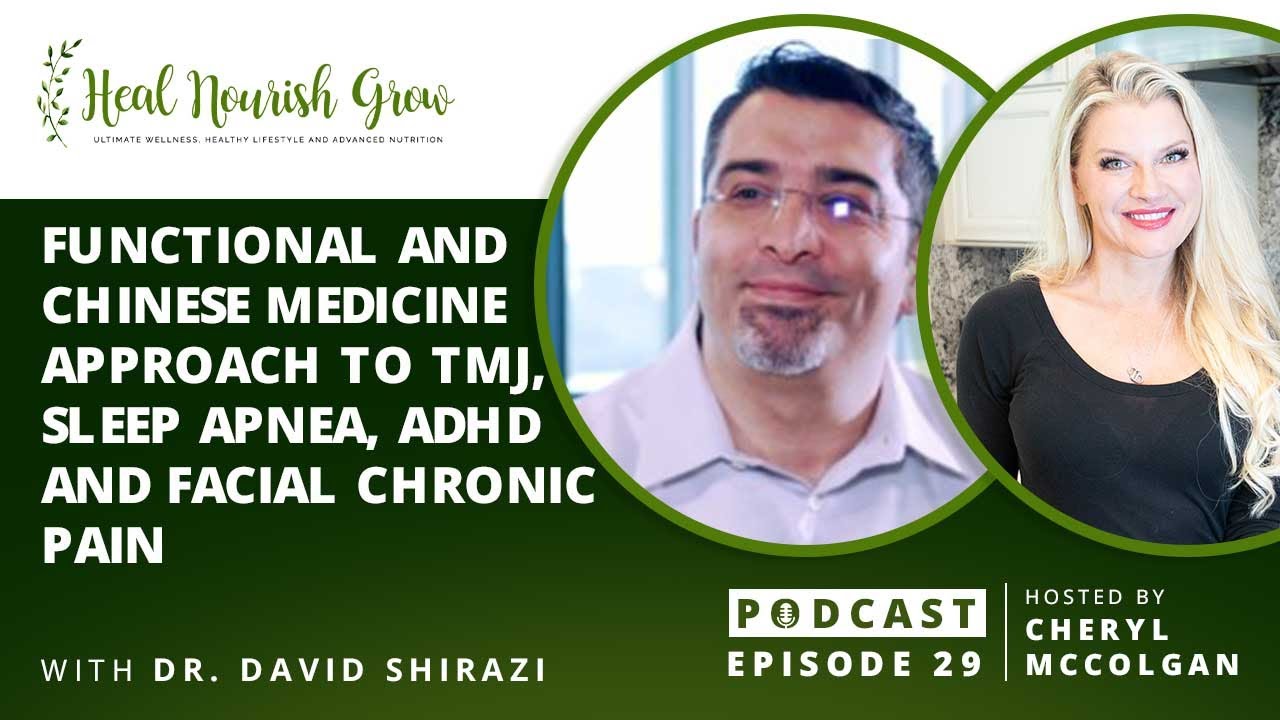
In this episode of the Heal, Nourish, Grow podcast, host Cheryl McColgan interviews Dr. Shirazi, a dentist who integrates functional orthodontics with Chinese medicine to treat TMJ disorders, bruxism, sleep apnea, ADHD, and facial chronic pain. Dr. Shirazi shares his personal journey—from childhood bedwetting and snoring to a family of health professionals—to why he pursued a master’s in Chinese medicine and functional orthodontics. He explains how sleep apnea is a major, often overlooked cause of ADHD in children, citing inflammatory markers (TNF‑alpha) as a diagnostic shortcut. The conversation links stress, autonomic arousals, and clenching as the primary drivers of TMJ pathology, emphasizing that dental bite issues are usually secondary. Dr. Shirazi outlines his conservative, functional treatment hierarchy: night and day oral appliances to break the clenching cycle, myofunctional therapy, acupuncture, nasal breathing optimization (nasal sprays, valve dilators, mouth‑taping with a V‑shaped technique), and interdisciplinary referrals (osteopaths, chiropractors, ENT). He differentiates TMJ‑related pain from tension headaches and trigeminal neuralgia, describing central sensitization and the brain’s plastic changes. The interview also highlights the TMJ Therapy Center network (≈65 global locations), his own clinics in Brentwood and Conejo Valley/Thousand Oaks, and his upcoming Bite, Breathe and Balance podcast. Practical take‑aways include nasal breathing importance, home remedies, and how to locate qualified functional TMJ practitioners.
Chapters
Hey everyone, welcome back to the Heal, Nourish, Grow podcast. I, I, I know it's so funny that I always say that I'm so excited about this next guest, but I really am. His name is Dr. Shirazi and he is focused on an area of functional medicine that is not really well, uh, researched, not very well practiced. It's, it's kind of a, a new, really cool thing he's doing. So I'm excited to share that with you. So Dr. Shirazi, I've read some of your CV before we got started here, but maybe you could tell people in your own words how you got interested in this area of study and what drove you to start figuring out new ways to treat these pain processes that people have with their mouth and facial pain.
Well, hi, and it's great to finally meet you as well. Um, I always joke that this profession, this specialty, found me, you know, rather than me finding it. Um, so for example, as a kid I had bedwetting, I had snoring, I had— and my mom was a dentist, my father was a pharmacist. Nobody knew that sleep apnea causes that, right? And now we know that among the treatments for children for sleep apnea, we have, we have like surgery, like tonsil adenoidectomy, we have the CPAP machine, and then we have what's called functional orthodontics, right? And the literature is pretty convincing that the best treatment is functional orthodontics because it can actually cure the problem, whereas taking out the tonsils won't 100% cure it. And CPAP, obviously you're dependent on the CPAP and there's consequences to wearing that in a growing child. Um, but that's what kind of got— I'll, I'll tap into how sleep apnea is related to TMJ disorders in a moment. But, um, when I got into dental school, when I finished, I immediately started the master's program in Chinese medicine, not because I wanted to get my master's or become an acupuncturist. I actually did it because I thought about having a family and wanting to just treat them in a more holistic way. I didn't want to do the whole steroid antibiotic to treat every problem under the sun, you know, sort of technique, which I despise. Everyone in my family is a doctor or dentist, so I'm not one of those people that puts doctors on pedestals, right? They're my family, they're my cousin. I can tell them to shut up, you know, anytime I want when they're full of it. Um, so I came out, um, I was doing the orthodontics, and we didn't know— this is over 20 years ago, you know, 99.9% of dentists, let alone orthodontists, didn't know about sleep apnea, let alone when we're doing functional orthodontics, that's what we're treating is sleep apnea. Like, we didn't know this, right? But the response from The parents were, oh my God, he's doing great in school. He doesn't snore. He doesn't bedwet anymore. Um, he's not defiant anymore. All the things. So the number one cause of ADD and ADHD is sleep apnea. Okay. Well over 2,000 studies on it. There is, there is not even like a 1% chance that that's false, right? In fact, the lead researcher on the subject who probably has a couple thousand studies under his own belt, He's a pediatrician with a sleep specialty. He said children respond so negatively to sleep apnea that you could just do a blood test. And if their inflammatory markers, their TNF-alpha, is over 2,000, which is a ridiculous number, by the way, okay? If their TNF-alpha is 2,000 or more, then you don't even need a sleep study. It's guaranteed they have sleep apnea, right? So that's what we're treating. And also kids were also saying, oh, my headaches are gone, my jaw pain's gone, my this is gone. And we didn't even know they had TMJ problems because kids often don't complain about things like that because they've only been in their bodies a short period of time. So they, if they feel headaches, they think, well, everyone must feel this, right? And they don't verbalize it very commonly. You know, oftentimes when I have to, when I am examining a a kid, I'll tell— I could see they're straining. And I said, do you get like headaches that are like really bad in the morning? They go, yeah. And the mom's like, what?
What?
You never told me that. So, you know, I got into it, and then the parents were like, well, can you also help me with my jaw issue and my, my snoring and sleep apnea? I said, sure. So I kind of went back into school, studied that, and right around the time that it was becoming sort of my passion and what I enjoyed so much was I was doing acupuncture from the master's program in Chinese medicine. Then I decided to, you know, take the board, finish out my master's, and then I combined the Chinese medicine with the functional approach to TMJ and chronic pain. And honestly, I never looked back. You know, I was not one of those dentists that was like a frustrated dentist that didn't like dentistry. I love dentistry. I, I would talk— I still I still geek out whenever I hear about a new dental material. I still geek out over it, right? But this to me is so much more rewarding than, than, you know, doing a filling or doing a crown, doing all those things. Um, this to me is so much more satisfying that I, I just— this is all I wanted to do.
Wow. And I, well, I think if anybody doesn't even listen to the rest of this, which don't go away, you should definitely listen to the rest of this, that learning that Sleep apnea is such a huge cause of ADHD is something I've never— I actually just interviewed somebody on this topic. She works with people all over the world with ADHD, and somehow that did never came up in our conversation. So I feel like it's shocking to connect you two.
It's quite shocking. It's quite shocking. And the literature is profound. It's not like, it's not like it's unknown, but you have to realize in the world of literature it's so vast, right? And it's very hard for people to kind of like stray outside their lane, you know. They just kind of go, okay, well, let's say their treatment is drugs, right? They're constantly going to look at new drugs, old drugs, mixing two drugs and putting those two together as an effective form of treatment, right? So, but it doesn't take away— so for example, neurofeedback and biofeedback is very helpful for ADD and ADHD, but it typically comes back, right? You shouldn't need to do neurofeedback every month of your life to keep it at bay, right? But if you sleep through the night properly without interruption, you shouldn't have ADD and ADHD.
Well, as you know, and maybe we can go into more on this, but, uh, you know, good sleep basically helps everything.
It does.
I would say in, in the time You know, you mentioned the literature, you know, people get like kind of focused on their own paradigm. And part of it is because there is luckily so much research in a lot of areas that you only have so much time in a day to absorb maybe one topic that you're really good at. Because my focus is on nutrition, so of course every problem I see, I'm always like, well, if you just eat better, you probably— but, but what I realized over time in working with myself and just all over the years is sleep and stress are such huge—
Number one.
Yeah. And then they're underappreciated. And I would imagine stress probably leads into some of the problems that you see with people having this jaw pain and stuff. So maybe we can talk about that next. You're talking about—
Absolutely. So the clenching is the number one cause of TMJ disorders, be it pain, what we call effusion, swelling, or what's called a disc displacement. You know, dental issues are a very minor cause. A bad bite is very rarely the cause. It's usually the other way around, where a subluxated jaw joint will change the bite, right? And so previously, like, I graduated dental school in 2000. When, um, when I was in school, they would, you know, they would talk about adjusting the bite as some form of treatment for people who clench their teeth, which is not, not really— it wasn't really tested or anything. It was, it was pretty, uh, outdated and old-fashioned, but even by then when I graduated Um, and, and the sleep. Okay, so a few things about sleep. Um, we get almost 100% of our growth hormone from one stage of sleep. Okay, it's called delta. And then, um, the next stage of sleep that's important is REM. That's where we do our mental, emotional, um, and memory consolidation. Yeah, so if you're having a stressful day or you're having a stressful conflict You need nice continuous REM, okay, so that you can process the challenge, the emotional challenge, right? But if you're interrupted by apnea, snoring, even a noisy dog, or what I call secondhand snoring— yeah, your partner's snoring— there's actually literature on that too, by the way. Um, that's going to cause what we call an arousal, which means you get kicked out of REM, or, or delta for that matter. And that's what causes so many problems, right? And it's worse. So for example, uh, we consider it— consider for an adult white male, if you have 30 events an hour or more as severe sleep apnea. In a child, in a very young child, one event an hour is severe.
Oh wow.
Right? Because most of their sleep is either delta or REM. There's very little light sleep, like stage 1 and 2, very little. Whereas in adults, we're supposed to have pretty much a quarter of everything, quarter stage 1, quarter stage 2, quarter delta, quarter REM. That's how we're supposed to be as adults, basically. And we have like some rebounds if we have an interruption. But the number 1 cause of clenching our teeth, which of course leads to the TMJ problem, are these arousals, what we call any kind of autonomic nervous system arousal or disturbance, right? So for example, if you are stressed out, yeah, you're going to go clench your teeth. But it doesn't stop there. If you're in pain, you'll clench your teeth because of the pain, right? So as, as a nutritionist, let's say you have a gluten and dairy insensitivity, right? Like an IgG insensitivity, if you go and eat a slice of pizza, I promise you, you will clench your teeth that night. You follow? And so the reason I treat it predominantly with an oral appliance is because there's so many reasons why we clench. I cannot promise that person that they're not gonna clench again. Nobody can, right? So, you know, someone cuts you off on the freeway, your kids bug the heck out of you, or you watch the news, right? You're gonna go clench. And now we talk about food. I mean, like, so much of our food has been tainted and adulterated that, that, that alone, you know, it's hard to get out of it. It's hard to find healthy, good food anymore. You know, so that alone will make you clench your teeth. So I understand the reality of our, of our current way of living. So we try to approach it in the most functional and conservative way possible.
Well, and you mentioned there, just to give people something concrete. So we've talked about, you know, getting better sleep, maybe finding some way to learn whether your partner is causing part of the problem or not, which this makes me go down a whole different road in my head. Um, but some of these other things, stress, sleep, whatever, okay, you can do all you can to mitigate those, but say you're still having jaw pain, you're still just struggling. You mentioned your most functional, least invasive approach. So what would that be? And are there specific— number one, do you take people online or work with people across the country? But also, if people are unable to do that for whatever reason, who do they look for? How do they find someone that goes down this path? Because like you said, it's not very common actually what you're doing with this functional dental approach.
Okay, I'm, I'm going to try to answer all your questions.
I know it was a lot of—
it was a lot of work. It's good, good. They're good questions. I'm sure you didn't want to forget any of them. So, um, of course we have to assess the patient, right? You know, I— on— when I see patients in office, and really the best way of seeing a person is in person, um, it— of course I take e-visits, but it is more challenging than actually being able to put my hands on them and palpate and have them open and close, looking at their posture, looking at the way they breathe. Um, you know, we take a large stock in how the nose functions. So when we take an X-ray looking at the jaw, we also want to see how the nose is functioning, how the neck is functioning. So seeing them in person, we also, you know, want to see if this is an acute or chronic injury. The reason for that is the jaw is unlike any other joint in the body in so many ways. But in the context that we're talking about here, if you sprained your ankle, okay, it's a joint, yeah, you would stay off your feet as much as you're able to. You would put weight on the other leg, correct? When you have a jaw, if you sprained your jaw, right, for example, um, You never ever get a break, okay? We swallow 2,000 to 3,000 times a day. Every time we do, our teeth come together. That means our jaw goes up into the socket for most people, which is not where we want it to be. And then we chew food and then we talk and then we go to bed and we clench our teeth. So there's like no break, right? There's no break. So if I have someone that has a very chronic old injury, in addition to the nighttime appliance, I might make them a daytime appliance for a couple of months just to break the pattern, just, just to give the body a chance to heal. Because I mean, if you had a wound, you know, on your finger, I mean, most people, you know, put a little Band-Aid on it, put some, you know, salve, you know, antibiotic salve, and let it just heal. But imagine you didn't, and 2,000 times a day you poked it, right? It will not only never heal, it'll become gangrene. Okay, so it's one of those things that it doesn't allow any opportunity for healing. Now here's the other caveat with TMJ that goes a lot very unnoticed. So we have a feature in our prefrontal cortex, and everyone knows what it is. We don't, uh, the brain doesn't like redundant information. So let's say you walk into a room that smells bad. Right? After about a minute, you can't smell it anymore. Right? But you know that the odor molecules are still going up your nose. Right? But your brain has shut off this redundant information because it's not useful for survival. Right? So, because the body is much more concerned about you being able to function rather than being in discomfort or in pain. So imagine that you have an injury that's being triggered 2,000 to 3,000 times a day, every time you swallow. Yeah. And then you clench your teeth. Your brain cannot, does not have the bandwidth to focus on that every single day for 2,000 times a day. Right? So what ends up happening is it causes other problems like tension headaches, migraine headaches. We were saying earlier how it's the number 2 cause of ear problems like ear pain, congestion, and even tinnitus. And people become much more aware of those symptoms. Right? But usually don't put the two together to say, you know, I wonder if my job could be causing that, because it's not well known, right? And there are ENTs— like, with the ENTs I work with here are very switched on. You know, if someone comes in, they complain of ear problems, they look inside the ear, they can't find anything wrong, and, and they'll tell them, do you have ear pain? Do you have ear clicking? And not that much, it's not that bad. And then they'll touch it and they're like, no, no, you've got a TMJ problem, you gotta go and address it. So It's that sort of, it's that sort of a situation where TMJ problems are like, they're not thought of as a primary cause, they're thought of as secondary or tertiary to something else.
Very interesting. When you're saying that, I'm sitting here thinking about how you can't ignore yourself. I really can't. Like, my— this jaw thing has been going on for a very long time, and what— you're right, your brain can like divorce itself from it for a little while. But if you suddenly become aware of it, just because obviously we're talking about that, we're focused on that, or if I have a particularly stressful day or I clenched more that night than the other, um, it definitely kicks up. So for people that have this problem, how can you distinguish between, okay, normal tension headaches or something, a temporary thing, uh, versus TMJ versus this other thing that I actually was diagnosed with that I don't know if I totally believe it, but tri-men-gial Trigeminal neuralgia? Yes, that. Okay. So if patients are struggling with pain, like, how do they really get to the root cause? Or how do they— I don't— not a differential diagnosis, but just, it all seems like so interrelated. How do you begin to pick that apart?
Right. Okay. So, well, trigeminal neuralgia is when we have extremely painful electrical surges along one of the three branches, or more than one, of the trigeminal nerve. Yeah, so it's a pretty rare disease, right? Um, the literature now is wanting to call everything that's related to TMJ pre-trigeminal neuralgia, right? Um, that's, that's, that— yeah, that's one point of view. Um, not one that I share. I, I can relate. Um, But tension— so, okay, so tension headaches, it's very— we know this, it's not a secret, um, are caused when the greater occipital, greater auricular nerve are compressed in the back between, um, C2, the second cervical vertebra, and the base of the skull, the occiput, right? And, and people will know this because they'll go to the chiropractor, they'll get their neck adjusted, and boom, instantly the headache goes away. Right? But then they clench and then they trigger it again because when we clench, we don't just clench here, we clench like this. So we engage our upper shoulder, like our trapezius muscle, and that's what causes it to go off again. That's why the night— that's why the night appliance that I make is so imperative because it actually stops it from contracting to the extent that it was before. And then if you do go to see a chiropractor, then the adjustments can actually hold.
Okay.
If that makes sense. Yeah. And trigeminal neuralgia and also migraines are what's called centrally sensitized disorders. Have you ever heard of that term? I have not. Or discussed it before? So, in a nutshell, is you have a part of your body outside of your brain that has been hurting for a long time. Okay? And when I say a long time, it's usually 6 months or more. And it causes— and you don't address it, you're not doing anything about it— your brain actually goes through physical plastic changes. It physically changes, and it starts making other parts of your body hurt that have nothing wrong with them.
You follow?
So, so migraine, for example, um, and I find this hilarious because physicians will call it a a vascular problem, right? But it's like the blood vessels don't have a mind of their own. They need a nerve to tell them what to do, right? And so because there's so much disruption in the ganglion, it causes the blood vessels to open and close, right? And which is what causes migraine. Trigeminal neuralgia is not so much with blood vessels, is also a centrally sensitized disorder, right? Doesn't mean it has to be caused by the TMJ, but in my practice I've seen it very often, um, where we can only assume that treating the patient's TMJ problem, um, has given them resolution in most of my patients for trigeminal neuralgia.
When you mention that specific appliance, is that something that all dentists— I mean, I've seen ones with springs, I've seen ones with this and that. Do you have—
yeah, yeah, though there's, there's, there's there's very little solidarity in my profession on how to, how to treat this, right? Um, and I don't know any other specialty or branch of dentistry where there's this much, like, one people on one side and one people on the other side. I've never, I've never seen anything like it before. Um, so the group that I follow, uh, the website is tmjtherapycenter.com. And Centre is spelled the British way, C-E-N-T-R-E, right? And you can click— there's two sides, there's for doctor education and for patients. And when you click on the patients, you can see all throughout the world where we have a centre. So we have, I think last time I counted, was like 65 centres throughout the world. So we're all over US, all over Canada, all over Australia, England. We got center in Bahrain and Dubai, and we're just growing. We're just growing. So, um, yeah, it's— those are the people that are my people. Those are the people that will understand, um, how to approach it in a functional way. And, and one thing you had asked about was, how do I determine, you know, what to do for the patient? I actually do a neurological exam on the patient, and it helps tell us what your body, what your brainstem prioritizes, right? Because sometimes people will have a TMJ problem and it'll be a lower back SI joint problem, right? And it's just being sprinkled with the bruxing, with the clenching, and that's what exasperates it, right? So for those patients, I might just do a little bit of acupuncture. I might just do a night appliance that like helps really just hold their jaw in the right place when they try to clench. And then I'll refer them out for someone who does the SI joints, like an osteopath or a chiropractor.
That is some interesting— I mean, this is what I love about functional medicine people, how you're really— I mean, again, the whole point of functional medicine is really getting to the root cause of something rather than just putting a Band-Aid on it. Like, okay, I stick this thing in my mouth every night that's supposed to help me not do it, but it's not treating why am I doing it. And that's right.
It's only because, it's only because, and this is something we have to concede, every dentist, I don't care no matter what your background is, has to concede this. There are so many reasons why we clench our teeth at night that when I— so if I don't control the patient's clenching of their teeth at night, no matter how much success I get, they will go back to the same problem they had when they came to see me 'cause they will clench back into it, right? And like I said, there's so many reasons, right? I mean, we're kind of living in pretty stressy times right now. Right? Um, and then you add sleep apnea, and then you add, you know, dietary, you know, sensitivities. Um, and then we got— everyone's got their own daily thing that they have to deal with, with co-workers and family and children and things like that. So, um, if I, I always say it'll be a trillion-dollar discovery when someone figures out how to get people to stop clenching.
Well, it sounds like you're on your way. At least I got some good ideas about it, right? I'll be able to say I knew you when. Um, yeah, we've been pretty specific this far on, uh, doing the TMJ and the bruxism and kind of this trimingial, very rare thing that most people will be like, why are we even talking about this? Um, can you give some more concrete and practical, whether it's advice, tips, or whatever, on how dental health really relates to overall health? 'Cause I think there's some interesting connections with heart problems that I've heard before, or knowing that people with heart issues, whenever they get their teeth worked on, you're disturbing all this bacteria. So they need to, you know, take some prophylactic antibiotics. There's so many things that like your teeth are really connected to your whole being health. If you could expand any on that or offer some practical advice and tips for people taking care of their teeth.
Okay. Well, given my background in functional orthodontics, The maxilla, the upper jaw, like where all your upper teeth reside, articulates with 8 pairs of bones in your skull and the septum of your nose, right? And the entire practice of osteopathy, right, you know, a doctor, an osteopathic doctor, um, is the relationship between your cranial bones and the meninges and the dura and the rest of your body, right? So one of the things we do is when we're expanding the palate when we're moving, and we're not so much moving teeth as using teeth as anchors into the palate to move the cranium where it needs to be and even improve nasal breathing. One thing we didn't touch upon is how important nasal breathing is for every walk of life, but not least of which, clenching and TMJ issues and sleep apnea, right? And for that, there's a couple of things we can do. If you wanted like some concrete, like take-home goodies, one of the greatest things you can do is just breathe through your nose, right? Um, that's huge. Um, I make my own nasal spray with essential oils that helps to flush out, um, some of the impurities and the, and the flora and the milieu inside the nose to just really get that cleared out. Yeah, um, and it's on my website, truebiologicfunction.com. You can just order as many as you like. It's pretty strong, you know, but, but it really works. Boy, does it really clear up your nose.
I gotta order this for my husband immediately.
But so, but you could even use a saline, um, nasal wash, maybe with some xylitol in it. And a lot of people in my practice have a nasal valve defect where they can't— so nasal issues, right? So you got the nasal valves, which is the beginning of the Coke bottle, okay? And then you have the nose, which is supposed to be this pyramidal shape, uh, three-dimensional structure. Um, if you have like, for example, food sensitivities, well, your turbinates are going to swell up. And you could, you know, if you have a turbinate space like this, it all gets filled up with the swollen turbinate, right? And then what do you do? You switch to mouth breathing. Right. And that causes, like, for example, your saliva to dry up, which will cause gingivitis, which will cause clenching, believe it or not, because our body reflexively responds to having mouth breathing by clenching. Yeah. And so I'm very pro making like a tape V on your mouth, like you're kind of closing your lips with the V, but you're leaving the middle just in case you had to emergency breathe. Yeah. And there is a device called the Mute, M-U-T-E, which is a nasal valve dilator. It's basically an O-ring and it goes inside your nose and it helps you breathe a lot better.
Oh, those are all really excellent concrete things. Because I think sometimes people hear this and they wonder what to do. And it's pretty common in my space to hear about the mouth taping at night. And I always wondered about that. If so, for some people that have really obstructed breathing pathways in their nose. Like, if they really tape off their whole mouth, is that a good thing? So I love the tip of doing the V shape instead so that you can still get a breath if you need it.
That's right. And you know, if you have acid reflux, don't do it. You know what I mean? If you really can't breathe through your nose, if you have physical bony obstructions, don't do it. You know, consult with your, you know, dentist or your ENT to see if it's a, it's a good idea for you. We also have what's called myofunctional, um, docs, which are— well, oftentimes they're dental hygienists, um, but myofunctional providers will— would also know an appropriate time for you to like tape as well.
Okay, all great tips there. I'm just thinking of— it's so funny, you always put things in perspective of your own experiences and, and, and that sort of thing. And I'm thinking about the fact that, you know, I've been into yoga for a very long time and very focused on nasal breathing, even when I used to be a runner for years. Never mouth breathe, always breathe through my nose. What I can't figure out though, is based on everything that you said, I don't know. I, I'm wondering if I do it at night and I don't know or something, because during the day, every other time, always nasal breathing. But I'm curious based on the fact that you said that a lot of people that clench also mouth breathe. I'm, I've resisted trying the mouth taping because I didn't really think I needed to, but now I'm wondering if I should do that experiment because maybe That is part of the issue.
There's really no harm in it for someone like yourself, right? You have a little V, um, have the open middle just in case. Um, because what can happen is even if you've got, let's say, halfway decent nasal breathing, right? If you're breathing through your nose, you're usually sucking in all the dust, all the maybe dander from, from your pet, or, um, something from your pillow, and eventually you'll stuff up a nostril, right? And our brain has that cycle, that paranasal cycle, where we engorge one nostril at a time. And if you have, let's say, one good nostril and one bad nostril, right? If, if it's time for the good nostril to be engorged and then it's already stuffed up with that, now you've got two bad nostrils, right? So it's It's, in your case, it would be a very simple thing to try and see if it helps you.
Yeah. And you, that makes a lot of sense what you said. Cause one thing I never considered, which I guess I just hadn't thought about this that much in the past is that at night also you're exposed to different things. Like I did used to have, once I didn't have pets anymore, man, that the whole breathing thing got so much better in a million ways with allergies and everything else. But everything that you mentioned, like the dust mites, the dust in your room, um, things on your pillows, say you, took a week off of laundry or something. There's any number of things that could affect you on a night-to-night basis where even if you're normally breathing pretty well, nasal breathing, maybe as your, you know, your sheets get dirtier or as your dog gets on the bed with you in the middle of the night, you might close off one side. So I think that's a really interesting thing for people to think about. Um, yeah. So since we've gone through all this wonderful knowledge and these practical tips so far, what I'd love, uh, for to hear about now is you have a couple of projects coming up. You are starting a podcast, which is really exciting. I'd love to hear about what you're going to be talking about there so people know where to find you. And then your actual physical locations, because you mentioned that you align with a specific sort of group that you, I guess, work with their beliefs or their system or whatever, but you have physical locations yourself. So can you tell us about those two things so people know where to find you?
Yeah. So the podcast is called the Bite, Breathe and Balance podcast. Right. And it's really pretty much what it sounds like. We're going to be talking to my mentors, certainly, but other leaders in the fields that overlap with what I do so that we can offer good, useful information for not just, you know, the layperson listening, but for also doctors so that they can go educate themselves. That's also a big deal. It's one of the reasons I like the Joe Rogan podcast. Is because, you know, he'll have on a guest who's typically a PhD or a physician, and they'll say something, and it's— they're talking about something in the literature, and then I'll go look it up because I just think it's so cool and interesting, and it'll change my point of view on things. It'll, it'll up-level kind of like the grander scope. So, um, that's what we want. We want to just educate people as much as possible. Um, our— my office, I have one in Brentwood and one in, uh, what we call Conejo Valley, Thousand Oaks. They're both suburbs of Los Angeles. Best website is tmjla.com. Pretty easy to remember, right? tmjla.com. The website for my nasal spray is truebiologicfunction.com. And yeah, we're just here to help people. We want to, you know, get the word out that, you know, just because your ENT couldn't find the cause of your ear problem, just because your neurologist couldn't find the cause of your headaches, doesn't mean you're a hopeless case. You know, TMJ disorders can be causal.
Yeah, and I, I love the, the objective of your podcast because by nature of what I do, I listen to a lot of more technical podcasts, um, podcasts that have doctors. One of my favorites is, um, and they're out on the West Coast with you, you might want to check them out, is called the, um, Low Carb MD podcast. Okay. And they're very focused on functional wellness too. Like, they always talk about, you know, getting people out of pain, getting them to sleep well, getting them, you know, eating is their primary focus, of course, and dealing with metabolic disorders. But I, I feel like there's some synergies in there, especially.
I would love to overlap with them. Yeah, that's really great.
Yeah. Um, so anyway, I will put all of that in the show notes. I just want to thank you for taking the time to share all your wonderful knowledge today, and I hope that we can stay in touch in the future. I would love to know what you're doing.
I would, yeah, I would love that very much as well. And thank you for the knowledge that you're giving your audience too. It's so important.
Yes, thank you. I appreciate it. I feel like sometimes we're just, you know, preaching to the choir, but you never know.
Well, you and I are, but your listeners are also educating themselves, so it's a beautiful thing.
Yeah, I totally agree. So thanks again and have a wonderful rest of your day.
Yeah, you too.
More from Cheryl









30 Day Challenge Series, Day 30: Choose Your Three Habits to Continue for 90 Days

30 Day Challenge Series, Day 28: Schedule Connection (Put It on the Calendar)