
Health, Fertility and Managing Menopause Symptoms: 63
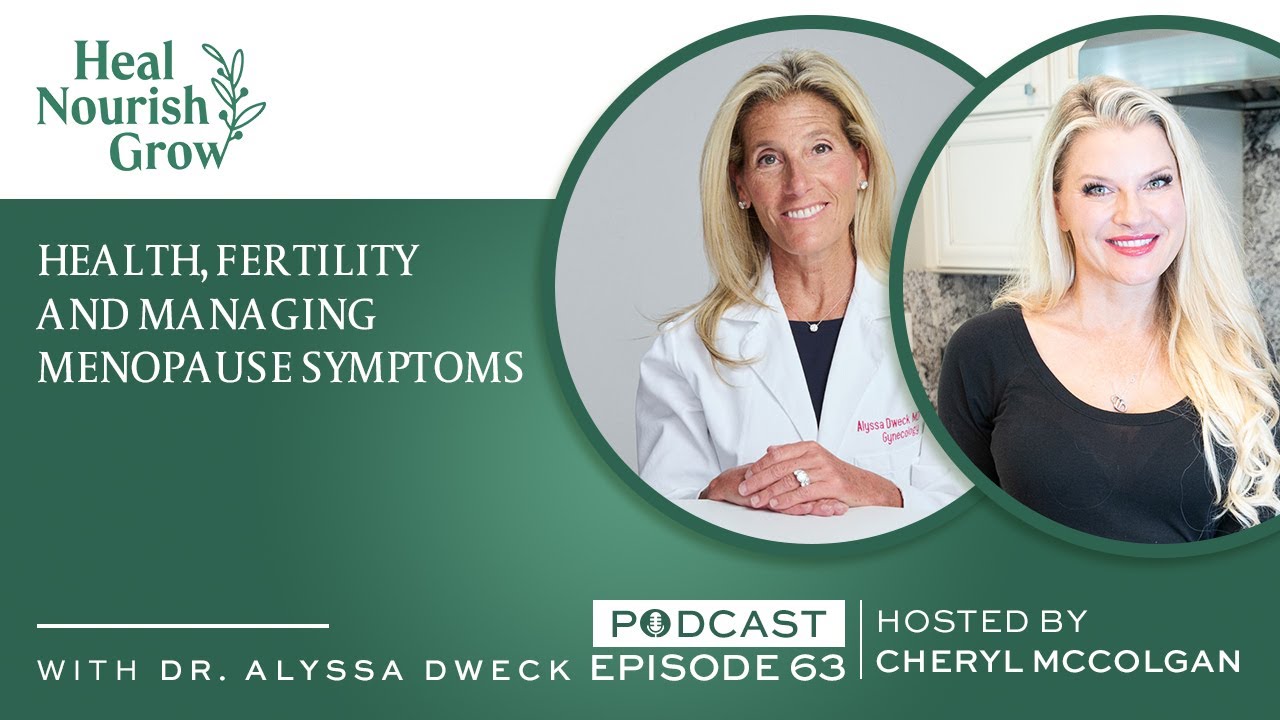
In this episode of the Heal Nourish Grow podcast, host Speaker A interviews Dr. Alyssa Dweck, an OB‑GYN and chief medical officer at Bonafide Health. Dr. Dweck shares how an early hospital experience sparked her career, then walks through women’s health topics from the 20s through menopause. She reviews modern birth‑control options—including combined oral contraceptive pills, long‑acting reversible contraceptives (IUDs, implants), non‑hormonal methods such as condoms, a lactic‑acid gel (Fexi), and fertility‑tracking apps—highlighting their efficacy and convenience. The conversation shifts to fertility, examining why more women face difficulty conceiving: delayed child‑bearing, environmental endocrine disruptors, polycystic ovary syndrome (PCOS) and insulin resistance. Dr. Dweck recommends lifestyle measures (Mediterranean‑style diet, regular exercise, stress reduction, smoking cessation, weight management) and notes the growing use of egg‑freezing for women in their early‑to‑mid‑30s. She emphasizes the menstrual cycle as a “fifth vital sign” and the value of tracking it. Definitions of perimenopause and menopause are provided, along with typical symptoms (irregular bleeding, irritability, hot flashes, night sweats, vaginal dryness, weight gain, joint pain, mood changes) and the average age of onset (≈51 years, range 40‑60). Modifiable factors—smoking, obesity, ethnicity (SWAN study findings)—and non‑pharmacologic strategies (cooling mattresses/pads, temperature control, trigger avoidance, cardio, yoga, meditation, tai chi, paced breathing, acupuncture) are discussed. Treatment options are presented from conservative to aggressive: hormone replacement therapy (HRT) with its historical WHI controversy and current risk reassessment, followed by alternatives such as certain antidepressants, gabapentin, and the Bonafide herbal supplement Relizin (Swedish flower pollen). The episode concludes with a plug for hellobonafide.com, which offers extensive educational material and product information. Throughout, Dr. Dweck blends clinical insight with practical lifestyle advice to empower listeners to make informed decisions about contraception, fertility, and menopausal health.
Chapters
Hello everyone, welcome back to the Heal Nourish Grow podcast. Today I have Dr. Alyssa Dweck, and she is, as you heard in her bio, an OB-GYN. She is now also a chief medical officer for a really cool company that we'll talk about later, but she is also expert in all things women's health, women's sexual health. So I'm really excited to chat with you today and share some of your knowledge with my listeners. So welcome, and can you tell us a little bit how you decided— you went to medical What made you end up being an OB-GYN?
Oh, wow. Well, first of all, thank you so much for having me. You know, I loved OB-GYN when I was a 16-year-old person looking for my first job in a hospital, and they just randomly put me into the labor room of this extraordinarily busy city hospital. And the drama and the excitement and the having babies and everybody rushing off to do things was extremely exciting to me. So the rest is history. It also affords people the opportunity to practice medicine, but also to do surgery and deliver babies and really to follow your patients through their lifespans, which is very rewarding for me.
Yeah. And since you mentioned following people through their lifespans, maybe you could— we'll talk, and this is all focused on women's health, but hey, if you're a man out there, stay tuned because you have women in your life. So you need to know this information too. But let's talk about women in their 20s. Generally, women in their 20s are trying to avoid getting pregnant for the most part, not always the case, but that is a big part of women's health in their 20s. Can you maybe share with people what you've learned over the years in regards to, you know, birth control, birth control issues? I know they're often prescribed for other things. And we're now finding out that, you know, maybe this might not be as good for women as we originally thought, this hormonal birth control. So maybe your thoughts on that and any advice, you have without, of course, giving medical information, just a general broad overview of what you've experienced in your practice.
Of course. So I think it's important to note that I've actually seen a lot of progress in the birth control front for young women over my 28-year practice. And I find that exciting because we are always worried about not enough innovation in women's health. So this has actually been exciting. Birth control pills, of course, have been incredibly popular for a very long time. They're excellent at preventing pregnancy. They do regulate cycles. So for those people who are having very erratic cycles, heavy flow, or cramps, they really can be quite helpful. What has made a really big splash lately are the long-acting but reversible contraceptives, LARCs. And this would include the IUD or the implant. And these have gained a lot of popularity because it's almost like a one-and-done in the sense that people don't have to remember to take a pill every every single day. They're extraordinarily effective. There's less human error, and some of them also control the cycle. The other thing I always have to bring forward is that there is a bit of a non-hormonal lean these days, where I see a lot of young people in their 20s who would like to go a non-hormonal route. So, obviously, condoms, whether they're male or female condoms, are always popular, easy to use, and reliable. They also help to prevent infection. There's a new gel out called Fexi, and that is the brand name, which is a lactic acid gel that's inserted before intercourse, and that prevents pregnancy by kind of incapacitating sperm. And then natural family planning has made a kind of a huge comeback with all the apps and digital information that young women are keeping about their periods. They really can can watch their cycles and if they're feeling up to it, can either prevent pregnancy or plan on pregnancy based on these apps.
And just also out of curiosity, since we are talking about fertility in this age group is hopefully at its most healthiest, one of the most healthiest points in its life, yet we're seeing this I don't know, like there's a— it seems that there's a lot more infertility than later. People are waiting longer to have children, maybe into their 30s, even to their 40s. And then they struggle and they have to go through— I know personally, probably 5 people in my life, friends that struggled with fertility, had to do IVF, either were successful or not. That's kind of besides the point. But do you have any insight into why maybe it seems like that women are struggling more with their fertility now?
Yeah, I think you brought up a great point about people waiting longer to try to get pregnant because, after all, lots of women have, you know, aspiring professional goals and other educational issues that they want to get done before they commit to being a parent. So that definitely has something to do with it because advancing age is one of those factors that's not modifiable and can affect fertility. Number 2, and this is my opinion, there are many endocrine disruptors that we are recognizing in the environment. And it wouldn't be surprising if this is interfering with fertility in some ways. What am I speaking about? Endocrine disruptors typically suggest chemicals, pesticides, plastics, things in fragrances, in some cases, that might interfere with our endocrine system, including, you know, the hormones that are present with ovulation. So that may have something to do with it. We see much more in the way of a situation called polycystic ovarian syndrome, or PCOS, which is, in very simple terms, a situation where ovulation doesn't occur very often. And it may not occur at all, and it can result in a hormone imbalance. And the jury is still out on what's causing this, but we do know that there's an association with PCOS and infertility. The good news is that there are so many things we can do now to enhance fertility for people who are having issues in that regard. And I like to focus on that.
So, and just before we move on to some of those other things that you do to help people with their fertility, one of the things, you know, so I'm involved with the low-carb and keto space, and one of the things that I've I have seen put forward as a possible, at least a relation to PCOS or possibly the cause of PCOS is insulin resistance. Have you seen that at all in your practice or can you speak a little bit more to that?
Sure. Insulin resistance can be a part of PCOS or it could be a standalone issue. I would say that there's probably more instances of this that are occurring right now, but I also think that as healthcare providers, we're more apt to look for this now and test people for insulin resistance or prediabetes. You know, the other symptoms of PCOS that are common would be irregular or absent menstrual flow, acne, hair growth, typically in, you know, male places on the chin, on the mustache area, and then also fertility troubles and insulin resistance or trouble with metabolizing carbs. So, again, I think more Information will come out in the future to explain why, but this is certainly something that is either more common or we're picking up more or a combination of both.
Okay. And you mentioned— so you mentioned age is a factor. So, you know, obviously people in their 20s, they're maybe not quite ready for yet. That's why people are waiting longer. Once people get into their 30s, then do you see any changes moving from 20s to 30s? And if so, are there ways are there things that women should be doing to sort of support their fertility moving into their 30s and then maybe their early 40s?
Sure. So I would say that at about age 32 to 35, we certainly start having a fertility discussion with people, even just during their annual preventative gynecologic exams, to understand what their fertility desires are, because that's when the window of opportunity starts to decline a little bit, especially if somebody wants to have more than one child. There has been, at least in my neck of the woods where I practice in New York, a big push towards what we call cryopreservation, or freezing eggs, because your eggs age with you. So if you're 35, your eggs are 35 years old and a little bit more prone to perhaps injury during all these years than they are when you're in your, let's say, mid-20s or late 20s. So I am seeing a big push for infertility specialists to offer this to our patients who want to delay their childbearing, but really wanna optimize their chances, and maybe don't have a partner that they want to freeze embryos with. So that's one thing that I'm definitely seeing as a way to assist. Other things that can be done just to optimize health, you speak about the keto space and whatnot. I'm a fan of the Mediterranean-style diet, which again, is a heart-healthy diet. That's what it was initially intended for. But it also helps with carbohydrate metabolism because it's kind of low carb other than complex carbohydrates. It doesn't have any refined foods. There's no, you know, it's limited in sugar. They limit salt, again, for blood pressure protection, but also for cardiovascular health in general. It's, you know, plenty of lean protein, fruits, vegetables. And so naturally we don't see the peaks and valleys of sugars the way we would in somebody who's not on one of those types of diet plans. We talk about exercise and making that part of a general regimen because nobody wants to start a, you know, big exercise program the day they get pregnant. I mean, it's best to be on a program beforehand. You know, avoid certain risks that are really just horrible for health: smoking, excessive alcohol intake, excessive sun exposure. And then I think the last thing that I should add is stress reduction because there surely are times where really enhanced stress can interfere interfere with fertility by maybe preventing ovulation or delaying it. And that's something that should be mitigated.
It's always just, I mean, we wish we'd pay more attention to our overall health our whole lives, but it certainly does become, you know, more in the forefront of your mind, the older you get, the same with skincare and all the things you think, oh, I should have been doing that when I was 20.
Absolutely.
Look, I didn't think about these things in my 20s because we didn't really have to, But I think now young people really are taking a little bit more ownership of their health. And again, with all the digital tracking, whether it's an Oura Ring or a Whoop or, you know, a period tracker, information is good. And I think it makes people much more in tune with their system. I will mention, you know, we speak in gynecology about the menstrual cycle being like a fifth vital sign, because it really is a window into people's health. And if something goes awry with your menstruation, it could be a sign of another medical issue that needs to be addressed.
Yeah, another great point, because I do think I have heard that phrase more recently too, and it's not something that in years past I think anyone really paid that much attention to. It would be like, what, you're having trouble with your period? Like, well, do you want to get pregnant right now? And if you say no, they're like, okay, then you're fine. Don't worry about it. But now it's like realizing that that's an indication of maybe something else going on with your health.
For sure. And look, most people who menstruate know what their habits are, and it's fine to have, you know, one month off, or maybe this flow is a little bit unusual, but if something's happening persistently or worsening, that needs to be checked out for sure.
Yeah, excellent, excellent point. Okay, so I think we're up to 40s now and 50s. So in 40s, women might start experiencing perimenopause, and, you know, This is something I think that more people, especially because of podcasts and things like this, people are starting to talk about this a lot more. And I think it's important to get some information to kind of prepare yourself for these things, because I think that can be kind of scary if you just hear sort of the negative aspects of all this. And it's obviously a sign of youth kind of going away a little bit. But as we move into perimenopause, you know, what are some of the things that women typically experience definitions, and then what are some of the things that you're using in your practice and in your company to kind of help ease that transition or to help at least make it— mitigate the symptoms if that's possible?
Of course. So a couple of definitions just to set the background. Menopause by definition means 12 consecutive months without menstruation for no other apparent reason. Perimenopause is the period of time leading up to menopause. Where hormone levels are a bit volatile, ovulation may be a little irregular, and we will see symptoms in some people. The length of time that perimenopause can last could be anywhere from, you know, 2 years to 10 years. I mean, some people will experience symptoms for quite some time. I think the iconic symptoms of perimenopause would include irregular bleeding, particularly skipped periods from time to time, and irritability. People really complain of mood changes. I have people come in all the time. It's literally like a prerecorded thing. I don't even recognize myself because I'm so irritable. So that is a kind of a hallmark, and a lot of that is hormonal. Some of it could be life circumstance as well. After all, you know, there may be a lot going on in the 40s. Symptoms that come on as perimenopause goes forward and menopause may take hold would be the iconic symptoms like hot flashes or night sweats. And if you've ever had one, there's no question what this is, but typically people get incredibly hot. They feel like a furnace from the, maybe the chest up. They may turn beet red, and then the waterworks start and perspiration occurs. It's very uncomfortable. It's very disruptive. Some people have them many, many, many times a day. Some people have them at night where they can really interrupt sleep and they can really disrupt quality of life. So that, that's kind of the most iconic symptom. And then as time goes along in menopause, I'd say the most concerning symptom that people present to my office for would be vaginal changes and sexual changes. So dryness, discomfort during sex, and things of that nature. There are so many other symptoms of menopause that we can go through. Weight gain, joint pain, skin changes, hair thinning, you know, mood changes, depression, burning tongue. I mean, you name it, it's almost like we could blame it on menopause, but the ones I mentioned are probably the most common.
And are you seeing any difference in the onset age of this or the length of time that it lasts? Because I think, you know, you mentioned before endocrine disruptors and I'm going to put a bookmark because we haven't really talked about that that much on the podcast yet, but it's something I have a particular interest in and I've been really trying to clean up my environment, my skincare, all this stuff for the last several years. I think it's really important. So that's a bookmark for a later date. But I'm wondering if you're seeing any change in how long menopause lasts or perimenopause in the age of onset, just because we do have all these other kind of environmental factors now.
Sure. That's such a good question. We are still quoting the average age of menopause that 12 months without a period, to be the age of 51 in the US. With that said, people can be in menopause at 40, you know, up until 60. So there is quite a range. I don't know if there's been a change in that over time, but I do know that there's been much more recognition of this in the past years so that now we're really tracking symptoms, asking people about their symptoms, and trying to mitigate them if they're uncomfortable. As far as perimenopause, The length probably has not changed. It's just that now we're putting a label on this time and certainly validating people's concerns and complaints with options for treatment. I always think it's important to mention that there's a big genetic component to when you go through menopause and what your experience will be like. So, you know, if you're fortunate enough to be able to ask your mom or some older sisters, you might really get a little bit of a window into not only the age that this may occur, but what your journey might be like.
That's, yeah, that's great information.
And there are—
ask while they're still there.
That's why you can, yeah. There are some modifiable factors for your experience in menopause. So for example, smoking, we know that smokers go through an earlier menopause. We know that smokers also have a worse time of it when it when it comes to hot flashes. So that's something that actually can be modified. Number 2 would be weight management. So it seems a little counterintuitive, but, you know, those who might be suffering with obesity might actually go through an earlier menopause or have, you know, worse symptoms. There's an ethnic divide when it comes to this. There's a huge study called the SWAN Study, which studies women over the ages, and they really noted that African American and Hispanic women tend to have a worse course when it comes to hot flashes, rashes and their duration and their severity when compared to their Caucasian or Asian counterparts. So, there are some genetic factors, ethnic factors, and then some other modifiable factors for sure.
Yeah, very interesting. And I just have to give a quick plug, and I hope you already know about this product because it's really been a lifesaver for me. Because when you're talking about the night sweats, oh my gosh, it's like a nightmare. Like, you literally wake up drenched, fluffing the sheets. It's It's horrible. But the product, it's called an Ooler. It's made by Chili Sleep, and it's basically this pad that you add to your mattress that cools you. And it has been a game changer. Like, I was not sleeping. It was just awful. And I mean, I would've paid 3 times as much if I would've known how well it was gonna work, honestly.
Yeah.
I mean, there are so many lifestyle changes that could be done to help with those symptoms. A cooling mattress, cooling pads, cooling sheets, the type of garments that you wear to sleep, you know, so that they're moisture-wicking. Because I hear the same thing from my patients, and what disrupts their sleep so much is that they actually have to get up and change their clothing because it's so drenched. And that's very, you know, interrupts the quality of sleep and the quantity of sleep. But, you know, we often talk about keeping the temperature down. I think 62 is what's considered optimal. You may freeze your bed partner out, but they can always put another layer on. You know, avoiding certain triggers which are known to be hot flash triggers like caffeine, like like alcohol, particularly red wine, like high sugar, like large meals, all things that can be mitigated if those are triggers for a particular person. And then, of course, there are treatment options. So, it really kind of depends on how disruptive the symptoms are.
Right. And if somebody really is suffering, what are the treatment options? I mean, I think everybody has heard of hormone replacement at this point.
Of course.
But there's also other options available. So maybe you could talk about kind of the gamut of those types of things.
Yeah, you know, I, I think the most responsible thing is to go from conservative to aggressive when it comes to treatment options. And that's what I like to offer my patients. So let's just get the most aggressive option off the table right now, which is hormone replacement therapy or menopausal hormone therapy. This usually contains estrogen in one form or another, whether it's in the pill or a patch or a cream. And then it also, if somebody still has their uterus in place, Okay, slight technical difficulty everyone, but we're back on.
So ready to talk about what options we have to mitigate some of these symptoms.
Yeah, so I think I'll start by just bringing up hormone replacement therapy. This is probably the most effective way to manage vasomotor symptoms or hot flashes and night sweats related to menopause, and it's FDA approved. A while back there was a study called the WHI study, that suggested an increased risk of breast cancer, uterus cancer, and cardiovascular risk as a result of this hormone replacement. So, you know, prescriptions for this therapy, which was helping so many people, really plummeted, and we needed alternatives. It turns out now in hindsight that the reinterpretation of the data suggests that there really isn't as much danger as originally thought. But with that said, there are alternative options because we still see so many people feel fearful of starting hormone therapy or who cannot take hormone therapy. So for example, breast cancer patients or patients who have a blood clotting disorder or migraine headaches who might be contraindicated to using this. There are other pharmacologic options like antidepressants, believe it or not, which can be quite helpful for hot flashes. So some people turn to that, especially if depression or anxiety are also involved in their symptoms. Some people use a medication called gabapentin, which makes people really sleepy, so we give it to them at night, and it tends to mitigate some hot flashes and night sweats. And I think there's been a huge push these days to go towards herbal supplements. So, for example, at Bonafide Health We have a product called Relizin. Relizin is very different from your standard herbal soy phytoestrogen product because it's made from a Swedish flower pollen, and it probably works through serotonin-like pathways to help mitigate hot flashes, night sweats, and help to improve quality of life in that way. And the nice thing about the product from Bonafide is that it has been studied in clinical studies time and time again to show that they're safe and show effectiveness. So that's one herbal option that I have found to be really helpful in my practice.
Nice.
Anything around diet or exercise that could be useful, things to change or modify?
Avoiding the triggers that we spoke about— caffeine, alcohol, spicy foods, large meals, high sugar, high processed foods. Those things do trigger hot flashes in many, many people. So if that's something that affects you, then really try to get rid of those things or prepare for the consequences. Exercise, no question, helps. I mean, it's a good stress reliever. You release heat from exercise, especially cardio. Cardio. Plus, it just makes people feel good because of the endorphin release that occurs in the brain. And then another plug for stress reduction, as hard as it is to, you know, it's a really big ask, but yoga, meditation, you know, some of the more ancient trainings, tai chi or whatnot, might be helpful for some people. Paced respiration, acupuncture, again, not a amazing results in studies, but plenty of women do, uh, you know, really claim good benefit from these practices.
Yeah, and those kind of practices, there's no downside, so why not try it?
Yeah.
Well, um, Dr. Dweck, where can everybody find you online, and can you talk a little bit about the website if people want to check out any of these supplements So the website is hellobonafide.com.
You'll see my bio, and the thing that I love about the website, other than the product descriptions and ease of use, is that there is a lot of really valuable educational material when it comes to all things women's health regarding menopause, regarding perimenopause, and loads and loads of questions answered there in a, in a medically accurate way.
Okay, great, great resources, and thank you for sharing all your knowledge with us today. I really appreciate it, and, uh, thanks for coming on.
Thank you for having me.
More from Cheryl









30 Day Challenge Series, Day 30: Choose Your Three Habits to Continue for 90 Days

30 Day Challenge Series, Day 28: Schedule Connection (Put It on the Calendar)