
Hormone Health Tips with a Functional Medicine Doctor: 96
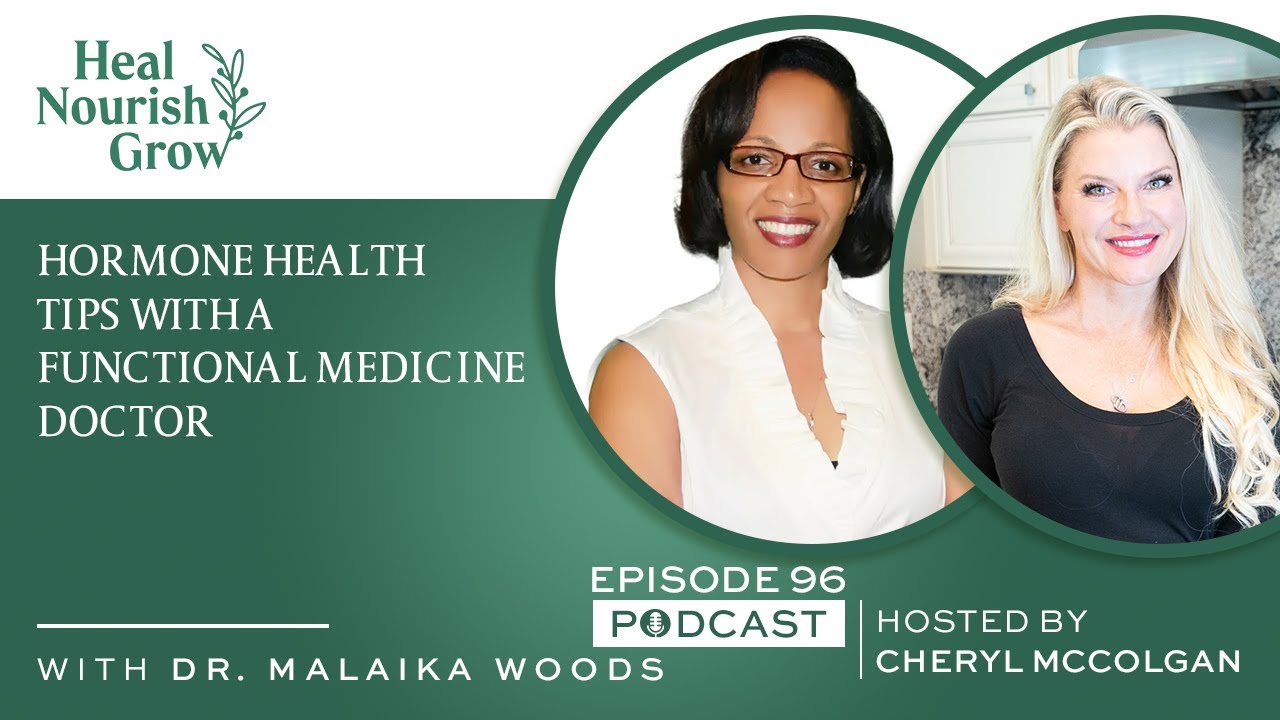
In this episode of the Heal, Nourish, Grow podcast, host Cheryl McColgan interviews Dr. Malika Woods, a board‑certified OB‑GYN who transitioned to functional and obesity medicine. Dr. Woods shares her personal weight‑loss journey, the mental‑behavioral tools that helped her, and how that experience shaped her practice. She explains the functional‑medicine approach to hormone and metabolic health, emphasizing a deep history, comprehensive labs, and the four‑to‑five pillars (nutrition, stress, inflammation, movement, sleep). The conversation covers common perimenopausal/menopausal symptoms, misconceptions about the Women’s Health Initiative, and the benefits and risks of bioidentical hormone replacement therapy (BHRT). Dr. Woods details the various delivery methods—creams, troches, oral pills, injections, and sub‑cutaneous pellets—highlighting efficacy, convenience, and potential drawbacks. She discusses the prevalence of low testosterone in women (≈80 %) and men, optimal target ranges versus laboratory “normal,” and how testosterone optimization can improve mood, body composition, and metabolic health. Thyroid testing pitfalls and the importance of baseline hormone panels are also covered. Finally, Dr. Woods describes her hybrid virtual practice, licensing in Missouri, Kansas, and California, her website, and a private Facebook community, offering guidance for patients in other states. Throughout, the dialogue blends personal anecdotes, clinical insights, and practical take‑aways for listeners seeking hormone optimization and functional‑medicine care.
Chapters
Hi everyone, welcome to the Heal, Nourish, Grow podcast. Today I have Dr. Malika Woods, and she is a specialist in women's health. She talks a lot about hormones, and she also sees men patients. So if you're a man, don't click away. Plus, you need to know this stuff about women's health as well. So all that being said, welcome, Dr. Woods. I would love if you could share with people a little bit about your background. How did you come to this line of work? And any personal health and wellness thing that speaks to why you're so passionate about this now.
Absolutely. Thanks for having me, Cheryl. So just to give you kind of a brief synopsis of my background, I actually wanted to deliver babies back in 8th grade. So that's how it all started. I ended up being— fast forward to 2011, I was a full-time OB-GYN in a very busy practice. I was a year out from having my second kid and seeing 30, 40 people a day. It was supposed to be the ideal job, but I was stressed out. I was a mother with, you know, a 5-year-old and a 1-year-old, and I was overweight. I was about 240 pounds, and I knew I needed to do something different with my own health. And so that was my first step into looking at something other than traditional obstetrics and gynecology, which is what I'm board certified in. So my first journey was weight loss, and I actually got board certified in obesity medicine. And over the course of 2011 to 2013, I lost 60 pounds. I tried a lot of different things, and we may get into some of that down the road. And then I learned about bioidentical hormones, and I thought, wow, I'm an OB-GYN, but I don't really know anything about bioidentical hormones. And so I got certified in, uh, BHRT— bioidentical hormones for short. And then I learned about functional medicine, and all this happened in a short span of time, probably around 2011 to 2014. And when I learned that functional medicine was about root cause approaches and natural solutions, I was like, okay, wow, this is what I've been missing all along. And so functional medicine is now what I do. It is umbrella under which I offer those other services, whether it's hormone optimization, weight loss, you know, thyroid support, a lot of different things. But that's kind of what brought me to where I am today.
Oh my gosh, I am so— I get so excited when I talk to health professionals like yourself that are really going away from sort of the traditional paradigm of just, you know, fix it with a pill or something, and where it's really like a whole systems approach and, you know, getting to the root cause with functional medicine. Do you think that, you know, you You mentioned that you had a weight loss journey, which I think is a really amazing background for you to have as an obesity medicine specialist now. Can you maybe share a little bit with people, you know, what were your frustrations with that process? What did you learn along the way? Just speaking from not as a doctor, but just as a person who had success losing a great amount of weight. I'm sure everybody would love to hear how you did that. What were your struggles? What were your triumphs? And, you know, any tips and tricks you may have.
Yeah, absolutely. I would say one thing for sure that everyone really needs to tap into is the mental aspect of weight loss. And so one of the things that I say to people all the time, and I found it to be true with myself, in a lot of cases it's easy to lose weight, but it's harder to keep it off. So it's kind of that idea that you can jump on a bandwagon for a short period of time, but it's hard to sustain something. And something that was a game changer for me, and I actually have, I think, the workbook behind me, kind of that pink book, It's called "Train Your Brain to Think Like a Thin Person." And it's actually using the concepts of cognitive behavioral therapy to help you with weight loss. And it is written by Dr. Beck, who is the daughter of the original Dr. Beck who came up with CBT to begin with. But I found that what I was doing as a heavy person is that I was looking for excuses, honestly. And I was thinking like, life is unfair, like it's unfair that this other person is so thin. I'll take, for example, I had a medical assistant in my office who was very fit. And when I really analyze it, it's not like, oh, it's not fair that she's so thin. She brought her workout clothes to work every day and she went to work out after work. And when the drug reps, before I went all functional medicine, when they would bring us lunch, she would have a salad and I would have a sandwich and a cookie. So you start to really say, hmm, what am I doing? You know? So one of the things that I learned is that I have to take responsibility responsibility. The other thing I learned is that, you know, it's important to have a community and to have support. So one of my phases of weight loss is that I got into P90X back when that was popular.
Yes.
And I did it with my husband and he was a great support. And we did all those, you know, crazy videos together. I'll say crazy because, you know, there were stories that people were hurting themselves and kind of doing a little too much, but we did that together. And so I think the community and having support is important too. And I think what I've realized working with patients is that traditional advice of eat less and exercise more is not enough for most people. That is a first step, but you have to take into account how are the hormones affecting your ability to lose weight? How is your metabolism and all the things that impact your metabolism, how is that affecting your ability to lose weight? So you really want to take a more comprehensive approach. So those are some of the things that I learned along the way.
Yeah. And those are awesome. Really good. Just succinct takeaway things that people can look at. Taking personal responsibility, having a— I always call them accountability buddies, which the first time I heard that phrase was from South Park. I don't know if it was somewhere else before that, but that's actually where I first heard it. But anyway, so I think those are awesome tips. And I love that you mentioned P90X also, because that was such a thing in that time frame.
It was a big deal back then.
Yes. In fact, my husband just brought it up the other day. We were talking about something and he said, yeah, I used to do the P90X yoga. But, um, anyway, all that being said, so you mentioned hormones and thyroid and a few things. So if people are, say, you know, whether they're just not feeling optimized or they do have some extra weight that they're carrying around that they'd like to lose, what are the sorts of things that patients come in and say to you, like how they're feeling and things? And then how do you move forward with identifying what their hormones might be doing or how you might be able to shift that to help them feel better, basically.
Yeah, absolutely. So a lot of times when I see women, usually they're in their mid-40s, early 50s. That's probably the most common age group that I see. And they're coming in and they're telling me— and I see virtual. So when I say coming in, I'm using that figuratively speaking, coming into the video room, if you will. And what they're telling me is they're like, Doc, I'm having hot flashes, night sweats. Even on video, they stand up and grab around the middle and say, "I don't know where this belly fat came from. It wasn't here 18 months ago. I haven't changed what I'm eating. I'm still exercising the same as I was before." And the libido is completely gone. Those are some very common things and fatigue. So those are the things that are the common concerns of the people that I see. And so the first step that I do, first of all, I just like to get a very detailed history. And because I have a non-traditional practice, I really have the opportunity to sit down with my, you know, initial patients, like 90 minutes. We like go in depth. And even our paperwork is more involved than patients have ever done before. We want to get the entire backstory. I also start with a comprehensive lab panel, which I think is very important, where we're looking at hormones and thyroid and inflammation markers and a lot of other things to really get a good idea idea of what's going on from the patient's perspective. And then also what is the body telling us about what, about what's going on. And we put those two things together to develop a plan of action.
And you said that typically people are coming in between maybe age 45 to 50. I would love for you to maybe talk a little bit to those people that aren't in that age group yet. They know it's coming before we move on to talking about how we deal with that, like once we're there, but when you know it's coming, Do you feel like there are things that women can do to better prepare to go into that stage of life? Things that they can kind of do to either mitigate some of the symptoms or to just have more knowledge going into it so they're not shocked when these things come up? Because I think, you know, once you're there, you're kind of like, oh yeah, now I know all about that with the heat and all the things you mentioned. Um, but they, they've at this point, hopefully they've just heard about it and they're like, oh, I wonder if there's anything I can do to my health now to maybe counterbalance some of that, I guess, going forward?
Yes, absolutely. And functional medicine is for everyone. Hormones, you know, not everyone needs that. But the functional medicine approach really encompasses a few pillars that we like to work on. So one of those pillars is nutrition. So really, you know, cleaning up your nutrition. And even for the younger women who may be in their early 40s, now some of them are truly experiencing what we call perimenopause. So you're around the menopause, but you're not at the exact menopause. And just for definition's sake, menopause is a whole year without a period for women who are still having periods. The average age of menopause is at 51, but a lot of women can start having symptoms prior to that. So again, in those early 40s, what can you do? One of those pillars is nutrition. And I tell women to be wary of what I call the menopause pretenders. So you may be young and you're having hot flashes and night sweats and you're like, I'm 39, 40, am I going through menopause? Likely not. But you may be dealing with a menopause pretender. And two of the biggest ones that kind of go hand in hand, one is alcohol. So, you know, a lot of times women are thinking, let me get a glass of wine so I can relax at night. But the swing in the blood sugar overnight can actually precipitate and bring on hot flashes. So that is a menopause pretender to be aware of. And then also sugar coming from other sources, you know, cookies, candies, et cetera, especially if you're eating that at night. So nutrition is a pillar. Another pillar is dealing with stress. And this is one that we just don't do a good job of because stress is so hard to kind of define. But stress has a real role that it plays in your body. It can wreak havoc on your sleep, on your ability to burn fat, and so many other areas. So stress is an important pillar. Thinking about dealing with inflammation and where it may be hitting you, moving your body is important. So those are some of those basic pillars that you can start to work on. And I kind of think of it this way, like if your body is in a hammock and that hammock is being held up by 4 or 5 of these pillars, if you can really raise those pillars, you're really off the ground. And so when you get a hit like menopause, you're not smacking down to the ground if you're already kind of upheld, if that analogy makes sense, by some of those good, you know, basics to be working on.
Yeah, I love that analogy. And it's also— I mean, everything that you spoke to is really some— just speaks to just the greater health that you have overall going into this, the more resilience your body has to deal with these extra things down the road.
Yes, yes.
Excellent points. Um, so, okay, so we were talking about have, have as good a health as you can going into menopause, but the truth is, once you get to into your 40s and early 50s, there are hormonal shifts that naturally happen that do cause these symptoms that you talked about. Is there— and I guess we should go to— I think I feel like everybody knows this at this point, but they probably don't. A lot of women know about the Women's Health Initiative study, which, you know, there was this big headline 25, 30 years ago that, you know, these hormone replacements cause cancer, which actually is not the case at all. So that's like the really simplistic explanation. Explanation, but I'd love if you could share a little bit about why that is not the case and how, you know, what kinds of things does hormone replacement help if you decide to, you know, go down that road?
Absolutely. So yeah, I was a resident, I was an OB-GYN resident when the Women's Health Initiative was published in 2002. So I remember it very clearly. And you're right about that headline. What we have under— what we understand now about that study and the OB-GYNs, we were understanding it in real time and we were the only ones still prescribing hormones. I kind of imagine all the other doctors just ripping up prescriptions, you know, like, no more hormones for any of you. And unfortunately, an entire generation or two, you know, 20 years of women have suffered from minimal access to hormone replacement therapy. So some of the big errors in that study, first of all, they were giving women hormones for the first time at the average age of about 62 or 63. That is not the real world. I just mentioned women in their mid-40s and 50s. That is when we usually start hormones. And the thing with estrogen, it is time dependent as far as how it works with your cardiovascular system. So if you give estrogen in a younger woman who does not have any plaque development in their vessels, estrogen can be protective. And there's lots of studies, longitudinal studies like the Nurses Health Initiative, that shows a 30 to 50% reduction in cardiovascular disease in women who take estrogen, who take hormones. And I'm gonna particularly— and they don't even make the distinction all the time between estradiol, which is bioidentical, versus ethinylestradiol, or what you get from your Premarin, your pregnant mare's urine, the synthetic. So sometimes even if you're on synthetic or bioidentical, you see that benefit. If you give estrogen in a woman in her 60s, when she is likely already to have some plaque development in their vessels, that is a potential disruptor is what that thought was. One of the biggest things that came from the Women's Health Initiative in my assessment and with my colleagues is that it was the synthetic progestin, medroxyprogesterone acetate, that was really the culprit as far as the increased risk of breast cancer, heart attack, and stroke. It wasn't even really the synthetic estrogen. And so if we think about what does estrogen do for you outside of even just helping you with hot flashes and night sweats, and the Women's Health Initiative talks does this, you see about a 30% reduction in colon cancer. You see a 30% reduction in osteoporosis. And those are major issues, you know, for women as they age.
Yeah, I, I'm so glad that you gave a much better explanation of that because I've heard this story multiple times, but not being a practitioner, I don't have to explain it to people very often. And I just tell my friends, I'm like, oh, that's been debunked. And then, you know, it takes a little, it takes a little, it takes a little research on your own to really to that place. Um, so where I'd like to go now, I, after learning all of that over these many years and knowing risk factors that I have in my family for various health things, um, including that my sister that's a year younger than me has, does have breast cancer. She's, um, in ED right now. Um, so that's one thing that people, and they recommended for her to not do hormone replacement, for example, different situation. Um, but knowing the other factors, I did decide to go down that road. And, um, I guess my question is there's a lot of So you mentioned bioidentical. There's a lot of different routes of administration that you can take these different hormones. There's creams, there's a pellet that you get in your subcutaneous fat. There's pills that you might take. And obviously you're not giving medical advice here, but with, um, not going there, can you maybe describe each one of those methods of administration and why some may be better than others?
Absolutely. And I'll give you kind of my opinion as far as, you know, least effective to most effective, or, you know, least popular, most popular in my office and amongst my patients. And so I will start with a cream. A cream is something that you apply daily. You can combine hormones in the cream like estrogen, progesterone, testosterone. Those are kind of the main ones. I had one of my patients say she's on the strony soup, talking about, you know, her different hormones. But the issue with the cream is that people absorb it differently. Sometimes people don't like it because it's messy. With the testosterone in the cream, you do have to be careful not to transfer that to, like, other people, pets, children, things like that. And with progesterone in particular, this one is very important, Cheryl. You cannot get a good blood level of progesterone. It's very hard with the cream. And so, and let me say why that's important with progesterone. Progesterone, I call it my secret weapon hormone because it has two really great benefits. It has a natural sedative effect, so it can help you sleep at night. And a lot of women are dealing with trouble sleeping, insomnia, when they hit this age range as well. And secondly, progesterone has a calming effect. It helps the mood. It literally works on these GABA receptors, which are calming. Now I veered off. So there's cream. Next we have a trochee. A trochee is like a throat lozenge. It's usually a square wax-based preparation. You hold it in your inner cheek and it's not, considered an oral administration. It's a submucosal. So in most of the— in most cases, you want to bypass the stomach in particular. You want to try to get right into the bloodstream with all of these hormones. They work better that way and less risk to your liver. With capsule, you can do progesterone as a capsule. You can do estrogen as a tablet oral. Then you also have an injection. And this is something that is actually very popular in my office. With injections, it's a little bit more potent administration, particularly for the testosterone. You can dial in the dose very specific to the individual. And so that's why we like that. It's every 2 weeks for women. And then you mentioned the pellet. I really like the pellet, Cheryl, but it is not something that I start with. And so when you talk to traditional OB-GYNs, they kind of lose their minds about pellets and they hate it. And the reason why they do is because I feel like there's people out there giving pellets not in the best way. And then the woman ends up with all this regular bleeding and they go to their traditional OB-GYN to fix them. So that's why they hate the pellet. Now, I love the pellet because it gives you a steady administration of the hormone for about 3 months. And so you only have to do it maybe 4 times a year. So that's wonderful. But you shouldn't start— I don't think you should start a person on a pellet because once the pellet is in, and let me say, it is a little compressed powder of hormone, like the size of a Tic Tac or smaller. We— it's a little procedure that happens in the office. So we make a little tiny incision, kind of nail to nail, if you're kind of doing a little pinch, and we slip that pellet into the fatty tissue. And it's absorbed in the body over the course of, again, about 3 to 4 months. So wonderful for a steady state of hormone. But if you have an unwanted side effect, we have to then wait it out for 3 or 4 months because you cannot go and take that pellet out. That's why I don't start there. I start with something that's easily reversible. And once we get a sense of how a woman is going to do on her hormones, then we will consider a pellet.
Yeah, that makes a lot of sense. And just if anybody's listening to this thinking, oh gosh, that's horrible, I would never like want to have this— it's really easy. This is actually what I get.
Yeah, it's super convenient, isn't it? It is.
And it's interesting because, um, you know, it just feels like a little pinch. They have me ice it. There's lidocaine in the, you know, shot they give you. It feels like a little bit of pressure, but for me, I I think what you said, the convenience of it is just amazing. And the one thing I had heard recently, though, that was interesting, and I pride myself on— I'm one of those crazy people that, like, I research the heck out of things before I do it. And of course, I was on PubMed doing all this research before I decided to do that. But then just lately, I saw a couple of people, you know, menopause is suddenly much more popular on Instagram and other places where people are talking about it, which I think is amazing. But with that comes the same thing as fitness, nutrition. Everybody's got an opinion. And You know, you never know exactly where they're coming from or if they're right. And I, one of the doctors commented on somebody else's post. He was saying that never a pellet for women. And I just said, I said, oh, that's interesting. Why do you say that? And he said something about big overdose. He didn't like explain it very well. But I guess the thought was that maybe it doesn't titrate evenly throughout the 3 or 4 months. Months. So I don't know if you've ever heard that or have any thoughts on that, but I'm just curious.
Yeah, my understanding of how the pellet works, and this is partly subjective in some of the research that I've done as well, it takes about 2 weeks for the hormone levels to peak, and then they're pretty steady again for about 3 months, and then they'll start to decline. And for women who have done pellets, you know this, because as soon as you say, hmm, I think my pellet is wearing off, like I'm starting to get hot flashes again, probably by 10 days later, it's like tanked. Like, you know, it's kind of out of your system. So, but I think symptom-wise, a woman can also attest that she gets a nice steady state. As far as overdose, again, I think it's the way that you're giving it. Each practitioner and the way that they administer the pellet, particularly the dose that they use, is probably unique. And so are there some people out there maybe getting, you know, overdose perhaps? But, you know, again, I think that the experience that I have with my patients, they do very well. As well, and we track their hormone levels. Now, if we're talking about testosterone— and Cheryl, you're probably familiar with this since you do some hormone yourself— with women, our goal is actually to super optimize their testosterone level. That's kind of how I explain it. And that also is sort of, you know, people kind of lose their minds on that concept as well for people who don't get it. But I would direct them to— I believe it's Dr. Glaser. You're probably familiar with her. She's done a lot of research on testosterone in women. She's based out of Ohio. Rebecca's her first name. And she published a paper of 10,000 of her women patients. And the average testosterone level was 299. And so, yeah. And so when a woman gets their testosterone level checked, the range only goes to like 30 to 50, 48 maybe. And so she super optimizes on purpose. And this is the same doctor who has looked at testosterone experimentally as a treatment for breast cancer. So, and this is the other thing, let's say for you, example, with a family history of breast cancer, a woman like you, you know, you may have some legitimate concerns about hormones. And even though you and I kind of understand, you know, they don't cause cancer, but that mindset is hard to unwind. And let me also say caveat, if you get a breast cancer that is estrogen receptor positive or progesterone receptor positive, then no, you should not be on those hormones. It doesn't mean that those hormones cause the cancer though. Again, it's complex. It's a lot to unravel. However, a lot of times if a woman has a concern about breast cancer, we start with testosterone. There's absolutely no concern about cancer there. There's really no controversy about breast cancer as far as testosterone is concerned, and it actually might be beneficial. Again, I'm just telling you based on some of the studies I've seen.
And would you say when people come in— and so you said you, you know, you're testing the hormones and they're telling you how they feel and things— when you test— actually, when I first had my testosterone tested, this is, I guess, about 4 years ago, so I'd been 47. And my doctor came in, she said, well, congratulations, you have the testosterone of an 85-year-old. And I was like, I was like, okay, that, that can't be optimal or good in any way. But, um, so would you say that when you test people that are coming now, you're seeing people that are having some issues already, right? That's why they're coming to you. So it might be higher, But would you, what percentage of women would you say come in and have low testosterone, for example?
Oh, I'd probably say 80% easily. And let me also say this too, for your younger women who suspect that they're having issues, we do see low testosterone in younger women too, in their 30s as well. And I think, and this is with men too, let me say that, like there's a lot of, the technical term for guys is called hypogonadism. There's a lot of men also who are coming in in their 30s with low T. You heard that word? Low testosterone. And I think it's environmental and just things that we're exposed to and just how our diets are different. There's a lot of factors, but I don't want a younger person to discount their symptoms and not get things checked out if they're worried about their hormone levels. And understand too that your traditional doctor is likely not going to check your hormone levels. They don't believe in checking hormone levels. They believe in treating symptoms more so. And again, it's just their style, not, you know, throwing any shade. I grew in the traditional world. But now that I do hormone replacement therapy, we take a different approach. We want to look at labs, and yes, we understand that the hormone levels fluctuate, but we also can look at relative changes and relative differences, you know, prior to hormones, after hormone administration. I think that's important. And the thing that I tell, you know, the folks that I talk to all the time, Cheryl, is that the lab tells part of the story and you tell part of the story. And I think it's important to find a physician or a practitioner who is going to consider both of those things.
Yeah, so many pieces of excellent advice there that you just hit on. And the one that I think I would say to people, if they are— happen to be listening to this and they're in their 20s, whether they're male or female, there's plenty of online services now where you can pay out of pocket to get tested. I would get your hormone levels tested as early as you can, early 20s, mid-20s, so you have a baseline, so you know as you age how much you've lost or if you've lost any. And it might give you a better idea of how to optimize it in the future. That's not to say you probably can't get there eventually without knowing what you were originally, but I always thought that would have been like, that's a basic biomarker. I'm not really sure why doctors don't test for that.
And to your point, when you come in, let me switch gears and talk about thyroid because that's another huge travesty, tragedy, all of that tragic that so many people are walking around with a poorly optimized thyroid. And so again, you know, you might come in and have all the symptoms, you know, I'm tired, I'm constipated, my eyebrows are thinning, my hair is falling out, I'm cold all the time. And, and you get that one number they check, the thyroid stimulating hormone, and it's quote unquote normal. Okay, what they don't know, and again, if you're 35, we don't know what it was when you were 25. Maybe there has been a significant shift, and not just in the TSH but in your actual thyroid numbers but you don't have a comparison. So I think that's a great point that you mentioned there, to know your baseline.
If we could only get people to, you know, have it as standard practice or standard of care, I think that would be amazing. Right.
I think unfortunately the traditional world is so occupied with just sick people. And that's, that's just sort of where we are. And so those of us who are the true health seekers, like people listening to your podcast, people who come to see me, They are the ones who are looking for optimization. And you're not going to really find that done well in the traditional world. It's okay. We need the traditional world, you know, when we break a bone, surgery, cancer, et cetera. But when it comes to optimization, when it comes to prevention, uh, not so much. And that's okay.
Yeah. And I, but there, to your point, I mean, there are more people like you and others that I've interviewed that, um, that are really into this functional health paradigm now. And they do, um, you know, no insurance care, concierge care. I mean, there's still it's a shame because maybe the average person can't as easily afford it since it's not covered by insurance. But by the same token, at least we're moving in a direction where that kind of doctor is available and that there are people that can help you do that if that's your goal rather than just sick care.
So absolutely, absolutely.
It just takes time, right? We'll get there, hopefully. Um, so you mentioned that you also see men as well in your practice, and I think you mentioned, um, low T men in their 20s, 30s. I think I read a study recently that the the average testosterone in men is significantly down from where it was even just 20 years ago. Can you maybe speak to a little bit on the men's side, what you tend to see in your practice and what kind of things do men struggle with when they're having low T?
Absolutely. So jokingly, I'm going to tell the ladies and the men to watch out for what we call the grumpy old man syndrome. Okay. So if they're, you know, they're irritable, you know, they're lacking motivation, they're getting belly fat around the middle. They're losing muscle mass, certainly their libido and, you know, erections and things like that can be impacted. So those are some of the signs when you know that the testosterone is low. And you may not have all of them. It may just be fatigue and lack of motivation. And it actually can manifest as something that looks like depression in men also. Speaking to the testosterone levels in men, you know, the standard lab test says that, you know, 250 or something and above is okay. But optimal is really 800 to 1,000. And to take it back to connecting it with, you know, health outcomes, there's a study of veterans where they divided them by testosterone level. The male veterans who had a testosterone level under 500 had a higher rate of diabetes, high blood pressure, risk of death, any you know, comorbidity problem that you could think of, in men with the testosterone below 500, it was higher compared to above 500. So I would say, at least based on studies like that, we should be shooting for at least above 500, not 250. So again, there's a little bit of disagreement in the hormone replacement world about where these numbers need to sit. And another thing that I learned from my mentor is that normal is not optimal. Normal, but optimal is best. You don't want to be normal and feeling terrible, right? You don't want a normal lab, but you feel horrible. And that's why I say the lab tells part of it, you tell part of it. So we have to put those two things together because again, men are walking around suffering as well. And you're just— it's sort of like, unfortunately, in the traditional world, like you come in and your testosterone is 500, you feel horrible. Talk about a guy. Then next year, you know, maybe it's 4:20, and then, and so they're just waiting and waiting and waiting, and for years you're suffering without, you know, taking action. And I can give that same analogy with so many other instances for men and women.
Yeah, and that's such a great point too, because I think that people forget in the general public that laboratory norms are based on the whole population of people getting labs, which are generally, they're already sick. Thank you.
I say that to everybody. I've said the standard lab is based on all the sick people coming in and out of the lab. You don't want to base your normal off of their normal. That's exactly right.
Yeah. So I'm, I'm, I'm with you there. You know, it's amazing when you, when you think, learn to think about these things in a critical way and, and, you know, how to read studies and stuff. It's like people just see these headlines and they don't kind of think more critically about what does that mean? Well, just because you're in the normal range, you're comparing yourself to all these people that aren't very well. So. Um, so Dr. Woods, you've mentioned that you see people online. Can you share a little bit about your practice, where you're licensed to do that, how you like to work with people, your website, all that good stuff?
Yeah, absolutely. So I am a hybrid practice. So I'm mostly virtual. And then the people who come into the physical space, which is in Missouri, uh, it's a suburb of Kansas City, Missouri called Lee's Summit. Those are the people who are doing injections or doing pellets. Otherwise I see people virtually, which is great. It's convenient for them. They can, you know, be on their lunch break and all of that. I see people who live in Kansas, Missouri, and California. So anybody living in those states, I can actually, you know, be your provider. And so ways to reach out to me. My website is drwoods wellness.com. That's just D-R-W-O-O-D-S wellness.com. I do have a private Facebook group called The Natural Hormone Fix. And so those are for the ladies who want to come in and learn about, you know, hormones and the functional medicine approach to that. I would say those are the two places to check me out.
Okay, awesome. And one final question, just because you mentioned that people from other states— for example, say I lived in California and I would like— I would love for you to be my provider. I don't live in California, unfortunately. I live in Ohio. Okay, but how would that work if they reach out to you and start to work with you? If they need to do something like have— get medications or get a pellet or something like that, how does that part of it work since they're not physically there with you?
Yeah, so pellet would be hard to do unless they're coming here to Kansas City. But otherwise, we can prescribe the other modalities. Our compounding pharmacies can send medications, you know, to all 50 states. I just happen to be licensed in those 3. And so actually, it works great to do this remotely. And think about it, you've got those examples of all these online big companies, you know, that do this as well. The difference is, you know, the doctor that you're working with, we get to develop rapport and have an ongoing working relationship together.
Yeah, awesome. Well, thank you so much for taking the time to share your knowledge and some amazing tips and nuggets in here that I hope people take to heart and use to better their health. So again, Dr. Woods, thank you so much for joining us, and hopefully I'll see you again in the future.
Thank you so much for having me. It was a pleasure.
Thank you.
More from Cheryl









30 Day Challenge Series, Day 30: Choose Your Three Habits to Continue for 90 Days

30 Day Challenge Series, Day 28: Schedule Connection (Put It on the Calendar)