
Managing Multiple Autoimmune Diseases with Nutrition and Lifestyle: 20
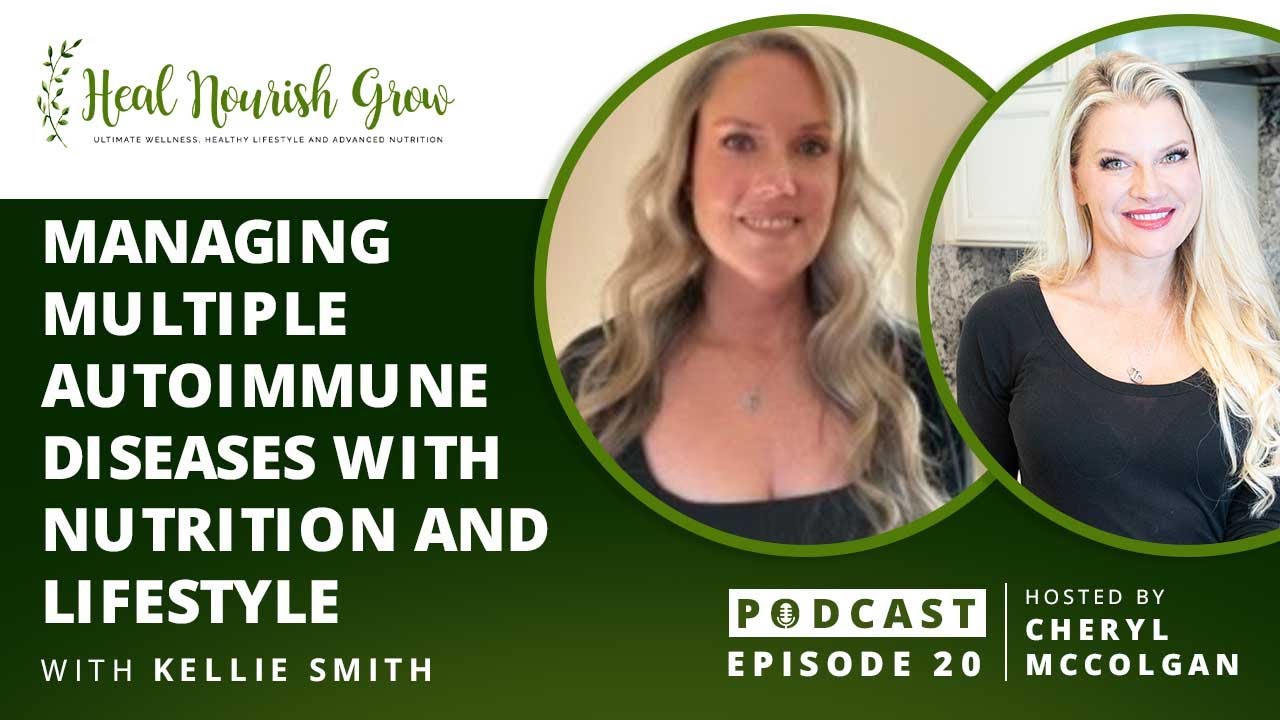
Kelly Smith has mixed connective tissue disease combining scleroderma, Sjögren's syndrome, and lupus. After five years and 15 doctors, she improved her lung function from 67% to 80% through diet changes, stress reduction, and moving to New Brunswick. A 2020 crisis triggered a flare, but carnivore diet and extended fasting brought dramatic relief.
Chapters
Hey everyone, welcome back to the Heal, Nourish, Grow podcast. If you had heard what I said before that, for some reason I am fumbling my words today, but I got it out. So here I am with my friend Kelly Smith. Kelly and I met on Instagram of all places, like often happens in the world now, a virtual wonder with the pandemic and everything. But I actually met Kelly several years ago on Instagram, and although we have chatted about a million times in our direct messages, I— this is our first time that we've gotten to chat that kind of face to face. So welcome, Kelly. I'm so happy to have you here.
Thank you so much.
Yeah, so the reason that I wanted to have Kelly on the podcast is because she has a very interesting health history with her. She has some autoimmune issues, and also some others in her family have experienced some health issues as well. And one of the things that she did to combat these autoimmune diseases is to work on her diet. And so, Kelly, if you could just start by sharing the background of how you came to know about your autoimmune disease and some of the symptoms that you were experiencing? Kind of lead us up into how you got to what you're doing now, basically.
Sure. Absolutely. It was certainly not a linear journey by any means. Uh, but, uh, you know, I, I was a teenager in the '90s. And so diet culture back then was all about no fat, fat is bad. And, animal products are bad, and the superfood of the '90s was soy. So essentially, uh, for 15 years of my life, I was following a low-fat, plant-based, soy-based diet, very heavily soy-based diet, thinking soy was the next thing that was going to save us all, right? And so going into my early 30s, I thought I was in the best shape of my life, right? I was working out every single day, and I, I I looked good and I thought I was eating a healthy diet. And all of a sudden, one day everything just changed. My workouts at the gym were getting really hard and I started noticing pain that I hadn't had before. And part of me was wondering if it was just coming into my 30s, right? I was thinking, "30s, oh no, no, no, this is just part of getting old, right?" And so I ignored it for a little while. And then one day I woke up and I just had like this rash all over my body. My fingers were turning purple. Like it happened literally overnight. And I had this cough that was persistent. It just— I couldn't get rid of it. It was more than a cold. So anyhow, I obviously started seeking medical attention and it took, it took about 5 years and 15 doctors to figure out what was wrong with me. I was diagnosed with so many different things from hives to folliculitis to all kinds of things, and nobody could really figure out what was going on. And Anyhow, this, this cough that I had just was persisting. It wouldn't go away, and I couldn't get rid of this rash. So anyhow, um, long story long, I found out that I had something called mixed connective tissue disease. And so what that means is that I have 3 different autoimmune diseases. So I have scleroderma, Sjögren's syndrome, and lupus. So I won the lottery of autoimmune disease, essentially. And it's really super rare, actually. So there were not a lot of doctors who had really any idea how to deal with it. Uh, so anyhow, while I was going through the beginning of my treatments, I was referred to a specialist in Toronto who was supposed to be at the top of her game in terms of autoimmune disease, a rheumatologist. And I met with her and we started talking a little bit about like my diet and my lifestyle and Her— the first advice she gave to me in our meeting was to immediately stop eating soy and to reintroduce meat back into my diet. And, uh, you know, I, I went back and forth with that a little bit. I'm an animal lover. It was really hard for me to reconcile, you know, me having a physical need to eat meat over the life of the animal and, and whatever. So I had this big moral dilemma here. So, but I decided to take her advice because I wanted to get better. And I was on a lot of medicine. I was on, you know, huge amounts of steroids and, and pain management pills. And I wasn't working out. And I started gaining all of this weight because of the prednisone I was on. And it was just like this, this snowball of bad things. Right. And so I started to, you know, get depressed and wasn't sure if I was going to be all right and what was going to happen. It was so also scary, right? And then unfortunately, I found out that this persistent cough that I had was interstitial lung disease. So what was happening was that the autoimmune diseases were starting to attack my soft tissue. So these diseases that I have, it's like an overproduction of collagen, right? So as a survival mechanism, my body's overproducing collagen to try to protect my soft tissue. But what happens is that that soft tissue, it's almost like it's, it's trying to build up an armor of protection, right? But it's, it's becoming scar tissue. And so my soft tissue is hardening, and so things aren't— are starting not to function properly. So that was what was happening to my lungs, is I had all the scar tissue all over my lungs and, um, this lung disease that just wasn't identified. Wow. So, um, because it was all so serious and scary, I decided to listen to my doctor and to reintroduce meat into my life a little bit. Little by little. Now, sorry, go ahead.
I was just going to say before, there's just, there's so many interesting things that you said in that. I kind of, before we go on to what happened later, which I'm sure people can guess since you're on here, it must've been something at least somewhat improved, right? But before we go on from that, so just to, so you went from being very strong in the gym to just not feeling as well. And you mentioned it's like a connective tissue disease. So is that— were you feeling like more pain in your joints and stuff in addition to the cough, or what were some of your symptoms other than just feeling really tired and not feeling well? Was there anything specific?
Yeah, it was just a lot of muscle weakness. Like, I went from being able to go hardcore at the gym for an hour to barely being able to be on the, um, the elliptical machine was the big thing back then, right? Yeah, barely getting through 10 minutes on the elliptical. Like, everything hurt. And it was so unlike me because I was, I was at that point in my life really fit and everything just got hard. So I stopped exercising altogether and then the pain started getting worse. And, um, and you know, it was a combination of, of, um, my physical health was deteriorating, but at the same time my mental health was deteriorating also because the diseases that I was being diagnosed with were all very scary. And this particular lung disease that I have, I was reading stats like, you know, 50% of the people who have it are dead within 3 to 5 years of diagnosis. And, you know, I had a— I have a daughter and was a single mom at that time. And so it was just all a lot. So I just snowballed into unhealthy patterns and I started like eating my feelings and stress eating. And it was just like a But through, through it all, I was also working a lot, right? So I was in, in the, the middle of building this career in education, right? And my job was really important to me and I kept working. And so I had the stress of work and the stress of my mental health and raising my daughter. It was just, it was just all happening at once. And it was a lot.
Fortunately, your story is something I experienced myself, but I've heard other people have the same story that they're going to the doctor with some symptoms that are somewhat unusual in some way, and they initially have trouble identifying what it is. And it takes— in your case, I think you said 15 years, or how long was it before?
5 years.
5 years, which is not a very long time.
Yeah.
What I'm curious about is what finally— I mean, over this time, I'm assuming you had a lot of testing and stuff, but was there a particular doctor or a particular like thing that finally led them in the right direction? And my point in asking this is because just in case anybody ever happens to listen to this that is experiencing something similar, because it is such an unusual disease process, that maybe it gives them some insight on the things to look for. Or if they're experiencing, you know, they're having trouble but they don't know why, maybe they can know a little bit more about how they finally figured it out.
Absolutely. So I took a very active role in my diagnosis. So I'm a bit of a Type A personality. My husband would say control freak, but I like to frame it a little more positively.
Tomato, tomato.
As soon as I knew that I was sick and I started getting all these weird diagnoses from doctors that didn't make sense to me, I took control and I started doing a ton of research. And I think that you have to do that. One of the difficult things about— I mean, illness in general, but especially autoimmune illness is they all look the same, right? They all sort of mirror each other. And it's really hard to get down to exactly what's happening. And I found also some of the advice I was getting— I mean, I've always tried to be fairly healthy. And I'm not a medicine person, right? I think that the more prescriptions you have— and I want to preface what I'm about to say by saying medicine is really important. And if your doctor prescribes something for you, you should take it. Right? There's a reason why they're in the medical field and I am not. And so I'm not, I'm not saying that they weren't giving me good advice, but I was kind of looking at the medicine as a Band-Aid fix, whereas I wanted to, while I was being treated with prescriptions, kind of figure out, okay, what's causing this and how am I going to fix it for the long term? You know, I was at that time, I guess, 35 years old when I figured out, okay, I've got multiple connective tissue disease. Right? And so, um, my lungs were deteriorating so quickly. I was thinking, you know, if I'm only 35 and, and this is all happening so quickly, I still have a lot of life I want to live. So how am I going to slow this down, right? And so, um, I took a very active role in, in doing a ton of research about all the different autoimmune diseases and trying to figure out, you know, which one seems to mirror my symptoms and, and Reading stories about people who had gone through this and so many women my age. I mean, autoimmune diseases can happen to anybody, but it's predominantly women between— I think it was like 25 and 45 or something was the age group. And so by the end of it with the doctors and also asking for second referrals, right? I didn't just stop at the first doctors I was referred to. Um, there were a couple that I didn't feel comfortable with, and I asked for second opinions. And I was not afraid to go to my doctor to say, you know, I know that you said it was this, but that doesn't make sense to me, so I really want to test this again. And then I also started seeing a naturopath. And a really funny story, my, my first rheumatologist was treating me for acid reflux. She said that's where my cough was coming from, and I had this cough at that time for 18 months. And I was thinking, this— I don't have heartburn, it just doesn't make sense to me that this acid reflux, right? And so I went to see a naturopath and I thought, I'm just going to try to do all of the things to try to figure out what's going on here. And so the first time I met her, she also does, uh, iridology. So, you know, where you're looking in the eyes to try to figure out what's happening in your body. And she took one look in my eyes and she said, your lungs are blocked. And I was like, hmm, interesting. So I went back to my doctor and I said, I really want another, uh, X-ray of my chest, of my lungs.. And sure enough, they found scar tissue all those months later while they were treating me for acid reflux. Right. So I think it's really important for anybody who's, who's trying to figure out what's going on in their body to, to not be afraid to ask for second opinions, to take an active role in researching. And, you know, you have to be really careful with Dr. Google, right? Because there's so much misinformation. And it's terrifying. I mean, the internet had me convinced I was going to be dead in a year, right? So you have to be able to kind of take that with a grain of salt and find the information hidden out under all of the horror stories, right?
It's challenging. And I think the lesson— and thankfully it wasn't 5 years, but I had something similar with my health history where it took them a very long time to figure out that I had all these tumors all over my abdomen, which is a story for another day. But I think important thing to take from this is it is important to be your own advocate. And I know that things are much different because Kelly's up in Canada, so their healthcare system works a little differently than ours. But just speaking from the U.S. side, uh, what happens here with doctors is we're kind of beholden to the whole insurance system. And so while we can get care very quickly, and for emergency care, I would say bar none, we have probably probably the best in the world. But for wellness care or a progressive disease that kind of nobody knows about, you're spending time typically with a doctor because the insurance system— for 7 to 10 minutes in an appointment. So it's no wonder that they can never figure out what's wrong because they're not taking time to get this health history from you, to learn all of the symptoms that you've had, to learn what other tests that you've already had. I mean, some of that they can look at in charts now because we We do have the digitized medical stuff, which is, I think, helpful. But, um, to say that the doctors know everything is, is just not— it's not fair to them, number one, but also the amount of time they have there. They don't have— they're probably not getting the information that they need from their patients to really dig into a diagnosis, especially when it's something that you presented with. It's very unusual and very rare. Uh, it just makes it that much more difficult. So just to remind people, you know, doctors are not God. I mean, we I love them and they're very smart people and I am thankful for them every day. And in fact, one of my longest closest friends is a doctor. But, uh, you know, at the end of the day, you're the only one that knows exactly how you're feeling, and it's important that you take that responsibility on yourself, even though it's annoying that you have to go research some things. It is just kind of unfortunately the way it is. And I don't know, maybe you can speak to a little bit how the differences in Canada, but the, you know, the 7 to 10 minute medical appointment here is quite common, so It's not very different here.
I mean, we have free medical care for the most part, but it's quick visits. It's really hard. I mean, I'm really thankful I have a really great group of doctors and a really good circle of care around me. But that didn't happen overnight, right? And it's getting more and more difficult to find— I was going to say good doctors, but that's not what I meant at all. What I meant was it's really hard to find doctors who are taking on new patients parents who have time to spend with you, who— I mean, they're all overwhelmed, right? Especially now with COVID right?
Yeah, makes it worse for sure.
Exactly. But you, you really have to be also a part, an active part, in your own circle of care, right?
Absolutely. Couldn't agree more. I just wanted to highlight that for people because I think quite often we— there's actually a really good book called Lies My Doctor Told Me by Ken Berry. You probably know Ken Berry. He's in the keto space. And It's just very interesting because he really goes into the reasons why unfortunately doctors are a little bit handcuffed on some of these things. And I think once you read that book and have that perspective and keep that in the back of your mind, it really helps you in your interactions with your doctors to not only be more proactive, but just to even acknowledge, to say, hey, I know you don't have much time, but this is what's happening right now. And I think we might need to dig deeper or something to that effect. It just, it just gives you a little bit more ammunition ammunition for when you— ammunition is not a great word, but you know what I mean. Yeah, we don't want to like— that's, that's not the right word at all, but I think people get the gist of it. So leverage, maybe leverage, leverage would be much better, much better word. So, um, thank you for giving that additional background, by the way, because I just think that would be really helpful for people, um, that are experiencing some kind of ongoing mysterious health situation. Um, but to move on from that, so then you got lucky enough to go to a doctor that actually said to look at your diet. So then what changes did you make initially? What did that look like? Was it a challenge you, you had to overcome, the, um, starting to eat meat again thing? But then, so how did all that go? If there's any insight into the, you know, eating meat for your health, because there are certainly a lot of us recovering vegetarians and vegans out there, and, uh, might be useful to hear how that you got over that.
And I still struggle with this actually, like, so it's been Oh goodness, how old am I? I want to say it's been 11 years that I've been eating meat again, and I still struggle with the whole ethical piece of that, right? And you know me, Cheryl, I mean, I'm, I'm an animal person, right? I'm pretty much obsessed with my dog, but I'm like that with all animals. It's— and it's really hard for me to put my own selfish needs over the life of another living being, right? So I struggle with this even now, but my health is really important, and I owe it to myself and to my daughter and my husband to be healthy, right? So that's kind of how I But anyways, I'm digressing a little bit. But so when she, when she recommended that I started eating meat, I went back to Dr. Google and started researching, um, more about vegetarianism and autoimmune disease. And I actually started finding a lot of stories about, um, linkages they have found between autoimmune disease and plant-based diets. So there were a lot of women who had been diagnosed with autoimmune disease who been following plant-based diets. And I was like, wow, there's, there's something to this, right? And so I thought, okay, I really need to try this. So I really slowly started reintroducing meat back into my life. But even at that, 70% of my diet was still vegetables, right? I'm— I, any time of day, will go to a restaurant and get a giant salad, and that will make me happy, right? I'm a vegetable person. I love it. Now I've learned to love steak now too, after all these years. But, um, I love my veggies. And as we grow up, we learn that vegetables are everything, right? If you want to be healthy, you eat your vegetables, right? We're programmed to think that way. And so it was just in my mind. So anyhow, my research with autoimmune disease and diet then took me to the paleo diet and Whole30 way of living, right? So I started playing around with Whole30. And at this point, Um, I, I was not— I was still not in a healthy place, right? I'm like, I'm now 50 pounds overweight from all of my steroids and my lack of exercise. I'm depressed. Um, I thought I was eating well, but now I'm confused because now I don't know what to eat. And, and so I had all of this work to do, right? My primary, my primary goal, my, my why, which you talk about quite often, yeah, was my daughter. I'm thinking, okay, my daughter needs me. I need to be healthy, so I need to figure this out. And so I started reading all of these stories about how the paleo diet was helping people with autoimmune disease and, and eating those whole foods and cutting out grains and sugar and all of these other things was helping, um, symptoms of autoimmune disease for many women and men. But again, it's predominantly a woman's disease, right?
Right.
So I started playing around with paleo and eating more whole foods and, and cutting out grains and cutting out dairy and cutting out all of these things that we're was supposed to be bad for me. And, uh, I, I did notice a change with some of my symptoms, but I still, like, I wasn't losing any weight and I was like feeling crappy because I was carrying around all this extra weight and I was taking all this medicine still. So, um, you know, I played around with the paleo diet for quite some time, but just, I just, I had difficulty sticking to it for some reason. It felt really restrictive to me. It felt hard to do. It wasn't helping my weight, right? Um, so from there, you know, when you start going through paleo, you start coming across things like Bulletproof Coffee and thinking, okay, what's Bulletproof Coffee? So I started Googling that and then Bulletproof Coffee is now linked to keto. And I'm thinking, oh, this is really interesting. So that was kind of how I came across keto, um, was the whole Bulletproof Coffee and biohacking trend that was happening in 2018. I think it was at this time. And I thought, okay, I'm eating a lot of carbs, even through Whole30. I was eating sweet potatoes and fruit and, you know, a lot of carbs. Right. And I was starting to feel a little bit better, but like I said, I, uh, I wasn't losing any of the weight and I was still having like trouble with my mental health. And plus I had a lot of stress at work. That's a whole nother story, but it wasn't quite the thing. Right. But it started me on this kind of digging deeper and coming across keto. So, um, I tried— when I was thinking about our conversation, I was trying to think about, you know, um, how much keto has changed my life. But I have to say, and it has, and cutting out carbs has, but it wasn't the only thing that I had to do to get healthy, right? So by 2018, I was, I was a broken human being. Like, I was really sick. My doctors were talking about putting me on oxygen. Because my lung disease was so bad I couldn't even have a conversation. If we were talking right now, I'd be coughing through the entire conversation. I had an infection in my leg that wouldn't clear up for 10 months, and, and I, I was just— and I was so depressed, and my work stress was like off the charts, and my job was, was killing me essentially, right, on top of everything else. So my husband came to me and he said, something's gotta give here. Right now on paper, we had like the perfect life, right? So we had our dream jobs. We made a lot of money. We had our dream house on the water and everything was great, but it was, there was so much stress, right? So much stress. And so he said, we need to figure out how to get you out of the job that you're in. Um, and give you more time to be able to focus on your health. Right. So that was when we decided to quit our jobs, sell our house, move across country, ended up in New Brunswick. Right. Which is—
no stress there.
No stress. We sold our house and had 9 days to move.
Oh my gosh.
Wow. Yeah. And didn't even have a house in New Brunswick. We had never been here before. Right.
Oh my gosh.
But my husband was reading and he was looking at where, where are the places in Canada to live that have the highest quality of life? The best balance, because balance is so important. And New Brunswick was it. So we knew my health wasn't getting any better. It was really scary to leave all of my doctors in Toronto, right? Because that's like, that's the hub for lung disease in Canada is Toronto. And so it was terrifying, but we did it. And I've never looked back because I, you know, I cut out a huge amount of stress out of my life. I gave myself more time to focus on my health, and that was happening while I was starting keto. So there wasn't— it wasn't just the keto that helped me. There were a number of things I had to do to get to a better place, to start becoming more healthy.
Well, and I think that that's why I've always appreciated your story so much, is because number one, if you guys don't follow her on Instagram, Kelly has the most beautiful countryside that she goes for walks in with her cute little dog Waylon. And, um, you know, that's something that for me, being a yoga person for most of my adult life, and, and, you know, having dealt with stress and weight, and it's, it's like, it's never one thing. I mean, it's sleep, it's activity, and it's, and it's the right amount of activity. It's not like overly stressing your body when you're doing all this stuff in the gym or whatever. You want to— it's got to like kind of this optimal amount, especially when you get to be like kind of more our age, you know, like your body can't quite tolerate the same things that it could when we were in our 20s and 30s. So I think it's really important to highlight what you said there because, you know, and some people might look at that and be like, oh well, you're lucky because you could just quit your job and blah blah blah blah blah. Well, you know what, if you're dead, then what good is any of it? What good is any having any money or having a job or any of that stuff? So I mean, not to be so blunt about it, but, you know, at some point people, people make a lot of excuses quite often. And, and it's not an easy thing to do what you did, to pick up and move your whole life and go away from your doctors and all of that. None of this stuff is necessarily easy. But I think that is what— and you brought it up, finding your why. I think that's, that's the thing for me that just is almost is like flipping a switch in your brain when you finally identify what that is. And the day that you said to yourself, like, I've got to be there for my family, I got to be there for my daughter and my husband. I mean, of course you want to be healthy for you too, but to me, that's probably what clicked. And you found it's like, I got to make some serious changes here.
I mean, yeah, absolutely. And, you know, our, our standard of living certainly went down a little bit, right? But it didn't matter because it got to the point where our standard of living was no longer as important as our quality of life, right? And so, you know, we're not— we don't have as much money as we did, and, and, you know, we don't— it's a little bit of a different lifestyle, but it's fine. I've never been happier in all of my life. And actually cutting out all of that stuff that we think we're supposed to have, that we're striving for because society says that's the way it's supposed to be, was so freeing. I couldn't believe it, right? When I told people at work I was leaving my job, because there was a long lineup of people for my job, trust me, they couldn't believe it. They were looking at me like, what, have you lost your mind? I said, no, I think I finally found my mind, actually. Yeah.
No, that's incredible. And I just think it is, it's not to say, I mean, everybody, you know, you have to obviously have a job and have be able to like buy food and have a house or have shelter and all of those things. But at the same time, if your health is so poor that you're just going to end up in the hospital, you're— what are you working for? You know, and that— and I do think a lot of people get caught up in that rat race and forget that.
Well, it was a real wake-up call for me because, uh, in 2018, right before we were starting to talk about this, um, we had lost a friend to the same lung disease I had. She died. And then we had another friend who had to have a lung transplant for the same disease I had. And he was so very ill. And all we were thinking about was, wow, I'm next. I'm going to die of this. And I'm 36 or however old I was at that in 2018. And this is it. I'm done, right? So when the doctor said to me, we might have to talk about putting you on oxygen, I was like, right? Especially after having that one friend with the lung transplant and having another friend die from this. It was just all too real. And there was just no more denying that we had to make a change or I was going to die. Those were my choices, right? So yeah, it took a lot of guts, but we've never looked back and our life is so much simpler now. And like I said before, that's so freeing. I love it. And I changed careers. Like, I found another job that was less stressful and now I'm not making as much money, but I like going to my job every day. I'm not waking up and having, or having nightmares all night about, you know, the mental health issues I'm going to be dealing with all day, or what's going to be coming into my, my office, and, and then waking up with a stomachache, trying to go to work, right? And that was— don't get me wrong, I was very fortunate. That was the job I worked really hard for. It was my dream job, but it very quickly became my nightmare, right? And, uh, so I totally changed careers, and I'm really happy that I did, actually.
Well, so now that you've— so it's been probably about 3 years since you made that big life change, making the move and really starting to focus more strongly on your health. And you said it's not just one thing. And I think we all are getting— people are becoming more and more aware of that. It's not only what you eat, it's your mental health, it's your stress, it's your sleep, it's all of these things. So as these 3 years have progressed, first of all, you said, for example, you're not coughing and you're— you You are seemingly breathing pretty well right now, but what, what things have changed in your health and what things, like, is there anything that your doctors have measured where you have been able to see that it's stopped progressing or that there's been any kind of improvement? Just kind of how things have been now that you've kind of gotten on the road back to health.
So my, the last 3 years road back to health has been very messy, um, because I was doing really well up until the end of 2019. I was, you know, I was meditating. Skating, doing yoga, working out. My, my lung function went from 67% back to 80%, which for a disease that's not supposed to be able to heal is unbelievable, right? Yeah. And, um, so everything was going really great, and I thought, okay, this is it, I figured it out. And then early 2020, my daughter got sick with cancer, and all of my health stuff went all to crap. I threw aside anything I was working on for myself, and it took everything in me to muster up all of the energy I had just to support my daughter. And all of the coping mechanisms I thought I had developed, I did not employ. And so that was a really rough year for us. And I bring it up because I want to stress the importance of managing your stress, right? And, you know, I mean, you're, you're You have a psychology background, so you know the importance of caring for the caregiver, right? And I knew this with my previous career. I worked with a lot of young adults with mental health issues, and I know the importance of caring for the caregiver. But in this instance, it took everything I had just to get out of bed and turn it on for my daughter. And then that was all I could manage, right? And so I was not eating well. I wasn't exercising. I wasn't meditating. I wasn't doing anything. I was just a ball of stress. Not dealing with my own feelings for the entire year of 2020 with COVID and my daughter having stage 3 cancer. And so, um, the reason I bring that up is because by the end of 2020, I was having the worst flare of my autoimmune diseases of my entire life. It was worse even than when I first got sick, and I could— I couldn't even lift my arms up to brush my hair or brush my teeth. Like, I was having nerve I was having muscle pain. Everything hurt. It was just bad. So I dealt with that through and just kind of sucked it up while my daughter was going through her cancer. And thankfully, at the beginning of 2021, after chemotherapy, 2 surgeries, and radiation, I'm very happy to report that she is now cancer-free. Touch wood. And it was very scary for a while. For a while there. I mean, really, after her first surgery and they found more cancer, we thought she was going to die. Like, she was literally sitting down with me and preparing me for her, for her death. And if you've ever had to have that conversation with anyone that you love, but especially your child, like, I wouldn't wish it on anyone, right? And so anyhow, at the end of it all, when we found out she was cancer-free, she sat me down And she said, Mom, if there's anything this cancer has taught me, it's how much I need my mom. And so you need to get healthy for me again. And I was like, whoa, you're right. I should have been keeping myself healthy through the whole thing, but I just couldn't cope. And so I immediately got back onto Instagram. I took a break for that year, as you know, ghosted every human because I just couldn't have a conversation with anybody but my daughter. Great. And, uh, and got back on the keto. Um, but before, before my keto break, uh, you know, I had lost 35 pounds and I was feeling fairly good, but I was having a lot of digestive issues. And, you know, I, even though I felt like I was eating really, really well, and I don't eat a lot of processed foods, like I have the occasional like, um, protein, keto protein bar or whatever, but for the most part I from scratch, and I try to eat whole foods. I'm still trying to implement some of the things I learned through Whole30 and the paleo diet, right? And I tried to work paleo somewhat into my low-carb lifestyle, and— but I was having all of these digestive issues, and, and my stomach was in so much pain all of the time. And so right before I took my break from keto and my daughter got sick, I went to see a gastroenterologist, and, uh, he said to me that I should look at the FODMAP diet. I'm, I'm sure you're familiar with all of your expertise and health.
It's actually, for anybody that's not familiar, there's an article about it on Heal, Nourish, Grow because one of my good friends who's a writer had some stuff and she was experimenting with it, so she wrote something for me about it. So yeah, it's very interesting.
Perfect. Yeah, that's great. Um, so essentially FODMAP foods are, are compounds that, um, I'm going to butcher the explanation of this because I'm not a nutritionist or a doctor, but essentially what happens is these foods sit in your lower intestine and they absorb water and start to ferment. And so they're not digesting properly and they cause a lot of disruption in your, in your lower, um, intestines. And so that seemingly was what was happening to me. Um, you know, he sent me for all the tests like colonoscopy, and all those things to make sure there was nothing weird, and there was nothing. So, and I was eating a lot of vegetables, like, uh, I was probably eating cauliflower and spinach every single day. Those were my favorites, right? And, um, and so he told me to cut out these FODMAP foods. And I found it so interesting when he gave me the list. And actually, if anyone's interested, um, he referred me to the list that's on the Monash University in Turkey. Um, their FODMAP list, he said, was the most reliable. Source of information. So, uh, Google that if you're looking for it. But, um, I found it so interesting that all of the foods on that list were carbohydrates and vegetables and fruits. And I thought, hmm, interesting, right? There's no meat on this list. And so I started to cut out a lot of those vegetables. And, uh, so Christmas of 2019, my husband bought me, um, a carnivore diet book. And, uh, I meant to— I can't remember who wrote it. This is so bad.
Paul Saladino.
Thank you. And so he bought that book.
There's actually two of them. There's another one, Shawn Baker. So Saladino's Carnivore Code, and that's the one I've read. And then Shawn Baker is the Carnivore Diet or the Carnivore—
It's the Carnivore Diet. It was the Shawn Baker one. That's right. Yeah. The Paul Saladino one, I think was the one that you told me about much later. So I started to look at this. This in late 2019 before my breakdown. And, and I, I was thinking, okay, this is really interesting. I mean, it seems to align with what my gastroenterologist was saying, but I was thinking, if I cut out vegetables, I'm going to get scurvy. Like, that's just the thing, right? Because my mom's saying, eat your vegetables or you're gonna get scurvy. So I thought there's way this can be good for me, right? Um, so I kind of pondered it for a little while, but then completely dropped the whole thing during my 2020 mental breakdown. And, uh, and yeah, so it wasn't until, um, this year when I got back on Instagram and got back in touch with you that I started looking into carnivore again. And, uh, I, I needed that nudge, right, to like start it. And then I remember you had said, I'm gonna do carnivore for a week, and I was like, yes! This is my nudge. I need— Cheryl thinks it's healthy, then I think it's healthy too. So I did that week with you, and I was like, wow, I'm just gonna keep doing it. So I did it for an entire month of strict carnivore, and I couldn't believe it. All of my pain was gone. I, like, I can wear my wedding rings again. Remember my fingers were so swollen I couldn't even get my rings on? And um, I was able to get off of my painkillers that I was on because of all the nerve pain. And I couldn't believe it. It was, it was honestly like such a blessing that you had started that week of carnivore. It was totally life-changing, and it's completely changed the way that I look at food now, right? Carnivore is really difficult, especially for someone who's like has difficulty reconciling the whole meat thing. Morally, you know, right? But honestly, it's the only time that I feel completely symptom-free is when I'm, I'm eating clean carnivore, like, you know, eating clean meats and, and healthy fats and, and whatever, right?
So I think it's such a— it can be such a miracle for so many people. I, I think, like you said it, and I've done a couple of trials of it since then, uh, and I think I, I have gotten more used to it now, but I would say, I would say I'm now basically carnivore-ish. So there's several days where I eat really only, um, meat-based foods, and then— but I still occasionally, to your point, I mean, I do still like just crave a big salad, especially in the summer. And fortunately, you know, I don't have an autoimmune condition that I'm dealing with or big flares of pain or anything when I do that. So for me, it's, it's, I feel like it's, it's probably a little more challenging just because I don't have any ill effects. But I think for anybody that is experiencing a lot of pain or has autoimmune disease, they owe it to themselves to at least try a short course of it and just see how their body reacts to it. Because I mean, what you were telling me, we, because we were in contact kind of the whole time you continued on doing that, and I just remember you were telling me every day like like how much better you were feeling and how your joints didn't hurt and how you put— when I think you told me when you put on your ring again, and I was just like, I was like, this is amazing. And honestly, it's the reason that— it's the only reason that I really do this type of stuff, because I just feel like over the years, the people that I've come in contact with, the stories that I've heard, the, um, and you know, for a lot of people in our, in our sphere, weight loss is a goal, if that's a goal. I mean, the, the things that come out of trying these very specialized diets can be quite amazing. And, and it's unfortunate that we don't— there's research, more research coming on keto in particular, less on carnivore. Although I did just see something out of Harvard. I don't know if you saw that, was on Shawn Baker's wall the other day on Instagram.
No, I didn't see it.
Uh, it's a trial out of Harvard where they're doing a carnivore dietary intervention, and it had a whole list of— I'm sure autoimmune was on there, but it was like weight loss and headaches and all these things. And most of them had a number for either remission or significantly better, over 50% of the people. So it's pretty crazy. But I'm just so thankful that you got back onto that. And I mean, I almost— not that I forgot, obviously, but when you were first saying about— and then 2020, hit, of course, in everybody's head what they thought you were going to say was, was— and it, it just reminds people that, you know, during the whole time this whole COVID thing's been going on, the rest of us, myself included, because we were kind of going through this at the same time with my dad having cancer, it's like life was still— life was still happening outside of COVID and difficult things were still happening outside of COVID Yeah, made more difficult by not being able to be at the hospital with your loved ones and any number of things, um, or just delays in testing and just everything, right?
There's so many things.
Yeah. But you thankfully, you got back to it. So now that you are where you are now and your daughter is doing so well and she's actually started keto too, right? Is that right?
She has. So, uh, she had some liver damage from the chemotherapy, unfortunately. Um, she actually had to stop her chemo one session early because of her liver enzymes. And, um, and so after all of it, she's thinking, okay, now I'm dealing with my liver. And they had to put her on hormone therapy and force her into— it was, it was breast cancer that she had, right? Um, and they called it stage 3, but she was right on the cusp of stage 4, um, given all of the cancer she had in her lymph nodes and everything. And, uh, so they had to unfortunately force her into menopause. And, um, because 85% of her cancer is made up of estrogen. So they've got her on hormone therapy to control the estrogen so that the cancer doesn't come back because breast cancer is a systemic disease, right? It runs all through your body. And hers was not in her breast, actually. It was under her arm in her lymph nodes, right? And it's not a curable disease, you know, and— but it's a disease that can be controlled, right? And so that's what they're doing with the hormone therapy. So Anyhow, um, she was having a really difficult time. She, she never really processed what had happened to her. She was so eager to just put it behind her that she jumped right back into real life immediately, went right back to work, went right back to, you know, living in Toronto and, and whatever, and then realized, whoa, I haven't even processed what happened to me. I need to like step back and take a minute, right? So anyhow, so she came back home again. I'm thankful selfishly about that. And, uh, she, she was really struggling with her mental health and she was really struggling with her liver and, and hot flashes from the, um, the hormone therapy and everything. And I said to her, why don't you just give the keto a try again? Because she had done it for me, or done it with me for a brief period in 2018. 19, I think. And, uh, I said, just give it another try because it's really helped with all of my autoimmune symptoms. And so she did, and holy smokes, honestly, her hot flashes are pretty much non-existent now. Um, and her liver— her last liver test was completely clear. So, you know, in a matter of a couple of months, she completely healed her liver by cutting out all of that garbage and kind of detoxing herself. And I have to mention, it wasn't just, uh, keto. So we took another page from your book. I'm like a— I'm like the number one Cheryl McColgan fan. Cheryl says it works, so it works. And we started fasting. So I, I have always sort of, while I'm doing keto, I've done like the 16 to 18 hours fasting I do every day, right? And I typically follow like 2 meals a day, which just works for me. Um, but we, we gave the 60 hours— well, I gave it a try with you the first time with the 60-hour reboot. And, uh, and then my daughter said to me, well, let's try it once a month because there's so much research that shows that an extended fast is as effective on cancer cells as chemotherapy. And so she said, let's start once a month fasting for 60 hours. And so we've been doing that. So with the fasting, she's doing, um, one meal a day mostly, sometimes two. But so she's fasting every single day also, um, but then once a month a 60-hour fast, and then cutting out all of the garbage. And she's completely healed her liver, which is unbelievable in such a short period of time, like a matter of 8 weeks.
Yeah, that is truly amazing. And it's, it's hard for me to believe how some— still, Western medicine doesn't want to think that these things make a difference. But, you know, I also think there's something psychological to all that in conjunction with what fasting and committing to eating a certain way does, because I, I think mentally, at least has been my experience and other people that I've talked to about this, is it gives it— so you've heard it in psychology, there's this internal internal locus of control versus external locus of control. And when you have like a cancer disease, so externus locus of control is like the cancer is in charge of you, or you, you have no control. Internal is like you have control over something, right? And so when you do these things like, I'm going to commit to doing this extended fast every month, and you know, you got onto it for the same reason. Because when I first started doing it was because when I learned about fasting years ago when my dad got his cancer I was like, okay, I need to do this more regularly. But I just, I hadn't made that mental shift yet where it got more serious. And then there was a couple other things that happened where that's when I made that shift. And now it's like, this month will be my 31st 60-hour reboot. Um, but it's because I now have that, that control mechanism now is really strong. And I'm like, well, I can control that. And I feel like it's doing something healthy for my body for, for all the reasons that, you know, I've talked about ad nauseam. But I think it helps with your mental health in relation to a serious disease because you feel like you are doing something to, to fight it and to help it. And so I think it's almost like a dual therapy in a way, like a mental therapy as well as a physical therapy for whatever it is you have going on. Um, and it's not always easier to get there. Like, as you explained, it took you a little bit, it took me a little bit to really get there. But once you get there, it, it is a very different mental shift as well.
Yeah. And, you know, I, I have not found this easy at all. And, you know, I, I, I've kind of identified the foods that are troublesome for me, but I'm so stubborn, right? I'm like, I know dairy's bad for me, but I'm gonna try cheese just one more time and see if I can have it.
That's so delicious.
I love cheese.
I know, I can totally relate to that one.
So it's, it's not been easy, and I've spent, you know, the last few weeks trying to reintroduce new foods back into my life, right? And, um, all keto foods, right, for the, for the most part. I mean, Thanksgiving dinner and Christmas dinner, I will always have turkey and mashed potatoes. I've just decided in my mind that's our tradition and that's what we're doing, and that's okay. It's a treat, it's one day, whatever. But for the most part, I've been trying to reintroduce, um, you know, keto foods. And, um, I— even the last few weeks, I'm not feeling good. Like, I'm, you know, I've been having too many nuts or, or too many, um, protein bars. And, and they're healthier protein bars, but they're still processed food, right? And, and I'm like, no, I'm not feeling great. And my, my face is getting a little bit red again, which is always is a sign of inflammation for me. It's like my body's talking to me, here's your rash, you know, you need to cut out the crap, right? And so I've been back on carnivore again and I'm feeling good again. And so, you know, I am convinced that, that this is real. And, um, but there's also a million other things my daughter and I are doing too, right? Working meditation back into our lives and, and yoga and, and even mindful eating, like You know, I'm no longer looking at food as like, oh, I really gotta have that because it's so delicious, and I'm dying. Like, no, this is either going to fuel my body or it's not, right? And I think it's been a shift for my daughter as well. Like, she's, she's having a better relationship with food because we're just looking at it very differently, right? This is going to heal me or it's not going to heal me, right? Um, and my daughter has been a rock star. I just have to say that, like, any, anything I've implemented has been because she has always— like, she has done all of the things, right? Join spin classes, just anything to just proactively figure this out. And, and so I'm also taking a page from her book and making sure I'm being consistent, right?
Well, consistent, community— I gotta remember my other 5 C's. It's been a while since I put them all down, but, uh, I do I just think that everything that you shared today, you gave— and this was always my hope for this podcast, is to really give people concrete, actionable, um, things that they can use to make a new lifestyle more sustainable, to help them change their habits. And I just want to thank you so much for sharing all of your knowledge and your stories and your history today, because I think so many wonderful nuggets of practical knowledge came out of this. So if anybody wants to find you, get in touch with you, ask you questions about things that you shared today, can you just tell everybody where the best places to find you are?
Sure. So Instagram, essentially that's where I, I, uh, communicate with all of my keto people, right? All of my folks, but not just keto people, anybody who's, who's trying to better themselves, right? And I'm always open open to support or open to advice or anything, or just talking about— if you have any questions about kind of some of the changes I've made, you can find me at caffeine.and.optimism. I used to have like a Low Carb Kelly account, but I've kind of changed it a little bit because again, you know, the lifestyle changes have not all been food related. I wanted it to be more of a holistic thing, so I changed it to Caffeine and Optimism. But feel free to add me. It's a, it's a private account Um, but I'm open to adding anyone. It's just a way to keep out like sales and things like that, right?
But yeah, well, and I will link that in the show notes so that people can easily find it. And, and I'm with you on that. That's one of the reasons that I, uh, when I started Heal, Nourish, Grow is I didn't want it to be all about nutrition, even though I am very focused on that. For me, it's more about being very holistic in the way that you approach healing and the way that you approach health. And that's probably why I always appreciated your account and your, uh, your, uh, what's the word I'm looking for? I'm having word issues today. Not methodology, your philosophy on life, I guess, is what it is.
Thanks, Cheryl. I really appreciate it.
Well, thanks again, Kelly, and I will chat with you on Instagram soon. To everybody else, another episode every Wednesday. We'll see you soon.
More from Cheryl









30 Day Challenge Series, Day 30: Choose Your Three Habits to Continue for 90 Days

30 Day Challenge Series, Day 28: Schedule Connection (Put It on the Calendar)