
Nutrition, Movement and Consistency for Weight Loss: 81
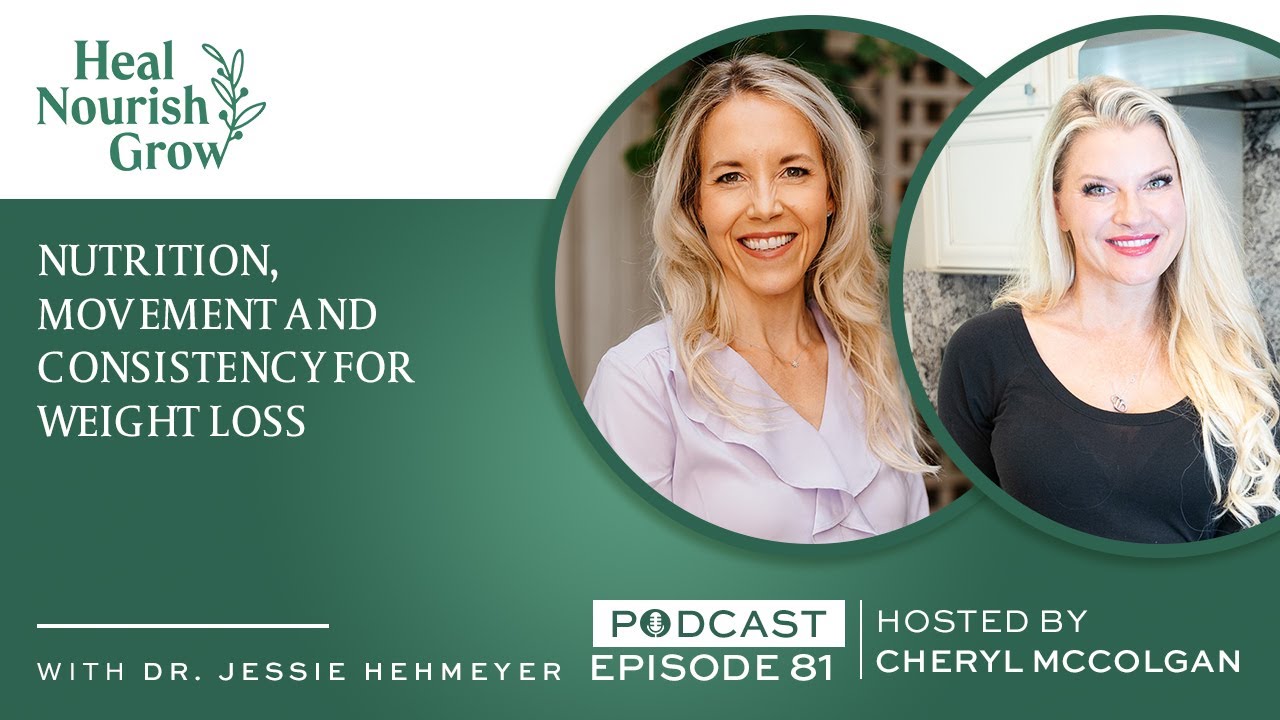
In this episode of the Heal, Nourish, Grow podcast, host Cheryl McColgan interviews Dr. Heymeyer, a chiropractor and functional‑medicine practitioner. The conversation begins with Dr. Heymeyer’s personal interests—hiking in Switzerland and Arizona, yoga, strength training, cooking, and travel—followed by a review of her professional trajectory from opening a boutique strength‑training studio in Chicago to earning degrees in chiropractic medicine, nutrition, and functional medicine. Dr. Heymeyer outlines her weight‑loss coaching philosophy as a blend of “heart and science,” emphasizing the importance of uncovering a client’s deeper “why” and co‑creating a vision of vitality. She introduces a concrete 5‑year future visualization exercise (pen‑and‑paper, first‑person present tense) to help clients articulate their purpose. The core claim is that nutrition accounts for roughly 80 % of weight‑loss outcomes, while strength training preserves muscle, boosts metabolism, and supports insulin sensitivity. Dr. Heymeyer argues that genetics play a minor role compared with environmental factors, inflammation, and epigenetic expression, and she critiques the notion that obesity is purely genetic. A patient case study illustrates how high inflammation and nutrient deficiencies were identified through lab testing, addressed with targeted nutrition and supplementation, leading to weight loss, increased energy, improved sleep, and reduced anxiety medication use. Practical habit‑building tips are offered—start with one small change, track drinks or vegetable intake, and build 15‑minute daily focus habits. Finally, Dr. Heymeyer describes a forthcoming six‑month hybrid program (max 15 participants) that begins with one‑on‑one work and testing, then transitions to bi‑monthly group sessions, providing ongoing coaching, testing, and community support. Contact information (wellempowered.com, Instagram @wellempowered) is shared for listeners interested in the program.
Chapters
Hey everyone, welcome back to the Heal, Nourish, Grow podcast. Today I am joined by Dr. Heymeyer, and before we get into all the wonderful knowledge that she has to share with us, I kind of just wanted to touch a little bit on her bio and her background because she has some amazing trainings, but then she also has some personal interests that mimic mine of like hiking and yoga and all that fun outdoor stuff. So Dr. Heymeyer, can you just maybe first share with people kind of what, like, what do you like to do in your spare time when you're not working and sharing knowledge about weight loss, what do you like to do?
Yeah, well, yes, as you said, I love hiking. Love hiking and love yoga, love strength training, love, of course, being with loved ones. And I love traveling and I love cooking beautiful, delicious, healthy meals for both myself and others.
Awesome. And, um, where do you hike mostly? What part of the country are you in?
Well, funny you should ask. I actually, uh, work remotely remotely from Switzerland, so most often I hike in Switzerland. In the States, when I'm here, I do like to get— I do like to get to Arizona. So I love hiking. I love desert hiking. I really never thought that I would find desert hiking as compelling as I do, but I just— I really adore desert hiking. But really, I've never met a mountain I didn't like.
Yeah, well, I— you just named off two of my favorite places there, so maybe we can talk a lot offline a little bit about, um, some of our favorites. But I'd love to just start to get into, uh, some more of your professional background now that we've talked about, uh, what you like to do for fun. Um, but you are— have chiropractic training, you have nutritional training. What was kind of your progression of— you started in one place, and then what propelled you to kind of do these other trainings as you started working with people, or just things that you learned along the way?
Fundamentally speaking, I would say the answer to that question is a deep devotion to evolving, evolving personally and evolving professionally and expanding my ability to contribute. So, you know, how I, how I made my way here is I like to say straight lines are boring. And, you know, out of, out of undergrad, I went to UCLA undergrad, and it really should have been a tip for me where to focus my attention, because I say that I chose my classes around what worked well for my workout schedule, which actually is quite true. So after graduating from there, I made my way back to the suburbs of Chicago, which is where our downtown Chicago at that time, which is from— I grew up in the suburbs and moved downtown Chicago after college. And shortly after returning to Chicago, opened up the first boutique strength training facility in Chicago in the Lincoln Park area. For those of you who are familiar with Chicago, Chicago, and it's still here to this day. So 21, 22, 21 and a half years later, it is still there, and some of the first trainers are still there. And I ultimately, after about 4 years, sold my half, knowing that I wanted to continue to learn more and expand my capacity to contribute. Made my way back to graduate school, as you mentioned, got first a degree in chiropractic medicine and then went immediately into a master's in nutrition and functional medicine. So it's always been my focus, even though, you know, the word chiropractor, people often think about aches and pains. I've actually never focused in that area. I've really practiced functional medicine since the day I got my license.
That's so exciting. And I love that progression. It has a, again, somewhat similar track to my own interest in how things progress, but I don't like straight lines either. So boring.
Who likes a straight line?
So I think what attracted me when your team reached out about having you come on the show is obviously Heal Nourish Grow is, and just by the name you can tell, it's everything health and wellness related. Um, but in particular, I really love your focus on functional medicine. And when this episode comes out, it's a time of year where people tend to focus on weight loss, kind of the New Year's, uh, resolution, sort of probably the number one New Year's resolution is to lose weight and or get into shape, two of your, uh, things that you're very focused on. So when you start to work with someone that comes to you saying they'd like to lose weight, can you just share how you approach that and how sort of the functional piece comes into that work relationship?
Yeah, absolutely. So I approach that with equal parts heart and science. So the functional part is very much the science-based. However, I have learned that information does not produce action— outcomes, rather. Information by itself doesn't produce outcomes. What produces outcomes or new outcomes is new actions, right? And so it really is marrying both heart and science in guiding people in authoring a whole new relationship with their body, a whole new relationship with themselves, a whole new relationship with food and beverages, and using science to make effective changes. And by effective, I mean changes that are going to produce outcomes. The outcomes you want, right? So it really is this journey of taking both of these essential components of heart and science and, you know, determining what the path forward, co-creating the path forward.
Yeah. And I love that you mentioned the science of it and creating, you didn't say the word habits, but that's the way I always like to think of it. And the way that I really focus on when I'm trying to help people or help myself with things that I want to change, So from the sort of heart part of it, what kinds of things are you talking to your clients about when it comes to weight loss?
So fundamentally speaking, one of the most powerful questions I've seen that shapes people's journey is people getting very clear on their why, right? And in particular, what I like to say is their what and how, it's connected to their why, right? So, um, we don't buy what we do, we buy why we do it. And the what part might be, uh, reducing alcohol consumption or, uh, shifting nutritional habits, right? That might be the what. And those in and of themselves may or may not be compelling to people. Some things might be more compelling than others. Whatever the case may be, it's when people get very clear on their why that not only are they able to make changes, but they're able to sustain them over time. So I, I work with people through a process that I call authoring your vision of vitality, otherwise known as authoring your intention for your health and your life, right? And it— and through this process, people get very clear on what their why is, and that begins to shift the experience itself, right? It begins to shift this area from an experience of self-aggression to one of self-love, right? It changes it from stick on the back, people beating themselves up over and over again, to ultimately that experience of carrot dangling and going towards something that's really compelling and exciting.
And without giving away your secret sauce, because we're going to talk about something a little later in the program, um, how people can work with you, of course, because that's always part of this. But if somebody is just starting to think about this, what are some of the— maybe your 2 or 3 top tips on how to dig into your why, how to figure out what that really is?
Yeah, so one tip would be to envision yourself in 5 years from now. So actually, like, you know, listeners, how old are you right now? Got that. Okay. How old will you be in 5 years from now? Got that.
Okay.
Now I'd like you to tell the story of you in 5 years from now thriving. Like, what is it like to be you? What's it like to get dressed in the morning? And what's it like to engage in your life, whether it's going to work or caring for loved ones or your children or, you know, just out there in the world? What is it like to be you with your health as you intend and desire it occur. And I actually invite you to do this exercise. Like, you might even pause this, this conversation for a moment and take out a pen and paper. I know that's super old school, or, you know, a laptop, whatever, whatever your, you know, your preferred way of writing is. But actually tell that story and tell it in first person present tense, right? So for me, that would be, I'm 52 in 5 years from now. And, you know, my body is resilient, it's strong, you know, whatever it is there, there for you to say, like you want to say those things in this 5-year future in first person, present tense. So that's one exercise.
I love that. And just as an aside, I would like to encourage people personally to use old school pen and paper because there is some psychological, like, brain evidence as far as, like, pen to paper that's very different than typing. And I find this when I write as well. Um, it's a totally different process.
I love that you say that, Cheryl. I feel so like— sometimes I feel like so old school saying that, but you're exactly right. Like, there is science behind using pen and paper, uh, and so for those of you who that seems like a foreign concept, you know, just try it on. Like, try it on and see what you notice when you do it, right? So yes, you're totally right. Pen and paper does allow for neurological connections to be made in ways that fingers on a keypad does not.
I know it's so crazy, but it's true, and I've definitely tested it for myself. So after they've gone through the process of kind of envisioning where they want to be in 5 years— and I love this because I have one that's kind of like 10-5-1 that I do backwards— um, but after they've envisioned that, what would be like their very first step to figure out how are they going to move forward from where they are now, how to get to where they want to be in 5 years?
Uh-huh. Well, one thing is they might need more information. Right? They might. And that's when, you know, like, this data and science really comes in. So maybe they really don't understand what is going on with their body. Maybe they're, they're struggling to figure out, you know, why am I not moving, losing weight? Oftentimes people come to me and they say, listen, this used to work for me, what I'm doing. It's not working for me now. Or, you know, I feel like no matter what I do, the scale's not, you know, the needle on the scale is not moving at all. So in that case, we, you know, we're going to get some information to understand what what the physiological barriers are to their weight loss. And there are a few that are pretty common that are often overlooked, like just not looked at in a more traditional approach. Um, so, you know, when someone walks into my virtual front door, these are all things that we're going to be touching on and looking at in assessing, you know, what's at the source of their, their weight loss challenges and also guiding their next steps ahead. Now, for other people, maybe it's clear. Maybe they do know one or two things they could do that they're not currently doing that would make a difference. And if that rings true for you, your listeners out here, my encouragement would be to just start with one thing, just one foot in front of the other. One of the problems with the inherited all-or-nothing approach is that it really is based on a myth that we can make tremendous, drastic, huge changes and maintain them. You know, rapidly, right? It's just so far not true for 99.9% of the population, right? So let's, let's honor that and look at, okay, what's the next step you could take? You know, just to share in an area of my life, right, with writing and sitting down and writing, it's like, okay, I started with creating a habit of just 15 minutes a day, you know, electronics off, focus for 15 minutes a day. That seemed for me like I could do that. I could do that. Right. It's like the equivalent of like getting up and walking around the block when you're interested in doing a Couch to 5K or something like that. Right. So, you know, just look for yourself at, okay, if your goal is to reduce drinking, maybe you just start by counting the number of drinks you're having in a week. Right. If you're— if you know it would make a difference for you to bring some more vegetables into your life, Maybe you'd start with just actually recording how many vegetables you're currently getting, the amount of vegetables you're currently getting as a gateway to the next step.
That's such, such good advice. And something that people have heard me bang a pot about is starting slow because my background's in psychology. And so I kind of approach it from a mindset place usually rather than a totally, you know, physical place with like weight loss and stuff. I think you gotta get your head right. So those are some amazing tips and I love to hear somebody else echo that. So it's not just me. You can believe it.
No, you're totally right, Cheryl. 100%. Absolutely.
Awesome. So it's, it, again, in the new year we're starting, we talked about weight loss and one component of that was, of course you mentioned nutrition and then one component of that traditionally has very much been movement based. Just eat less, move more. That's kind of what everybody's heard. Where do you kind of follow on that, and do you have any more nuanced thoughts about kind of how people can approach that? And again, keeping in the back of your mind that whichever one you're gonna choose of those to focus on, or if you pick both, which could be kind of a lot at once, that you're starting slow. But do you have one side or the other that you kind of believe feeds more like progress, I guess, more quickly?
Yeah, absolutely. So in the way of progress, we're gonna talk about like, okay, what is progress? In this case, we're talking about progress being movement on the scale, right? When I work with people, it's never just that, but Anyway, for this conversation, we're using that as the metric. And 80% of that is going to be coming from nutritional shifts, right? Not just what, you know, the quality of the foods you're consuming, the quantity of the foods and beverages you're consuming, and the consistency with which you're making those shifts, right? So nutrition is about 80% of the conundrum. However, it's certainly not the full story, right? So we know movement— if we're just talking about the number on the scale, we know that if we do not do strength training and we only make shifts to our nutrition, we're going to lose weight indiscriminately, which means we're going to lose muscle mass as well as fat. And we do not want to lose muscle mass. Muscle is metabolic magic, right? So increasing your muscle mass actually increases your resting metabolism, which means you burn more calories while you sleep. And that is the magic of muscle when it comes to weight loss. Now, there are tons of other benefits as it relates to muscle, and, and actually, I would say that's part of the magic, right? When we increase our muscle mass, we increase our insulin sensitivity, which plays a role in our weight loss also. So lots of other great things muscle does. Um, so that's true. And then also, there's just the truth that for most people, their mental health and well-being is playing a role in their habits, in their cravings, in their overindulgence, which is different than indulgence. Right? So, we know that movement is a powerful way to positively impact our mood. So, it's kind of like, okay, yes, nutrition is 80%, but if we really look at the totality of the pie, it ends up being like 150%, right? All of it together. Right? It makes no sense, but it's true. Right? So, uh, so yes, nutrition is going to most markedly move the scale, the, the needle on the scale. And I don't know of a way people who are struggling in this area of life can produce meaningful weight loss and sustain it without mastering nutrition and their relationship with food and beverages and all those things.
Now, this is, if you're up for this, and we can always, we can always cut this out, but I think there's kind of an interesting trend right now, or interesting conversation about, um, who was it like that one of the head of the, maybe it was like the American Diabetes Association, somebody like that said that, um, weight is all genetic, something to this effect. And kind of in my opinion, this is purely my opinion, not whatever Dr. Jesse's gonna say, but really just pushing the agenda of pharma with the weight loss drugs that are coming out, um, that people are using them for weight loss, not the diabetes. So I would just love to hear your take on that, if you're up for that. Um, yeah, whether it's genetics, whether it's diet, whether— what are your thoughts around that whole thing?
So my thoughts are, well, I'll tell a little story which will give away my thoughts. So a couple of years ago, my husband and I were watching, I don't know, some documentary, and it was a documentary that had video footage from the 1950s, 1960s, something like that, right? And it showed this little clip where there were people going through. It was actually, it was like Neil Armstrong on the back of a car going throughout America. And, you know, here he is in Iowa and here he is in Utah and there he is in California. And, you know, just different glimpses of America with, you know, Neil Armstrong floating about saying hello and waving. And the thing that I was struck by was that no matter what clip they showed, there wasn't anyone who was markedly overweight that I saw. Right. And this was all throughout the country. So if we look at that and see that, you know, okay, yes, there were some people who were overweight at that time, you know, but it was exponentially less than it is right now. And we do know, factually speaking, genes do not evolve that quickly, period. No way, no how. Does not happen in a couple of decades, then we can kind of reach the conclusion that what he is saying is just not true. Yes, there are some genetic tendencies. Certainly, you know, you can look around and see people who have bigger frames and smaller frames that have naturally a little more muscle mass or less muscle mass. Of course, that's true. But to say that, you know, obesity is, is really, you know, purely the result of genes is, is a far cry from the truth. I definitely see people who have had a long, you know, more or less since they were born, right? They were born into a family. For whatever reason, their family did a great job at, let's just say, emphasizing education or, you know, things like that. But maybe they didn't make health as much of a high priority in their household. And so their genes, as a consequence have been exposed to pro-inflammatory foods for 4 decades, right? They— from out of the gate. And so, that will affect the epigenetic expression, right? Our genes live in the environment that's both inside of us and outside of us. And so, that will affect what we're manifesting from a health perspective. And it definitely, you know, for someone who has 4 decades of marinating in pro-inflammatory foods, so to speak, is just an example. It's a whole level of inertia that's hard to— that, that is not present for someone who, you know, they won the lottery on that front. Their family did emphasize nutrition. You know, none of us have anything to do with that. We arrive where we arrive. Right. And, and so it's, you know, someone who just has a decade of, of nutritional habits to undo, so to speak, and physiological impact to undo. That will be— there's going to be less inertia present, right? So fundamentally, I am with you that the genes are exponentially less important than the environment we are surrounding our genes with.
And that being said, I do want to end it on a positive note because you're right. However you grew up or whatever you were exposed to in terms of diet and nutrition, is not something that you created for yourself. And so when you become aware of this later in life, or it's causing you issues, wanna have, you know, some way is, is it possible to change? Is it possible to change that paradigm? Is it possible to, you know, take your epigenetics in another direction? And I think that the science does show that it is possible. So I'd love to hear and maybe even have a patient example without showing or without sharing a name or anything of somebody who maybe has come from that kind of background and then was able to shift into a healthier, less inflammatory food kind of pattern and find some success.
Yeah, absolutely. I would love to share that. So what comes to mind is a woman who I began working with her about 2 years ago. Now we have shifted to— we see, you know, check-in in every twice a year right now, and ultimately she'll be moving to a once-a-year check-in. But, you know, where we started is she arrived at my virtual front door She was about 20 pounds overweight. She was exhausted even though she was sleeping about 8 hours a night. Her liver enzymes were elevated and she had done all of the appropriate workup to make sure it was nothing, you know, quote unquote scary, right? That's important. We always want to make sure that's done. It wasn't. But ultimately, the answer was, we don't know, it's not scary, go on your merry way. So, we did a wide variety of assessments of what was going on with her body. One of the things we found was that for her, inflammation was out of control, right? Some people show up at my virtual front door and say, I'm really inflamed. And I'll say, how's it showing up in your body? And they might say, oh, my joints hurt, or I have these rashes, or whatever it might be. But more often than not, there aren't any obvious signs of inflammation. The only way we know if inflammation is playing a role in how someone's health is or isn't is if we actually get the numbers. And so there are lab tests that let us measure inflammation. So we measured her inflammation. It was super duper high and quite frankly, like higher than I would've expected for her. Um, And we also got to see a number of nutrient deficiencies that were playing a role in her fatigue, that were playing a role in her liver function. Um, and ultimately over time we replenished nutrients, we supported her detoxification pathways, we hit down that inflammation in a major way, both with nutritional shifts as well as with targeted supplementation. Sometimes we can just do it with nutrition, but hers was just like so out of control. It was was, you know, feeding this vicious circle of inflammation, which was one of the reasons she was struggling to lose weight. Because when inflammation is high, it is like, you know, it really puts the brakes on our metabolism. That was actually my, the thesis for my master's was on that very topic. And so, you know, over time, not only, at first we just saw her numbers shift and I let her know, I was like, listen, you know, this is gonna take a second. To right the physiological ship, so to speak, right? It's gonna, it's gonna take a second. And when people have really high inflammation, I, I get it, right? It's like, it's gonna be 6 to 8 weeks, sometimes even, you know, 3 months of someone consistently taking actions before they start to see the scale move in a meaningful way, right? We've gotta undo that inflammation and then all of a sudden the body just kicks into gear and it's like, oh, Wow, huh, now I see it, right? And that was very much the case for her. And so what was so cool for her is over time, yes, she lost the weight. Yes, her energy absolutely went through the roof, like in a wonderful way, not in a hyper way. The other— one of the things that she said was she's like, oh my gosh, I actually thought I was sleeping well before, but now I know in contrast I really wasn't. So there were quite a few things we did that led her to a place where her energy She was, you know, in a great place. Her focus was in a great place. That was part of it was just like sense of energy and part of it was mental focus. Her weight, she's at a place where she feels great. Another cool thing that we— about maybe 6 months ago, she said to me in passing when she came to see me, she was on medication for anxiety and she was doing well with them. Like, we weren't looking to shift it. We were, you know, keep— stay on those medications. They're working well. And ultimately, she said in passing, she's like, oh, you know, I stopped those medications. My, you know, anxiety meds because I just didn't need them anymore. And so that really validated that inflammation wasn't just playing a role in her energy, it wasn't just playing a role in her weight loss, but it was also creating, you know, brain inflammation that was impacting her mood. So that's, that's someone who is just a great example of what's possible.
Yeah, I love to hear such a positive story. And just to give people another resource, because I think that the connection. Again, my background in psychology, I'm always geeking out. It's not like this, but the connection between mental health and nutrition and diet is very real. And, um, maybe I don't know if you've had a chance to read it yet, but Dr. Chris Palmer has a book out called, um, Brain Something. Anyway, Harvard doctor, really profound work on the connection between, uh, nutrition and brain health. And so if people are out there and they happen to hear this, it's not saying go off your meds or do anything like that, but definitely nutrition is something to look further into for mental health.
Totally. So well said. Yeah, love that.
So, uh, Dr. Chris Palmer, I'll leave a link for that. Um, so we talked about this before we got on the air, Dr. Heymeyer, that for people that are looking to lose weight, I mean, you mentioned some great things like testing's a good thing to do because I think nutritional deficiencies are fairly common, as well as high inflammation. But if people don't test, they might not know that. So you had mentioned you're starting a group in February, and I would love to hear more about that. What's involved with that? What they get out of it? Are they getting testing? Are they getting coaching? What is that all— what does that all look like?
Yeah, so what it will look like is it's going to be a small group, so I'm going to cap it at 15 max, and I'm actually toying keeping it even a little bit smaller. But we will be— it'll be a little bit of a hybrid approach. So we're gonna start with some one-on-one work, and yes, we're gonna do some testing, and then we're gonna shift into group work. So it really marries a combination of honoring what's true for you and your, your unique physiology with some of the common barriers and challenges that people encounter in in making changes that produce the outcomes and sustaining them over time.
And how, how long does the program run for? Is there also— you mentioned it's a group, so are there group meetings too where people can kind of share and get support from the group?
Yes, exactly. So we'll shift from some one-on-one work into group work, and the group work will occur so twice a week— and I'm sorry, twice a month rather— and the entirety of the program itself will be 6 months. Very cool.
Um, well, before we wrap up, are there any final thoughts that you have that we didn't talk about? And again, we were kind of focused in this conversation on weight loss since it's the beginning of the year, and that tends to be, again, a big goal for people this time. So anything that we didn't talk about or mention that you think is really important for people to know if they're, if they're trying this on their own? And I always do recommend, like, have at the very least have an accountability buddy or have a coach or work with a functional medicine practitioner or something like that. But if they're just trying to do this on their own, any other final thoughts on things they can be aware of or think of or that might be really helpful?
I would say a few things. One is have some compassion for yourself, right? We inherited a lot of things in this area of life around our body and food and, you know, our weight. That simply put don't serve us, right? We didn't invent this disempowered relationship, we inherited it. And so like, fundamentally speaking, it's not your fault, right? And also, if this is an area that you know mastering it would powerfully impact all of your life, um, I really encourage you to take it on. You know, just like Cheryl said, in whatever way you see is the next best step for you, I'm going to be a champion for that. But know that you absolutely can triumph in this area of your life. And that might look like you partnering with someone like Cheryl or myself or another resource, or it might look like you just, you know, putting one foot in front of the other to get going and then reaching out for support as you find that you've got information missing and, you know, find it would be useful. But, uh, my commitment is, you know, you thriving, because I know when people thrive, not only did they bring their best selves to life, but they also inspire others to do the same. And that to me is what it's all about.
So true. I love that. And so where can people find you online if they want to work with you, if they want to join the program, if they just want to follow you on social media, if you even do that, where, where can they connect?
So you can find me at wellempowered.com, and that's where you can schedule a complimentary consultation. And learn more about working together, whether it's one-on-one or as part of this upcoming course, please do that there. And then online, I'm mostly on Instagram @wellempowered.
Awesome. Thank you so much for taking the time today. It was lovely to meet you, and I can't wait to hear at least a little bit more about your hiking adventures.
Awesome.
And the podcast. Yeah.
Thank you so much, Cheryl. It's been such a treat to be with you in your community.
Thanks again.
More from Cheryl









30 Day Challenge Series, Day 30: Choose Your Three Habits to Continue for 90 Days

30 Day Challenge Series, Day 28: Schedule Connection (Put It on the Calendar)