
Using Neuro Tools to Create Better Habits: 61
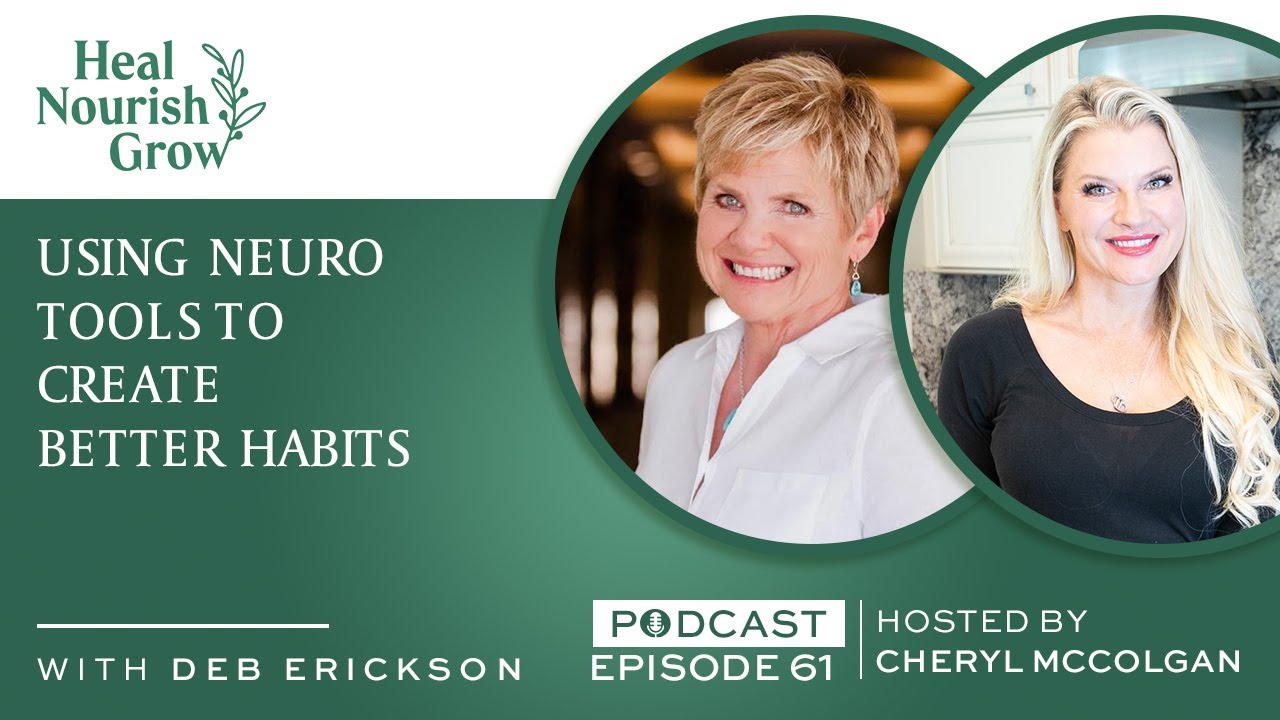
Deb Erickson, a former teacher, created a neuroscience-based app to rewire habits using audio tools like binaural beats and guided visualizations. Her system, the ABCs of mindset management, replaces willpower with what she calls mind-power. Women are 86% more likely to achieve goals in a supportive community.
Chapters
Hello everyone. Welcome back to the Heal, Nourish, Grow podcast. I am joined today by Deb Erickson and she is going to share with us some things that we can use to shift habits, which as you know, is one of my favorite topics. And this should be really appropriate because this episode will be airing just prior to the new year when people are looking to change certain things. So anyway, welcome Deb. Could you tell us a little bit about the work that you do and how you got into all this?
Yeah. You know, I was a teacher. I graduated from school with a teaching degree and a coaching degree and, you know, realized very quickly, I mean, within a matter of years, it was like, okay, this is not gonna pay the bills. And so I began to speak and travel motivational speaking. I was working with, uh, salespeople. And I, I started recognizing that there was, there was a real need to help people bridge the gap between what they knew they were supposed to do, you know, no matter what the goal is, right? This is— I know that I need to be doing this, but you're still not doing it. And I realized that gap was being created by doubt and uncertainty. The fear center of the brain would be triggered off and people were getting stuck sabotaging, making excuses. And, and the thing for, I think for most people, when they set a goal, let's talk about a health goal and you don't achieve it, is that you take it personally. At least women do, right? It's kind of like, it's me. I just can't do it. I just, I have no willpower. And the truth is there's something much more sinister going on. It, it's as if your brain is actually working against you. So it can be your greatest ally and it many times is, you know, definitely the great obstacle. That's where I put my focus. I've spent years studying the mind, the brain, you know, what it is that causes us to com— you know, continue to repeat patterns that no longer serve us. And most recently I built an entire system to support people using an app, being able to interrupt those habitual patterns that don't serve them and choose better habits instead.
Oh, love it. And based on your experience of working with so many people, what would you say is the most common barrier to changing habits, or what consistencies do you see in, in people when you're working with them on changing certain things?
You know, most habits are being run by the subconscious mind. They're kind of below the surface. They're just, they're just running. I would say the vast majority of people don't why they do what they do, right? Because that's really being run, you know, it's subliminal, it's under the surface. And so one of the things that I notice is that when people become aware, you know, awareness is always the key to change. You become aware, then you can make different conscious choices and we can rewire the subconscious mind so that you can actually begin to create automated responses to habits that really help you.
Yeah, and I think that's the real challenge, that you hit the nail on the head there. And I actually had another guest recently that spoke about the same thing, but it's the actual awareness, because once things come very habitual and they are sort of below the surface and subliminal, then how do you even get the awareness to discover what they are at that point? So that, that becomes the real challenge. And I'm assuming you must have some tips or some tricks about how to get to those things.
So I like to talk about the ABCs of mindset management, right? Being an is awareness. You've got to be able to question and examine and observe, you know, what's going on here? What am I doing? I mean, the first thing is to know what, right? What's happening? Then the B, belief, really, it's really about examining the old beliefs that no longer serve you that are driving that behavior and then creating new belief habits and new belief patterns that will take you where you want. So we either belief bust or we belief build. And then the C stands for choice point, right? Recognizing in the moment when you can decide and make a conscious choice to create a new pattern. So everything I do is based on neuroscience understanding, number one, and then neurotools, because you, you really need a little bit of help. Otherwise you would've broken the patterns a long time ago. So when people need help, they need two kinds of help. Conscious awareness help, right? That's when in this moment I know, man, I am headed down an old pattern. I'm getting ready. Cravings are taking over. Old paths. You know, have you ever stood at the refrigerator door? You know, you open the door and you're like, I need something. And in that moment, you know, you don't really need something, but you just got stuck in a habit, right? Busted. And so we've got tools that help people in the conscious moment and then tools that rewire. So you can actually listen to neurotools as you're falling asleep, as you're, you know, on a run, as you're, as you're doing something else in your life, you can listen to these neurotools. And what it does is it plants the seed of, of a different conversation, of different fundamental beliefs, of different energy, so that it just becomes easier to make that shift.
So would you say it's almost something in, in that specific tool that you just mentioned, is it something similar to like a guided meditation? So it's almost it's not passive, but it's sort of just, you know, if you do it often enough, it starts to become kind of sink in more and be ingrained more than a real obvious thing. And I do have a— I have a thought of an example after you, uh, kind of addressed that question.
Yeah. Well, here's the thing about neurotools. They're a combination of everything. So as an example, the music in the background, right, it— what it's done, it's got binaural beats, the energy that calms the brainwave frequencies so that your mind is open. So you're in a very calm relaxed state. There's visualizations, there's affirmations, there's a meditation bell. In other words, all of these things are kind of linked together so that the brain will calm down, open up, because that's when we can reprogram. You know, your original programming, whatever you have now, was really set in place in the first 7 years. Most people, you got 7 years when the mind is open. You know, children are basically big sponges, and so they accept all that programming, and then we keep repeating, repeating patterns for the rest of our life unless you become conscious and aware, you choose something new. So all new patterns have to be repeated. So the way we reprogram is repetition over time with emotion, repetition over time with emotion. So you're right, we're gonna repeat something over and over and over until it becomes the new truth in our mind. And you gotta do that in a space where your brain is open and receptive.
Yeah, that makes a lot of sense because I know I used to teach yoga classes publicly and I've done it myself for years. And one of the things we talk about at the end of a practice, you've done, you've done all this physical movement, you've done this focused work on breath and all of these things. And when you're in shavasana at the end, you're kind of just, you know, laying on the floor and people are extremely receptive in that moment because of, I think, most of the reasons that you just mentioned. But the other thing that you said that I would love a great example of because I'm not really sure what this means. I think I have an idea, but you said, you know, the repetition and all that, but with emotion. What is the with emotion part? And like, why does that make it stick?
The subconscious mind doesn't know the difference between a real experience that you're having and something that you're imagining, especially if there's deep emotion. So a great example, you go into a movie theater, you sit down, the lights go down, and then there's creepy music that starts, right? And there's a very foggy scene and a woman is walking by herself down an alley, and then all of a sudden there's a screech, you know, and you jump. Why? Because even though your conscious mind knows you are sitting in a movie theater, the subconscious mind, it can feel it. It's taking its cues. Your heart is beginning to race. You know something is about to happen, and yet you know you're sitting safe in a, in a theater. That's how it works, is the more emotion that is involved in the moment, the deeper the programming, the deeper the impact.
That's interesting. And it also is kind of, I think, when you get further away from whether it's a traumatic event, a happy event, whatever, your brain kind of has this thing where it, it protects you and you kind of forget how intense that emotion was at the moment. So it's kind of a double-edged sword, it seems to me, like you can use that to reprogram, but at the same time, you know, you've used it in that moment. So is that how the tools really work more on a neuro— neuronal levels? Is that reprogramming the wiring that you've already done in the first 7 years of your life?
Exactly. So neuroscientists say that neurons that fire off together wire together. And when you get neurons that wire together, they create pathways. And the more times it fires off, then those pathways become networks. And so the, the place, which is how habits get created, right? As we repeat something over and over and over and over, and before you know it, the subconscious mind grabs that pattern and says, never mind, I can do this without any help, and it begins to run it, right? So what we are doing is we, we need to like scratch the record. If you think about an old, you know, vinyl record, it— when the needle was running perfectly, everything was beautiful. But the minute there was a scratch, the needle followed the new scratch. And you could never play that record the same way again. Well, it's the same. It's exactly the same way in your brain. It's kind of like the pathways are running, but when you want to make a change, you got to destroy that, that current pathway, create a new pathway, run it and run it and run it and run it, run it, run it, run it until your brain goes, oh, I see, this is the way we respond now. So when I, when I want chocolate, I'm feeling a craving, right? I can become aware and go, wow, what is it I think chocolate's going to give me? And I can look into my past and go, oh, I remember my dad. You know, he always gave me chocolates when I got hurt and when I was afraid. And when he had to leave, he gave me chocolates. And so my brain wired up chocolate is safety, chocolate is love, right? So now what does that mean here? Well, what it means here is I'm looking for some love. I'm looking for a sense of safety. I'm looking for something else. And I keep asking chocolate to give it to me. And for a moment, I am feeling the thing I'm after. But then afterwards, I pay the price because now I've got cravings going and the sugar craving. And so what this is really about, the conscious awareness, really about, okay, then I can— when I feel that need for chocolate, what I know, I've gotten triggered. What I know is I'm needing something else. So now what I can do is I can go to my app, right? Oops. I can go to my app. I can do a search. You know, I'm, I'm just wanting to feel safe. I'm wanting to feel loved. And I can listen to a neurotool that helps me rewire, right? Adjust to that, to connect to that emotional state I really wanted. So I can say no to the chocolate, but yes to the feeling I was pursuing.
Oh, I love that. And I love that you've got such a tool to go with that. I think that's really interesting when I talk to different people about different types of work. And quite often I struggle with, you know, and I don't think that anybody's ever has this intention, by the way, but I struggle with personally, I'm like, well, are they just wanting to promote their product or whatever, you know? And, and I want to bring information. And I think most people are like so good at just really giving the information. And it's like, you created this tool because you became passionate about this topic, not the other way around.
Right.
Um, But anything that helps people, I'm, I'm all for using the tools because all this stuff is hard enough when you're doing it yourself and doing the work. And I know that because I did it for years before apps or any of that stuff. You know, I've always, always had this kind of focus. So the fact that we now have tools that provide immediate feedback, like, why wouldn't you use the tools if they work? So I think, I think that's really awesome that you created this.
Yeah. Yeah. Well, I, I, uh, let me just tell you the story because I really created it for me. So I was sexually abused as a child. I have carried 40, 50, 60 pounds extra my whole life, up and down and up and down. I would use willpower and discipline to fight against, you know, make my body adjust. And then the minute I let go, boom, all the weight plus more comes on, right? And I was, I mean, on and off, right? So I was at one of my heaviest weights about 5 years ago, and I was standing on a stage because I was on a speaking tour for the business, all the business tools that I've created. I was speaking, I was talking about neuroscience and neurotools and habit, you know, busting and all that kind of stuff. Woman raises her hand from the back of the room and she said, seems like this would work for other things like weight loss. And in that moment, I have to tell you, here I am on stage, heaviest I've ever been, and I had to go, yeah, it really, it really should work. And, and, oh, I was so humiliated. I went home and I thought, okay, that's it, Erickson, you know, we got to do something about this. So I built this entire entire system. And I started using it every single day, using it every single day. And what I noticed was that my weight just fell off. Seriously, I didn't get on the scale. I wasn't watching the numbers. But I would stand every day or every week, I'd stand in front of a mirror, and I just would tug on my pants. You know, in the early days, I was stuffed into it, falling over the top. And then pretty soon, I wasn't stuff. Pretty soon they were moving, and then it wasn't long before I could just like pull them down. And as I watched that, it was like, wow, this is such a different experience than I've ever had in my life. I noticed that I was making different choices, but I wasn't forcing it, that I would actually be inspired. It was like, I think I'll have some water. I think I'll go on a walk. I think I'll do some yoga. Wouldn't it be fun to have more greens? You know, maybe, maybe I'll have a salad today. It would, it was as if out— it, it felt like out of nowhere, but I know it's not. It was the neurotools that I had been planting those seeds. But my language changed. Instead of saying, this is the hardest thing I've ever done, I started saying, you know, this is so easy, this is effortless. I mean, I'm transforming in front of my eyes. And yes, I'm making a lot of better choices, but it wasn't willpower. Wasn't willpower, is mind power. And in that moment, I realized I really had something. I kept building unique neurotools, and before you know it, all of my business clients started saying, what are you doing? What? You know, that was 60 pounds ago. I lost that 5 years ago, have not put that back on. And so what I know is that this works. You know, I'm not promoting a specific diet or a workout regime or any of the stuff that of course you have to manage. This is about mindset management. And it's a— it was a— for me, it was a different journey than I'd ever experienced anywhere else. And really, that's why— that's why I created more and more and more of it, because it was like it worked. And I still use all the tools today. I use them every night, every morning, because this is— this is a lifetime journey. This is not, you know, drop some weight for the, you know, the big event. This is, this is the rest of your life.
Well, not only that, Deb, it sounds like you really just finally took on the past trauma that you had in a much different way than you'd ever had before. And so it was more like the trauma was feeding into you not feeling well and not feeling good in your body and not, you know, even though you wanted to make good choices, like you said, the willpower, it's just that innate subconscious wiring is in the way so much that it doesn't matter how much willpower that you have. And I think a lot of people struggle with that. Would you agree? I mean, you must have heard— talk to people now that have been using this tool and maybe having a different experience than they ever had before.
Yeah. You know, for me, what it was, was, um, the, the gentleman that abused me, um, said to me every single time, said to me, I can do this to you because you're a girl. Nobody cares about you and you're small. So literally, this is what's happening inside of a little 3-year-old brain. My little brain is saying, it's not safe to be a girl— can't change that— and it's not safe to be small— I can change that. So what I noticed is my, my whole life, when I would start dropping weight, I would freak out. Like, I'm not safe, I'm not secure. And, and I would go into, you know, crazy behavior, putting the weight back on again. And I kept doing it over and over again. It's like, what is this? Why am I so compelled? And so when you do this work, you begin to explore, right, the— and have compassion for the wounds of your past that are driving the, you know, this extraordinary behavior. And you, you make peace with that. That you, you find a place where you can forgive, you can make peace, you can really design a life that is not driven by your prehistoric fear center. No.
Yeah. And, and thank you for sharing all that, because I think that that adds a lot of, of a lot of color to why this works and the types of things that are, you know, are deep inside and painful that people don't want to address. And this kind of method, I think the rewiring of it instead of just digging up past history with a therapist and talking about it, which even as a psychology person, I've, I've always kind of struggled with that a bit. I'm thinking like sometimes it's like, it seems a little worthless and pointless because you're just talking about it. You're not actually doing the work to create a different way of, of connecting with it or, or connecting around it, if that makes sense.
I agree. You know, I, I got into therapy in my thirties.
I was.
Um, you know, I was really struggling and got into therapy. I was in therapy a decade, uncovered all the memories, processed all the memories, you know, collected all the stories, confronted, you know, my abuser. I did all that work, but what was still the problem still was I was really angry. I was still very angry, and I still felt very unsafe. So I, I know that was an important part of a journey, but there's, you know, I don't know, I'm that kind of person that's like, hey, we got to be dealing with this stuff. I need help right now. I can't afford to go into therapy for another decade. I got to have help right now.
Yeah, and that sounds like this is the beauty of what this tool provides. So now we kind of given the background on it, can you describe— I mean, number one, it's an app, so obviously people can get it, but can you maybe describe on a more, just like what that looks like on a day-to-day basis, how somebody really uses that.
Yeah. Yeah. You know, being an educator, I mean, that's my background. What I know is that adults learn differently than children. So children, we can just say, here, memorize this and we're going to test you on Friday. Adults, you have to help them understand. There has to be perspective. Why is it important? How's it going to change my life? What are the benefits going to be? All of that, right? There has to be that. And so this is the journey where on a daily basis, part of the app, what it does is it teaches, right? It says, here's the neuroscience, here's what you may be facing. So there's modules that have learning experience so that you get the cognitive awareness piece of it. But then the next piece of it is just the day-to-day application. So there, there is a power-up, little inspirational video every single day that kind of talks through, all right, guys, here's your day. Here's what we're going to be focusing on today. So give them an assignment. Give people a process, tell them what neurotools we're going to be using, why we're using them. And so it kind of gives people instruction every single day. Then there are over 2 dozen neurotools so that depending on what you're dealing with, you have a resource. Do you need to reframe something? Do you need to, you know, do you need to scratch, you know, that old pattern? Do you need to habit block, you know, habit stack? What do we need to do? So They're going to learn how to use it. And then, of course, there's a list of those they can have access to. And then there's a weekly live check-in. So it, it's not unlike a Weight Watchers where you're going to show up every week and something's going to happen. Going to have success stories. You're going to be able to get a little coaching, ask some questions, get some support. There's a community. So we've tried to pull together everything that we know is important. For especially women to set and achieve a goal with their, with their wellness and weight loss. So it's not just weight loss. It's really pretty much you can tackle almost any weight challenge. I had a woman actually on a check-in call this morning who is faced— had— was facing knee surgery, and she resists any kind of rehab as she was terrified, having panic attacks just thinking about about, you know, going under. And, and so she used the system to reframe, you know, what was happening and how her rehab was going. And so we checked in about a month later. She's doing fabulous. She would— she made a miraculous recovery inside of the surgery. So basically, here's the thing: your brain is in charge of your body. So when you become the boss of your brain, you become the boss of your body. And that's what people come and play with.
Yeah, it sounds like it's great for all kinds of things. Like you said, not just weight loss, whether it's changing habits around the type of food you— I mean, it doesn't have to be the type of food you eat, cuz just because you're a quote unquote, I'm gonna use the air quotes if you're not watching the video. Um, it's one of my favorite things. I'll just do that and I'm like, wait a minute, nobody can see that. But, uh, to, for example, you know, just because you're a nor— a nor— normal weight, and that was what the air quotes were for, whatever that is. For you, but it doesn't mean that you're necessarily practicing healthy eating habits or healthy living habits or drinking habits or whatever it is. So it sounds like you could use this to really address anything that is something that you'd like to change in your life for, to, for a healthier purpose.
Oh, sleep better, reduce stress, um, mental clarity instead of fogginess. I mean, you know, The number one challenge we have in our society these days is mental wellness. And mental wellness begins with really understanding what's going on for you. Are you not getting enough sleep? Are your mental and emotional patterns running you into worry and doubt and stress and fear? You've activated the fear center. You can't calm it down. I mean, I think that, you know, the last 2 years have taught us, demonstrated to us the power of health, wellness, mental wellness, you know, mindset, all of these things. We now see it. It's undeniable how important this is to living a, you know, a healthy, full, vibrant life.
Yeah. And I'd say you're exactly right with the whole last couple of years. I mean, I think more people than ever are struggling with any number of things, even just anxiety, depression, all kinds of— or just being fearful of the world now in a different way than they never had before. So it's really great that a lot of people are realizing this and kind of bringing these tools more forward so that, you know, people don't have to suffer in silence and have to go somewhere in person. A lot of this stuff too, it's nice that it's virtual because people do still have that worry about, you know, being in certain situations or being out in public. And this is a way they can address that. Um, you know, hopefully where they get back to a place where they can live a more normal life again.
Right.
So thanks for, thanks for bringing this tool to everyone. It's great. Um, can you just talk a little bit about, uh, future projects, anything you have going on? If people want to work with you or, or listen to you speak, what are the best ways that they can do those things, be in touch and find you?
Yeah, well, obviously, you know, our Facebook is, you know, is— I know we're going to put all the links here, so I'm not going to rattle all that off. But obviously you can get Instagram, Facebook, get access. You can go to our website directly. People— the beautiful thing is people can try the app free for 2 weeks. We decided we were going to do a free trial because what I didn't want to do is say, you put up the money, if you don't like it, we'll give it back. What I wanted to do is say, look, I am so confident you're going to fall in love with this thing that you don't have to put any money up front. You know, give you 2 weeks. You can get through the whole first module, try all the neurotools, and then if you like it, then pay, right? Then pay for monthly. And so I am on live with that community every single week. I'm doing podcasts like this with people who have meaningful health and wellness you know, conversations with the world. So I would say all of those. And I know, like I said, I know we're going to add some links here. All of those are great ways to get connected and stay connected, um, with me and others.
Okay, great. And it sounds like you have a really vibrant community happening, which I've talked about this a lot in my content. I think that community as a resource is underappreciated, and for all kinds of— all aspects of health community, you it. It's, it's one of my top 5 C's, and I have like these 5 C's around wellness, and community is the, like, probably the number one, actually.
Uh-huh.
Uh-huh.
Did you know that women are 80— I, I think that it's 86. I was going to say 87, but I think it's 86% more likely to achieve a goal if they are surrounded by a positive community. You are exactly right. Community, and especially in times like these when If we're isolated physically, we need to make sure we're not isolated logistically. You don't have to be isolated more. You can find robust communities where there is love and support that will surround you. And you're right, we need it. We need it.
Yeah.
Well, thank you.
I had not heard that stat before, so thank you for sharing that. And thank you for coming on today and sharing all of your wonderful knowledge and experience. I'm looking forward to having the audience try this tool. Like Deb said, you can get it for free for 2 weeks, which is really amazing. So definitely check that out. Get in contact with me or both of us because I'd love to hear how it works for you. I'm definitely gonna be trying this for myself as well. So again, Deb, thank you so much for taking the time today. I appreciate it.
It's great to meet you, Cheryl. Amazing work you're doing in the world, and we love you right back.
Oh, thank you so much, Deb. That's very sweet.
More from Cheryl









30 Day Challenge Series, Day 30: Choose Your Three Habits to Continue for 90 Days

30 Day Challenge Series, Day 28: Schedule Connection (Put It on the Calendar)