
Using Nutrition for Overall Health: 59
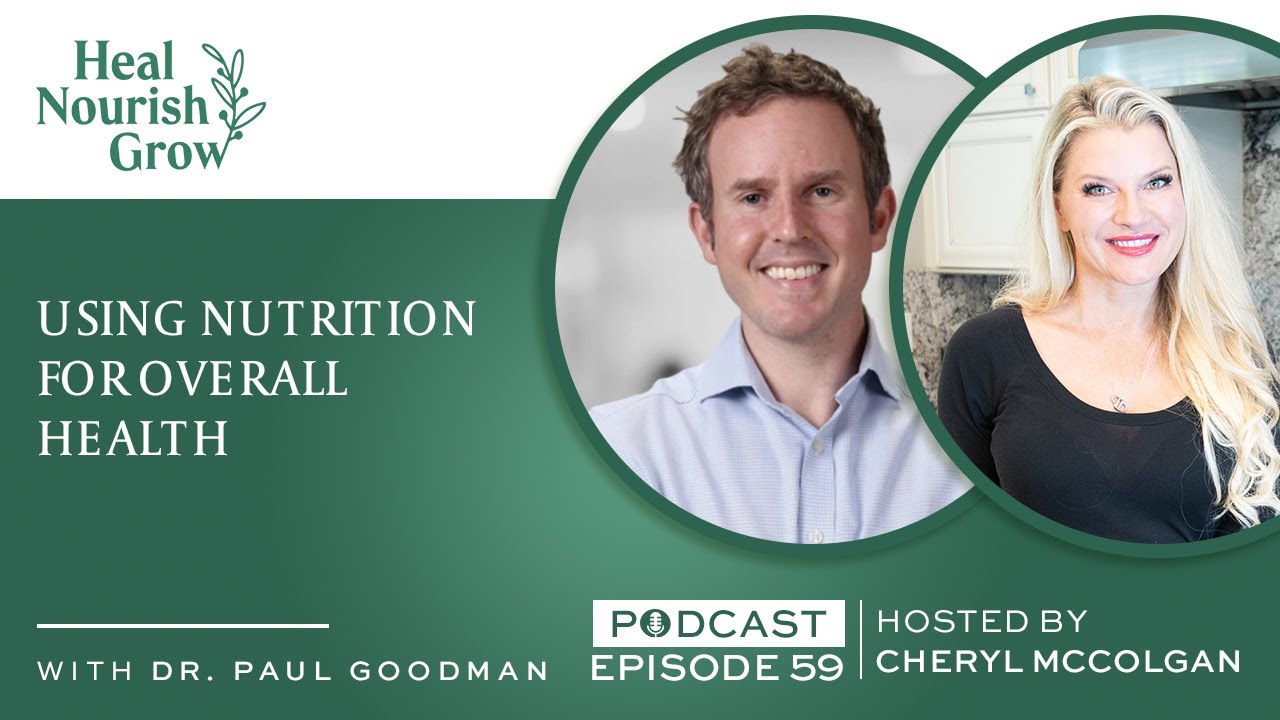
In this episode of the Heal, Nourish, Grow podcast, host Cheryl McColgan interviews Dr. Paul Goodman, an ophthalmologist turned medical officer for the ready‑to‑eat company Fresh & Lean. Dr. Goodman explains how a pandemic‑induced pause in his eye‑surgery practice led him to explore nutrition, beginning with a project on macular degeneration that revealed strong evidence for the Mediterranean diet and specific micronutrients in protecting eye health. He expands the discussion to broader research showing that whole‑food, plant‑rich diets can dramatically improve mental health, reduce depression symptoms, and cut Alzheimer’s incidence, citing the MIND and related studies. The conversation also touches on the role of lifestyle and communal eating (the “French effect”) in amplifying dietary benefits. Dr. Goodman shares how he educated himself on nutrition—systematic PubMed searches, following trusted sources, and noting surprising findings such as the powerful impact of diet on mood. Practical advice is offered for people transitioning from a standard American, highly processed diet to whole‑food eating, emphasizing small, sustainable steps, taste‑bud retraining, and not viewing setbacks as failures. He discusses metabolic health, noting that there is no single “diabetes diet” but that reducing processed and refined carbs, sugars, and fried foods—common to Mediterranean, keto, and other anti‑inflammatory approaches—helps control blood sugar and chronic inflammation. Finally, Dr. Goodman describes Fresh & Lean’s model: fresh, refrigerated, whole‑food meals tailored to various dietary patterns (Mediterranean, keto, Whole30, vegan, high‑protein) while maintaining core principles of unprocessed foods, and he provides his professional contact information for listeners.
Chapters
Hello everyone. Welcome back to the Heal, Nourish, Grow podcast. Today I am joined by Dr. Paul Goodman, and you just heard his bio. But what I'd really love to hear from you, Dr. Paul, is a little bit on how you got more interested in metabolic health, because that wasn't exactly your training when you went into medicine. So maybe you can kind of tell us a little bit about your journey there.
Sure. Happy to. Yeah. Thanks for having me, Cheryl McColgan. So, yeah, my background is I am an eye surgeon, an ophthalmologist. So med school, residency, et cetera. And besides maybe 2 hours of class time on nutrition, you know, it really was not a focal point for me. However, you know, fate had another plan for me. Basically, when the pandemic shut my office down, which for a subspecialist was, was, it was a big chunk of time where we were really not doing much. I was looking for something else to do and fortuitously was offered the chance to work with another ophthalmologist on a project in nutrition, specifically helping patients with a particular disease called macular degeneration to eat the correct foods. It happens to be a a disease with a lot of evidence behind food as a treatment or prevention or nutrition in general. But we of course never had time to help our patients do that in a 10-minute clinic visit. We were interested in solving that problem. And that was really the start. You know, that is not what I'm doing now, but it opened my eyes to the really the literature in support of what I would call food as medicine. It's not an exact term, but just this idea of eating certain foods to treat or prevent disease. And in a way that's beyond what we have always known, which is certain fruits and veggies, don't eat fried foods, et cetera. It's really quantified it and given us the ability to say exactly how powerful it is, which is very powerful. And yeah, I expanded beyond just eyes, took an interest in metabolic health as a whole. And then by hook and crook connected with Fresh and Lean, who really wanted to lean more into the fact that their food was what people should be eating and how to connect to not customers as much as, you know, not just customers, but also patients, you know, people in healthcare, that kind of thing.
Right. Because I think part of the challenge, or a lot of people will say that their challenge is that they want to eat healthier, but they find it inaccessible or they don't have time. And And so some of these convenience sort of companies that are coming up really do help people get healthier. But before we go more into that, because we'll definitely want to hear more about that, I would love to just hear what you discovered in this project on eye health, because I think it is very interesting. You said that there is some literature. Not all disease processes have literature showing that a particular diet can help. So since this one does, can you just share a little bit about, you know, what you learned when you really dove into this? What kind of things should people be eating to support support eye health.
Yeah, so you're right that this is a, it's a very unique situation where it's really one of the oldest sort of food as medicine examples. There was this study done called the Age-Related Eye Disease Study. It didn't, it wasn't just looking at macular degeneration, it wasn't just looking at nutrition, but over the course of a lot of iterations and a lot of solid science, they found that certain micronutrients in combination, in the form of a pill actually originally, did seem to lower the rates of macular degeneration. And so, what they then found, and what was more compelling, I think, for us, was that those same micronutrients in whole food form, of course, were perhaps more effective or at least equally as important. In particular, they looked at the Mediterranean diet in one publication and found that folks who ate that style of diet had lower rates of macular degeneration. So it really wasn't a specific food. It was always at every step, really a combination of either antioxidants or whole foods with antioxidants in them. And yeah, it kind of led the way, but eyes, you know, they never get that much attention. And so I think it's an interesting starting point for a lot of people who are like, oh, you're an ophthalmologist. What in the world are you doing at a food company? But in actuality, eyes and ophthalmology has one of the original sort of places to start. You know, I think folks are particularly focused on carrots and that's sort of an old wives' tale, but it's not wrong. It's, you know, They're great. They're just— they're not the only one. In general, it is, you know, vegetables, fruits, whole grains, more plants, less meat, but not no meat necessarily. Legumes, antioxidants, sort of a litany of the things that we're commonly hearing today. And then maybe in particular, leafy greens really stand out as an important component. You know, spinach and kale and all those types of things seem to really be critical for eye health.
Is it a specific micronutrient found in those that helps, or is it some other component of the plant that seems to be the main ingredient?
Nitrates were a big part of it, but I, I don't even remember off the top of my head if they ever drilled down with a, with a like controlled randomized clinical trial to show that, um, or if it really was just show that the benefit was shown and they hypothesized why. Why that might have an effect. I mean, nitrates and blood flow and things like that seem to be useful, not just potentially in macular degeneration, but also glaucoma. But again, it starts to get theoretical, like, you know, like a lot of things in medicine, we see that it works and we kind of don't argue with it. And then someone comes back later and tries to figure out why, but we don't always necessarily have to know. It can be just an empirical study where We gave a bunch of folks spinach and their muscles got bigger and we say, hey, Popeye was right. And we don't really know why, but just eat spinach.
So yeah, that makes me kind of curious because as you know, part of the, I think part of the confound in some of the Mediterranean diet studies is there's a huge component of overall lifestyle in addition to what people are just eating in the Mediterranean areas. And I just, did you run across anything like that where they talked at all about the community aspect or some of these other more relaxed lifestyle that could be also contributing to some of the reasons that they don't have a lot of diseases, not just macular degeneration, but they found with the Mediterranean diet, there's a lack of other things like heart disease and some other processes.
That's right. Yeah. I don't think it's that well studied, but I think it's inarguably an important part it's certainly a nice part. It's not something anyone would argue with this idea of making food pleasurable, eating in a different way. There's this French effect where, and they don't eat a Mediterranean style diet. It's very traditionally heavy and a lot of the exact wrong things like butter and sugar, but they also have us, they beat the Western diet pretty handily. And so why? And I think you're probably looking at this effect of a different culture around food, not like feeding, but like dining. It's nicer. And a glass of wine, but not 10, and having it with other people at the table. And maybe it's as simple as when you eat as a community, you just eat differently. You may eat less, portion control may be better because you're It's not just like shoveling food time, it's time to chat. But again, this is speculative. I don't know, but I'd encourage people to sort of wrap that up in their approach. It can make the whole process a lot nicer as you change your diet and lifestyle to make it, you know, to add these other nice things, you know, an alfresco dining experience with your family and that nice red glass of red wine. It changes the outlook on it versus say a juice cleanse that you do in a locked padded room in your basement. This is a bad— that's not the way. You'll have negative associations at best.
Yeah. The French dining sounds much better to me.
That's right.
And I will say, just based on personal experience of having been fortunate enough to travel in Europe quite a bit, the lifestyle. I mean, you just do feel a different pace of life when you're there, and the dining is a big part of it. It's not rushed. It's communal, as you mentioned. And I think that people would do well to, like you said, just try to incorporate some of those things, especially when you're doing something difficult like changing your diet to a more whole foods-based diet. Making it more pleasant in some way makes it a lot easier, right?
Yeah. Yeah, I mean, this is a fight against a neurobiologic process. It's essentially food addiction. We have to find ways to help ourselves feel at a chemical level better about what we're doing. We have to develop better associations. Yeah, everyone's going to have a different process how they can kind of seperate themselves from the Western diet, but it's not easy. Like it's so wrapped up in what we enjoy and how we think about our day and all that stuff that yes, this idea of like adding some sort of, you know, I'm sorry about that, adding some flavor to the process, not just in the food, but et cetera, is I think a great way to change your to make it positive, a positive experience. Yep.
So when you, you mentioned, and this is not unusual because you hear many doctors in the space talk about this, is that when you're in medical school, you really get virtually no nutrition training. So then when you started to go into this project about the macular degeneration, and then after that becoming, you know, associated with a company that's based all around food, What sort of things did you start doing to kind of get your— I'm sure you were probably thinking like, okay, I only had like 2 hours in medical school. I don't feel very up to speed. So I would imagine that you were taking on some things to try to learn more about what is the latest in nutrition. If you could share with people maybe some of the things you found, what kind of literature you found interesting, anything that you found that really surprised you, that went against conventional wisdom that maybe people would not think of.
Yeah, I, my approach was really focused on the literature and it's quite a project to go to start from scratch and just go on this website, PubMed, where, where they have most publications and say like, okay, let me find every, you're not gonna find everything. You're not necessarily gonna be able to prioritize what's most important. So it's a combination of, of looking just sort of generally searching, macular degeneration diet, whatever, seeing what pops up, seeing what papers tend to get referenced. And then more importantly, looking somewhat in media and looking at sources like newsletters and things like that, that where, what things they highlight. And I think it, my, what I wanted to do, which was to understand where there's good science, you really can't rush it. Like, I didn't need that for the eye stuff. I knew the studies already. As I expanded beyond it, it just took time and there was no substitute for that. Like, I'm now, I think, familiar with what would be considered the key studies, but every once in a while I'm talking to someone and they'll mention a key study and I'm thinking like, I've never heard of that. I mean, it's not telling me something I don't know, but it's certainly good to hear about it. And so, I mean, if you're, you know, it depends on if you're concerned with, say, as a listener, how can I learn more? I think you just have to find good trusted sources, people who do care about what science says is true and follow them. I think that's— and there are, you know, I think there are sources out there to follow and And I think that's the best way, like doing the literature search yourself. If you're not doing it for professional capacity is really quite like it's a full-time job more or less. And then you ask—
I could agree with that.
Yeah. Yeah. I mean, we both know. So one thing that really surprised me coming in, I think was the mental health studies on mental health with food. I just, I never would've thought of it. I think it's obvious to anyone that food affects our heart, it affects our weight, things like that are just ingrained in us. We know it. But the effect of food on mood is not just, it's not like it's just sort of indistinct, oh, you feel a little bit better when you eat well. It's like taking Prozac. It's specifically a study I'm thinking of that did a randomized control trial and looked at what happened when people who did or didn't eat whole unprocessed foods and they had a remarkable improvement in their symptoms beyond statistical significance or well into that range. And that particular study, I remember being like, wow, I'm really surprised that in a short amount of time food can have that dramatic of effect on depression in this case or mental health. I think it's just a really neat thing to bring up and to know it speaks to the, the multifaceted, like, benefits of eating healthily.
Yeah, I'm so glad that you brought that up because my background is actually in psychology, and when I was in school for that, I remember at the time it was like, exercise beat Prozac every time. Like, every time. Move, move your body, get out in nature, beat whatever drug that they had for depression. And so I've always known that there's this you know, great connection with that. And then just in my personal experience with how I eat and how my cognition is and how I feel, I think, um, you probably are familiar then, Dr. Chris, um, blanking on his last name, but I will put his link in the show notes for everyone because he's doing a lot of work on this lately. And he just had a new book come out that is really in relation to what you just mentioned. So if people are struggling with depression or not doing well on their meds, which is a lot of people, um, you might want to check out this book and then bring it to your doctor so you guys can like check out a new plan together.
Yeah.
Anything else you can think of?
Well, I just would, I would add to what we just said. I'm always careful to point out, I don't, you know, I don't recommend food necessarily as a replacement. I do think it can be on par with the medicine. I think people are anxious to find non-pharmacologic interventions and it, that can be a dangerous path. Like don't jump off an SSRI.
Yeah.
Never go off. Yeah. It's potent. It should not be ignored. It's adjuvant or perhaps an equivalent therapy, but not, you know, I think Western medicine is also full of really important things and I don't dismiss that. But yeah, it, you know, as we said, it's something, I mean, it does work. So sorry, what did you ask me before I launched into that?
Oh no, just, and I'm glad that you clarified that because that is important. I mean, we're not talking about jump off your medication and just start eating better. You always want to work with your doctor on these sorts of things. But a lot of people do have a lot of side effects or find that SSRIs are ineffective for them. So knowing that there is another option is really a nice thing to think about. But just, was there any other things in the literature that you ran across that were kind of surprising, or is that the one that really stuck out to you?
I mean, sticking to sort of, you know, neuro, brain, that kind of stuff, I think the effect on cognition was really impressive. I forget the numbers from the MIND study, but it was, first of all, they were looking at Alzheimer's particularly. It was a really dramatic decrease in the incidence of Alzheimer's. I think somewhere around half, like, you know, 50% fewer. If you've ever known anyone with Alzheimer's, that in and of itself should mean that everyone's, you know, every Every foundation is running to fund these studies cuz Alzheimer's is so horrific and it, and a 50% decrease exceeds anything else we have in terms of treatment. But they also looked at cognition and folks with no dementia, no cognitive problems, just simply the normal cognitive decline that unfortunately we do experience as we age was lessened dramatically when folks ate healthier diet. It was like 1/7 or something. I, I'm sorry, it's, The numbers are escaping me, but it's not always the easiest thing to frame because you're not telling someone they'll get smarter. You're telling them they'll lose their marbles a little slower, but it's a big difference. And in effect, it is making you smarter because after 10 years, you're going to still be sharp as a tack, whereas normally you would have had increasing difficulty with short-term memory. With processing speed. You don't lose that. And that's really impressive. And again, just from food, these were the MIND trials, which is a Mediterranean diet combined with DASH, essentially low salt. They were good trials. They were interventional, they were clinical. So on people, not mice. And so it's a real result. And Man, eat this way. Who wants to walk into a room because they're 70 and be like, oh my God, why am I in this room? I have no recollection, which according to my parents is inevitable, but I'd like to put it off.
Yes. And I think we should all at least try. And if you can do it with just eating whole foods, why not give it a shot?
Yeah. It's not, again, you said it, that medicines often have side effects, can be unpleasant, you know, they're important, but this is not, this is not a pill. It's food. It's not bad food. It's food you have to maybe have a little taste bud rehab to get used to, but whole foods, fruits, vegetables, fish, things like that, you know, whole grains if you're into it or, or, or, or not. It's not the worst thing in the world to have to do.
Yeah. And I, I like that you mentioned the sort of retraining your taste buds part because I think what happens with people is we have all these really hyperpalatable foods. If it's in a box, it's been designed by scientists to hit all the bliss points, hit all the things that make your dopamine go crazy. And it's hard to go from those kinds of packaged engineered foods to just eating whole foods again. So in any of your experience when you've, you know, kind of talked with people about this or had experience with people that are, that are making this change in their life, do you have any practical tips or tricks for people that are just, you know, going from a standard American diet, maybe highly processed and these engineered foods to moving to that whole foods model? What would be the best way to get started with that?
Yeah, so I, my general philosophy is to consider it a long-term process and don't, don't concern yourself with fixing everything all at once. There's a lot of approach, there's a lot of ways to skin the cat, but find baby steps to take. The example I gave in one lecture was, it was to doctors. It was like, if you have a patient who eats McDonald's every single night and then you convince them to switch to spaghetti with meatballs, beef, refined carbs, et cetera, but they make that switch, they have made a positive step. And this is better just to doctors, but it's like, help them see that this is something to be proud of. Help them capture where this makes them feel better, that they don't feel sick every morning, and then take the next step because obviously spaghetti with meatballs every night isn't good either. But every, but it is a positive step. And if you look at it from a population perspective, if everyone could take one baby step, our healthcare costs would go down by, what, like a billion dollars or whatever. So for your listeners, I think it's the same thing. Forgive yourself. Don't allow yourself to think you have to do everything all at once because that perfection is going to often lead to failure. And eventually, once the honeymoon wears off, and failure can be very absolute with dietary interventions, when people fail, they tend to be like, I'm out, I've failed, I'm going to McDonald's. Poor McDonald's. I just hammer them with all this stuff. I mean, they're doing fine.
They kind of deserve it though. Yeah, I know, I know.
But yeah, I mean, I think it could resonate with everyone that when I say when you fall off the wagon, it tends to be like all the way. Don't put that pressure on yourself. Like with the holidays coming, eat, enjoy your food and enjoy the time with your family. Find ways to take small steps in the right direction, but don't make yourself insane and try to find a way to gradually start to take steps in the right direction, which a few years from now will have absolutely added up and you'll be a happy, healthy, sort of, you'll like these foods and then you have something that you can sustain for a lifetime.
Yeah, I love that. And that's always my advice too, starting slow and taking some steps. And you mentioned the holidays. I did have a recent episode about how Really during the holidays, I tell people don't really focus on trying to keep losing weight, but just focus on not gaining any more weight during the holidays because you still should enjoy your family and special meals, but just not every day so that you don't do that thing where you said you go completely off and then you're kind of back at square one. Don't mess it up, your progress, basically.
Really, this is more a personal philosophy, but I think people, go next Thursday absolutely crazy, which I'm gonna do, you know, it's okay. And then they feel like, well, I've already gained 5 pounds, what does it matter? And like, understand that you can make a, like, it takes like 3,000 excess calories to gain a pound. You're not doing that in your Thanksgiving meal. So though it's certainly a big step in the wrong direction, it's not irreversible. So don't feel like the next day you're already too far gone. You know, you can be fine. Eat a healthy lunch, have leftovers Friday night with your family, and that's fine. But like, yeah, as you said, kind of pull yourself back from the brink. Take opportunities where you can to find some balance. Like every day, you know, as everyone knows, if you really go over the edge, it's not pleasurable, right? Like you just, you end up like, like, I'm eating bad food again, I don't feel good. And like, keep it, keep it to an occasion and, and, and you'll be fine. It's only, you know, it's a month. You certainly are not obligated to gain weight. Like, I think people almost feel like it's inevitable and it's not.
No, no, I think, I think that you can still enjoy your life, find balance, go for a walk after dinner, you know, keep doing all the healthy things. Yeah. Since I just mentioned the walk after dinner, we haven't hit on one of your topics yet, which is metabolic health and using food to kind of help people manage their blood sugar. And going for a walk after dinner is an amazing way to impact your blood sugar. So that's the tie-in there. I like it. Good segue. Maybe you could talk a little bit about how you've moved on with, you know, becoming the medical officer for this food company. You're really focused on, you know, helping people with metabolic health. A lot of that is in relation to sugar and diabetes. So maybe you could talk about that a little bit and what you've been finding out in that realm as you've kind of dug into this food world?
Yeah, I mean, you know, there's no, there's no one diet for diabetes. It's— there are, there are a couple of different really good ways for people to control their blood sugar. I mean, and in general, they all tend to boil down to these same things that are going to be recommendations you end up getting for everything from Alzheimer's to depression, whatever, which is avoiding processed foods. And that's probably of greater importance when it comes to blood sugar, avoiding high calorie density foods like fried foods, which are going to make you fatter. And fat is a real step in the wrong— obesity is going to lead to to these same metabolic health issues, including high blood sugar and insulin resistance. And yeah, I mean, it always ends up being these same foods and it's true for diabetes too. I actually naively, as I embarked on this, thought there would be a very, very specific recommendation from the ADA. And really it's not. I mean, they're kind of like, there's not a one-size-fits-all, but If it's a carb, it cannot be refined. Obviously avoid sugar, but we should be doing that for the sake of our whole body or limit sugar and then avoiding processed and fried foods. So, yeah, our meals fit that. Of course, we're not, we do zone, we do zero in on diabetes for some of our partnerships. Like we're working with MedStar Health, which is a big healthcare system on the East Coast, specifically with diabetics. But the food that we're using there is really the same we're using elsewhere. Like, we are working with depression and menopausal health, and it ends up being essentially the same stuff. So I often feel like when I come to my operations team and explain, like, the menu idea, I feel like they're starting to get skeptical because They're sort of like, you give us the same answer every time. It can't possibly, you're talking about very different diseases with the same treatment. And the answer I give, I think, I borrow this from Dean Ornish. I saw a talk he gave, which is, it's not one treatment for many different diseases. It's really one treatment for one disease. And that disease is probably chronic inflammation. And that seems to underlie just about every chronic disease process. And so the foods that reduce chronic inflammation, either actively through antioxidants or passively by keeping you off of refined sugars and processed foods, those seem to be the cure-all for everything, including blood sugar. It's sort of it seems too good to be true, but it, the science really supports that idea. And everyone's approach may be different. They, people may prefer other ways. I know like keto is a very popular and excellent option for this, but as is the Mediterranean diet, which is not keto and has carbs in it, both seem to work. And we don't, studies don't suggest one is better. They suggest they both work. So whatever works for you, like I'm happy for it.
Yeah. Couldn't agree more. And that's the thing I've always gone by. And people know that I lean keto. It's just what I've personally done in the past. But I always just say, "Just eat whole foods." That's really the take-home message, whether you do keto, whether you do vegan, whether you do vegetarian, whatever it is you have, just eat whole foods as much as possible. And like you said, if you're making that transition from standard American diet to whole foods, you might need to take it a little slow and just kind of retrain your taste buds. I like that phrase that you used. So you hit on Fresh Lean a little bit. Now that we're getting towards the end here, can you just share a little bit more about what the company offers and how that sort of works? Of course, there'll be a link in the show notes if people wanna try it out, but is it, I know you just said it's kind of ends up being all the same, but are you targeting certain diets? Are you targeting certain disease processes? How does that work?
So I shouldn't undersell our, variety because what we try to do is target people's individual needs while maintaining foundational first principles that do hit on this thing that's always in common, which is unprocessed whole foods, lots of vegetables. It's true of all of our meal plans, but our meal plans do become very specific because people have found their own way. I mean, I like to use keto versus Mediterranean diet as an example because they're both pretty effective and some people feel very strongly about keto. And I think that you've found that it works for you and there's probably a reason for it. Maybe biologic that, you know, maybe appetite suppression from circulating ketone bodies is particularly effective for you, but whatever it is, like if you're doing it and you're eating whole foods, that's great. And we wanna be able to provide that including Whole30, vegan, higher protein. But each one is still that same fundamental principle and Mediterranean diet, of course, which is plant predominant, whole foods and no processed ingredients whatsoever. Including that ours isn't Frozen. It's fresh made, it's shipped refrigerated. That's of questionable significance in terms of nutrition. It may be, but it means that the food is really good. And our goal, I mean, my goal in joining on was to be able to have a platform where I could aim this very tight kind of effective solution for folks that need it, that need to eat better and don't necessarily have the time or expertise to prepare it for themselves. It's just, here you go. Like, this is what you should be eating. Whichever meal plan you pick, I promise that they're pretty well vetted and will provide you a big step in the right direction.
Yeah, that's awesome. 'Cause like I said, I think one of the things I hear the most was, I don't have time to cook, which I always just kind of joke with people 'cause I'm like, really? You can't like scramble some eggs on the cooktop? It takes like 3 minutes. Less than 5 minutes, but hey, besides the point, it is nice to have these options when you are very busy or you're running around kids after work and you just have all these other obligations. You don't have to think about it. Or if you just get so tired and you're frustrated and you just wanna order takeout cuz you didn't prepare. Yeah. If you have this in the refrigerator, then you're far more ahead of the game.
Yeah.
And as you said, you're formulating them for, you know, kind of whatever style you choose to eat, but it's the healthier version cuz you've got these foundational components in place. And obviously they're bringing on doctors to kind of ensure that process. So that's a nice feature of the company as well.
Yeah, I say, I mean, I'm pretty sure I'm the only ophthalmologist in the ready-to-eat. So take advantage. Yeah, it's, it's a, it's just not everyone needs it. And that's great. But a lot of people need it. Like a lot of people need much like the pharmaceutical company makes pills, like they need someone to make the medicine to have it handed to them, myself included. Like, I don't— I use them for— I really rely on them for lunch, but the meals, and it's a really good solution. Like, I, as much as I know, and as much as I should know better, if I didn't have them, sometimes lunch would be less than ideal because I don't have stuff in the house or I don't feel like making it. I don't have time. Time. And these are perfect. They just heat and eat. They're genuinely good. It's good for you. I just think it's a really important component as a whole, as we take food as medicine more seriously in our society and in our healthcare system. Some people need this. And I was so excited for the opportunity to come to Fresh and Lean and hone what was already a pretty refined version of what we— not, I mean, refined is the worst word for it, but an accurate version of what people should be eating and sort of just like help broadcast that, that this is it. Like, just try this.
Yeah. And serves a wonderful purpose, as you said. So where can people find you online if they wanna connect with you personally or look at your work or just know more about you? Can you share any links or social media things? And of course, this will be in the show notes. And then obviously the name of the company, we've said Fresh and Lean. I think it's just freshandlean.com, but can you confirm that part too?
Yeah, so freshandlean.com, you'll find, you know, the carefully tailored experience to get you to the meal plan you would most like. For me personally, I am happy to have folks reach out. I'm very active on LinkedIn and Twitter. Either one, you know, I will respond quickly if you want. I also post a lot and share a lot of articles and thoughts on there. So feel free to please follow. And, you know, if anyone has any questions, like, I'm just a, you know, regular person. I really, am happy to converse on this. And, uh, so don't hesitate to reach out there.
Okay, awesome. Thank you. And I'll make sure everybody can do that easily with the links in the show notes. But, um, Dr. Goodman, I just want to really thank you for taking the time today to share with our audience and to give some of this, uh, practical tips on changing your diet, as well as if you need help in that direction, then using these sort of food packages that aren't processed food is a really convenient and nice way to do that. So thanks again for coming, and I appreciate having you on the show.
Cheryl, it's my pleasure. Thanks so much for having me.
More from Cheryl









30 Day Challenge Series, Day 30: Choose Your Three Habits to Continue for 90 Days

30 Day Challenge Series, Day 28: Schedule Connection (Put It on the Calendar)