Christine O'Connell walks through aligning your identity and energy with your business design, then ruthlessly prioritizing high-leverage work and cutting the rest. The goal: a sustainable flywheel that runs on about 20 energizing hours a week instead of burning you out.
Chapters
What I want to. Really. There's a couple of directions that I want to take. Everything you just told me, from the journal to the coaching, membership in school, in the ecosystem idea that you're developing.
Yeah.
So I think what overlays all of that is if you have a single offer, a single transformation, if you will, that you're, you know, you know, you can deliver on and is powerful for people who need it. So the construct that I like is, you know, creating programs that are enjoyable to design, fun for people to enroll in.
Yeah.
For you. Joyful to actually deliver. Right. So that's sort of the frame, because if we have a. If we are. If it isn't a win for us, if it isn't a win for the world, and it isn't a win for our clients, is it really a win? So using that frame, we're able to tick off all those boxes.
Yeah.
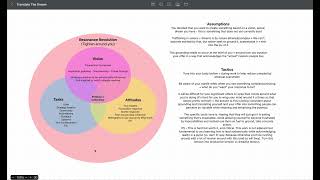
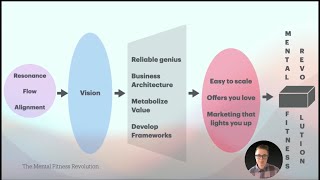
The other thing that I want to just mention is the way that I like to try to help people break it down into something that feels more manageable tactically. Yep. Is doing work in, like, identity psychology. So. So some of this has to do with heroic, you know, the eating, moving, sleeping, focusing, which I'm sure you're quite familiar with. But on top of that, how we create an economic engine around our energy so that the business becomes a renewable resource, as opposed to something that sort of drains us over time, like a battery. So what?
Identity, how we create an economic. And I'm just going to write that down.
Oh, yeah, sure.
Yeah. Economic engines. You know, those are words. I love them and I've never. I've never thought about them.
Yeah. So what this gives us permission to do is to identify and then double down on the parts of this business that we're constructing that really make us come alive and either get rid of or delegate. Ideally just get rid of. But if it's really truly needed. Delegating the things that don't allow us to come alive.
Yeah.
So that the business, the work we're doing, gives us the same type of energy that our energy protocol gives to us.
Yes.
Because I think there's a false. A little bit of a. I don't know if it's. I think it's a mistaken belief, like the energy has to come from eating, moving, sleeping, focusing. I think also we can get that same type of energy from the business that we're creating provided.
Absolutely.
Construct it and architect it in an intentional way. Does that make sense?
Yeah. Yeah. 100. Yes.
Cool. So once we've got that identity really cohered, you know, who we need to be to step into the level of success that we want. We start talking about high and low leverage. We get really ruthless about what the high. The high leverage things are for us, and we get incredibly mindful of when we fall into low leverage tasks.
Yeah.
So now we've constructed the identity and energy, we've focused it in high leverage. This should lead us directly into flow state.
Yeah.
So we basically use identity leverage and flow to make steps bigger, steps faster. Does that make sense?
Yeah.
So leverage being depending on where you're at and what you're trying to build. Let's use the example of sales calls. Okay. Depending on where you're at, those are either going to be high leverage, you're going to get lots of data, or they become the bottleneck.
Okay.
Because you've already gotten enough market research, you're really familiar with the problems and the pain points that a person might have. So all of a sudden they are the bottleneck that keeps you from growing. So determining what the what. Excuse me, Determining depending on where you're at in the creation of the vision, what the high leverage and low leverage things are for you to be doing and being really intentional about removing. Be being really intentional about being unwilling.
Yes.
To engage in low leverage tasks. Because frankly, you would be better served by allowing yourself to play in some white space than spending two hours in low leverage tasks. Does that make sense?
Yes, absolutely. Yeah.
So the idea is to construct an architecture of your business where the tasks you're doing, and this includes client delivery, you know, the back end type of thing, your creation of the modules that you're going to be doing for your membership. This all occurs in 20 hours a week or so. Right. We don't. You can extrapolate it to, you know, many more hours than that. But the point is, is there any true glory in working 50, 60 hours a week? Anybody can do that. Yeah, but how many.
Yeah.
How many hours of flow state can you stack together? That's an entirely different challenge. And that's where we're really trying to organize ourselves so that this becomes more like a flywheel. You're just so energized by what you're doing that it sort of cranks into the next cycle. Yes, that makes sense. Cool.