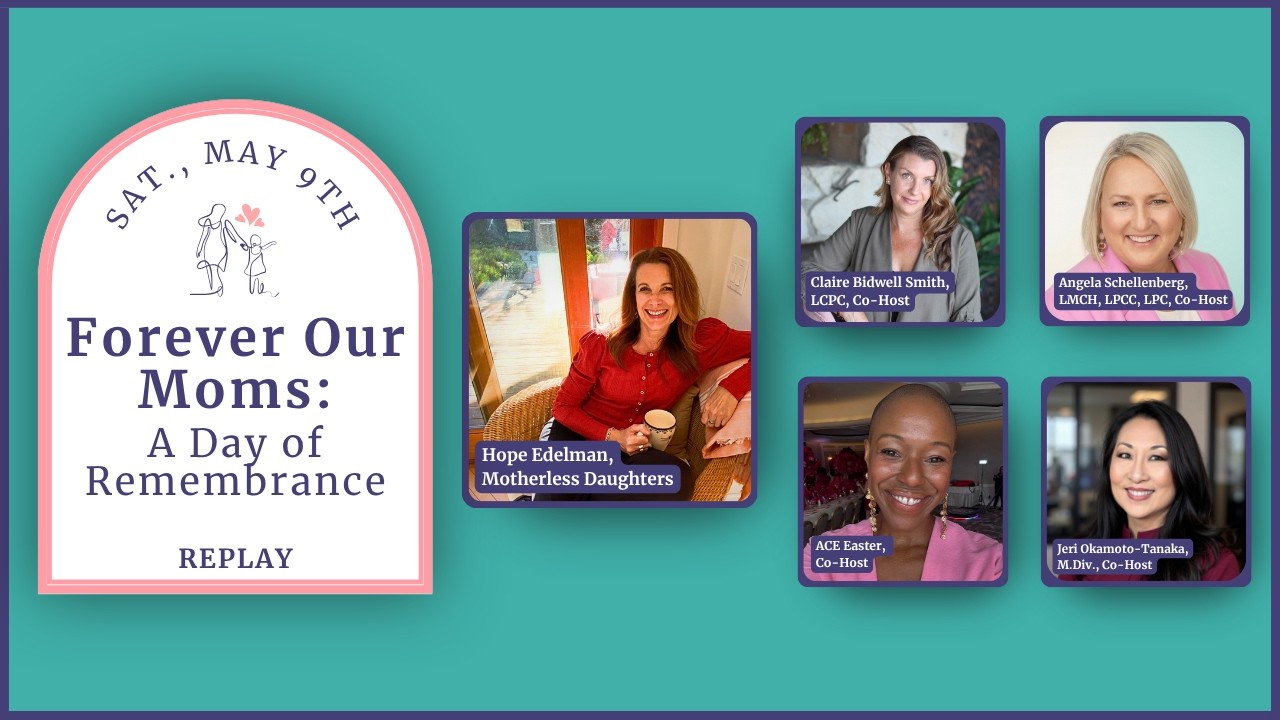
The video is a live‑streamed, hour‑long Motherless Daughters community gathering held on the weekend of Mother’s Day 2026. Hosted by Hope Edelman, author of Motherless Daughters, the call brings together five co‑hosts—therapist Claire Bidwell Smith, grief‑and‑trauma therapist Angela Schellenberg, yogi/somatic healer Ace Easter, and chaplain Geri Okamoto Tanaka—plus admin Sabrina Davis. The purpose is to provide a safe, ritualized space for women (and some men) who have lost a mother or mother‑figure to honor their loss, share grief, and learn coping tools. The program unfolds in several parts: (1) opening blessings and personal introductions that acknowledge the historical roots of the event (first gathering in 1996, 30‑year anniversary); (2) Claire’s narrative about her own mother loss and encouragement to give oneself permission to feel whatever arises; (3) Angela’s psycho‑educational segment on mother loss as an attachment trauma, the four trauma responses (fight, flight, freeze, fawn), and nervous‑system regulation (window of tolerance, self‑rating scales, grounding techniques such as EFT tapping, bilateral eye movements, nail‑bed squeezing, toe‑wiggling, breath work); (4) Ace’s guided meditation that uses heart‑centered imagery, golden light, and breath to foster self‑compassion; (5) Geri’s blessing and the “Circle of Remembrance” ritual where participants virtually hold a hand‑hold, state their name and their mother’s name, and raise candles or cups; (6) Hope’s heartfelt open letter recalling her own mother, the evolution of the Motherless Daughters community, and the symbolic meaning of grief as love. Throughout, participants are invited to share emotions, ask for support, and practice self‑care. The call ends with collective gratitude, a toast, and encouragement to continue the community’s work.
Chapters
This hope.
Hello everyone. Hello, hello, and welcome to Forever Our Moms, a day of remembrance, an hour of remembrance, a weekend of remembrance. Hello. I see— I can only see a little bar across my street, across my screen. So hello Cassidy and Gina and Stefania and Betty and Jill and Jenny. You're at the top of my screen, and everyone else who's coming in right now. I'm Hope Edelman. I'm the author of Motherless Daughters and the founder at motherlessdaughters.com. And I'm here today with 4 co-hosts: Claire Bidwell Smith, Angela Schellenberg, Ace Easter, Jerry Okamoto Tanaka. And we're going to guide you through the next hour for our annual Mother's Day weekend call. I also want to introduce you to Sabrina Davis. Some of you may be familiar with Sabrina, who's the admin and program assistant at Motherless Daughters. You may have received emails from her in the past. She's going to be here on the call today to assist us to let people in from the waiting room, and you can DM her in the chat box with any questions that you might have. Sabrina, would you like to say hello to the group, and is there anything you'd like them to know as we start?
Yes, sure. Uh, my name is Sabrina Davis and I have been part of Hope's team for almost a year now. I'm truly honored and grateful to be part of this beautiful community. I'm also one of you. I lost my mom to lung cancer when I was 26 years old. And as part of this community, I'm very grateful to have a space where I can be understood, supported, and connect with other people just like me, or people who get sick. Thank you for this opportunity, Hope.
Thank you, Sabrina, for everything you do. I'm already crying, and I don't have tissues. I have everything here, all my, all my accoutrements, but no tissues. So that was, that was an oversight on my part. But it's an emotional weekend, and we want you to know that tears are welcome. We are very tissue-friendly. We believe crying is an important form of emotional release. So if the tears come for you, that's to be expected, and that's welcome. And if you, you know, need to take a break and come back, we welcome that too. Any form of self-care that you feel will be nourishing to you today. So I want to welcome you all to this call. It is a special annual event. On Mother's Day weekend, there have been ways and celebrations to honor mothers who are no longer living for several decades. But this call in particular is near and dear, I know, to a lot of our hearts. I'm going to say about 10 or 12 years ago, Claire and I started doing this annual call on this weekend. And we used to do it on a conference call. This was pre-Zoom. It may even have been pre-Skype. I think the first 2 were maybe just on the phone. And then we May have done some on Skype before Zoom came along. So we want to welcome you to this one and just give you some support on Mother's Day weekend. As I said, I'm here today with 4 co-hosts. We're all going to take a portion of the call, so I will let everyone introduce themselves. But I just want to acknowledge.
How—
what an incredible dream team this is. We did the call together last year. And so of course, we were going to try to do it again together this year to give you some much-needed support on this weekend. There historically hasn't been a place or a space or a time carved out on Mother's Day weekend to honor mothers who are no longer living. We spend time Celebrating mothers who are living. And for those of us whose moms have already passed on, we often feel that there isn't a place for us this weekend. If we have children of our own, maybe we're being honored on Mother's Day. Maybe we are expected or even happy to acknowledge our mothers-in-law or our stepmothers on this day. But it is always— and how can it not be a reminder that the mother that we wish we could spend this day with Isn't here, and that can bring up a cycle of grief. So it's our intent and our hope to offer you a place where your mom cannot just be acknowledged and your loss cannot just be tended to, but she can actually be honored as the person who gave you life and the woman she was. So that's what we're going to be doing today. So as I said, I'm here with Claire Bidwell-Smith, author and therapist. Angela Schellenberg, therapist, grief, trauma, and EMDR expert, Ace Easter, yogi and somatic healer, and so much more. Jerry Okamoto Tanaka, who's going to lead us through our blessing. Jerry is chaplain. Is that the correct terminology, Jerry?
Chaplain.
Jerry's been to seminary. She's been a member of the Motherless Daughters community for almost 10 years. And Gerri last year opened up our call with a blessing and ended it with a toast. And we thought it would be a nice container for this year's call as well. So Gerri, why don't I hand it to you? Maybe you could say hello to the group, tell us a little bit about yourself and lead us through the blessing to start off our call this year.
Sure.
Thank you so much, Hope. And welcome sisters and siblings. And it's such a gift to be with all of you here today as we gather from around the world, as I understand it, connected through our mothers, but also as connected through our loss, but also hopefully connected through hope, both Hope Edelman and just the hope in general in this really precious and sacred time of gathering this morning. So I'm Geri, the daughter of Chiyo, a mother who lived, as we learn in the Motherless Daughters Circle, also a mother who died, But a mother who I'm still in relationship with.
This—
my mom and I spent many Mother's Days together, but I've now spent 34 Mother's Days without my mother, and that's more than I was able to spend with her. So her sudden passing when I was a younger adult really left me lost in many, many different ways, but including spiritually. And so that's the area that I kind of leaned into to ask those big questions of why, why my mom, why when she was the age she was and the age I was. And when I was looking for a pastor to do her funeral service, I returned to my Japanese American Methodist roots, which the Methodist Church is actually where the very first Mother's Day was held. And as Hope has shared with us, it was actually a motherless daughter's Mother's Day because the founder was looking for a way to pay tribute to her mom. So I've been on this long spiritual quest that led, as Hope said, to going to seminary. I still don't have all those answers, but I found answers and comfort in this community through the retreats with Claire and Hope, and someday, I hope, with Angela, and, um, being part of the retreats and the circles. I'm still a part of a circle, so a shout out to my dear circle and retreat sisters. So this opening blessing comes to you from my heart, I think from my mother's heart as well. And it's for all of us, whether we've been walking decades or maybe just days, right, since our mothers have passed. So I'm sharing a blessing from a poet, Jan Richardson, who was inspired by Henry David Thoreau, who said, there is no remedy for love but to love more. So, sisters and siblings, let us come together for this blessing. Let us agree for now that we will not say the breaking makes us stronger, or that it is better to have this pain than to have done without the love. Let us promise we will not tell ourselves that time will heal the wound when every day our waking opens it.
Anew.
Perhaps for now it can be enough to simply marvel at the mystery of how a heart so broken can go on beating, as if it were made for precisely this, as if it knows the only cure for love is more of it, as if it sees the heart's sole remedy for breaking is to love still. As if it trusts that its own persistent pulse is the rhythm of a blessing we cannot begin to fathom, but will save us nonetheless. So, dear ones, as we begin this time together, I invite you to place your hand over your heart in a gesture of self-compassion. And feel that pulse of your heart that's still beating since the day you were born, and even before, since the day you were adopted or somehow came into relationship with your mom. And it's been beating since the day that your mother died, giving you the force of life, giving you love, giving you the pulse of compassion. So throughout our time today, if emotions arise, you need to feel a little something special, give yourself some comfort, just bring your hands back to your chest and remember that love is going to help the love to continue. So with all that, I'll send it off to Claire.
Oh, Jerry, you got me really emotional. I always cry every year on this call too. I show up all year as the professional grief therapist I am in all kinds of settings. But it's this place and this community where I feel most connected. And I feel most kindred with all of you. I see all of you here on this call, everyone who's showing up today. And it reminds me of the first time I Stepped into a conference room for Hope Edelman's first annual Motherless Daughter Conference. What year was that, Angela? Hope, was that, um, 2014? And I remember I, I took the stage in this conference room and I looked out at the audience and it was a sea of women. And I realized that every woman there in some ways knew me better than my best friends. Because we shared this commonality of losing a mom and walking through the world without a mom. My mother died when I was 18, and next year it will be 30 years since she's been gone. So I'm coming up on my 3 decades of carrying this loss. I'm a mom myself to 3 kids and 3 stepkids, so 6 altogether, and This time of year and this date, I'm just always just very conscious of everyone who's coming into this weekend and everything that they're carrying. I'm so grateful to Hope for creating this space each year. I think over the last three decades of carrying this loss for myself, I've just had many different understandings and many different points at which I've come to understand what it means to carry mother loss. And one of the very first moments of that understanding was. You know, gosh, 25 years ago when I walked into a bookshop in New York City, and I tell this story every time I'm with Hope, but I walked into a bookshop in New York City and I was only a few years into my mother loss, and I came face to face with this floor-to-ceiling display of Motherless Daughters, and I just stopped in my tracks, you guys. I bought it. I couldn't read it, but I bought it, and I stood there, and I thought for the first— it was the first thing, the first moment in my journey when I realized that there wasn't something wrong with me, that this loss was a big deal, and that there were maybe other women out there who were also carrying it. And it was the very beginning of me starting to really heal through this community and find this community. And it was so meaningful. And I'm always so grateful to Hope. And I couldn't believe it when I met her several years later in person, and then we began to work together. So today, I want to talk with all of you a little bit about Just all the different losses that we're feeling on Mother's Day. I know some of you here today are experiencing Mother's Day for the very first time without your mom. And I just want to acknowledge how hard that is. All of us sitting here on the screen have, have had many, many Mother's Days now without our moms, but the very first one can be so blindingly painful, so overwhelming, so scary. so heartbreaking. You might feel numb, you might feel anxious, you might feel angry. You might feel scared, you might want to close all the blinds. I think back on my first Mother's Day, and, and I barely remember it. I was so numb. I was so disassociated from myself, my body. I couldn't understand that this was happening in my life, that I was going to have to carry this loss. Couldn't fathom that I would one day be decades out from it. I didn't know how I was going to be in the world without my mom. So the first Mother's Day for me was, was very numb and very painful. And then in later years, it was kind of just very sad and very hard. You know, I started to be in my body more with this loss, carry it. And I think realized that I would be walking for years. Jerry, when you said that moment about our hearts beating ever since the day our mothers died, like, sometimes I still can't believe it. You know, how can I be here without her? And I think the compounded— for those of you who have been carrying this loss for a long time, the compounded years and grief and accumulation of it can feel very heavy around Mother's Day, that we're still doing this. Sometimes I get— I've had years where I'm just sick of it. I'm tired of my grief. I'm tired of carrying it with me. I'm tired of being a motherless daughter. I don't want this identity anymore. I want to be done with it. I've had other years where I've felt very peaceful with it, and I feel very accepting of it. I feel ready to open up and honor it and be in ritual with it. And it's different every year. So I really want you to give yourself permission to meet yourself where you are this year, this weekend. I think coming here, being here with all of us is so important. And that is a way to hold yourself in this space, but really give yourself permission to let this year be whatever it needs to be. And please give yourself permission to ask for support from the people around you. Even if they don't get it, even if they don't understand it the way we do, you can still ask for support. You can still remind them that this weekend is hard for you. And Hope mentioned, you know, some of the other women in our lives that we're facing on this weekend. You might have a stepmom, you might have a mother-in-law that you're honoring, and sometimes that can feel really hard to do when you're carrying this loss. And I always recommend in that case— Yeah. In case— sorry, one of my kids is calling. They always call in the one moment and window of which I'm on Zoom. But I think if you have to go into Mother's Day tomorrow and either be celebrated by your own children or you need to be celebrating another woman in your life, taking time before you do that to honor your mom and yourself, whether that looks like lighting a candle and looking through some photos, talking to her, writing her a letter, writing her a card, creating something in her honor, just taking any small private moment where you are in communion with her, you're feeling her energy, you're giving something to her, you're receiving something from her, and just honoring her. I think it can really help us go into those other moments. My kids love to celebrate me on Mother's Day. It's very sweet. They're aware that I don't have a mom. They really like to just show up for me, but I don't actually really like it. Like, I don't want to be celebrated. I don't want to do Mother's Day. I feel this pressure to show up for them so they can show up for me. And it's like this whole weird thing. And the only thing that makes it feel okay is that I've been here the day before. I've been with all of you who understand this. And we've come together and held hands virtually. And that's— it makes it much easier for me to go into that, if that resonates with any of you. So I just want to, you know, again, remind all of you just to give yourselves permission to meet yourselves where you are. Please find some way, big or small, to honor yourself and your mom this weekend. Just being here and showing up to this is part of that. But if there's anything small you want to do. I love writing. I think writing is the most powerful tool for grief— not one of the most powerful tools. So write her a card, write her a letter, go to the store, buy a Mother's Day card. You still get to do that. Pick out the one you would love to give her and write her a note in it. You don't have to do anything with it, but just do that. It feels so good. All right, I'm going to hand it over to Angela to talk about all kinds of other good ways we can take care of ourselves through this weekend. But again, thank you all. I'm so honored to be with all of you.
Thank you so much, Claire. I'm tearing up as I'm doing this. Feel my heart, Jerry. Welcome everybody. My name is Angela Schellenberg and I am a grief and trauma therapist. And I lost my mom, I always say twice, once when I was 11 to mental illness and she was institutionalized. And then I lost her again when I was 22. And in the middle of that, my father was gunned down and murdered. And It was so much trauma by the time I was 22 that I didn't even know what trauma was. And I told myself, you know, as I come of age, I never thought I'd be a grief and trauma therapist. I didn't plan on that, as none of us do when we lose our mom. The way that it shapes our identity, our self-esteem, and our safety—it's so big. And I just told myself, you know, there's so many things that I didn't know about the trauma and grief. And so I wanted to share a few of these things with you as you're kind of coming. If you're new here, your mother has just died. I also like. like Claire. Um, my mother's name is Golda, and I, I found her book the year after when my mom died. And it was— I was at Washington State University— go Cougs if anyone is here from there— and I saw it in the bookstore, and I just carried that thing around like a Bible. And I was just so thankful. And I see in the comments, many of you, how this community has changed your life, and it's changed mine. I feel like you guys are my sisters and my family. I don't have any family because all of it is gone, and I do have 2 twin boys and my husband, so I want to count them too. But I'm so thankful and grateful for this community. Um, I wanted to start with, uh, you know, when my mom first died, like you, Claire, I don't remember that much. And that is really trauma. You know, it's so fragmented when you're 22 and that trauma lands in your body. You have this sort of fragmented memory that happens. And mother loss is an attachment trauma. I want you to hear that because I don't think we talk about that enough. I didn't know, you know, that all the ways in which that trauma was showing up for me. I would get highly anxious, I would forget things, I would, you know, be living at a level 10. It was just so much to take in. And the reason that it's a trauma is because if you think about your brain, there's 3 things that your mom gives you for attachment. So there's the nurturing piece where she— if you're lucky enough to have this, some of our moms have their own generational trauma, so they did the best they could. But there's that nurturing piece where they look at you and say, oh my gosh, honey, you're looking up into the left. Did something happen to you today? You know, that's the nurturing piece. Protection, you know, your mom protected you and made sure you were safe. And guidance is where, you know, maybe your mom went, hey, have you thought about this? Maybe you're hanging out with this crowd that isn't good. You might want to look over here. Or I noticed you're into tennis. Do you want to take some lessons? So those are the things that we get from our mom. And when she dies, We don't have that anymore. And that's an attachment trauma because our brain is constantly looking for her, constantly looking for that attachment. And we're just— we don't understand, and our brain doesn't understand how that happens. And so I want to just reiterate that again, is that losing your mom is an attachment trauma. And there's other traumas, you know, if you're caretaking or your mother dies suddenly, there's acute trauma. But attachment trauma really goes with mother loss. I also want to talk about the 4 trauma responses. Some of you may or may not know this, but there's 4 trauma responses. So there's fight, and you might find yourself in 2 of them predominantly, but there's all 4. So there's fight, which is like self-preservation at all costs. Like, I remember I'd get so mad at the clerk. I mean, I don't think Starbucks was going, but I wasn't into it at 22. And I'd get so mad and yell at the clerk, or I'd have these anger outbursts that would just be so big. And fight is kind of that where you just feel really angry. There's flight, and that's kind of self-preservation without cause. You're going faster. I always call this one going faster than my Buddha and angel can fly because you're just going, your flight. Like, I've lived in so many different countries, and I think that's a flight response to trauma that I want to keep going. Freeze— freeze is when you go into that sort of dorsal freeze mode where your nervous system shuts down and you can't get out of bed. We've all been there, and I know you're going to identify with a lot of these. Um, and fawn— and fawn is like people pleasing, where you're just literally people pleasing. You're trying to make everyone else okay. And so recognize those and know that sometimes we might think those are our personality, but a lot of times they're responses to the trauma that happened to us that keep us safe. So we don't want to judge them. We just want to say thank you for keeping us safe and also look at those and say, hmm, I wonder which one I'm in now and how can I show myself so much compassion? The 3 things that are affected are identity— who am I after my mom dies? Self-esteem— how do I love myself more? That's constant work when you don't have that person that lights up when you walk in the room. And safety— how am I safe? Our sense of safety in the world is gone after our mom goes. So I want to talk in the next one a little bit about nervous system, and then I'm just going to move to some quick tools to show you. So I have my little chart here, okay, that I got. I brought this in. This is the elementary teacher in me. But in here, this is the window of tolerance. So this is kind of where everything in your body— because when the trauma happens, it goes in the body— it lands right here. So you might feel grounded, present, relaxed, connected. You feel creative. All these things are going, and you kind of— we kind of work on widening that, trying to stay in that window of tolerance so our nervous system stays regulated. What happens is when we get dysregulated, like a lot of us are now, I was this morning, I went for a walk, I was like, oh my gosh, I gotta— I'm nervous, I've got to come down. So I can go into this fight or flight mode, which is that hype, it's hyperarousal, it makes the nervous system go like this. And we can have intense anger, we can get overwhelmed, we feel threatened, out of control, we can't sleep, our heart rate goes up. I think the first 10 years after my mother died, I lived in this state all the time. I didn't know about nervous system regulation. You know, we look to our mom to regulate our nervous system, and my mom was always up here, so I have to work really hard. I'm always like, Ace, how do I, how do I regulate? How do I bring it down? You know, and, and it's, it's real, right? This is what happens. It's a trauma response. And so what happens when you get up here, then you roll down here to that— I'll go, so go, go, go, go, go, and then I'll crash. And that's the hypoarousal, which is down here. So when it comes up here, it goes down here, and you can feel depressed or numb. Poor digestion, disconnected, shut down. And so I wanted to share this with you so that you can kind of see one of the goals of grief and loss and trauma is helping us kind of get back to that baseline. How do we do that? What do we need? Well, part of that begins with scanning, like 0 to 10, where am I? 0 is no distress at all, 10 is the highest level. And then where am I feeling something in my body, like maybe my chest or my stomach? Whenever it's stomach, It's always unprocessed emotions. And sometimes just naming the thing also helps take away the charge. So I just wanted to share a little bit of this with you today, just to kind of help make you feel like— I remember I just felt like an alien half the time, like, what's happening in my body? What's going on? What's wrong with me? Why am I so anxious? So I wanted to share that with you. And then I wanted to just go over a few— through my thing— just go over a few—
Toxic.
Just go over a few things to help you kind of calm your nervous system. So one of the things, and this is to kind of get back to that window of tolerance, the first one would be bilateral stimu— bilateral stimu— stimulation, which is EFT tapping. And this is like this. So if you can try this with me and just do this, you're tapping your left, right, left, right. And what that does is it helps take the charge out of the trauma. And it brings that charge of the trauma down by using that left-right bilateral stimulation. So if you start to feel a lot of anxiety, you can do this. I always say put your legs up on the wall. That also helps while you're doing this. That's a great help. Eye movement. If you want to try this, if you look to the left or the right, wherever one, and then look up to the ceiling, down to the floor, back to the middle, and then look to the left and up to the ceiling, down to the floor. What that does is resets your vagus nerve and helps reset the nervous system. So there's a whole bunch of these little things that I'm just going to give you a few more. Another one you can do is kind of an— this is a somatic, and soma means body. Our trauma lives in the body. So We're constantly trying to regulate and get ourselves regulated. You can go to the left and then do an eye roll all the way up to the right and then try that again and then go all the way up to the left, and that just helps also reset the nervous system. Another trick you can do is squeeze your nail beds. If you squeeze your nail beds like this, you can do that, like, if you're on a Zoom meeting at work, you're feeling highly anxious, it's really hard, you can just squeeze the nail beds, which is really helpful. One other tip that I love is stand on one foot. If you're standing on one foot, You can't be dysregulated because you're literally in your body, so that's another trick that you can do, and I have my clients move sometimes when they get dysregulated. I say, stand up and then breathe, so we'll do some breathwork. Take a deep breath in, hold for 4, and just make sure that your exhale is longer than your inhale, so if I hold for 4, I'm going to exhale for 6, and I like to have people put their hand here and really feel that exhale. Okay, so these are just some of the things that you can do when you start to feel anxious. You can also do the self-hug where you're doing this, and if anyone has any things that have really helped them, please put it in the chat because you never know, it can help some people when we're feeling that anxious and out of body and just trying to come back to our center. So those are some things that I just wanted to share with you. Also, if you're standing there, wiggle your toes. If you wiggle your toes right now, it kind of brings you back to the present moment, and that can be really helpful as well. You can splash cold water on your face. That's a great one. To kind of get yourself back in your body, taking a shower. If you were really— I threw my thing, but if you're really, really high on that hyperarousal, sometimes this is really important. If you're really high, if you all of a sudden go to still meditation, that can be really triggering because you have a lot of trauma in your body. So if you're really high, take a slow walk, right? Do some moving meditation rather than going to the stillness. So just notice where you are. and literally try to do some things to downregulate yourself. Or if you're frozen, another thing that's important is just start by wiggling your toes and start by just slow movement because you've got to come out of that state. So I wanted to share this with you because I think nobody shared it with me and I thought I was going crazy at the time. I'm like, why do I have so much trauma? What is happening? I can't do this. Visualization, I just read that, that helps too. Guided meditation, any visualization, that's also so helpful. So these are just some things that I thought I'd share with you as you're going Mother's Day. You know, I'm a mom myself, have twin boys that are now the same age that I was when I lost my mom. And so I struggle with the same thing as you, Claire, is wanting to show up for them, but also feeling so deeply sad and missing her so much, and then getting so tired of missing her. I'm like, will it ever go away? And the answer is no. I went with hope and tried to put my dead mom in Machu Picchu, and that didn't work. So there's no, there's no way that we get rid of this loss. We just are always holding it, and it's difficult. So I just want to say, if you're here, thank you, and, um, take care of yourself. Reach out if you have any questions or anything. I'm here. So thank you, and I'm going to hand it off to Hope. Oh, you're mute, Hopie. Okay, thank you.
Thank you, Angela. Thank you, Claire. Thank you all for being here today. We had a Zoom glitch, and I'm so sorry to those of you— for those of you who are joining just now, we expanded the size of the room, and somehow the room did not— this room did not expand. So we're feverishly working on it on the back end. People are coming in now. Sabrina will be letting you in. You will get a recording of the first half hour of this call so that you can get caught up. And, um, well, we're letting you in right now. We're really sorry. Um, again, if you'd like to drop into the chat box where you're calling in from, we always love to know. Um, I'm calling in from Venice, California today. All of us, all 5 of us here are West Coasters. And, um, I know we have people calling in from Europe and from India and from all over the world. So please let us know where you are today. We'd love to welcome you into the larger sisterhood. So every year, I take time in the week leading up to Mother's Day to let you know— we— somebody here, if somebody here could mute, we would love to. We've got some background noise. Thank you so much. If you could keep your microphones off. Every year, the week of Mother's Day, I write an open letter to motherless daughters. It's been tradition for about 20 years. And this week was so, so, so busy. There's just been a lot happening over here in the lead-up to Mother's Day that I didn't really have a big chunk of time to sit down and write to all of you until this morning. So this is really hot off the press. I woke up at 6:00 AM and got on my computer with my coffee. And so this is the letter that I wrote. To all motherless daughters, but really very much this morning with all of you in mind. So I will read it for you right now. Dear motherless daughter, I'm sitting here today on the Saturday morning of Mother's Day weekend 2026 at home in Venice, California, drinking from a mug of coffee while the cats eat their breakfast behind me and the refrigerator softly hums. Every year, this is both a busy and a solemn weekend, a time of activity and contemplation. Every Mother's Day, I remember my mother, Marcia, of course, who died in 1981. I remember her bright smile, her frosted hair— it was 1980, after all— her chicken cacciatore, her blue Oldsmobile station wagon, the way she loved Chopin and Sidney Sheldon books, and 1970s disaster movies and big glasses of Tab. Remember Tab before Diet Coke? Big glasses of Tab and her 3 children. And I also remember the moments and the joys of being a full-time mother, of the ever-present laughter and the frequent chaos and the overwhelming fears as I raised my 2 daughters, both now in their 20s and out in the world. living full lives of their own. But mostly this year I'm thinking of you and all of us, and specifically 120 of us, because this year is the 30th anniversary of the very first Mother's Day weekend gathering for motherless daughters. On Saturday, May 11th, 1996, 120 women came together in New York City for the first event to honor mothers who were no longer living. The luncheon was sponsored by the Motherless Daughters nonprofit organization that had been started by 5 women in New York the prior year. And just as an aside, the office for that nonprofit was on the 9th floor of a building on Lower Broadway in SoHo, and the suite number of that office was 911. True story. On this Saturday in 1996, we gathered at a restaurant in Manhattan. with CNN cameras that were there to film us. And at the very end, we launched a tradition that we, we came up with in the Motherless Daughters office that year. And then at the very end of the event, all 120 women stood up in a circle and held hands. And we went around the circle. And one by one, we said our names and our mothers' names out loud. We called this a circle of remembrance. Just like the love that ties mother to daughter and daughter to mother, these circles of remembrance have been an unbroken chain of connection for 30 consecutive years. We do them at the end of every retreat, at the end of every workshop, every conference, every luncheon. We do them at the end of every Mother's Day virtual event, as we will at the end of this call too. There is something inexplicably powerful about being in a big circle of other women who've also lost their mothers, especially on this day, on this weekend. We have a saying at Motherless Daughters retreats that there may be 24 women sitting in our circle, but there are 48 women in the room because it's all of us and all of our moms. So right now there are 328 women in this meeting room. So we're here to remember 328 mothers with tenderness and with love. And so that means, if I get my math right really fast, that's 656 women who are being represented on this call today. We've come together today to make a collective statement to say our mothers didn't just die, They also lived, just as Jerry said. My mother who lived. We're saying that our mothers mattered, that they still matter, that we remember them and we cherish the time we spent together, however brief it may have been, and that the love we feel for them lives on. There's a popular saying right now that grief is love, and it's a beautiful sentiment, and I won't tell you it's not true because grief is love. Or to be more specific, it's what we feel when our love can no longer connect with its intended object in the physical world. But grief is many other things too, as I'm sure all of you know. Grief is sorrow, and grief is numbness, and anger, and despair, and relief, and confusion, and guilt, and mystery. and awe and gratitude and appreciation. If you're feeling some or most of those things today, please know there is room here for them all. Grief is a country that no one wants to visit. But once we enter it, we realize how very vast it is, and also how many others have journeyed across the same borders too. No one is a tourist in this country of grief. Once we enter, we are all granted temporary residence, the kind that allows us to come and go with enough frequency to notice when subtle, subtle changes are occurring between each visit. That corner store that was here last time, it has since gone out of business. The house across the street, it's been painted a lighter shade of blue. A new traffic light. went in down the block. The neighbors across the street just got another dog. The landscape is mostly the same, and also it is different. Each time we visit, we're different too. Are you the same person that you were 20 years ago? I mean, in some ways you're fundamentally the same, and in others you're probably more mature. More ripened, more fully realized as a woman, as a human. I'm not the same woman who stood in the circle with 119 other women in New York City in 1996, still searching for a place to belong in a world without my mother. That's very much who I was then, but I've found that place to belong through this work and through all the women I've met who've also crossed that border into the country of grief. Sitting with them, hearing their stories, discovering I'm not alone. It is not an exaggeration to say that this very special form of sisterhood changed me for the better, and that is my hope for you too. That's why showing up here today is not a small thing. You are carving out a space and time for your mom grief this weekend. You're giving it the attention And the intention it deserves, perhaps the attention you were not able or not allowed to give it in the past. You are taking a stand by saying not just that your mother matters, but that your grief matters too. Your tender, jagged little heart matters. You matter. And that is the most beautiful and profound act of self-mothering. That I can imagine. We have another saying at Motherless Daughters, that the best way to honor a mother is to take good care of her daughter. So well done, daughters, every one of you. By being here today, you are making your mamas happy and proud. This weekend, you are lifting their hearts. You are assuring them that you will be able to manage without them. Because you know how to nurture yourself. You will miss them, of course you will, and you will continue to love them forever in their absence. And you will live in a way that honors them, because in the words of our dear Ace Easter, you will embrace moments of joy. And as a mother myself, I can vouch for both the relief And the levity that comes from knowing our daughters can do that. This is my wish for you this year. All 5 of us are so honored that you've chosen to spend this hour in the company of each other and in the company of us. So may the rest of this weekend for you be one of peace, of self-compassion, and of finding grace and joy. in all the small things. Thank you. I will now, with gratitude and admiration, hand the call over to Ace Easter, who's going to lead us through a meditation. Thank you, Ace.
Thank you, Hope. I love you. Um, oh, Claire, Angela, thank you so much. I love you both so much. And Jerry, it's lovely to see you. You guys are also beautiful. Thank you for that blessing at the beginning. I've just been watching the chat, and I've also just been watching faces that I can see here on the screen. And there's a deep desire of being in a space of like, yes, I get to cry here. And there might also be a sense of like, okay, it's also— is it okay for me to feel glee?
Mm-hmm.
Not glee that my mom has passed away, of course, but glee in the fact that, like, I still get to live here. I still get to breathe. I still have breath in my body, meaning that I still have options and I still have time. And as we all know, that time is not something that we can negotiate. It is what it is. But what we can be is in charge of of what we do with the time that we have here in this life. And so coming to this call for an hour to have yourself be seen between the snot and tears, but then also maybe the smiles and the sparkle that comes with growth. The fact that you may have been coming to this call, been working with Angela and Clare and Hope and Gerry for some time now, and there's a bit of levity that's come over the years around this day for you, even if it's hard, because it is. It's never not a little tender. I've been without my mom— this will be my 24th Mother's Day without her. I have no idea what it was that first couple Mother's Day was like. I was 19 when she died, and my birthday happened. 5 days later, she passed away. This is all in April, and then a couple weeks later is Mother's Day. So I was in college, there's no way I was paying attention to what was happening. But I do know over the years and coming to terms with the, the fact that I didn't know what was happening, I wasn't grieving, and so many other things was happening in my body. I was holding it in my body. And as an active person, I sought solace there. And then thereafter, I sought solace in the mind, in the heart, and in the ethereal, and the spirit, and all those sort of things that has brought me here and with this beautiful group of teachers today. And so, I am just always honored to be in the space and sharing it with Hope, who I knew well before she ever knew me. And being able to hold space with her at her retreats and on these calls is just so— it's been really healing for my journey as a motherless daughter and being able to, for the last 9 years now, which is kind of wild, being in a space of being able to hold space for other motherless daughters like myself on actual Mother's Day. And I'm doing something tomorrow with a dear friend of mine who's also a motherless daughter. And we both got to a place where we knew that it was our time to share, to share the grief and whatnot that we'd gone through and experienced and allow it to not be in vain, but allow it to be in service of. So I'm just grateful to be always in service. And so, as you journey through your body for the next few minutes, I'm just gonna ask for you to just really drop in, really just allow yourself to not even feel the need to respond, to react, to share a message, to say a me too, to really just be here for the next few minutes, eyes closed if you can.
Mm-hmm.
Fingers relaxed if you can, toes relaxed if you can, and just let yourself receive. Let yourself hear, starting with the beautiful beating of your heart, as Jerry started us with during our beautiful— with such a beautiful blessing. Hearing the beautiful beating of your heart, and even that reminder before you were even born, your heart was beating with within someone else is beating along with your mom. So there was 2. And if there was more of you there in the womb, then, you know, multiple hearts. So understanding that when your heart beats now, you're never alone because you've never been alone. Part of your mom is still beating within you. So as you relax your fingers, I'm going to invite you to just imagine sparks of light traveling up through the bottoms of your feet, through your fingertips, from the crown of your head. And they're going to find a sweet place to nuzzle right next to your heart. Allow this golden light of energy to be whatever it needs to be for you to feel held right now. Is it your mom? Is it your granny? Is it your auntie? Is it a mom-like figure that was instrumental in you being who you are today? Allow your authentic energy to meet her by calling your energy back, calling your energy back from whatever it took for you to get here. Call your energy back from the anticipation, the anxiety, the worry, the wonder, the gut-wrenching pain of perhaps this being the first time you're celebrating or honoring or being on Mother's Day without your mom. Call your energy back. If only just for the next few moments. Call your energy back so she can nuzzle up next to this beautiful golden light, this nook, this cozy nook next to your heart too. Maybe the golden light looks at each other with such Admiration, maybe such sorrow, longing, nostalgia. But at the end of it all, it's love. So much love and gratitude for life. A thank you for my ability to be here.
So much of the pain here.
Like my hip flexor.
Here.
But it's been a while.
My ability to be here. It's okay. Sorry about your hip flexor. Um, please mute yourself and we can deal with body aches later. Right now we're just allowing ourselves to really be held by this light that's next to our heart, looking into the eyes of the golden light that's with us right here, right now. Such beautiful glee. And maybe you start to whisper to yourself or out loud, because we're all muted and at home or wherever we are. Thank you. Thank you for creating me. Thank you for ushering me. And we're thanking this light That is our mom or the mom-like figure who brought us into this world and made us who we are today. Thank you. And we say, I love you. It could be, and I miss you. And I'm so glad I got to be yours. And you get to be mine. So move throughout the rest of the day, the rest of the weekend. As you may, and as it feels right, Sherri again beautifully instructed us to do, bring your hand to your heart again as a way to remember that I started in this life beating, 2 hearts beating, mom's and mine.
Mm-hmm.
So even though the physical— her physical presence is no longer here, my heart beats. So spiritually, emotionally, energetically, hers always beats with mine too. Take an inhale here through your nose.
I—
It out, let it go. With such gratitude and grace and love, inhale here through your nose again. And exhale, sigh it out, let it go. Whenever you feel ready, you can open up your eyes or stay remaining there in the space of feeling the golden light. And then I will pass it to Jerry. Thank you.
Thank you, Ace. That was beautiful and relaxing and so meaningful. I'll share too that I'm a mom of 2 young adult daughters who came into my life through adoption, and we have a huge circle of adoptive sister siblings in the adoption community. And I, I believe on the call today are some of those sisters who've also lost their adoptive moms in addition to their birth moms. So I just want to name that and say that you are seen. And I know I might not have given birth to my daughters, but I still feel like our hearts sometimes beat in sync because of the love that we've shared as mother and daughter. So we are gonna come now to a time of honoring our mothers individually, but also together in community. And I, I'd like to just think all the moms, wherever they are in that next space, are somehow gathering together, enjoying this opportunity to get together and to see how we're taking care of each other as well as ourselves as our mothers' daughters. So please get your cup or your candle, or both, or whatever trinket is meaningful to you, and we will start this toast. So, beloveds, we light this candle of love that will illuminate our way forward from what once was to what is now. To what is becoming and what is yet to be. So let the cups we raise in tribute to our mothers that sometimes feel empty and broken, with nothing in them, maybe be mended and filled in this circle today, filled with love, maybe a little bit of sorrow, a little bit of laughter, a little bit of—
Thank you.
the essence of your mother, but also filled with all of the women in this circle today, all around the world, who share with you this feeling and this sense of your mother loss. So let that sink in. All around the world, we raise our cups and our candles to all the moms and to each and every one of you. With love. Forever our moms, forever their daughters, forever, forever. Cheers. And I will drink. And we will circle back to hope.
Thank you so much, Geri. That was beautiful. And thank you, Ace. That was just what I think we were all looking for today and this weekend. Love you both so much. And Jerry, thank you for mentioning adoptive moms. I want to acknowledge other categories in addition that might be represented here on the call today. We may have women who have recently lost grandmothers who were mother figures to them, or sons. There may be some sons on this call too. We may have women who are grieving stepmothers who stepped in to become mother figures to them. We may have women on this call who have lost children, and so this Mother's Day is a particularly tender holiday for them, every Mother's Day being so. And so there are also women raised by aunts or other mother figures or foster mothers that they might want to acknowledge. This weekend as well. So we open our Circle of Remembrance to include any mother or mother figure that you would like to honor on this weekend, anyone who has passed. I'll explain the Circle of Remembrance to you now. It's, as I mentioned, for those of you who've joined us recently, this is a signature feature of all Motherless Daughters events. We did it for the first time in 1996. At the very first luncheon for Motherless Daughters on Mother's Day weekend, and we've been doing it every year since. So we're thrilled that you're all here to join in the circle today. When we do them in person, we stand in a physical circle and we hold hands. And I think it was either our first or second retreat, Claire, when you taught us the special Motherless Daughters handhold. That our chef Goya maybe told us about. Can't remember, but but we do it every time now, and we've passed it on to other to other circles as well. So even though we are virtual today and we can't do it, I'll explain it to you in a moment. We'll virtually hold hands in our special motherless daughters circle handhold, and then we say. our mother's name and our name together out loud, because out in the world we may call our mothers mom or mommy or mama or mother, and we don't often say her name. And so many of our mothers, all of our mothers, have beautiful names. I know, Claire, your mom's name is Sally, and Angela, your mom's name is Golda, and Jerry, your mom's name is Chio, is that right? And Ace, can you remind us what's your mom's name?
So we can acknowledge her.
Cynthia. Cynthia, that's right. And my mother's name is, we say, is Marsha. So we say our name and in alignment with our mother's name as a representation of the enduring connection that exists between us. So I would say Hope, daughter of Marsha. If you'd like to also add granddaughter of, niece of, stepdaughter of— please feel free to do that in the circle. When we're in person, we go around and we hold hands and we squeeze the hand of the person next to us and we speak one by one by one. I think we've done it with as many as 200 women at a time at a luncheon or a conference, and it's incredibly powerful. We can't do it that quite that way on this call. So we choose to get ourselves in position. And then I say 1, 2, 3, unmute, and then we all say it out loud together. And I really encourage you when you get the link to the, to the recording, that you listen to that part again on the recording, because it's so amazing to hear. 329. We have right now in the room 329 women say their name and their mother's name out loud at the same time. I feel like it's an energy that transcends time and space and links us together all around the globe. So I hope that you will have an opportunity to do that after the Circle of Remembrance. We will close. We hope to see you at any future events that we do, any virtual events, any real-life events. There are a number of women here I can see on the screen who've come to retreats, who take part in our community calls, who have worked with Claire and Angela and Ace and me, and may have met Jerry at retreats. And so we look forward to continuing that relationship with you in whatever way is possible. But for now, we will do the circle of remembrance for the 30th anniversary event. 30 years. So the handhold is we put our hands out in front of us with our thumbs up, and then we turn both of our hands to the left. And if you can't get it's okay. There's always one who goes in the opposite direction, and then we just do a fast correction. It's okay if you're on the right. But the idea—
Yeah, but if there was somebody next to me, it would be this way.
I mean, next to you, that way.
We need someone to mute just for a second. So we will ask you all to unmute at the same time. Not quite yet, if it's okay. And we will put our hands out and both to the right, and then we open our hands like this. And we move them over to the sister next to us. So, and this is so that when you are feeling low, your sister can lift you up. And when she well, she can lift you up. And when you are feeling low, she can lift you up. And we do that, you know, at the same time. So, if you would like to get your hands sort of like in position now, you have to mute, of course. So that's a problem. But I'll say one. 2, 3. And then if you'd like to unmute and say your name, daughter of, and then anyone else that you'd like to acknowledge in that moment. And when you're done, please unmute and we'll come back together for our goodbye. All right, everybody. So as we gather in our circle of remembrance to honor our mothers, holding hands, Across time and space and the ether. Let's go ahead. One, two, three.
Jessica, daughter of Deanna Renee Davis.
Jessica bringing us home. Thank you, Jessica. Oh my gosh, that was amazing.
Yeah, daughter of Patricia.
I'm not crying, you're crying. We're all crying.
It was 660 mothers and daughters here acknowledging their connection to each other. It was really, really beautiful. Women, thank you so much for spending this time together, um, and for being here and loving your moms as you do and supporting each other as you do. Um, this is something really special that we do every year, and I hope we can keep on doing it. Thank you. And be here for you and help you find ways to be here for each other. So Claire, Angela, Ace, Jerry, you truly are a dream team for this call. Blessings, a special blessing to all four of you this Sunday, and extended blessings to the 319 other women on this call and anyone who's watching it. Afterwards, on the recorded version, we see you, we hear you, we feel you, and we're here for you. Have a beautiful weekend, everybody. Thank you. Love you all. Bye. See you. Thank you. Thank you. Thank you.
More from Hope

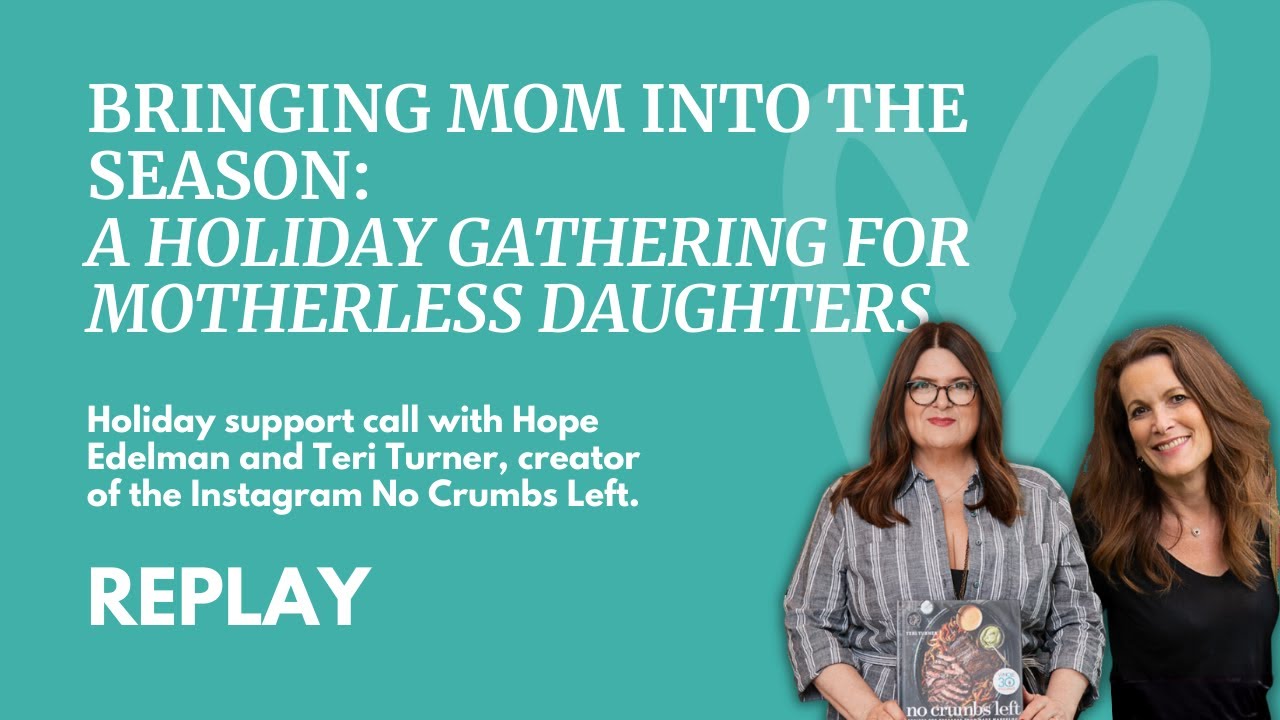
Bringing Mom Into the Season: A Holiday Gathering for Motherless Daughters - REPLAY


Childhood Trauma & Complex PTSD ~ A real conversation with author Stephanie Foo