Ian Ugarte (speaker) argues that affordable housing and profit are compatible. He recounts leaving paid employment within 13 months using an affordable-housing strategy and describes a market mismatch in Australia: houses have grown substantially in size (35 m² in 1881 → 246 m² in 2011) while household sizes shrank, producing excess 3–5 bedroom stock. He proposes converting standard large houses into communal living arrangements (individual bedrooms with private bathrooms/kitchenettes plus communal areas) to double rental income (example: turning a $420/week four-bedroom into $800–1,000/week by creating multiple $200–250/week units), reduce rents for tenants, and build community; he also highlights vulnerability among 55+ single females.
Chapters
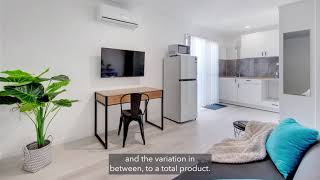
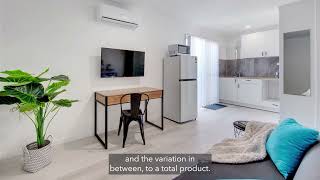
Hey there. My name's Ian Ugarte and I want to talk to you about affordable housing and the great profits that you can make. Now, a lot of people say, isn't that a contradiction? That you're actually doing affordable housing and you're making profits. Is that possible? Well, it is. Now, I can tell you, as a position of a former investor that invested in negative gearing, it's a disease that you can get over. I found myself in a position where I needed to get out of paid employment as quick as possible, and negative gearing wasn't going to do it for me. So what I did was actually implemented a strategy in affordable housing that got me out of paid employment within 13 months. And I want to talk to you about that. Now, what it looks like is this. The Australian housing mismatch is that when hotel rooms were costing a lot of money to rent out for a night, a place called Airbnb started and actually fixed a marketplace so that now I only need to pay 200 to 300 for a hotel, and if I want to, I can go somewhere else in an Airbnb platform and actually rent something for $120. Uber came along and fixed the taxi industry. And with the taxi industry, what we found was that they weren't actually producing enough for making customers happy. Uber came along, lots of happy customers. Now, right now, what I can tell you is that in 1881, we built a house that was 35 square meters. By 1960, it became 85 square meters. And in that 85 square meter house, it was 3.8 people. In this three, at 35, there was actually 5.5 people. And if we fast forward to 2011, in 2011, Australia built the largest houses in the world at two hundred and forty six square meters. And each one of those houses there was only 2.5 people. Most of these houses were four bedroom, two bathroom developer stock, which is the worst stock that you could put onto the marketplace today, if that's what you're going to do. Investing in property. Now, what I also want to say to you is that there's a mismatch in the marketplace, because when you look at the marketplace, 80% of the people that are looking for rent are either singles or couples. And ironically, 80% of what we have in stock in the marketplace that's available for people to rent are three, four and five bedroom houses. We have a market mismatch that you can fix in the blink of a second sometimes on your existing portfolio. Most of the time in your existing portfolio or any other property that you're going to go off and buy. Because let me look at what it looks like for you. Let's take a standard everyday four bedroom house. You'll have a bedroom down here, you'll have three bedrooms up here and you'll have one kitchen and lounge area. Now as a standard return and I can tell you there's some studies in the metropolitan area of Australia where the four bedroom, where a four bedroom house rents for $420 a week. So this is a four bedroom house but a two bedroom house actually rents for 415. So you're going off and you've built an extra two rooms, an extra hundred square met for a $5 return on your investment. That's not a good return investment. But what if I said to you that you can take planning policies around the country and that within somewhere between two weeks to four weeks you can get approval to take that exact same house and convert it and create a communal in area in here. And each one of them can have their own bathroom and sometimes their own kitchenette and use one communal area. And each one of these couples or singles will, will now be renting somewhere between 200 to 250 per week. That effectively means that when you were used to get $420 a week rent, you're now getting 800 to $1,000 per week. Double your income, half the house in this case, double the income, quarter the house. Now you might say, well you know, really, what does it really mean? Residents that stay in our properties are great residents. They actually save a half to one third off their normal rent. The investors do really well out of it. And what happens is we create genuine community with the people that live in that house. Because what we've done is we've provided some diversification in housing. I know that when I grew up in a street in Sydney that I had multiple different houses in my street with multiple different people. Right now it might surprise you that the biggest growing demographic of homelessness in the country is the 55 plus single female. These are women and men that you would not realize are actually homeless because we no longer see the face of homelessness. We have great tenants that pay great rents and give us great returns. Now smallies and you big that's what we're all about. And I really appreciate the time that you've taken to watch this video and listening to my message.