Ian Ugarte walks through vendor-finance strategies for buying residential property without bank approval or large deposits. He covers asking sellers to carry part of the price, rent-to-buy deals, 100% vendor financing, and lease options, with worked numbers on cashflow and how to protect yourself with a registered caveat.
Chapters
Morning everyone. How we going? Just arrived in Sydney and so a little bit later than normal for Sydney time, But.
Still about 8:30 in Brisbane or Queensland where the.
Cows don't know what to do if they change the time or the roosters wouldn't know when to crow or the.
Curtains would fade with the extra hour. That's why we don't do daylight savings up there. Morning, Sue.
So I, I'll talk about vendor finance this morning just while we're on the way, going across to Neutral Bay to see brandheart, who's working on our brand. And effectively your brand is the, the brand is not the McDonald's logo, it's not the apple apple, it's the culture behind it. You know, when you talk about brands you talk about Google, whatever. So that's what we're working on, making sure that it's transferring through into our business from what our. Why is. Anyway. So vendor financing is.
A way to be able to get into property on a couple of different levels. And I know, you know, I've broadened, I've broadened the topic by saying vendor financing, there's a number of different styles of vendor financing financing and what you can do to get into them. And we've done a number of styles of indoor financing over the years and it's really quite an exciting space, especially when you don't have cash or you don't have the serviceability to get loans or you don't have both. And you know, circumstantially there is a lot of people in that situation where they don't have cash to buy into property and they also don't have the ability to fund loans which, and especially now with the APRA changes that have happened at levels. So let's. Morning, Sean. And so let's look at how the number of different ways that you can vendor finance. The first way to vendor finance is to simply ask. That's when you have serviceability, simply to ask the vendor to leave some money in the deal for you. And that would be, you know, if you can get an 80% loan, you would be asking the vendor to leave 20% in the deal. Or, or you might give the vendor a little bit of money and then he or she will vendor finance the rest. So that is, you will pay them interest on their money. Sometimes you can get away with paying no interest on it. They're just happy to sell the property. So vendor financing will work.
Thanks, Jeremy. Vendor financing looks.
At a position where sometimes the best time to vendor finance is when they, the Vendor is in a position where it's a non saleable property. It's a very difficult property to sell for various reasons. It could be the markets down, it could be a unique property, it could be presented very badly. It could be that the, the vendors themselves have got themselves into trouble and need to get themselves out quickly before the banks start closing in on them. There's a number of different circumstances where vendor financing work. So why don't I start where vendor financing won't work? Vendor financing will not work in a hot market unless you're very good at able to give the person that's selling an opportunity to make more money. Right. So that's where you'd probably be doing a vendor jv, which I'll do as another topic rather than vendor financing. So when you, when you look at the scenarios of what's possible and the availability of what you can do, the, the first thing is to ask the vendor to leave some money in the deal. You will generally pay the actual price of the property and they will normally say yes because they've been tried. Well, there have been multiple attempts from the market and their real estate agent probably trying to condition them down and down and down. You come along and say happy to buy it because there's potential in your property and if you could leave the money in the deal for a set period of time, we will take it. And I'll give you an example. The last vendor finance we did was on our own ppr. Actually we had our money tied up in other deals, deals and we didn't want to and we had some money to the side but we didn't want to chew that up because money is better spent in manufacturing the growth in other deals rather than buying a ppr. Some people will not, will actually not buy a ppr. Some property investors have a very strong position in a PPR being a loss of money, in which case you're far better off actually renting someone else's house as a PPR rather than tying up your money that could be making manufactured growth somewhere else. So for example, I've got a mate in Melbourne, his name's Tim, very, very successful investor and he rents his home. So he rents from someone else. If he wanted to buy that, it cost him two grand a week to rent that house. If he wanted to buy that in interest only if he catered. If you looked at the money being tied up, it would probably cost him three grand or more per week to buy in that same area. So he says, you know what, I can Rent here. If I don't like it, I'll just out and go somewhere else, which, you know, you can do. Chris Gray, some of you may know Chris Gray, he's a very staunch supporter of the fact that you should never buy a ppr, should always put in your money into investments. But anyway, I digress. So our last one was our PPR where we said to the owners, we're willing to pay you the full amount, we're not going to condition you at all. We knew that the property had potential for uplift and it was exactly the property that we had been looking for as well. And we essentially said to them, we'll rent it from you for a year, let's agree on a price now and we will buy it from you in a year's time. Can you allow us to do some work to the property? And we. The sticking point here is always going to be your real estate agent, if there's one there. And that's because when, with a delayed settlement like that, we essentially have to. We, we agreed to pay the agent half up front, I think it was, and then his commission was, was looked after for at least half the commission and then that came off the price at the back end and we simp.
We just simply paid an amount of interest on that property for the term of that year. And when we worked it out, it was actually because it had two dwellings on the property, we paid them, I think it was 750 a week or 700 a week, 720. We rented the granny flat for 300 or 350. So essentially we were paying 350 a week versus the interest cost of a thousand a week. So to rent a house for $300 versus a thousand a week in cost, if you owned, was a far better opportunity for us so we could make money somewhere else on an investment. So that's one style of indoor financing where you go in and you simply say to them, let's leave now for the protection of the owner. What they'll want to do is obviously you need to protect their money. Their legal team will usually try and drag this style deal down because they're saying you've got no protection. In which case you would say to them, we will give you a registered caveat. And on the registered caveat you try and do it so that it actually doesn't end up on title. So they, it's what they call a registerable caveat and that is if they, if you miss a payment, if they get a bit. Not sure about it, they Just simply go down and within an hour the caveat gets put on the property so that you can't sell the, sell it on them and they've got an interest registered on the caveat of that property. So if, if that's the, that's the, the main danger is that if someone went and sold it and then they would have no, they'd have no control or grasp or being able to get their money.
Unless it was a lengthy court battle, which you wouldn't want to do. So that's one way that you can vendor finance. The other way you can Vendor Finance is 100% vendor financing. So we know we've got Mark in Victoria who's one of our high risk team members and he has Vendor Finance probably six or seven of his last deals at one of them at 100%. So it was 100% vendor financing. He bought a small block of three units off a little old couple that we're just going to stick money in the bank. And he said rather than sticking it in the bank and getting 2%, why don't I pay you 5% and you can be the first mortgage holder across this property. They went in, spent about 20, $25,000 in the first year, got 27 grand of income by the changes that they made using high risk strategy. So that's another way. 100% vendor financing, you might have a 20% deposit that you put down and that you give to the owners and then they give you 80% loan at a higher rate. So it's 6%. And with this, the little couple is usually a really good.
A really good vendor to aim at because they are simply just not wanting to have to look after the property anymore. And they are happy to take a higher interest payment than just sticking their money in the bank. Now a lot of them, and remember with anything that you do in, anything that we do in property is always going to be a hit and miss. You know, you're not going to get 100% success rate. If you think you're going to get 100% success rates, especially when you're doing load to no money down deals, you know you're going to get some no's and so you're going to need to knock on doors more often. So that's a standard vendor financing style. And then you can move into what they call lease options or vendor finance options. And that is a term that's used and it depends where you are in the country. It actually has been.
You know, when you're driving around the Streets. And you may not have ever seen this, but if you see signs that are nailed to telegraph pole posts and trees that says we buy houses now, that's a particular educator who has had a pretty bad run as fund as far as the authorities are concerned in recent times. And I don't think is allowed to operate in some states anymore. But take that out of the equation. I'm not going to comment on that part of it. But we buy houses is simply a tactic of buying. So you buying a house from someone else for an amount of money and then on selling it to someone else who can't get into the housing market and then that way, and you sell it for a slightly higher rent and slightly higher value and you take the in between. Now some people go, well, that's not very fair. You're making profit or someone instantly. Well, it's not an instant profit, it's actually a long term profit. It's not my preferred strategy as far as doing deals because ultimately you don't own the property at the back end of it. You are, you are controlling the property. You're not owning the property. So let me give you an example.
There's.
A man or a woman that want, let's say there's a guy that wants to sell his house. It's basically worth the same as the loan. Okay, so let's just use some round numbers here. So the loan amount is $300,000. The value of the property is 315. Say, okay, so you see it advertised on Gumtree. There's a number of different sites around that actually specialize in advertising this style of property. And so I'd go and let's call him John. And I'd say to John, hey John, I see that you're trying to sell your property. If you sold it for 315, how much would your loan be? And he'd say, oh, it's about 300,000. Okay, so by the time you've sold this and paid your agent, how much money would you have left over? And you essentially would say it would only be, you know, 10 to $15,000. After paying an agent, you go.
Changing lane. I've been guided by Siri and Christine.
So you say, okay, I will buy this from you, I will give you the $15,000 up front right now. But rather than, rather than me selling you, selling the property to me, I want to be able to pay you an amount of money to cover your loan and cover your extra debts that are on top of the property for a period, three or Five years. And the guy and John says to me, why would you do that? I say, well, because I've got a friend that wants to buy the house as well, but they can't buy it right now. But I'll look after all the costs. So let's say it is $300,000. That's probably, that's 15 grand a year in interest. So that's 300 plus there's some extra costs of about $50 for insurance rates, you know, all that sort of cost that comes into the property, property. So you go, righty o. So you say to John, I'll give you 15,000 up front. I'll give you $315,000 for the property and I'll also pay for all the costs and you can just go off into the sunset. And this style of deal is something that we do all day long. Don't worry about it, we'll look after it. So John goes, well, as long as you're paying the 315 up, so you're paying me the 15 grand that I'd have in my pocket. And as long as you're paying for the costs of the property, I would be more than happy to sell it to you. Now there's, it's not as simple as just saying that. Obviously there's going to be, there's going to be an intercept of different negotiation in that. And you know, again, it's a hit and miss. So you go, right, so now you've controlled the property, you're essentially in the property in control. And you go out and you advertise the property for sale for say 3, $350,000 dollars. And you'll say no deposit or low deposit to buy in. So Sarah comes along and Sarah is a nurse, she's only just started her job. She's got a small deposit but not a lot. But she wants to get into the property market. And you say, okay, Sarah, well what I'll do is for $15,000 I can get you into a property and for $15,000 I'll sell it to you for 350, but you don't have to buy it.
Say three years from now or five years from now. Now the reason that I can justify selling that property at a higher price than what I'm paying John for is because in three or five years time we would hope that the property market goes up and in capital and that by the time they own that property, that's now worth the money, if probably not more than what they're paying, especially five years and especially if you do it in the right market. And a lot of these people hurt for a long time and that's why they're willing to sell, because they just want to get out of the problem.
So we then say to Sarah, okay Sarah, what I also want you to do is rather than paying $350 a week, I want you to pay 500 a week. And Sarah says, well, I've got the income, I just don't have the serviceability for time because the bank doesn't look at me because I've only just started my job or whatever it is, whatever the reason is that could a bad debt across the mobile phone that's affected their credit rating. There's a number of different circumstances and there's a huge amount of people that cannot get loans in the market right now. So you go, okay, so you've now agreed to sell it to Sarah at 350 in three or five years time. And she's paying $500 a week. So let's say it's three years. So the 15,000 that Sarah gives you, you literally hand across to John straight up. Now you can get a higher payment. You might get 25 grand, which means instantly you've got $10,000 in your pocket right now you go, okay, let's say it's just the 15 you've swapped straight across, but now you've got $350 is what you're paying John, but Sarah's paying you 500 and you might say to save.
So you say okay, I will, I will be getting an extra $150 a week. And you might say to Sarah, for the extra hundred dollars that I'm extra 150, a hundred is going to come off your end price.
So over three years.
Over three years you've paid off another $15,000 off the buy price. And, and then you're also getting $50. Now I'm using really low numbers. This can work out to get for you to get $150 to $200 to $300 a week, depending on how you decide to set this deal up. So let's go through the numbers again. I've paid $15,000 to John and there's still $300,000 owing on that property. Sarah's given May 15. That's where John got his money from. I have to pay John's cost of 350 a week, but Sarah's giving me 500 a week. And out of that, 550 is mine and a hundred dollars is coming off the price, but it's still mine because it's, it's. I'm ultimately, I'm selling a property. It's part of the thirty five thousand dollars money I'm gonna make over, over the three years. And at the end, because Sarah's paid 350 less than fifteen thousand dollars, which is 35. Three hundred and thirty five, she's now paid another fifteen, so she's down to three hundred and twenty thousand dollars. So at the end, I would then sell it to her for the same amount, but she only owes me an extra $5,000. And that's why the beauty with this strategy is it actually gives you, it gives you the potential for a. For Sarah to actually develop a credit rating because she's been paying a high amount of the money onto the property and making.
And making, and making the property worth it. So it's a very confusing strategy when you first hear about it. When you sit down and start doing the numbers on it, it's actually not that hard. It's quite simple. All you're doing is grabbing something at a lower rate and then selling it to someone else at a higher rate over a period of time. And the price of the property is hopefully going up for both of you and them. Now, what happens if people default? Well, if people default, you simply take control of the property again and then you take back the property and you end up in a position where you get another person to go into it. And remember, you were paid 15 grand up front anyway, there are insurances that are required. I had this, this one made of mine. Tim from Melbourne has done in excess, you know, of 80 plus of these deals. So when you have 80 plus of these deals at a hundred dollars a week coming in, like, that's really good cash flow. Remember though, at the end, you don't end up keeping the property. And it took me a long time to get Tim to understand that. I wanted him to keep more and more of what he was doing on these deals. And ultimately he's done that in a different strategy and he's doing smackingly well. I tell you what is really impressive about how he's doing what he's doing. So anyway, that's vendor financing. We will do vendor JVs, I suppose pretty soon around how you actually work with an owner to get the most out of your properties. And we'll work that. Alrighty, thanks for this morning. See ya.
More from Ian


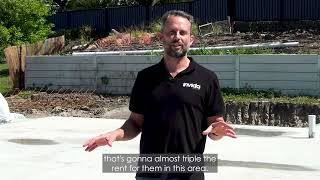
Check out INVIDA's latest project ...an adaptable home with universal access. (30 seconds)

Check out INVIDA's latest project ...an adaptable home with universal access. (60 seconds)

Check out INVIDA's latest project ...an adaptable home with universal access. (120 seconds)