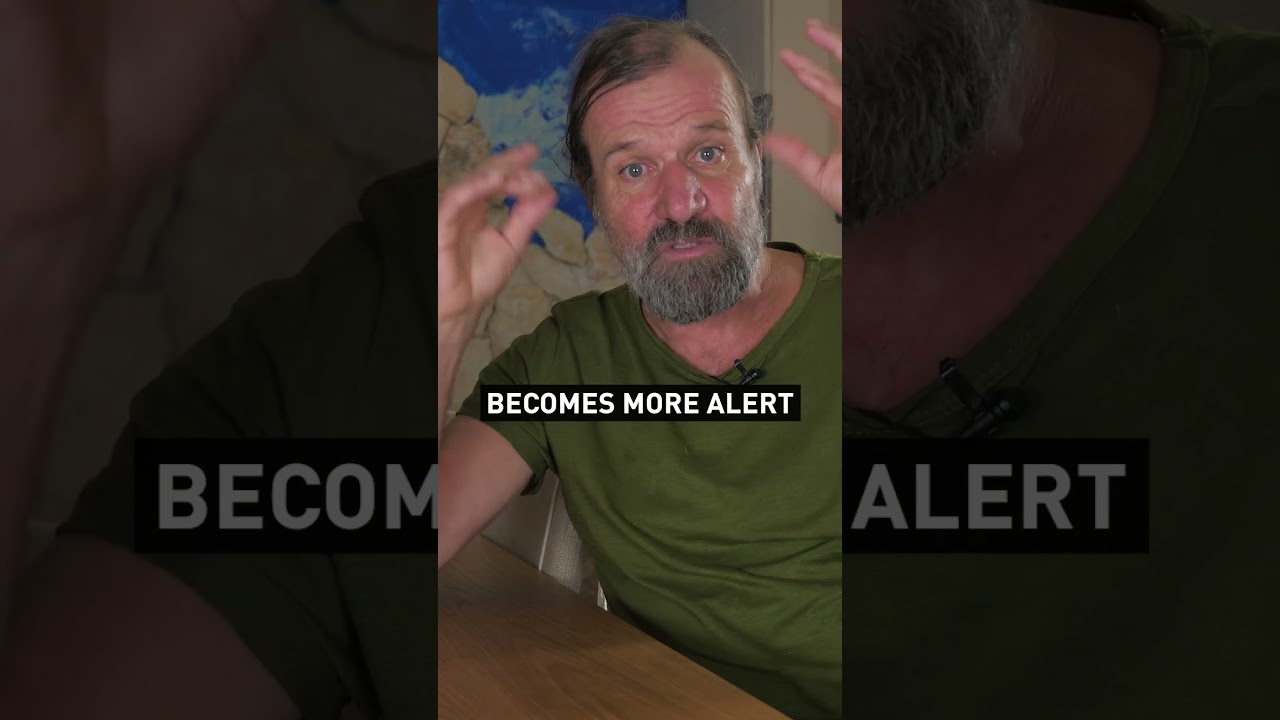
Wim Hof taught himself Sanskrit in the 1970s to read the Upanishads and Vedas, then wrote his own yoga manuscript in 1988 with hand-drawn illustrations and invented asanas. He sees yoga as silencing the mind and building body awareness to prevent disease, developed alongside his cold-exposure work.
Chapters
Look at my hair. It was still there. In 1988, as a result of a lot of practice before and trying to get into the depth of what yoga really is all about, because there was nothing of yoga the way it is right now in those times. It was intriguing because we had no idea what was coming out of the East. For us, it was mysterious, something unknown. But we were opening up, maybe because of the Beatles. I wanted to find my deeper self coming in bloom, full bloom. I think that's a birthright for everybody, but it's not a fact. It's not real. In this society. So I had to go and dive deep into the yoga, into the scriptures, because yoga to me was the best non-dogmatic technique written from thousands of years. And I had to update it. I had to find a way to get an understanding of the real depth, because the blah blah about prakriti, the purusha, aham sarvasya prabhava matar sava and all that. Was like Latin or gibberish to me. I taught myself in Amsterdam how to read and write Sanskrit and to get into the scriptures and to have a full understanding of the Hinduistic culture, which is very much related to yoga. In '72, when I was 12, I already was very interested in psychology, Hinduism, Buddhism, in music, scriptures, readings, and all that. Yoga in those times was something unknown. That was strange. Don't do it. It's wrong. The man is strange there doing strange things. But I was already into that. So I had to find— I went through this matter of the old scriptures, the Upanishads, the Bhagavad Gita, the Vedas, all that through Sanskrit. Through an Indian teacher, a priest, he taught me. Yes, I was the only Western guy there in the mandir, in the school. Of course, I was a stranger in those times. I was a stranger. And then I found techniques that I can understand with my Western mind, that I can practice, wherein I feel instant elevation of my being. Where it came from? I had no idea. So I began somewhere. So it says here, yoga. Yoga is yoga, chitta vritti nirodha. Silencing the modifications of the brain. Of the thoughts going down. And how do you do that? Yeah, through yoga. I made some nice little drawings. When did you write this book? This was in '88. So this is in '88. '88, I came and I wrote this book with my little means. I had very little money. An old typewriter. Tick, tick. That was my technique. Tick, tick, tick. And so there you got it. And drawing some pictures. Nice. Like me meditating, going into the tree. You know, to be one with the tree. And the tree sees you. And I see the tree and I'm one. You know, fantasy. Yes, and sitting in Pahattmasana. The lotus. Yeah, just put your knees in there, do some stress on your knees. It's a sort of a drawing book because I had no real photos. At a certain moment I had somebody with a photo camera and he made photos of all the asanas and things. We got many, many types of yoga. Kundalini yoga, hatha yoga, kriya yoga. Go on, huh? Trying to explain it all. And when I wrote the book, as a conclusion, this is it, this is that, this is that. I was still into this psychic being locked up in this society. I tried to make an attempt to find myself, the deeper self. That was quite difficult in those days. But I had my discipline. I went into the cold water. I had developed my own kind of yoga, you know, instinctively, intuitively. I could not really understand what this was all about. This was a different culture coming from thousands of years ago, and it appealed to me, but really understanding, I did not. It's too esoteric, too far away. Oh, here, look. This was an exercise. Eka Hastasarira Uttanasana. This exercise was actually in no book on Hatha Yoga wherever in the world. I just invented it. But because I knew my Sanskrit, that's why I called it Eka Hasta, which is one limb. Eka Hasta Sarira. Sarira is body. Uttana is lifting up. Asana. Eka Hastasarira Uttana Asana. One arm bended, I call it now. Look at them flying, eh? It's all in. Body awareness is here. Fully present. I tell you. Yes. This was one of my exercises. And of course, Adho Mukha Vrksasana. The tree. The tree I knew in many, many ways. To stand on even on one hand. Nice, nice exercise. Just standing on your hands. The handstand. Oh, here. Look at this. The Durvasana. Durva, he was a man with— he was a wizard, but he was always angry. He was always angry and he was known for his anger. So they made an exercise that controls his head. Because the anger goes through the head, you become a rat. And if you put your leg on the back of your head, you bring down the anger. And that's Durvasana. Yeah, man. Look at my hair. It's still there. It's funny. Sama Kon Upavisti Konasana. Yeah, it's like a nice little spread. I call it the sandwich spread exercise. But then the Hanumanasana, which is like this. It's good for blood flow in the loins and all. It's nice. I call it a get your balls on the ground exercise. Hey, it's a free translation, you know. No disrespect, no disrespect. Just twist your feet. Just twist your feet and your ankles and do something with your body. And then feel proud to do it. Yeah, I know. Yeah, more of those exercises. These are the asanas. And asanas means seeds. Asana literally means seed. The seed of the soul needs to be good. That's our medium, our body, our vessel. The vessel of the soul is the seat. So it needs to be good. And Hatha Yoga actually is body awareness to prevent from disease. Oh, here I got into a sort of— when you get into pranayama, and it was in '88, when you get into pranayama, then explain it, Pranayama is not just a little breathing exercise or something. You go into the mind. And this is like going into the mind to make it big. And then we got into the Sanskrit. And of course, I think it was him. He is now a little bit grown up, but he's still a baby, my baby. When you were young, you were writing over my book. Yes, he wrote into that book, you know. That's what they do. The new generation still don't give a fuck about what daddy is doing. Oh, but it is my book and you cannot do that. But it stayed. And now I am proud. I remember a beating. Uh-oh, don't tell that. We are into yoga, man. We are into peace and love and all. We cannot talk about that. That is really wrong, by the way. No, there was no beating. No, I know, it's just jokes. So I did this book. I came, I did this book, and that was beautiful in 1988. Use it as? Now you can— yes, exactly. You can use it for your ass. This is what you said. As toilet paper. Yes, it's a little bit sturdy and hardy as toilet paper. But no, it shows that to get to know some things in the beginning, you have to take on things you never will use anymore later. And that is the preliminary stages in which I got to know that Knowing this is what I should not know. Or what I should leave. And that's what I did. I know my shit, but then I left it. Yeah, alright. Going to the toilet. Oh yeah. Hey man, I tell you. You will not have a good time. Thanks, man.