Ep. 594: Mel Dorman | How Seller Financing Helps Women Build Wealth Without Banks | #InvestHER
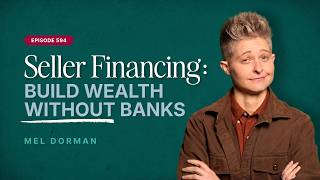
Mel Dorman explains seller financing as an alternative to banks, where you negotiate price, down payment, interest rate, and term directly with the property owner. A $500 investment in a triplex generated immediate cash flow through an interest-only note. The approach keeps wealth circulating among individuals rather than institutions, especially as women inherit the coming "silver tsunami" of intergenerational transfers.
Chapters
In today's market, you can't afford to rely on just one financing strategy. Seller financing can open an entirely different path to growth, one that's creative, relationship-driven, and often far more accessible than most women realize. In this episode, we're talking with Mel Dorman about how to use seller financing to build wealth without depending solely on banks, unlock new opportunities, and expand what feels possible in this market. Let's dive in.
So what is the biggest advantage most real estate investors miss when they decide to go through traditional real estate financing versus creative? Mel, what would you say?
Well, I think you lose complete control over the terms, you know, whether it's the down payment size or the interest rate or the length of the term of the loan. You know, all of these factors most investors never think they have control over in the first place. And when you find somebody in your community that you can custom design the terms of your deal so that it works for them and works for you, then you have complete mastery over what's gonna happen in the outcome because you can control the biggest lever, which is the debt.
I think I, I wanna do a quick follow-up question here before Liz bit me. What goes inside people's head that they're listening right now is illegal, right? And I think that the, let's go further with that. If I don't know something, it sounds illegal. And I think that, right?
Especially for women, right?
Yeah.
It's illegal.
Totally.
Right? Or it's a scam or something like that. And I think that what we are trying to break down here is a system that didn't give us access to the knowledge. That doesn't mean that other groups are not, taking advantage of this for years and years ago. So I really wanna address what are people thinking when they hear that, that we are able to set our own terms when it comes down to a loan.
Yeah, I'm so glad you brought up that because, you know, as a population, we've been socially conditioned to over-rely on banks and institutions for our lending needs. And before the banks got involved in the 1930s, this is how we bought and sold real estate. We did it person to person, and we designed the terms around each one of our problems and, and what what we wanted to do. But somewhere along the line, we've lost faith in one another as community, as other human beings, and we've learned to trust logos and mortgages and lenders. And if we look historically back, those institutions are not for us. They are extractive. You know, we look at the 2008-2009 crisis. That was a product of people trusting institutions over one another, and those institutions then exploited that opportunity and harmed, you know, Over 8 million people lost their homes because of the 2008 crisis. And so what's interesting to me is as a social group, we need to re-engineer a system whereby it benefits the majority of us and doesn't extract from us. And it's just been normalized that we send hundreds, if not thousands of dollars from every American household, whether you are a renter or whether you are a homeowner in bank interest. And it's not just our housing, you know, it's our student debt, our cars, our healthcare, right? All of these things are leveraged And, you know, Americans spend most of their time working just to pay off debt. And so this is a system that we are now subjected to that we can change in these everyday activities like seller financing.
Yeah, and I wanna go back to the structuring of it in a moment, but I wanna go here for a moment that you were, a lot of this came up for you and you were deeply influenced by Muhammad Yunus. And I know he's written a bestselling book and what his philosophy is on, on, on microfinance. I know that was one of the concepts that I was so intrigued by when I read the book. How did that, that learning, and I know you mentored under him from my understanding in, in talking with you, how did that, what was the philosophy and how did that impact how you're actually structuring deals now in this, you know, kind of breaking away from the system and doing it more person to person?
Yeah, I mean, for those who haven't heard of Muhammad Yunus, he's a Nobel Peace Prize winner because Really back in like 1978, he was a college professor in Bangladesh and he decided that he wanted to figure out what is the macroeconomics in the real world. And he went to a village nearby in Jorba and he sat next to this woman and she was making little bamboo stools. And he asked her, "How much money do you make?" And she said, "Just a few cents a day." And he was shocked. So he asked, "Why is it? Because you're not spending a lot of time working?" And she said, "No, I work here all day." And he could see the quality of it was really good. So he was perplexed and he realized after he spoke with her that truly it was because she couldn't afford the $5 a day that it cost to buy bamboo in bulk. So once he realized this, he went all over the village and he asked every woman, and do you know what it costs to liberate 42 women in a Bangladesh slum in 1978? $27. Ah, I get this too. And so he went around, he gathered these women, he put them into microlending groups and he taught them basic financial literacy. And they started lending that $27. He pulled it out of his wallet right there and he said, "Hey, go ahead and use this and pay each other back." And one woman would build her business and the next woman, the next woman, and they became this little bank amongst each other. And he said this really powerful thing that I think applies to Americans right now is that the poor are not a financial risk. They're a financial revolution just waiting to happen if only someone would trust them first. And I feel we are that same exploited group who are being extracted from by all these institutions and banks, and we are overleveraged in our lives because we're just trying to survive. Yeah. I mean, that's just what it costs to survive in America right now is you have to have student debt and you have to have a mortgage and all these things just to try to get ahead. But truly at the heart of this, nobody's asking the most basic question, which is where is our money flowing? Is it flowing amongst us, between us, or is it flowing upwards to banks and billionaires and institutions? And we have full control over the flow if we just take notice first.
And considering we are facing right now one of the historical wealth transfer, uh, to women's hands. Now it's a matter of, uh, those women really taking the driver's seat, getting educated, surrounding themselves with people that they can trust, um, and verify.
Always trust and verify. Suspect.
Always. No matter what.
Trust and verify. Exactly.
And my biggest thing is that we really need to talk more about different ways, or I don't know if it is different, to be honest. I think it is just that I, my head right now goes into all the things that I didn't learn when I was younger that wasn't available to me. And I think right now with AI and with women stepping up in more leadership positions and getting more educated and taking control of their financial future. We are hungry to really understand what we don't know versus just, um, accepting the traditional ways of doing. What I really don't wanna see is that the women that are receiving the, the, the transfer of wealth, just accepting a financial advisor, um, Yes. Advice that are, is getting something out of it, if you know what I mean. Yeah, of course. And, uh, saying that this is the best that I can do. And I think normalizing having conversations about, wait a minute, I didn't know about this. Now how can I gain that as a tool to our toolbox? It's like a tool. I think seller finance is a tool to our toolbox. Not every deal will be a good fit. Not every single circumstances. So if there is a woman that is listening now and they're like, okay, I just don't wanna learn another strategy, Andresa, another thing, another like silver object, shiny object, silver object, another shiny object. But why seller finance right now in the current market? Could be a tool that could help women really take their next step towards achieving their goals?
Yeah, I mean, to your point, we are entering into what's called the silver tsunami, which is the largest transfer of wealth that our nation has ever seen. And that will primarily be spearheaded by the women, the widows that are left behind by the husbands who are leaving that wealth. And, and boomers, you know, is that generation, they're gonna have so much wealth to transfer. So we're at a critical moment in American history where we can pivot. That if we have enough consciousness and enough awareness of how to do these interchanges between people and not institutions, that we could really disseminate that wealth back to the population and create opportunities for ownership. But what people get really scared of is, again, that social conditioning. You know, you go to a bank and you do this thing, and the bank gives the buyer a loan, and the buyer pays twice as much, right? They pay for the house and then they pay for the interest, and then that's how the system works. But truly, that interest, you know, belongs to the seller. Mm-hmm. That interest could be monetized and given to the seller. Those hundreds of thousands of dollars could go to a person and not an institution. And so getting through that hurdle, I mean, there's so many professionals that can help you with this process. You don't have to be an expert in this at all. You know, there are, there are mortgage loan officers who can underwrite the buyer, for instance, and can protect you from, from accidentally making a deal with somebody who's not really ready or responsible enough to carry a mortgage, right? Just like the banks do. You can do the same process. You can have a realtor who is an expert in seller financing, help you to advertise the property just like you would if you were selling it on market normally, right? You don't have to become an expert. All you need to do is talk with the right experts who can guide you through that process at a fraction of the price that a bank will, will charge you. For example, an MLO who's going to underwrite— a mortgage loan officer who will underwrite your buyer is going to cost you about $800. If that buyer pays for that $800, which they would, they could do that with you, or they can spend close to $10,000 or $12,000 paying a bank to facilitate that process and underwriting fees. Right. So there's a savings. Talk about the contract, right? Bank is going to be $10,000, $12,000 to underwrite that contract, create a mortgage, all those sorts of things. And a regular attorney, a real estate attorney is probably going to be about $2,000. So all in on a crazy scenario, you might spend half as much as the bank if you really bought all the professionals along the way. And I think most people just don't realize they can resource themselves. They don't need to learn all the intricacies of seller financing, but other people know that already for them and can take care of that. And what's, what's like always puzzling to me, if you've ever seen a mortgage, which I'm sure you guys have seen 100, it, it's like 30 pages big. Like it's like a book. You sign a book on closing days. And seller finance transaction is about 5 pages and a high schooler can read it. Like it's, it's the most simple document, but because it's, it's a new concept, it's a word we haven't heard. And I, and it's almost like, you know, when you live in a different country, right? You learn a language at first, every word is like very scary 'cause you've never heard it before. But when you have a context for it, well, promissory notes becomes a very comforting word. It's just a promise between one person to another. It's not a scary document at all. It's like, hey, this is what I'm agreeing to. But if you've only never heard that, you don't have that context, then it's really scary. And so it's just bringing the scary out of it and bringing the professionals in to help facilitate.
You know, scary, what it is, is to sign a 30-page document without reading anything and like, yeah, do you want to sign this over here? Say, sure, it was Andresa Guidelli who wrote this, so I should be fine, right? That's the scary part.
You've heard us say it before, real estate is a relationship business, and one of the most powerful ways to build those relationships is through meaningful conversations. That's one of the reasons we love podcasting. It's allowed us to connect with incredible women, build deeper relationships, and open doors to opportunities we never expected. But to keep the show running consistently at a high level, we don't do it alone. We have an amazing team behind us at Social Chameleon, who handles all the behind the scenes work, the production, the content and distribution, so we can stay focused on serving you and growing our business. So if you've ever thought about starting your own podcast or taking it to the next level, they can help you do the same. With Social Chameleon, you press record and they handle the rest. Check them out at socialchameleon.us. That's socialchameleon.us.
us.
I'd love to dive in, Mel, in terms of the specifics of what are the types of projects, what are the types of real estate opportunities out there that the light bulb goes on? Because that's what I think is important is like, okay, this is a great opportunity for seller financing. And I'm sure not every property, the way it's structured, the way what it's, you know, what's owed on it, you know, how they're, where the, where their, you know, ARV is. I'm sure not every deal is created equally. So for you in the work that you've done, I know you've done these types of projects a lot. What are some of those key characteristics that women can start to increase their awareness in saying, hey, especially right now, you know, in our interest rate environment where it's a little higher, what are those opportunities for them? What should they be looking for?
Yeah, I like to call these the green flags of seller financing. So the first and most important ingredient Is that the seller has to have equity, right? If they're going to lend you their equity, they have to have equity. So if somebody doesn't have equity, they're not a good candidate. Second to that is they don't have plans for what they're going to do with the proceeds of their sale. So, you know, if they are planning to immediately buy something else and they need that capital, they're not a good candidate. If they have, if they have the desire to be in a 1031 exchange, that's probably not your person, right? They, they're continuing to grow their portfolio. They're, they're not looking to be your lender. If they've owned the property for for a long time, that's a big green flag, right? They, they have a big capital gains tax coming up. If they, especially if it's a rental, which is another green flag, being able to help somebody downsize and retire or somebody who's been a tired landlord and they don't want to deal with the maintenance and the tenants and the toilets, those are your prime candidates. And when those folks have equity and they don't have another place where they're planning to invest that can compete with what you can offer in a seller finance transaction, then you win. And I'll, I'll give you a very clear example. Like, My first seller finance transaction, I, I bought it for $500 out of pocket. It cash flowed day one because it was an interest-only loan, so it cut the payment down by a third. And what was so great about this transaction is because it was person-to-person, we designed everything together. And that property allowed me to, and I don't want to get too technical, but you can do multiple deals out of one property. So buying that, that triplex from the seller and designing the note, I put in the note that I could divide the note, that I could move the note. Right? So if I want to sell this property and keep the debt and move it to another property, that's going to make it cash flow because it's really good debt. I can do that in my portfolio and you can't do that with a mortgage loan, right? I could, I could, I could chop the note in half. $700,000. One, one is on the subject property, $350,000. The other one is on second position and another property in my portfolio. Well, now the subject property has tons of equity and you could sell it and cash that out. You could do a refinance, right? And pull out that equity as a down payment. So you're within the seller Yes. The debt itself becomes very malleable.
Yeah.
And it turns your seller into a lifetime lender, right? So they're in the next project with you and the next project with you. And they're so excited cuz they didn't have to become a real estate investor to do all these cool projects. But you pick up the phone and you say, I have an opportunity. Could we move this debt here and this debt here? And then I'll sell this property and now I have a bunch of capital and we go do this thing, but I need your permission to move this debt. And it, and the main key is you just have to make sure it has sufficient equity and cash flow, just like an underwriter would, right? You have to make sure that the seller's in a good position so that you never, you know, you're never putting them underwater or in a position where it's negative cash flow, but they're your business partner, so you wouldn't want to do that to them, right? Your, your future. What's so beautiful about seller financing is your future is tied to their future and it becomes a very intimate relationship. You care about their outcomes just as much as they care about yours because you're tied together financially. And it's that kind of, interpersonal relationship building in our communities that restores the social fabric that has been so shattered by the media, by, you know, the divide politically. Like so many things have shattered our trust for one another, that this is a way to rebuild that trust in a very tangible financial way.
I love that, Mel. And I never heard solar financing, I don't know about you, Andresa, but I've never heard solar financing explained in that way that that your success is dictated, connected to their success. And it makes sense, but I like, that's a really great way to think of it. The question I have is where a lot of women will go is, okay, they get that, they're aligned with that. Like, that's even better because they wanna create win-win. I think women naturally will do that, right? Where versus I'm gonna take advantage of this. No, no, a lot of women, the women in our community are not coming from that place. The one thing that they, the one thing that they do they could lack that they need to sometimes learn is like, what's fair and equitable in this situation? Fees, everything in our world is like, okay, I can charge you 20% interest, but is that fair and equitable? Right. So, so I think that's the biggest knowledge gap for women to, to utilize this strategy. So I'm curious, what are just some key, you know, you don't have to give us exact percentages, but I'm curious to understand your thinking around the— how do women determine fair and equitable? Because they want to be fair. They also wanna be fair to themselves and not just give it away or be taken advantage.
Absolutely. You know, good boundaries. We need to have good boundaries in this because again, our futures are tied. So if I overpromise and underdeliver and I have a negative cash flowing property, I'm actually putting my seller at deep risk. So it's important to underwrite the deal very well and structure it correctly. But I, I mean, the range of possibility is endless. That's what's so beautiful about this. For instance, last, last spring I had a seller who called me and she had two duplexes, or she had a duplex and a triplex and they're green, clear. And so I knew she was a prime candidate for seller financing. And so I met with her and I said, you know, Cynthia, your triplex is worth this and your duplex is worth $550,000. And she said, yeah, I agree. And I said, but I think, how would you like your, how would you like to make a lot more money than $550,000 on that duplex? And she looked at me intrigued, of course. And I said, well, I think if you sold this with an interest-only payment, you could beat out the banks pretty significantly and it would drop the payment by a third and you could boost the price by 10%. So you could create a win-win. And she was very interested. So instead of $550,000, let's sell it for $610,000. And she said, actually, I know the exact right person for this. The tenant, he's a doctor, his name's Abdul, but you know, he makes $350,000. He wants his mom to move in next door. Like it's a perfect example of seller financing, but he has one little problem. He can't get a bank loan because he can't pay interest because he's Muslim. And I said, okay, that's not a problem. Yeah, that's not a problem. I said, you know, we get to design the terms. That's what's so beautiful about the imagination of seller financing is it's two people figuring it out together. And I called I called up Abdul and I said, hey Abdul, how would you like to pay a 0% interest loan? And he said, yes, of course. And I said, great, how many years would you like to pay this off for? And he said, 7. And so I got my calculator out and I calculated what a 7% interest rate would be for 7 years and this, that, and the other. And I added it to the purchase price and we ended up selling Cynthia's, what was going to be $550,000 listed on market for $725,000 over 7 years with a 0% interest loan. And it created a great cash flow for Cynthia, $7,000, $8,000 a month for the next 7 years. And And so Abdul was thrilled because he was getting into a property on a 0% interest loan and his payment is the same. It doesn't matter what the price says, it doesn't matter what the interest rate is. It's ownership. It's a pathway to ownership. And so when it comes to fair and equitable, it's, it's really weighing what I call the four levers of negotiation. You have price terms, uh, sorry, price, uh, down payment, interest rate, and the length of the term of the loan. And those are the four levers you're just sort of pulling up and down. So if you're going to give the seller price, you got to think about, the, the term, right? If I give a high price, I need a lot of time for my appreciation to do the heavy lifting. Otherwise I'm going to be in trouble. I'll be underwater. So we gotta, we gotta move those levers separately. And then I think about down payment similarly. If I have a really low down payment, well, I need a longer term because I want to make sure I have some equity by the time I have to, you know, pay you out. And if I'm going to have a low interest rate, well, maybe I need to give the seller a higher price, right? Because they're, they're going to get a good monthly payment still. I want to make sure that they're getting what they would if they rented it out and still cash flow, right? So these are the levers and you really just custom design based on the needs of both parties so that it, it truly works. And it's really a win-win. And it's not, I, I think in real estate it's always like this framework of win-lose, like find somebody who's down and out, divorce, death, you know, trick 'em into thinking their property's worth less than what it is, flip it, make money, get in, get out. I don't care about the community. This is a very different model. This is find somebody who's responsible in your community, who's paid off all of their debt, who is afraid of the tax liability, and you structure something that, that totally changes their life. And they, they move from, landlord to lender, and they're completely passive going forward. And now they can monetize the equity that they've earned, that they, they really, that they built over time. And that's, that's truly the win-win.
I just had a wild thought. Yeah, I'm gonna say it out loud.
Wild thoughts are on deck.
I think every single damn realtor should know this.
Yes.
Like they should know it.
Exactly.
Because they come across so many Yes. People in situations that—
Yes.
It's, it's not a win-win for anybody. Even if the real estate agent gets a commission out of it.
Yeah.
You know, I think it, it should be mandatory versus us learning those—
Yeah.
Niche.
Wonderful questions as a, as a realtor. But for the women real estate investors that are listening, ma'am, here's what goes inside their head. I understand the benefit and everything, but man, do I overcomplicate when I'm trying to explain this to somebody. Yeah.
Right?
Yeah, no, totally.
I wanna know every single damn thing.
Totally.
Because God forbid somebody ask me a question that I don't know or never came across that. And then they overthink and they overtalk a lot. So for If that's you, raise your hand, whatever you are, at the gym or whatever, say me. But for that person, is there a clear, simple way to do not suffocate the other person, but shows the pros and the cons and to really explain what is the opportunity for both parties that you use that you could share with us?
Yeah, absolutely. A lot, you know, newer investors, that's the biggest mistake, right? They rush in with their strategy and their pitch, which is really the opposite actually. You can imagine if you showed up on a first date and you're like, I'd like to get married. I'd like to do it in the Bahamas. I'd like 40 people there. I'd like, you know, oh my gosh, you lost right there. Nobody wants to, you know, no family for you. You're a weirdo, right? So do the same thing. You want to find alignment, right? You go there, you listen, you know, what is your goals? Where are you trying to get to? You try to understand the urgency. Is it now? Is it in 3 years?
You know, what's the most important thing to you?
Is it getting this much money each month or is it having a, a big price? Uh, is it spreading out the capital gains? Tell me what matters to you. And then you collect these clues and you bring 'em back and, and you don't make an offer the first time actually. You just spend time listening and building a relationship with another human being that you're about to commit the next 5 to 10 to 20 years with, right? You just invest in the person first. And then once you have that, you conceptualize it. You go, okay, well based on what they told me, these clues, I can guesstimate that they would want this kind of down payment or this kind of interest rate or this kind of monthly payment. And you go back And you, you say it very simply of, you know, I think I could really maximize the amount that you could get outta the sale. I, I could, I could offer you this offer here, which is a normal conventional loan, and this would be my interest rate, and this is how much I could offer you cuz I wouldn't really cash flow. And it, it doesn't look that great, right? It's probably about $50,000 to $100,000 less than if you'd let me do it this way. And based on everything you told me, right? You know, Susan, you told me that you wanted $50,000 to go get an RV so you could travel the world. Is that right? And you get an agreement, right? Yes. Yes. And then you go, and you wanted to, you know, you wanted to get the lump sum maybe in 10 years when Johnny's going off to college. Is that correct? Great. You listen and you confirm. Okay, well, based on everything you told me, it was basically your idea. I just kind of, you know, when I was away from this conversation, I started to realize it based on what you told me. But maybe the best thing would be just to give you X amount for down payment, $50,000 for the down payment. And then could I just pay you in installments over time. I did the math and I realized that you could save X amount in taxes if we did it this way. And, and I was really thinking about your position. You know, if you cash this out, $700,000 property, you're gonna walk away with $560,000 and $560,000 reinvested at the rate of say 9% in the open market. You still wouldn't compete with my 5.5% interest only on this asset pre-taxed dollars. So could I just pay you 5.5% and then you can have a safe asset that doesn't go through the waves of the market? Yes. Would that be good for you?
Yes.
And it's like you present it in their viewpoint of what's their milestones, what they want, what they're aiming for.
I just wanna make a comment before you leave.
All right, make a comment.
Don't we all, I bet you guys are all thinking what I'm thinking. Don't we wanna take Mel and bring her with us?
That's what I was gonna say. I'm like, Mel, she's not reading from anything. I'm sure this is just how—
You know, and I think that's the piece.
We all want Mel like, Mel, come with me.
I am in Minnesota. Can you come with me? I have an appointment this afternoon.
It's a skill set though, Mel. I'm sure the first time you had this conversation or the second or third, you weren't rattling off exactly. I mean, you got it dialed in.
Yeah.
Hands down.
Spent time.
So women listening that wanna get this right, they don't wanna say the wrong thing. They don't have it dialed in just yet. Maybe they have property, but have never done it the way you're suggesting. What are a few key things they could start to do so they can do this? So it doesn't stop them from, I gotta either hear, I gotta sound like Mel or I can't do this, right? Because then it's going to feel really away from them and really far. So what are some of those things that they can do? I don't know if it ties into the negotiation part you were going to share, but what can they do to—
Practice.
Yeah, practice, get set up for success, right?
Yeah, I think, you know, Mm-hmm. And, and my book, Bank on Your Neighbor, I really list out this process in, in fine detail of like what I call gathering agreements, right? Whenever we're trying to create a relationship with somebody and we're trying to get a big yes. Yeah. We wanna stack a bunch of small yeses, right? Based on all the clues we've gathered. And so I think getting really good at active listening, which is something you can practice on your spouse or your children or whatever, you know, like— So sometimes, sometimes, yeah, it's not easy. It's simple, but not easy. Um, but I think practicing, you know, being able to gather those clues, asking the right questions. One of the things I teach my coaching students is before you go into an appointment, write at least 20 questions of proposition. What are the questions that if you should get these answers would help you put together the puzzle that would allow you to give the best possible offer to this person? You know, what is their timeline? What is the down payment they absolutely need when they say they want, you know, 40% down or 20% down? Ask 'em why. Where's that going? Because a lot of people will just assume, well, 20% down's what the banks do, so that's what I want. But when you get into the nitty-gritty of it, they would actually have a huge tax liability if you gave them that. Maybe they're not aware of that. So you ask those questions. Are you aware of the tax implications of this sale? Have you talked with a realtor already about the price? What would, what would be the price that would make you super excited? Would make you dance in your living room? You know, what would, what would it mean to not have to do any repairs through this process? What would it mean to have a really great landlord who came in and took great take care of your tenants and prioritize that and didn't increase rent. What would it mean to you not to charge me an exorbitant interest rate so that I could keep your rents low, right? Like what? All of these questions start to shape the answer of what is a great offer for this other person. And so I would say by and large, it's not what you say, it's how well you listen.
I love that. We should hashtag that. We should hashtag that. And for all of you that are listening, so Mel's We're gonna put the link on our show notes because I know you guys love a framework. Tell me exactly the step-by-step and the best part of it. Did I hear right, Mel, that they can get it for free?
Yes. Yeah. Best part is on any, you know, Apple or Spotify or whatever, if you just type in Bank on Your Neighbor, um, I made it widely available for free cuz you know, I didn't want Jeff Bezos to be making too much money off of my intelligence. Uh, So it's widely available for the public there and, and also on Amazon, unfortunately.
Awesome. Awesome. We were gonna have it on the show notes.
And where can Mel, everyone listening, learn more about you so they can follow along on your journey?
Yeah, you could go to sellerfinancing.com. That's my community. Or, you know, look me up on social media, Mel Dorman. I'm on every major social media and got quite the following. So jump in. We'd love to have you.
Awesome. Mel, thank you so much for your time. What a lovely conversation. I know we could go on and on over here and get into a tangent about so many other subjects that are not related, but totally related to real estate. I know that for sure. So thank you so much for your time, your generosity, and clear steps that you're sharing with our community.
Yes. Oh, thank you. Absolutely my pleasure. Thanks for the, for, for just amazing conversation with both of you.
Thank you. Thank you so much, Mel.
Thank you for listening. I hope you found today's conversation valuable. And don't forget to subscribe so you don't miss any future episodes. And share this with the women in your life that needs to hear it. I'll see you next week.
More from Andresa


The real estate investors who are going to make it in this next era won’t be the ones with…






Ep. 598 | How to Avoid This CEO Triangle Trap That Every Real Estate Investor Falls Into #InvestHER


Ep. 595: Daniella Devine | How to Analyze Commercial Real Estate Beyond the Property | #investher
