InvestHER Webinar - PIVOT! Underwriting Deals in this Shapeshifting Market
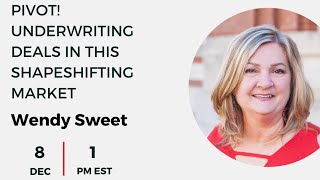
The InvestHER webinar, hosted by co‑founder Liz of the Real Estate Investor Community and guest Wendy Sweet of Carolina Hard Money Lending, walked a largely female audience through underwriting strategies for real‑estate deals in a rapidly changing market. After a brief community introduction—mission, podcast, meet‑ups, Strive membership, InvestorCon—the presenters covered how to protect and grow portfolios when market conditions shift. Key themes included prioritising cash‑flow over valuation, using short‑, mid‑ and long‑term rental strategies, leveraging DSCR and private‑money loans, employing cost‑segregation for tax efficiency, and creative financing such as subject‑to deals and seller‑financing. Wendy shared lender‑side underwriting criteria (90‑100‑day comps, 70‑75% LTV, 7‑8% interest, pre‑payment penalties) and risk‑mitigation tactics (stay local, maintain cash reserves, monitor rehab costs, adjust leverage). The Q&A addressed cost‑segregation applicability, post‑private‑loan financing options, DSCR loan timing, and marketing mid‑term rentals. Throughout, the hosts emphasized networking, building lender relationships, and solving housing‑supply problems rather than reacting to fear. The session concluded with announcements for upcoming events, a debate on syndication, and encouragement to keep investing despite economic headlines.
Chapters
Hello, welcome everyone. My name is Liz, excited to be on today's webinar with all of you. We're going to be talking about underwriting deals and how to do that in the crazy market that we're in. And just really pumped about being here with all of you. I'm going to bring Wendy on here in a moment to join me when we get going in a few minutes. As you're As you're joining, I wanted to encourage you in the chat box to share where you're calling in from, what you're looking forward to learning today. I'm going to change this. OK. I think everyone should be able to chat now. OK. But yeah, welcome to everyone. I'm excited to have you. And the chat box should be working now. So please share where you're calling in from. And I'm going to bring Wendy over and we'll get going right on the hour. We like to start on time, so bear with me as I'm doing that. And just thanks so much for being here. Okay, Wendy is coming in here with me. Carissa, thanks for being here. You're calling in from Raleigh, North Carolina. You're a neighbor of Wendy's, so That's exciting. Annie, you're calling in from Redding, California. Thanks for being here. Heather calling in from Orange, California. Awesome. Thanks for being here. Laura from Chicago. Awesome. Michelle from Skip Pack, Pennsylvania. Where's Skip Pack? I have never heard. I'm also in Pennsylvania, but I'm in a little town called New Hope. I've never heard of Skip Pack. So very cool. Thanks for being here. Heidi, thanks for being here as well. Minneapolis. So we got some great representation here. You're a local hard money lender. Awesome. Very cool. California, Crystal, Naomi. You're excited to be here. We're excited to have you as well. You're calling in from the Bronx. All right, so let me help Wendy here because I do not hear her or see her.
I—
so you can hear me? I can hear you. Hey, Wendy.
But it's saying that my video—
I know. I don't know why. I need to promote you to co-host.
I feel good about that.
I don't know why the chat box never works, and also that panelists can't show— I need something in my settings, uh, show the, um, screen. I'm gonna write this down because I'm gonna forget this.
Hey, Teresa! I see a lot of people I know. Isn't that awesome?
I just allowed you to, um, start near Valley Forge. All right, cool. Uh, Michelle, here we go. Hey, Wendy!
Okay, ignore my junk. That's my Christmas presents all bought for the year.
There's no judgment on my end. No judgment, Wendy.
How are you? I won't show you my desk. You can't see it anyway. It's covered.
Yeah, my, my desk is a hot mess too, to be honest. Um, thank you so much for being here today.
Thank you so much for inviting me. Very thrilled to be here.
Excited to, excited to jump into this great, great topic because it's a hot one, right? Especially with So many of the women in our community struggling to make deals work, struggling to kind of pencil things out. And there's a change upon us, right? Always deals to be had, but you got to be smart and you got to be conservative and make sure you're prepared. So I'm excited to jump into this topic with you around underwriting and shifting in today's market. So I'm going to introduce you here in a moment. I'm going to jump in here because it's 1:00 on the hour. Eastern time. So I like to make sure we start on time and end on time. But thank you so much for being here. I'm going to introduce Wendy here in a moment. Make sure you can share your screen, Wendy, when it comes time. And I'm going to share a few slides and share a little bit about the community first.
Okay.
I need my glasses.
It looks like I'm good to go. You're good to go. Okay.
Awesome. All right. Awesome. I'm going to All right, I'm going to just make a note of that. All right, cool. And we'll have more and more people joining us.
We had, I think it was like almost 400 people register for this.
So we had a lot of people register.
Yeah, yeah.
And they're all going to get the recording as well. So I know people will keep coming. So yeah, hot topic here. All right, so I'm going to share my screen. And if you're joining us, welcome. My name is Liz. I'm one of the co-founders of the Real Estate Investor Community. I'm here with the amazing Wendy Sweet. I'm gonna introduce her in a moment. We're gonna be talking about underwriting deals in today's kind of interesting, as you're calling it, shape-shifting market. I love that term. And as we kick things off, I just wanna spend a few, few minutes for those who are new to our community. We have a lot of women joining us every single week. We take for granted, right? We always think everyone's been in our community for the last few years, but we have a lot of women who are new. So if you're new to our community, put new in the chat box. I wanna keep you engaged. We'll make this time well spent for you. And it'd just be great to welcome— Hey, Naomi, I'm glad you're new. A number of women are new. Awesome. Well, thank you for being here. I wanna share a little bit about what we stand for, what we're up to, and then give the floor to Wendy. So, a little bit about our mission. It's just a good place to start because we're really committed to everything we do in InvestHer, in our InvestHer community, really committed to our mission. So, our mission's all about empowering women in real estate to live a financially free, and balance life on their own terms. And we're really all about creating an intimate global platform where women can create deep relationships through, through content, through courses, through live events, through memberships, through just being in community with each other. And we're really all about creating this global, global community. So a few things that we're up to, a few ways to plug into content and just support— a lot of this stuff is free— is number one, our podcast. We are published by BiggerPockets. It's released twice a week. And it's We're up to 55,000 downloads, which is really cool. But we're all about interviewing rockstar women. Wendy's been on our show twice or 3 times, I'm not sure which one, but she's been on our show and that's, that's a big deal. We don't really bring on women a lot of time, multiple times. But we do a minisode once a week and we do a full-length interview. So check our podcast out. Our meetups are, our meetups are our community, a way to build community. And we have 60 meetups now across the country and in Canada. And what that's all about is a local community of women coming together on a monthly, month-to-month basis and giving and getting support. And they're free. And these are great women who lead these meetups. So check it out. If you don't have a meetup in your area, please let us know 'cause we're looking to expand in 2023. Just make sure we have a meetup in every area of the country and the world. Our Strive members are our membership. Wendy spoke at our Strive Higher event a few weeks ago. I feel like I just saw you. And these are women who have done 5 to 10 deals deals, looking to expand their portfolio. We're actually— we open the doors twice a year, uh, once in, um, once around the middle of the year, around June, May, June. It'll be next year, May 2023. And then we open the doors now in December. So if that's of any interest of yours, if you're looking to scale, team processes, um, be around a really strong like-minded group of women— we have about, um, 80 women in that group— um, check that out. It's on our website, our website/membership. So check that out. But our doors do open, and literally tomorrow and through 16th. Um, our Facebook group, many of part of our Facebook group. This is a free group. If you have questions, you need support, that is what this group is, was, was based upon. We're close to 14,000 women in that group. And there's no stupid questions, a safe space. But I always like to recommend you to be specific, rather than being super general, because then women don't know how to help you. And there's some amazing women in this community that can support you. We are always doing events, we have 2 free events happening a month. We have another great one next Tuesday evening at 7 PM about whether to syndicate or not syndicate. We're going to get into a little debate, so it should be pretty fun. And then we also have our eXp team for those agents who are looking to— brokerage is not working for them. They're looking to be part of a group of women like ours that are not just encouraging and teaching and training agents, because that's what our team does. More importantly, are you building your own wealth? And that's what really what we stand for. Because women need to build their wealth. It's really critical and it's really kind of near and dear to our heart. And then we are active investors as well. We just worked on a 670-unit— we were a partner of a 670-unit deal earlier this year. And we are always looking for deals and involved in a few different interesting projects right now. So we're active along with you. So that is a little bit about our community. Last thing, I'm going to introduce the wonderful Wendy. The wonderful Wendy, I like that. So we're in full steam ahead for InvestorCon. We have, um, it is May 18th and 19th. For those who have not heard, it's going to be literally at this resort. So this is not a stock photo, this is actually where we're going to be in May. It's in Scottsdale, Arizona. And, um, what's really cool about this conference is we are, we are maxed. We have the entire resort, so we can literally have 500 people. We're almost halfway sold out for, for the conference, uh, in terms of tickets. So, which is really cool. I think women are anxious to get here, but it's gonna be— if we're releasing the agenda, we're releasing speakers, it's gonna be a 2-day on experience, we're doing like a, um, by the end of the year you get a ticket, uh, by December 31st, you will get the recordings from last year. I keep saying last year, it was actually earlier this year. Sorry, it was May— I'm sorry, June of this year, and it's May of next year. So I wanted to— I'll put that in the chat box as Wendy introduces herself. But that's what I got in terms of some announcements, a little bit about who we are, what we stand for, uh, because it's always helpful to do that. Wendy and I connected a number of years ago. And I, you know, I take this— I know we don't take these events lightly. We don't just randomly pick people who have nothing else to do on a 1 o'clock Eastern on a December 8th to speak in front of all of you. Our community is like in our heart. So we take it very seriously who we put in front of our community. And Wendy and I connected a number of years ago and just always enjoyed— not just— not only is she super funny, and enjoyable to listen to, 'cause that's important when you're presenting. But she's super knowledgeable and such a, she has such an expertise in this area and is able to explain it in a way that makes sense. And she has such an amazing journey and story and has so much to offer. And she runs Carolina Hard Money Lending. She's the, I don't know if you're the president and co-founder, but I know you run the shop, if you will. And so from a lending perspective, she has such an amazing ability to see what is happening. She's underwriting deals to lend to, so she's got a great perspective on this topic. Again, Wendy is one of our key resources that we utilize for events and just, you know, getting connected to her and for all of you to learn from her. So without further ado, I'm going to stop talking. I'm going to take my screen off, but I'm here as your number 2. If I can encourage everyone, because we have a big group here, if I can encourage everyone to please put your questions— this is a, this is a big topic, and I know you're gonna have questions. So instead of putting stuff in, questions in the chat box, if I can encourage you to put them in the Q&A, we can then field them as we go. So I'm not going anywhere. It's like I'm, you know, going out for lunch or anything. I'm just gonna stop talking, just to be clear, and I'll be handling questions, but we're gonna go for about an hour. We'll end right on time at 2:00. And Wendy, if you wanna, you know, in terms of content and then stop 10, 15 before, we can yield questions field questions, field questions, excuse me. Or if I get them and you're okay with me interrupting you, I can feel them in the moment. Whatever works for you.
Absolutely. You can interrupt at any time.
Okay. Thanks for being here.
Thank you. Thank you so much. I'm really excited to be here. And yes, I do. I should say I do run the company, but I run it from a different position now. I've been so blessed to have an incredible team in place. Now I'm called a visionary. That sounds really important. And as far as underwriting goes, I only get the problem children now. Things that are issues, they bring to me, but my team's able to take care of everything else. So, and I'm now into self-storage facilities. I do short-term rentals. It's, it's, this business is so fun. I just can't even begin to tell you how much I love it, but I'm getting ready to, let's see, I know it says start slideshow. There we go. I already had it on there. Play from the start. Here we go. Oh, and isn't that pretty? I'm really excited to talk with you about what's going on in today's market because, you know, I started this— I should say I started this PowerPoint a couple of weeks ago and had to change it because things are already changing. It's that, it's that crazy. Underwriting deals in a shape-shifting market. As a lender, we are just constantly looking at what we're doing when we're underwriting for any loan that we're doing, whether it's commercial or single-family, multifamily, whatever it is out there. It's— everything's changing so much, and it depends on what market you're in too. It's just absolutely, it's just absolutely crazy the way things are changing. So what are we going to learn today? So We're going to talk about how, how you build a wall around your business, because that's really what you need to do is you need to be in a protection mode. How do you reduce your risk in a falling market? Is it falling? Well, depends on where you are. And yeah, it's falling from where we were, but we're just getting back to normal, folks. When is a good time to invest in the recession-resistant Assets. Is now a good time to be a lender? Every time, every day, every moment is a good time to be a lender. I love being a lender. Should I flip or should I hold? Should I stay or should I go? Now everybody's going to have that earworm that you're not going to be able to get it out of your head. So the first thing we're going to talk about, let me see if I can move my bar a little bit so I can read a little bit better. I've got stuff covering up. So how, how do I build a wall around my business? So the first thing we need to remember is that a house does not care what it's worth. So don't be hung up on what's going on in the market. A house doesn't care what it's worth. What kind of cash flow is happening in that, in that house. So cash flow, rent options, maximum profit. So you have really— and I like the way this is numbered 1 to 1. I didn't catch that and I'm really sorry, but the cash flow is what's really important right now in properties that you have. And what are some of the rent options that you have out there? Are you going to be able to do possibly short-term rent, midterm rent? Those are ways of increasing your rent. Another great thing is to take a, take a, a longer lease in this market right now. There are some markets where rents are actually dropping on what you can get for rent. If you're in one of those markets, go ahead and get somebody hooked up on a lease that's longer term, 18 months, 2 years. Let's ride it out and see what you can do about having somebody that you can count on to make that money every month and get that cash flow going. You need to pivot your portfolio a little bit. Let's think about what that means. And that's leverage. How much leverage do you have on your properties? You've got to really find the balance between, of course, what you owe on it, what that equity is, and what that income is going to be. You've got to really figure out what that happy medium is. And just because interest rates are at 7% and in some cases 8%, on these DSCR loans, loans that are, are the long-term loans that you can get for rental properties. Don't run from them right now. It's still a good option. I can tell you that in, oh, I don't know, 2002 to about 2007 or '08, I was thrilled when I could get a 6 or 7% interest rate on a conventional mortgage. For a landlord. I was thrilled. And, and people are just afraid to do any loans now because they think it's so high. It's really all about what we have stuck in our mind, what we've just been through. What we've been through was unusual. We are just now getting back to normal. And that's really the way you need to think about it. As long as you run your numbers. In fact, in, on our show today, we do a, a show every Thursday, a live show. Here at Carolina Capital on YouTube. And one of the things we talked about today, and is one of my, my partners, he, when he buys a rental property, he is basing it on a 12% interest rate. He says if it can cash flow at 12%, cash flow means making the mortgage payment, making sure he's paying the taxes and insurance and taking care of any maintenance and vacancies that might come up. If he can still make that work at a 12% interest rate, it's a deal. Yeah, you're probably thinking, oh yeah, I guess it is. But really, those are the numbers that you should be working on if you want to stay safe in any market. Equity. You can use equity with private lenders. One of the things I want everybody to make sure they have in their brain is, and I'm a hard money lender, so I'm not sending you away from, from institutions like us. Private money is the best way to finance your deals. It's, it's, it's— you can usually get them cheaper. It's a person that you're dealing with. It's a real relationship that you're building. And they'll do things that are a little more out of the ordinary than an institution would. They would be interested in taking a lower interest rate on a longer term, maybe 2 to 3 years. And maybe getting a little equity out of it. When you do refinance it or you do sell that property, try to, to think of some creative ways to let that private lender make money and actually partner with you on these deals. You can also give them a percentage of the rent income. So I want you to think about that. Got to think outside the box when you're buying property or just refinancing them with private lenders. There are plenty of people that are, that are on this call that have self-directed money in an IRA that would love to park their money for the next 18 to 24, maybe even 36 months in a property or in a note that is collateralized by property. You, you've got options to help other people build wealth. You need to connect. That's why these networking events are so, so important to go to. We talked about that in Winston-Salem just really a few weeks ago when we were there. What a great event that was. So well put together, incredible group of women that were there and a couple of men actually. It was, out of this world. And it was so deep about what everybody was learning. They learned about each other, they were able to put together a network, they, they trust each other, they encourage each other, they lift each other up. It was just a great— it was great to sit back and watch and see these relationships grow. And now they all had money that they can lend each other. That's why we're here. So Those are some things that you can do when you use private lenders, even for a longer-term loan. And when I say longer-term, I'm talking 2 to 3 years rather than just a 6-month or a 12-month term that you're going to get from someone like a hard money lender. Talked about this a little before, is, is think about getting your leases, the leases that you're getting in place now. That you set them up for a longer term, and you might want to give them a little discount maybe in the, the last month that they're there to get that longer term locked in. Just be— just especially if you're in a market where you're seeing rents stagnate or drop a little bit, because that is happening in some markets, especially the markets that were what we refer to as bubble markets that were happening recently. Austin, Idaho, there's some places in Florida, North and South Carolina. They were two markets that really grew in value in a house. And those markets that grew really quickly are the ones that you're going to see stagnate and maybe even reduce in value. Not much, just getting back to normal. Here's the other thing, and I'm going to put this out here because I really want you guys to take a moment and write this down. In today's market with what we have, we may not be getting all of the cash flow that we were hoping we were going to get. But one way to really turn those tables is to take advantage of the depreciation and the deductions that you're allowed as a landlord in single-family houses. I'm sure many of you have heard of cost segregation. Just in case you haven't, cost segregation is taking all of the things in your house and let's use an Airbnb, which is the best thing to do this with as an example. In a short-term rental property, you're going to have the house that's going to depreciate over, you know, the 27 years. But you also have carpet, hardwood flooring, appliances, furniture, window coverings, all kinds of things that are in there that all depreciate at different time schedules, whether it's 3 years or 5 years or 7 years, whatever the government's going to allow you to put in there. Don't forget about your landscaping, your, you know, if you have a gravel driveway, fencing, outdoor fire pits, decks, All of that can get 100% bonus depreciation really quickly. And a lot of people say, well, if it's not over about $600,000, that the house didn't cost you at least $600,000, it may not be worth it. But I have a new company that I've been talking with that does this cost segregation, and they have this tool And that's the, the link that I put in for you. The tool, if you were to, to go ahead and use this tool and purchase the report they give you, it costs $450 per property that you're going to do that. But what it does is it's a form you can put in all the things that you have in a prop— in a property, and it'll let you know, yes, this is worth doing a cost segregation. Yes or no, this property is not worth doing a cost segregation. If it is, you're going to want to go ahead and buy this tool and it gives you that report that you give to your CPA and they can take those tax deductions for you at the end of the year. The thing you need to remember is whether or not you need that depreciation or those deductions. Now, maybe, maybe you're already losing plenty of money on paper, I hope. Where you don't need those deductions, these are things that you can roll over to next year and the year after. You can roll them over. And so they don't really go away. You can take advantage. Then you hear people say, well, I don't want to take these depreciations because I'm going to sell this house in 5 years. I'm going to have to pay it all back. You don't have to pay it all back. Yes, you are going to have to add back some of those depreciations, but it's on a schedule that's reduced from what you actually took. But it's, it's a great way to wash what you owe in taxes. So please take advantage of this. How do you reduce your risk in a falling market? We want to calculate and adjust for what's going on in the current market. People, you know, we've just been going crazy buying and rehabbing and flipping properties here lately. And are you in a rehab now? Did you kind of get stuck when the rates went down? Our rates Went up, I should say. The buying went down. The quick sale went down. It's sitting on the, you know, things are sitting on the market a little longer. What are some of the things you can do to save cost? You know, before 6 months ago when we were rehabbing properties, if you wanted to sell a house at top dollar, you had to trick that house out. It had to be really cool backsplashes and countertops had to be You know, the high-end countertops, you wanted everything to look perfect. You had to replace the cabinets. It had to be pristine. That may not be the case right now. It may not make much of a difference on how quickly you sell it and what you get for it based on the rehab that you're doing on that property. So, so review that. Take a look at it and see where you might be able to save costs. Do you need that really expensive light fixture, or will one at a discounted rate that looks pretty much just as good work? Those little things will help you save money on that. The other thing is, can you hold the property rather than flip it? What, what can you rent it for? And can you add an ADU in the backyard, an additional dwelling unit? I know in the city of Charlotte, where I'm really close to, they just passed some zoning where every house can have an additional dwelling unit in the backyard. And so everybody's jumping on that bandwagon. And it's a great opportunity. Number one, it adds more value to the house when you want to sell it. But look at the additional income you're going to be able to get off of that if you do some sort of a short-term, mid-term rent, or just rent it on a yearly basis to have that extra punch there in the back. And, and again, ask yourself, can I hold this property? I had a house that I just finished August 1st, put it on the market, rates went up like crazy. It was on the market for 30 days. I had lots of showings, but it just didn't sell. Um, so I quick put a combo lock on every door. It's a 5-bedroom property, had 2 master suites. Quick put a combo lock on every door. I added a college-size refrigerator, a small 36-inch cabinet with a kitchen-type countertop on it, a shelf above it with a microwave, and I'm individually renting that property out. The majority of what I'm getting in there are traveling nurses, traveling medical people, 13-week contracts, and I'm making a killing on that rent. So it's not what I wanted to do. And I'm telling you, that house was tricked out. It's, it's better than my house. I'm a little jealous of it, but it's really, really nice. So they, they each have a room. 3 of them share a bathroom. It's a good-sized bathroom. I have den furniture in there, the television. The kitchen's really nice. It's fully stocked, but everybody also has a cabinet, a microwave, and a college-size refrigerator in their bedroom along with television. That's what I provide to them. My master suite's getting $1,200, um, which I think pretty, pretty darn good to have that. So, so think about other ways that you might be able to do that. So, so let's look at this from a lender standpoint on how do you reduce your risk in this market. Did you want to say something, Liz?
Yeah, I got a few questions here.
Okay.
Do you mind?
No, have at it.
On cost seg. So I want to make sure we— okay, it's pertinent. So, Paulina, you're asking about, can this also be done? Can it also be used in duplex or fourplex?
Yes.
Understanding is yes, you can use it on any size, right?
Yes, absolutely. You can't do it on a commercial building. Like, I wanted to do it on our office. We can't do it on our office, but we can do it on, like, my self-storage facilities.
Got it. Good stuff. That makes sense. Laura's asking, what are the best options for financing after 2 to 3 years of private lender financing is complete if we're still holding?
Well, I would look for a DSCR loan, and you could Google that and a bazillion of them will pop up. Unfortunately, many of them are dropping like flies. They're going out of business. We offer them. I know that there are other companies that offer them as well that are doing a really good job. Um, they're— the interest rates are going to be— you're just going to pay 7 to 8% on those interest rates right now. They offer 30-year mortgages, 20-year mortgages, 10-year interest-only mortgages. Um, they— all kinds of adjustable rates. They've got a, just a plethora of things to to choose from. But the thing you need to really concentrate on the most are the prepayment penalties. Most of them come with a 3-year prepayment penalty. That's 3% in the first year, 2% in the second year, 1% in the third year to be able to refinance that. So you, you really just have to kind of run the numbers on whether or not you think you're going to sell it or refinance it later if in fact rates come down a little bit. But just just be prepared. The rates, the rates are tough.
Yeah, makes sense. Good question. Teresa, cost segregation benefits are for buy and hold, right?
It is for buy and hold. That's the only reason you'd want to do it is for, for a buy and hold. And one of the things that you're doing when you do a cost segregation, you're actually telling the government that, hey, I'm getting ready to change the way I do taxes on this property. And that's where the, that's where the cost comes in. Because these companies are, this report on the single family, you know, the cheaper one where you're doing the $450 for that tool, your CPA is actually filling out a form. And I wish I had that page in front of me that it's form. Oh, I do have it. It's Form 3115. That's the form that's going to have to change that gets filed with the IRS when you're changing how you're going to depreciate the properties. And the other thing too is it's going to depend on how long you've owned the property as to whether or not it's going to be beneficial. If you've owned the property 8, 10 years, doing a cost segregation may not be worth it anyway because you're already pretty deep into how far you are to be able to deduct those things. But it's always worth a shot to see, you know.
Yeah. Paulina, you're asking with long-term tenants, I'm assuming you're asking as a follow-up to your cost. Okay, gotcha. Yeah, we kind of answered that. I'll just do one more question and I'll get you back.
No worries.
One quick question. Why are DSCR companies going out of business?
That's a great question. It is because a lot of When, when the DSCR companies came into business, many—
Can you explain, Wendy? I don't mean to interrupt you, but explain what— for those who are on the call, I'm sure there's some that don't even know what that stands for. Do you mind?
Sure, sure. It's, it's— and I had it right in my head when you said that. It's— what is wrong with my brain?
Debt Service Coverage Ratio.
Thank you. I'm thinking discount.
I'll catch you back. Debt Service Coverage Ratio.
Yes. And, and really what it is, is they're underwriting your deal based on what the cash flow is, you know, what you're getting in on it. Most of them want to see a 1.1 return or a 1.2 return, which means that whatever you're getting on the income, they want to make sure that the mortgage, taxes, and insurance are covered by at least, uh, in full 100% or by 110%. For that payment for that month, or $100. Okay, so we got that. It's a great loan. They don't underwrite it based on— they do care about credit score. Most of them are gonna want to see at least a 680 or higher. If you're 720 or higher, you're gonna get the best rates. It's very rate-driven on that. But they're, they're, they don't care how long you've been in business. They said some of the companies do care about experience, but the majority of them don't care. So bottom line, these kind of loans are really based on the property, not so much you, which is really important. But the reason why they're going out of business is because when, when those loans were first offered, these smaller companies were really excited about it. They wanted to open them up to a lot of, a lot of hard money companies are the ones that are representing it. So they were really brokering the deal. From these big institutional lenders. And when everything's— when rates started increasing and getting kind of scary, those institutional lenders went, hold up, we're not doing these anymore. So unless you are really funding it yourself as a lender, many of them have gone out of business because they just don't have the money to sell it to the people to sell it to. So, you know, Wall Street gets scared real quick. And they'll stop what they're doing and sit back and wait. So many of those companies just don't have those offerings anymore. We still have one. We've got— we're dealing with a great company that's very strong. They hold their own stuff. They're not getting that money from big institutions. And there's several others that are that way too. So that was a great question.
Awesome. I think I'm going to just take a— I want to get you back to the floor and then we'll come back to questions. All right.
Okay. No, no worries. Thank you.
You're welcome.
As a lender, we're going to talk about— we're still talking about how to reduce your risk in a falling market. So as a lender, if you're lending money at this point, you really need to stay involved in the loan that you've made. And what I mean by that is get nosy, check on the property, see how far the rehab's going. Don't take pictures from the person you're borrowing it from or that, that you're lending it to. Make sure you're putting your own eyes on it or that you've hired a third party to put your own eyes on it. Just stay involved. Ask them how they're doing. Constantly ask them, you know, what can I do to make things smooth for you? You want to drag them across the finish line because people are getting nervous. They're having trouble getting supplies. Contractors are still a little difficult to find that they can count on. Just, just stay much more involved than you have been. Don't just assume that it's going to work out. You got to really be involved in it. Okay. So when is a good time to invest in recession-resistant assets? So we're trying to calculate and adjust for future— the future assets that we have coming up. So for us, we have been investing and lending on recession-resistant loans since January of 2019. When everything started going crazy here, which was about that same time, 2019, we actually stopped lending on anything in our market where the after-repaired value was more than $500,000. Now, this is for single-family residences. And of course, in our market— I apologize, I've been sick. I'm at the end of a cold. So if I hack, I'm sorry, but we stopped lending on these properties because we knew it had to stop sometime. We knew that this craziness was going to end sometime. We just didn't know when. So, and our loans are between 6 and 12 months, 12 months long. So we know that because of the length of our loans, we can, we can change the ship. We can turn the ship and change in whatever direction we wanna go in. And so we didn't want to have everything fall out and go crazy, stop selling like they are now and be stuck with all of these high-end properties that didn't sell. Because we know that in any market, when a recession starts to hit, or when real estate starts to fall off a little bit, the first people that are going to get hit are these high-end houses. I don't care where you are, that's going to be the first thing that gets hit. And of course, that certainly happened in our market. But we started in January 2019 really reducing our individual, individual loan amount that we would do on any individual property. We wanted to make sure that we could take it back tomorrow if we had to. And rent that property out and our investors would still get their returns. That's the main thing is making sure our investors get their returns. So we really started doing that. Now we're sitting in a great position where any, anything we have in our portfolio, it can, it can rent for what it needs to rent to be able to pay what it needs to pay. So we know we're sitting on something pretty solid. A lot of people can't say that and we're feeling pretty good about it. So What we're doing now, though, when we're underwriting new properties is the comps that we're using. We don't go back any farther than 90 to 100 days, and we're not changing that. Like, we didn't say, okay, anything after August 15th, we're not going to use comps that were sold previous to that. We're making it a rolling number. And the reason why we're doing that is because it's still changing. The market is still different and it's different. You know, we lend in the Southeast. Even if we just took the state of North Carolina, we know that the market in Charlotte is very, very different than the market in Fayetteville or the market in Winston-Salem, which is where we just were. We know that, that every city kind of has its own personality and that those comps are going to be very telling if you really keep it tight to that 90 to 100 days old. It's, uh, it, it's a very live number. That's, that's what we like to look at, is, is the live number. We're still lending 70% of what the after-repaired value is, so we haven't reduced that. We haven't raised our, our, um, our interest rates, um, and we're not charging anymore We want to still be able to offer a great product, but we also want to make sure that the asset that we're lending on is truly the value that we think it is. And we— it's, you know, my crystal ball broke, so I can't see into the future. And anybody that can, please reach out to me because I want to hear. We've got to underwrite based on the information that we have now. That's as close to where we are now. So that's one of the things that we're doing. Um, it's also important to stay in the right price range for, of course, your after-repaired value, the right price range for rent, and the right asset type. Um, for us, we're really conservative, and anybody out there who's lending money, whether you've got a big fund that you're lending out of, or, you know, you've got $80,000 in a self-directed IRA that you want to lend out of, you want to make sure that you stay in the right price range for where you're lending. And if I were you, I'd be cautious about going outside of the market that you know. Staying in your backyard is— there's nothing wrong with that. It's a, it's a great way to lend. You can put your eyes on it instantly, and normally you can find the borrower pretty quick if you need to do that. You're also going to understand the rent range a little bit better, and you're going to know what's selling in your market, what's not selling, what's renting, and what's not renting in your market. This is a great time to stick close to home when you're lending. The other thing that I think is a great opportunity is to look for properties that you can buy subject to, subject to that mortgage being in place. You're going to see more and more people coming to a point where they're not really going into foreclosure, but they can't really afford their payments anymore because they bought a huge house. They've got a great interest rate on it, but they don't have a job. Uh, milk is higher, gas is higher, all foods are high. Everything is so much more expensive right now that their cost of living is getting them to a point where they can't afford the mortgage anymore. So you're gonna see more and more houses, or they need to move, they've been transferred and they can't get the house sold. Um, or there's not a lot of equity left in the house. That's cool too. Subject-to is a great way to get into a property. You turn around and rent that, especially if that interest rate is low. You're going to want to be able to, um, be able to take over that mortgage. Now, a lot of people say, oh, you can't do subject-to. How do you get them to trust you? How do you make those, uh, make the, the mortgage company talk to you? So So when I do a subject to, I call the mortgage company. I first of all get them to sign a piece of paper that says I can talk to them. And then I call the mortgage company and I tell them what I'm doing. I let them know I'm gonna be making the payments on this property. And, um, I just wanted to let you know, to be familiar with me, that, that I'm the one you're gonna be dealing with. When I do my insurance on the property, I continue to leave the person who is selling it to me subject to on my insurance as an insured, and I just add my company as an additional insured. So we're both insured on that property. And then, you know, how do you make somebody trust you? Well, you've got to build a good relationship with them and, and allow them to trust you. If, if you don't do that, it's hard to convince that person to do it. But subject tos are great. There's an abundance of them and there's going to be an abundance more that are coming on the market. The other thing that you can do with recession-resistant assets is you need to really get creative with your financing. We, we touched a little bit on this previously about financing and getting other people to lend you money, private folks to lend you money, but Understand that sellers can be a good source of being your lender. And many of them are willing to take second position, to hold a second. You can use a hard money company to, to purchase maybe 50% of it and let the seller hold the second 50%. There's ways or it might even be 10% that you need. Whatever it is, think about different ways that you can get this financed. It doesn't have to just be one person lending you money. There's a multitude of people that you can have involved. And just understand that when you are buying any kind of property right now, if your intention is to buy a property, fix it up, and turn around and refinance it, I want you to understand that 6 months down the road, that DSCR loan that we were just talking about may not be available to you. It may not be available to you at that rate. It may not be available to you at that loan-to-value, which means they're going to lend you less. You need to be prepared for big changes down the road. Just make sure you have a Plan B. And a Plan C behind your Plan A on how you're going to handle that. Is now a good time to be a lender? Yeah. Liz, did you want to talk? You're muted still. Oh, maybe I missed her. Okay, so Is now a good time to be a lender? You better believe it. It's always a good time to be a lender. So how do you do that? Oh, this one looks familiar. Use comps that are no more than 90 to 100 days old, just like you are when you're borrowing money or underwriting a deal to buy something. You want to use that same concept As a lender, you want to make sure you tighten up on your comps. You want to do the same thing about the price range and lending in your backyard or buying in your backyard. You want to stay the same, get creative with the financing, bring somebody else on that can help you lend. Yes, it is very familiar. So here's one of the things that we're doing as well as lenders. You want to lower your loan-to-value and the after-repaired value. If you're using comps that are tighter in the guidelines that we were just talking about with the 90 to 100 days old, that's a great way to do that. One of the things you might consider instead of doing 70%, drop it to 65 or 60%. I always feel much more comfortable when I'm lending money to someone that has money in the bank. They have cash in the bank. This is that old adage, you can only borrow money if you already have money. That's really, really true. And if I know somebody is really good about saving money, they have access to be able to get money quickly. They have cash in the bank. They have a self-directed IRA they may be able to tap into. I want to make sure that they have money in the bank. Now, now, whether— I'm not going to ask them to bring all of that to the table because I certainly don't want to clear— clean them out. But I want to make sure that if something happens and they need to get to some cash, that they can do that. I also like to see them have a little more skin in the game, especially when things are in the situation that they're in now. So here we go. Should I flip or should I hold? There's that earworm again. And it is a terribly volatile market. What is happening? I don't know. It's unprecedented. Like I said, my crystal ball broke. It's just, it's crazy right now. And you just need to be prepared for all the things that could happen. So we know that Warren Buffett didn't make all his money in the downtimes, but he made a good majority of it in the downtimes. And he says something about— I love a quote that he says. It's when people are swimming and the tide goes out, you can see who's naked. You're able to see who really doesn't have their crap together, are the ones that don't have their swimsuits on or their protection. You need to follow the people that have made big money and see what they're doing. That's a little bit different. The other thing I want you to think about is fear is an F-word. It's a bad word. Don't operate out of fear. You're not meant to do that. You need to be aware of what's going on around you, but don't operate out of fear. Fear will paralyze you. Fear will make you make decisions that you would not normally make. Fear will keep you from making decisions. Fear will send you in the wrong direction. Be smart. Do your due diligence. Surround yourself with a network of people that have been down this road. Surround yourself with people that have scars from the past. That can help direct you to make the right decisions. Don't find a house and just look at it and decide, oh yeah, I'm going to do this. Talk to a few people that have done this before. Get a second opinion. You do it at a doctor, get it with your house. Make sure that you've got other eyes looking on it to give you some advice. That's what's so great about being in a networking group like this. It changes everything for you. Don't stop thinking about tomorrow. You really need to always be looking into the future. And if we just stop and we're not lending anymore or we're not buying anymore, we're, we're stagnant and you're not building your wealth. So don't stop. Keep moving forward. Just be very, very cautious with what you're doing. So I think this may be a, um, this, this may be a record for me to be able to finish this quick.
Don't you speak meanly about my friend Wendy. We do have lots of, um, but please share, share where folks can connect with you. Further, and then we'll do a few more questions.
Okay, sure.
Like 19 in here.
Okay, great. So I do a subgroup. I facilitate a subgroup called Sunrisers. It's a faith-based sun groups, faith-based investor group. We've been meeting for 20 years. We started out having breakfast at 7:30 on Friday mornings, and COVID forced us online. And we've stayed there because now we have national speakers, people from all over the country come. It's a great group. So if you text to this number, 803-5, uh, I'm sorry, 803-653-6868. If you text SON, all caps, to that number, you can sign up to get the reminders, um, sent to you for this meeting every Friday, which is free. The other thing that I do is I love to give back because that's how I got here in first place, uh, as people led me, poured into me, shared with me, taught me what I needed to know. If that same number, you can text WWW in all caps. It's called Wednesdays with Wendy. It is a 30-minute free mentoring session. I had a lot of people from Winston-Salem sign up. It was wonderful. Um, and, and we can just talk about your business. I, you know, whatever topic you want to talk about from a lender, you know, I get to see everything from kind of a 30,000-foot view. And, and I, if I can't help you, I know people that can, and I want to be able to share that with you as well. Um, that QR code that's there, that's our YouTube channel for our live video, um, show that we record every Thursday. Um, we do have all the recordings out there as well. From Carolina Hard Money. And then if you are interested in— if you're an accredited investor, you know, we can certainly tell you about our fund. And then we also sell notes out of our fund if you're not an accredited investor. So send me an email if you have any questions. I'm here. So now what can I answer for you?
Good stuff. That's awesome. All right, so let's, um, I did a WW day with Wendy and it's wonderful. Wendy is amazing. Oh, that's great. Um, thank you, Deanna. Hey, Deanna, one of our Strive members. Good to see that. I thought she was saying something about WWW, like, I don't know, World War.
Well, yesterday I was getting a little confused, but I get confused easily.
All right, let's, let's knock some of these out. I think there's some great questions here. I think you mentioned a little bit about, uh, midterm rentals, traveling nurses. We have an episode coming up with Ziona, who just wrote the book 30-Day Stay by BiggerPockets. So that's coming up very soon. She like drops down tons of knowledge about midterm rentals. I just want to give a little shout out to that episode coming up. It was a great, great episode. Awesome. But, but Naomi's asking, what sites do you use to market to midterm rentals and traveling nurses? What are you using right now?
So, so right now I'm all about Furnished Finders.
And that one.
Yeah, yeah, it's great. Plus, I've kind of cheated a little bit. The one of the people that sold me that particular 5-bedroom house is the one that's in charge of traveling nurses for Atrium Health in Charlotte. So that's been real, real good. But also on, on short-term rental for Airbnb, I'm listed on Airbnb and I have a required 30-day stay on there.
Okay.
So I'm not I'm trying to stay away from anything shorter than 30 days. And by doing that, I've eliminated all the competition that are under 30 days. So when they pull up 30 days, I'm at the top.
Yeah, that's awesome. And just a big shout out to Ziona McIntyre, who we interviewed, and Sarah Weaver, who's one of our Strive Pod mentors. They wrote this book, great, great book, 30-Day Stay. It's published by BiggerPockets. Gives a great, great insight into like actionable things to do in that niche. And it's a very growing niche. And it's people, more and more people are doing it. So good stuff. Kira, Kira, hey Kira, Kira is one of our Philadelphia meetup leaders. So thanks, thanks for being on. So you're asking about, don't you think we need to add more value to rehabbing homes? This might have been middle of your presentation, but she says, don't you think we need to be adding more value to rehabbing homes? Because people aren't just buying lipstick houses anymore. People will spend more money on quality. I'm—
when I say to reduce what you're doing, I'm not really— you have to be picky about what you're doing. Sometimes we will buy a chandelier that's a lot more expensive than what would work. So So remember, inventory, it's a little bit down. People are holding back on what they're listing. And no, I don't think, I don't think that's an issue. I really think that you need to, especially if you're doing rentals, you need to just be really careful about what you're putting in properties.
Yeah. Great insight.
It was a good question.
Yeah. Great question, Kira. Thanks for being on. This is an anonymous attendee, so I can't say your name. You're asking, should I wait until I have a property under contract before contacting a lender about a DSCR loan, or is it like buying a primary and have to have a preapproval with offer? I have an opinion about that. What do you think, Wendy?
You always should have your money lined up. Always. Even if you're not looking for another 6 months, get your money lined up and don't just fill out one. There, there are a multitude of people you should be talking to. Private lenders, you know, use more than one hard money lender. Check out the DSCR companies because they all do offer different rates and different programs. It doesn't hurt to do it. So do it.
Yeah. And I'm also a very big fan of, you know, you need to build relationships with lenders when you don't have a deal and even afloat them potential deals because every bank has a different level of appetite right now in what they're looking to lend on. They still have to lend even though interest rates are going up. They still have to lend money because they're not going to make any money. So, remember that they need to lend, keep lending. They're going to be conservative, of course. However, you want to build multiple relationships. We've had the most— me and my husband, as we grew our portfolio over the last 17 years, we had the most success with community banks. But larger banks are also doing a lot of getting more aggressive. One of our sponsors of our conference was was JPMorgan. And what they have going on for small to medium-sized investors blew my mind because we always say like, stay away from the big banks and they're not, they really don't understand us investors or smaller investors, if you will. And they're, you know, they have a lot of resources now. It's called Story by JPMorgan and they're actually developing like tenant, you know, support. But yeah, you just wanna get into conversation with lenders, all types. Types and see what appetite they have and if it matches up with what your goals are, because they're not all created equal, right?
The other thing I want people to remember, especially if you're using private lenders, private money, is most of the people who are lending private money are experienced investors. They've been down the road and they, they will guide you. They, you know, hey, will you take a look at this deal? They'll give you great ideas. And make you think of things that you may not have thought of before. So use them as part of your brain trust as well.
Yeah. And I was just going to give a suggestion. I know we— you and I talked about this a little bit during our, our Strive Higher event. But when people are looking for private lenders, you know, folks that have a self-directed IRA, get in contact with these various custodians that have self-directed IRA events. Because what they do is they have these folks who have They have money in their accounts and they're looking for you. They're looking for me. They're looking for Wendy. They're looking for people to lend their money out to because they can't use their own self-directed IRA on their own properties. So they constantly have online events. They have in-person events. There's some great, great companies out there. Quest Trust was one of our sponsors of this particular event. Strong company. There's tons of them. But get in, get into relationship with those kinds of companies, see what events they have going on, and you'd be shocked. Of how many people are there that are not— they're not looking for money. They're actually looking to find people like you to lend money to.
That's right.
So just, just FYI, I would highly recommend that as a simple way to source people in a safe environment, right?
That's right.
It's basically called— they have tons of online and in-person events, but they're hosted, Pauline, by custodians, self-directed IRA custodians or companies. So it could be Quest, it could be, you know, all types of IRA custodians, they're called, if that makes sense.
Right. Right.
Arlene, are there investor asset-based new home construction financing available for a new investor?
No, not with the DSCR. I had to think about that. So hard money lenders, I mean, we lend on new construction and but we lend on new construction. It's just like a rehab. Loan. Same kind of thing. In fact, our applications for investor builder loans has increased dramatically just in the past couple of months. So there's a lot of that going on out there. But again, the banks that you're talking about, they're getting more and more into the new construction because new construction always seems to sell you know, a lot faster anyway. And if you're building the right size home, that's another thing that you really need to be concerned about is not building something too big. You know, stay away from the McMansions for sure.
Yeah.
But make, making sure that your house is, that you're not building a bigger house than you need to. Um, and of course finding the lot at a, at a decent price is, is really important.
And we just, um, we had just interviewed a woman this week. It hasn't been released, but it was a great interview about, um, taking vacant commercial property, uh, and converting it to, to high-end residential or residential. And the opportunity that's out there that people are just not jumping into is crazy because these office buildings that are small, not huge, are in these small towns, are just sitting there.
That's right.
She actually said one quick tip. I know it's not the point of today's seminar. She said don't go after properties that are for sale. Go for the properties that are actually for rent because those folks are motivated, but they're not like to the point where they're motivated where they, you know, they're actually for sale. So those tend to be the best opportunities to negotiate great terms for yourself. I thought that was brilliant.
I'm like, it really is. And what a perfect person to seller finance something for you.
Yep. You know, absolutely. So sidebar, we'll do another webinar about that topic, not to confuse everyone. What's the best way to find private lenders? And then we'll just do a couple more and we'll wrap for the day.
Ask. When you're in a networking group like this, you need to ask. You need to go to your local real estate investor association. That's— I've raised $23 million of other people's money by just attending our local REIAs in North and South Carolina. Yeah, it's, it's— that's really, really important. And let people know you're looking for money. Don't be— people need to know what you do. And what you're doing is you are offering other people an opportunity to build wealth by investing in you. That's really what you're doing. So don't think you're going around begging for bucks, which is what you're doing. What you're really doing is offering people an opportunity to build their wealth that's backed by real estate.
Yeah, no, it's so true. And I always say it's like you're creating those win-win opportunities. That's how we built our company. Um, it's not about win-lose because then those, those are the projects that always go south, and you're not going to be the one winning and them losing, nor should you be losing. It should be, it should be a win-win.
That's exactly right.
And, and meetups, our investor meetups are there for local women connecting. I've heard so many great success stories of women that are doing deals together, partnering together. Just because they go to the same meetup, which is just super, super cool.
Well, you mentioned Quest earlier too. Quest— if you go to Quest Trust IRA, go to their website.
Yeah, put Andresa Guidelli's contact information in there because they're, they're a great resource.
That's right. That's right. So if you go to their resources page, they have— they offer live webinars all the time. Everybody on there is trying to find a place to put their money. I'll take it. I mean, that's a, that's a great way to do that. I see the down payment for the DSCR loans. Yeah, they're really lending between 70 and 75%. So you're going to come to the table with at least 20, but in most cases 25, possibly 30%.
These are all great, great questions. We're not going to get to everything. I want to be really respectful of everyone's time. Wendy is a resource. Our community is a resource. Honestly, take the question you posted here, put it in our Facebook community just to get more conversation and connection. There's some wonderful women who know subject-to like the back of their hand too. Wendy's an amazing resource. I want to just ask this. Let's end on this one question about, um, I think a depression. I think something about depression. Not to end on this, um, topic, but I think it's interesting. Um, someone asked about where do you think everything's going with the economy, and, um, are we headed towards a lot of gray-haired people down the toilet?
No.
I just thought it'd be a good way to kind of close, close us out here. Like, I'm not, I'm not seeing it right now because there's a lot of questions here. Oh, depression. Lots of gray-haired investors are saying a depression is coming quickly. What do you all say regarding that?
So I say that with a capital BS. There's no depression coming. Like I said, my crystal ball broke, but there are too many things that are going well. And they are— we are not going to run into a depression here. There's still, bottom line, a great demand for housing and very little available properties. So that will always keep us, what I like to say, on the straight and narrow. That what's going on right now is it has to happen. They have to raise interest rates. They have to make— they have to change inflation. The only way to do that is to get us back to what was normal. There's so many things that happened to get us upside down. They've got to get us right side up. But it's only getting us to normal. It's not getting us to a point where we're going to see another 2008. That's, that's, it's not going to happen here. That's why I'm saying don't operate out of fear. If you read any kind of headline, everything you say is the click and grab, you know, oh, the sky is falling, everybody's losing money. You know, the pricing on houses is dropping. Really? It's not dropping. It's getting to normal. You know, rates are really just at normal. It's, it's— we need to get a hold of ourselves. Yeah, we got out of— we got out of control.
Yeah.
The cost seg— will you be able to show that on my— from my slide? The tool— they're asking me for the company name for the—
oh, what was the company name?
I'm not sure which one it was. It was on one of my slides.
Okay. It will be in the recording.
So folks, yes, it'll be in the recording. So I'll be there. I don't have that. I wish I had the name, but I don't.
I would also say one really quick thing is that, you know, we're as investors, we're always in the business. You should be always in the business of solving problems. You're solving housing problems. And if you're solving housing problems, I don't care what kind of economy it is. And I think we don't often think that way. We're always like looking for a deal, we're looking for an opportunity, but instead you should be solving problems like literally taking vacant properties like commercial, small properties. They're literally sucking the life out of these owners when we can be converting that in, in a housing demand in that community. Because a lot of communities are in housing demands. There's not housing for them, for people who want to live there. So let's look at it with those lenses versus what, what's going on in the recession. We need to be mindful of interest rates. We need to be mindful of our economy, global, nationally, locally. I'm not saying to just being a vacuum. But if we get into the issue, if we— it's really about problem solving, you know, and housing. Housing is a big problem, and, and there's housing demands, and there's no housing. So be on that side of the, of the history, and you'll win, versus like, you know, being in the mindset of, oh, there's no deals out there. You have to create some. You have to get creative right now. So I just want to leave on that because I think I'm coming off this great interview with this woman who like brought me like, I gotta start driving around my own community looking for these little, you know, opportunity, right? So thank you everyone for being on. Wendy, thank you so much for sharing your knowledge and being such a valued resource and partner, if you will, in our community. You're always so amazing. So thank you for your time.
Thank you for having me. I really enjoyed it. I love doing this.
And really quickly, December 13th, we are gonna have— 4 of us will be on debating whether to syndicate, which means pooling other people's money together, or not syndicate. And that's a big discussion people have whether kind of do it with a small group or go all in and actually get passive investors and start doing it that way. So we'll have a nice— be 4 of us debating, if you will, about this, where, which way to go. So that's next Tuesday, 7:00 PM. And Wendy, again, thank you so much. Everyone, thank you so much for being on. I think there was a question about— oh, there you go. Elizabeth put the cost segregator information in here for everyone.
Awesome.
Tammy, you're asking a question. I am going to copy your name and I'll reach out to you. I'm sure I have your email and I'll make sure I help you with the question you have so I don't keep everybody. Thank you everyone, and everyone will get this recording. Wendy, thanks again.
Thank you.
Bye everyone.
More from Andresa


The real estate investors who are going to make it in this next era won’t be the ones with…






Ep. 598 | How to Avoid This CEO Triangle Trap That Every Real Estate Investor Falls Into #InvestHER


Ep. 595: Daniella Devine | How to Analyze Commercial Real Estate Beyond the Property | #investher
