Mobile Home Investments: Your Roadmap to Financial Freedom | Charlotte Dunford (Ep. 460)
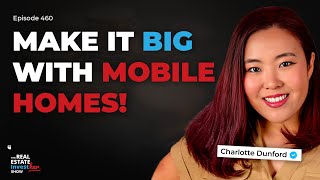
In this episode of The Real Estate Investor Show, hosts Liz and Andresa interview Charlotte Dunford, who grew a mobile home park portfolio from one to 28 parks and over $5 million in assets within three years. Charlotte explains why she focuses exclusively on the "parking‑lot" model—owning the land and lot‑rent while tenants own the homes—because it avoids depreciation, high maintenance costs, and tenant‑related headaches. She outlines her market selection criteria, favoring Midwestern metros with populations over 100,000, median home prices above $100 k, and strong local rental rates. Charlotte describes her deal‑sourcing process, emphasizing data‑driven underwriting, a proprietary algorithm, and the frequent use of cash purchases or seller‑financed deals (e.g., 30% down, 3% interest, 30‑year amortization with a 10‑year balloon). She details value‑add tactics such as cosmetic upgrades and infilling vacant lots, noting cost ranges ($5 k for upgrades, $100 k+ for infill) and the impact on community perception. The conversation also covers team building—leveraging women’s negotiation and communication strengths, delegating to specialists, and vetting brokers through track record and knowledge checks. Charlotte shares pitfalls, including pandemic‑related tenant deaths, eviction moratoriums, and the importance of tenant advocacy, as well as vacancy targets (≤20%). Financing challenges, red‑flag signals for seller‑financing offers, and strategies for building credibility with brokers are discussed. The interview concludes with personal insights: Charlotte’s favorite book (Peter Thiel’s Zero to One), her routine of drawing strength from her newborn daughter, and the inspirational legacy of her grandmother Huiqin. Throughout, the episode blends practical how‑to guidance with a mission‑driven narrative about providing affordable, stigma‑free housing.
Chapters
Numbers are extremely important, and that's what we do focus on. However, if you want the numbers to be sustainable, you have to provide a product that serves the tenants. You can't just simply bully them into paying you more. That's not going to work long term.
So in today's episode, we have Charlotte Dunford. She went from 1 to 28 mobile home parks within 3 years and has over $5 million under management.
Listen, if you are looking to invest in mobile homes, I don't say this lightly, but this is the episode that you must listen to and really pay attention on the roadmap that we're laying out here from Charlotte, who has walked the walk. Let us know what you think, but I think this is one of the best podcasts about mobile homes that I've ever came across, and I don't say it lightly.
Welcome back, everyone. This is Liz.
And this is Andresa.
Welcome back to The Real Estate Investor Show. Did you know that women outperform men as investors? They do. I did not make that up. And our community, the investor community, exists, right, to empower women to live life on their own terms and whatever success looks like to you. So, so excited to have Charlotte Dunford, who's doing this in her own life, on the show today. Jumping into mobile home parks and how she's been able to scale that very quickly and really get into that niche. So thank you so much for being here, Charlotte.
Thank you so much for having me.
Yeah, excited to jump in. We're really going to give you that— all, all of our listeners, I would say all the women listening, but we know we have our loyal men, so we appreciate you guys so much. We're going to really give you kind of like an A to Z. We're really going to dive into this, this niche of mobile home parks, especially right now. And people are trying to really get a sense of, okay, my multifamily's not penciling out, right? Let me maybe look at another particular asset class. So before we go there though, here's the first question I wanna ask you. You've been able to grow your portfolio, mobile home portfolio, from 1 to 28 parks in 3 years. So what lesson have you learned that you wished you knew when you got started?
The biggest lesson would be that it's all a teamwork effort. So you would absolutely need to leverage a team effort and other people on your team to complete the job. So, you know, one cannot be good at everything. So you have to be able to delegate and be able to focus your resources, your time, and your talents on something that you're extremely good at. Focus on that. As you know, as women, we have lots of talents that men simply don't have, and use that— your negotiations, your communication skills— to get the deal done and leverage everything else to other people who are really, really good at that job. So that's the biggest lesson I've learned.
I totally agree with you. I think that the biggest challenge here— we're, we're talking to women that mastered the art of doing things themselves, sometimes by choice and sometimes not by choice.
Yeah, they have like a PhD in it, right, Andresa?
Exactly.
Yes, it is. And I think that a lot of the women that are listening to our podcast, we encourage you to focus on the things that you're going to have to unlearn in order to get to the next level. Many times we focus on the things that we need to learn in order to take our business to the next level. And I'm— I highly believe the key is unlearn a lot of things. And I think, Charlotte, you're pointing in one major key, which is leverage. So when we are looking at any asset class, I don't need to be the one really doing everything because Honestly, I suck at a lot of things, right? But I'm really good at others too. So when it comes down to this specific asset class, mobile homes, why investors that are listening to us right now should pay attention to it considering the economy the way that it is right now?
Right, you're exactly right. So the economy we're heading— many economists predict that we're heading into a recession. So we call the mobile home park industry the dollar store of housing. So in a, in a—
I've never heard that term, Charlotte, the dollar store of housing. I've never heard it that way.
Exactly. So, so, so it's dollar store of housing. So people are looking for less expensive housing as people getting really get their pay cut. You know, there are multifamilies, for example, is not penciling out, is not getting the collection you want to. So the dollar store of housing, let's look at dollar stores in a typical recession. They, they actually do very well in a recession. We typically receive more phone calls and wanting to rent. Our mobile home park lots in order to move into quality neighborhoods with affordable housing options. So really, in a nutshell, it's a parking lot business because we don't own the homes. We own the dirt underneath the homes, making it less expensive to operate. Now, there are expenses to operate every asset class, obviously, and there are pitfalls that we need to watch for. However, I would say that it's the parking lot to bring affordable housing to American homeowners. They can have that American dream of owning a home at the same time not having to pay an arm and a leg for every month payment. So that's really in a nutshell what it is.
So I just, I just want to clarify a couple of things, right? I'm not an expert in mobile homes, but I've, I've learned a couple of things here, here and there. So for the women that are listening, let's, let's break down what you just said. That there are different ways that we can invest in mobile homes. One of them is to own the lot itself, not necessarily the mobile homes that are owned by the people. The other strategy is to own both and rent that out.
Which one?
Or there might be several hybrid modes over there. So what you're focusing on in your business strategy correct me if I'm wrong, is on the parking lots only, or you have a hybrid model?
Yeah, it's on the parking lot only. I'm going to say this again and again until my face turns blue, and that is do not, do not, do not, do not, do not own park-owned homes. So I'm going to say it again. If you take away anything from this show, it would be that focus on the parking lot land model, not the mobile homes. Why? Because mobile homes depreciate, they're a headache to manage. They have on average $200 month per mobile home in repairs and maintenance. And the tenant base and the clientele, usually you're looking at different demographics. So you really, really want to stay away from, from that. Talking about self-care and self-love, you know, some of us are moms, some of us are women just really trying to make it work. Really save yourself some trouble, stay away from those park-owned homes, those, you know, mobile homes that are about to die. They're really, you know, their titles are registered at the DMV. Would you want to buy an old car that you can't fix? You don't want to. You want to be in the real estate business. That's not even considered real estate. So stay as far— run away, run fast before it's too late. That's what I love this.
I know.
I love this because I don't think I ever heard with such a certainty before. And the way that you explain made a lot of sense in my head. Which business am I in? I am not in car business. I have no desire to do that.
Exactly.
And it sounds more aligned with, with my self-care piece, which I know you just, you just know, you should just, I was going to say you just deliver a baby. So you have, you have a newborn.
Exactly. And when you're feeding the newborn in the middle of the night, you really don't want to get a call from a tenant who's on drugs and want you to fix their toilet right now. That's the kind of clientele you would have to deal with if you're in the old car renting business, old mobile home business. And they're paying you maybe $400 per month, if that, and you're going to have to pay $1,000 per month just to fix that thing. So what you want are actually people who own their homes, which you own the land, they're good homeowners, have pride of ownership, have that American dream going on. And that's what you want. That's what you want to get after. You wouldn't have to, have to feed the baby and answer their calls in the middle of the night if you do that. So that's, I would tell everybody that. Yeah.
So Charlotte, you probably have a lot of people that are listening right now. I was like, okay, that's, I'm on board with that. So now the question is, how do I do that, right? So let's talk about markets and let's talk about like where to even begin. We always talk about people get so enamored about the specifics when they don't even know really where the best spots are. So what does that look like from, you know, owning the land, like you're saying, the dirt, what kind of markets, obviously, that align with affordable housing? What are other things that people wanna look for in that what would work for the market that would align with your strategy?
Really, the business is owning an affordable housing option. You're offering tenants a product, right? Think of yourself as an HOA, right? In your neighborhood, you're offering this lot for people to move their homes into, or you're, you're buying an entire neighborhood, you're renting the lot. So what would you look for, right? So you're looking for for your product, your affordable housing lot rent, to be a lot lower, a lot less expensive, a lot more affordable than other housing options, other housing products in town. For example, when you look at a market, look at what the median housing price is. You want to look at a number at $100,000 and above in median housing in the city. If not, if everybody can get a house, median housing for $40,000, then why the heck would they want to move to a mobile home park, right? So it's really for the affordable housing. So that's one of the things Okay, and another thing, is it part of an MSA, a metro, that has at least 100,000 people in there? So it's a town, it has business going on, so that's the economy, so it supports, you know, the pillars of the economy there. So you have some sort of stable tenant base. You don't want people leaving there. And another thing, looking at the market, would be look at the local apartment rents, right? What are they charging with utilities? You want the total charge that the tenants will pay to live there to be at least $400 to $500 more than what they were paying at your park. So that's what makes you affordable. So stick to your niche, which is the affordable housing niche. So you want your product to be a lot better, a lot more affordable than— remember, dollar store housing, right? Are you really offering the 3 Below and dollar store prices compared with, let's say, the Gucci and Louis Vuitton? Really, just, you just have to compare yourself with that. So that's what I would look at in a market. So the 3 So in my head, here, here's where I'm at with it.
Okay, I'm looking at those markets and I have a couple of options, like buy land and start from ground up, or buy an existing that has an opportunity, upside opportunity. What would you recommend and what are the pros and cons of those two approaches?
I would certainly recommend the second one because buying land and starting from the ground up is extremely expensive and almost impossible to do given the permitting and zoning restrictions, because most municipalities don't really like mobile home parks because of tax reasons. So they almost never ever permit new zoning and permitting for new mobile home parks unless it's an economic development opportunity. So there are so many existing mobile home parks that we buy. You just have to look at the deals, the parameters that you look at when choosing a deal. So we always, always recommend getting an existing park with some upside to it, you know, in lot rent, cosmetic upgrades, curb appeal, infilling, those value-add strategies. So that's what we look at.
When it comes to underwriting and analyzing, you know, we pride ourselves on saying, okay, if you don't know what a good deal looks like, you know, the good deal is going to maybe pass you by. And when you're entering a new niche and you're thinking about something here in terms of like, okay, I really— this intrigues me. You know, your opportunity, whether this is a good deal or not, right? Your skillset's not there. So, well, how did you begin really getting, getting clear on what you were looking for? Getting clear on like the, the dollars and cents of, is this a good deal? How, how do you build that muscle in this particular niche?
Right. In this particular niche, I learned my lessons the hard way. I started by practicing actually owning and operating the parks. So really all of our data, all of the, you know, the, the deals are actually from our actual numbers of operating. So we look at all the 28 parks we had, and we look at them, see this one is working well, this one's working okay, this one is really working well. So what, what went right, what went wrong? So we look at all the data and gather, you know, do some data analysis. I have a background of business analytics before I launched my full-time business.
I was gonna say that you're like data-driven.
Yeah. Where does that come from?
Yeah. So everything has to be quantitative. We have an algorithm that we've designed, uh, based on what works and what doesn't work. It's like machine learning, using data to train your algorithm to see what works and what doesn't. So we really have to learn. I would say take your first step, take action. The first action step would be, you know, start talking to brokers and getting your first deal done. And that way, you know, sticking to the right parameter— for example, I'll give you top 3, you know, mostly tenant-owned homes, you know, pride of ownership, tenant-owned homes, and then public utilities, you know, because the biggest money loser is utilities. And then The third thing would be look at the cap rate. You don't want to overpay. So if you got those three things right, you wouldn't have to battle. So start with those three, get a park under your belt, and then you will learn. That's how you will actually start training the muscle. Because honestly, you can learn, you can listen to as many podcasts as you can, but those are really helpful, but you have to get actual experience.
Charlotte, what's like a small park? Like what's considered small park, medium park? Is there like an average number of You know, size, like how do you, how do you figure that out?
Anything below 70 pads would be a small park. Anything beyond 70 pads, over 100, that would be a medium level. Big one, you're looking at 300 to 1,000. So that's like a small city. So really they're players in different niches. And then the bigger ones are, are for the institutional buyers. The medium ones are medium level private equity firm. And us, we're in the niche of a smaller to medium level parks. And there's money to be, be made in the each niche. You just have to find your niche and dominate it.
I'm thinking in multifamily terms, so forgive me, but okay, so you got a small, you got the small pad, right? You call it, you have 70, you said less than 70 is a small one.
Yeah, less than 70, anything from 10, 50, 70. So, so anything below that is considered small to medium, really small on the smaller side.
In terms of like what the average, like for us, right? Multifamily is like, what's the average door, right? What's, how much, how much can I buy this, you know, property for on, on terms of per door, right? If we're looking at large multifamily, every market's different, 35, 50, 70, Oh wow, that's 50. The market's really 70. That might be a good deal, more value add there. What is it for this niche? So how does someone— is it the same type of like, how do they assess what's average, what's low, what's high?
In terms of door count for mobile home park is really the lot count. So you want to look at how many occupied lots are in each mobile home park. So I would say a smaller park, you know, small is actually good. It's not a bad thing. Anywhere from 10 to 50, that's small. Anything beyond that would be medium. And then beyond 100 and more, that's, that's, that's big.
In terms of vacancy, what is the sweet spot?
It depends on how much money you would have and then the value add you would have to infill. Infilling means that attracting new tenants or buying a new mobile home to put it in there and sell it to a tenant. So you always want to stick with the land business, right? So I would say the sweet spot for us for vacancy will be 20% or less.
Got it.
And in terms— I'm getting— listen, ladies, I'm fighting here for all of you, right? I'm picking Charlotte's brain right now and getting to like her sweet spot so you guys can really get a lot out of this. In terms of markets, where are the markets that you are focusing on, and what are the markets they're like, uh-uh, not a good one for it based on our past experience?
We like the Midwestern market, Iowa, Wisconsin. Those Midwestern markets are good. Certain states we don't like, including Illinois, certain southern states, because of the tenant base demographic and economy, lower lot rent. We don't like such as— and certain zones with hurricane risk. And flood risks, for example, including Alabama, Oklahoma, and certain, you know, weather risks and insurance wouldn't even insure on that, you're going to be in a pickle there. So I would say focus on Midwestern states, less on the Northeastern states. I wouldn't exclude any state, but I would just focus on Midwestern states with really good rental prices, good high lot rent with good solid tenant base. And the agriculture background really supports it.
So in terms of financing it, what has changed so far in terms of your traditional finance and then the syndication piece with private lenders? Where are we at on the spectrum when we look at mobile home parks?
Right now, investors are skittish, right? So they are looking at the markets, there's so much volatility in the market and they don't feel comfortable with a lot of things. However, you know, you can make real, make money in real estate in good times and bad times and recessions and thriving economies. You just have to grab your chance. So as far as financing in mobile home parks, especially for the smaller ones, we've almost always bought our deals with either full cash at a discount or seller financing. So one of the deals that we got, it was just an example, would be seller financing at 30% down, 3% interest rate. And those are the rates you never even think about that's possible in commercial real estate. So really grabbed a piece of seller financing with the sellers in mobile home park. The reason for that is because banks would rather lend on a single-family home than a mobile home park because there's less risk there. So that gives you a lot of chance for seller financing. A lot of the sellers are mom-and-pop sellers who built the park, and they don't have a loan, so they can seller finance. So that gives you more advantage.
So it's just less traditional.
Yeah. A word of caution though, so if you see a deal that says screams from the top of their lungs saying seller financing available, be careful, because that usually means there's something wrong with the deal because people would like to be cashed out if possible. So I would say the best kind of deals are they say seller financing isn't available. However, you're able to use your communication skills. As women, we have really good communication skills, so you need to negotiate that and get that deal done. That's usually worth it.
So if I see seller financing available, that's a red flag.
Absolutely a red flag.
What questions can I ask to really confirm that? Because, right, let's, let's give a chance that somebody is just saying that they're open to, to that, right? But how can I really confirm that that is not a good deal for me?
If they don't mention seller financing, if there is some sort of pushback on seller financing, then that usually it's a green flag. But if they send you an email blast and say seller financing available, that usually means, okay, something is up. You have to find that out. So certain questions— let's give you maybe 3 questions. So let's say, you know, why are you selling? Usually the reason they tell you is not the real reason, but you have to feel for it.
Yeah, I love that. So let's go back to this example. I love real examples with real numbers so we can get our heads around like dollars and cents. So you got the seller financing deal, You said it was 30% down and it was about 3% of what—
3% interest rate. That was one of the earlier deals that we did. Where was it?
Where was it?
How'd you find it? Yeah, that one is located in Ohio. I found it through our broker networks at the time. The network's always expanding. So I found that one. They didn't offer seller financing, but it was a smaller park. 10 lots with a little bit of upside to it. Good paying tenants, all tenant-owned. So 3% down, 30-year amortization and 10-year balloon. So those monthly payments are pretty low because of 30-year amortization, a long time to pay off the 10-year balloon. So that's close to free money at that in today's economy, 3% interest rate.
So amazing. So when you say upside, right, so we know what that means and I know what that means in multifamily. I just keep going back to multifamily as an example. What does that mean? What does that mean for mobile home park? What is, what does upside value add look like?
The value add would be two major categories. One is cosmetic upgrades. Two is infilling. Infilling is a lot more expensive, but a lot more profitable. Cosmetic upgrades is less expensive, but can be somewhat profitable if you do it right.
What's infill mean?
Infilling means if you have a vacant lot with utility setup or without utility setup, you either have to set up the utility. Most, you know, you want to buy the park with utility setup, so that's for some money. So you want to either put an advertisement saying that, hey, I have a lot available, just like you see on the side of the road, say we have, you know, homes available in this neighborhood for mid-$400s, right? So those are the signs. So it's the same thing with mobile home parks. You want to say, hey, our lot rent is this, and come live in our neighborhood. So people want to buy their own homes and bring their homes into the neighborhood. You know, you may have to pay up setup fee, you know, hooking up the utilities. But that's, that's one way to do the infilling. Another infill would be you buy a new home or used, good used home out of your own pocket, put it into the lot, and then you sell that home on a rent credit program to a new tenant. So that way the tenant pays you rent, lot rent, and home rent. So that you got to increase your vacancy, you got a new tenant, a new lot rent, and you improve your neighborhood. And the second one is the cosmetic upgrade is a lot easier, a lot less expensive. With the infilling, you're looking at $100,000 upwards of $100,000 per infill. With cosmetic upgrades is less than $5,000. You can put a new signage at the park saying that, hey, welcome to Beautiful Lake Mobile Home Park or something. So give it a more neighborhood feel or add white fences to it.
So if you're really creating, you're creating a community like that's the, that's what I'm hearing, right?
Exactly.
And it's fascinating because We see this with the investor community, right? You know, now more than ever, people are alone. They want to be connected. So then you take that one step further in terms of like a housing solution. People do want to be connected. They do want to be in a safe environment. It matters to people. And so that's really interesting. And my wheels are turning. You get me? You get—
you're getting me wanting to look into these things because basically you're creating like an identity, right?
Exactly.
How this mobile home, how we run things over here, people do care about their lots. They take pride in it. There's no trash around. There's flowers there. There's a way of being here that you kind of set the standards for everybody.
So it's not just a small deal by deal, is we're making a big change here, right? Mobile home parks have a stigma. You know, we all know what that stigma is, but we're changing that. We're changing that. We're creating a better neighborhood. Creating the new American dream. We all know how expensive houses are nowadays, and nobody can afford a house for this next generation. Can we change the stigma and create a brand new— not brand new, but a new product, a new concept, change the stigma and really have let people have the opportunity to have that American dream, owning a home and being in a safe neighborhood?
I think that's great, Charlotte. And I think that's the work that everyone listening to this podcast needs to do. Meaning there is a housing shortage. The need for affordable housing is incredibly important, meaning people just being able to afford where they live and where they want to live. That is a very big need. And so then that's happening, and then there's a bunch of people complaining about interest rates being high. They can't buy their next investment, but they're not trying to solve problems. And I love that you are building a business and you're investing in the community and you're solving a problem. That's never going to go out of style. And I think people really need to get that, especially right now, because it's just harder when things are harder to pencil out. People just run versus like, how do I solve a problem here? And I think that's the key. That is the key to thrive right now. Because if you're not solving problems, what are you doing? So, tell us some about the pitfalls. What is something, you know, tell us a story. Tell us, not a story, but tell us a, what happened and what you wish you would have done.
Do you want to know about all the things that went wrong? Yeah. You like horror stories?
I have so many.
My mother— Liz is like my mother. I open Netflix and I was like, Mom, there's always like murder and then police. I was like, yeah, Mom, I think you have a problem.
Yeah, exactly.
Liz is like my mom. She wants to know the horror stories.
I do. I do.
That's great. I think horror stories are teach us a lot. So one of the horror stories I would share is, you know, the pandemic really changed a lot of lives for a lot of people. So during the pandemic, we would have— we have a park out in Arizona and there are tenant deaths in our parks. Several tenants died from COVID in the hospital and there's nobody taking over the home. So that's kind of a mess of cleanup. So what we try to do, we always try to— I would say the biggest horror story as a whole would be the pandemic, you know, for the entire mobile home industry because of the eviction moratorium and just all of those things that's going crazy. So we try to be advocates for the tenants. When people die, when people can't make their rent, what do you do? Right? When everything is coming at you, what do you do? And so as women, we are used to everything coming at us for a long time. So what we did, you know, so what we did, the funny story is not funny story, horror story, but we turn it around, was we try to become advocates for the tenants. We try to apply for rental assistance. On their behalf or give them the resources. Say, hey, here's a link to apply. Here's local ministry that you can talk to. Here is the local government you can talk to. So we actually recover so much revenue from that, that being advocates for them instead of just evicting them and putting them out, making them homeless, we actually became advocates for them and tried to advocate on their behalf, try to give them the rental assistance because the pandemic was really a disaster for everyone and people die. You know, we've got, you know, so we had to just clean it up. There has to be a process for that. I would say that would be the biggest headache that we encountered.
And I think that's a way of being, right? It doesn't really matter what's coming towards us. I think the way that you are running your company and creating the— I think I rarely hear that a landlord is advocating for a tenant. But I think that it's— what I'm hearing is that it's more than just an asset class. You're creating a culture of our company, your company, what you're standing for in the world. And just, it's a win-win across the board.
Absolutely.
That's what I'm hearing. And I think that a lot of people really focus on the numbers and not on creating something that they feel proud of. And I think that that's why a lot of investors really lose that passion about the industry, right? It gets really boring and very transactional, right?
It does get that way. And I think numbers are extremely important. And that's what we do focus on. However, if you want the numbers to be sustainable, you have to provide a product that serves the tenants, you can't just simply bully them into paying you more and become a slumlord and treat the park like an ATM machine, that's not going to work long term. So if you're in this, you know, for a long shot, you want the numbers to look good in the long shot, you want to provide a product that works instead of just bullying and doing the strong-arm tactic. That's not going to work.
Yeah, I love that, Charlotte. One more question I have is brokers. We all know commercial brokers are not created equal, but when it comes to these type of projects, I'm sure you could find some off-market, but I'm sure you work with brokers and they've become your champions too to find the right deals. So I'm curious, what are some ways that like women listening as they embark on maybe building their team, right? Taking those first steps, what would be like a sure sign that this commercial broker is not gonna be a good fit for them? Like what are some qualities that they wanna see? I could answer that from like a multifamily space, but I'm curious, if it varies a little bit based on the niche?
I would say if you're trying to buy, the buying broker and the selling brokers, you kind of want different styles. So as a buying broker, you want to make sure that you can work that into your advantage as a buyer. Now, you don't want the broker to be not knowing what he's doing. He can't answer your questions. He barely knows anything about the park. That's a red flag. So I would say really test his knowledge, ask him as many questions as possible about the park and see how much he actually has done his homework, because someone who doesn't do his homework is not professional, and that's not someone you want to deal with. And I would say 3 words when hiring anyone, hiring anybody on your team: track record, track record, track record. So you want to see their track record because history honestly repeats itself. So you want to make sure this— that is looking at their resume, ask for references, see how they've done the job for other people. So you don't want to go into a pitfall. You can't afford to do that, right? Because you're just— if you're just starting out or you're just building your team, having a bad team member can really mess things up or set you back.
That's great. And just one follow-up question to that is, how does someone who's new to this niche stand out? Because then a broker who's really like that quality A-team broker is like, oh geez, A newbie, I gotta deal with a newbie. Like they don't really like working with, in my experience, right? They get it, you have to sell them on you. So is there anything that the, you know, when reaching out to brokers that are new to mobile home park can really, hey, I've done this, this and this, I have this behind me, you know? So those brokers who we really actually wanna work with wanna work with us.
Right. You're exactly on the money there. And another thing that is, we're women and they, a lot of times they really don't treat women seriously. Unfortunately, they see, they don't think you are the investor. They just think that you are probably a receptionist somewhere for an investor. They want to talk to the real investor. So what you really need to do is make them an offer, make them an offer, a strong offer, present it in a professional way, make them an offer, and then you can talk. Now they know you're talking business. Now they're looking at that offer. They see their commission right there and they're going to want to talk to you.
Yeah, that's a great idea, Charlotte. I love it. I love it. Appreciate all your great insight here today. Where can the ladies listening learn more about you?
The best way to reach me, you can email us directly at info@johnscreekcapital.com or go to our website at johnscreekcapital.com.
Awesome. All this information you guys can find on our show notes. Now we're going to transition to our fabulous 3 questions. And the first one, Charlotte, is what's the most transformational book you ever read?
It's called From Zero to One by Peter Thiel.
Oh, I love it. I don't think I came across that yet.
It's a great book. It's a great book if you, uh, for entrepreneurs. Love it.
Taking some notes here. Second question: what's the most powerful routine that you do to create a financially free and balanced life, whatever balance means to you?
The routine would be looking at my daughter and my newborn daughter who was born in March of this year, looking at her pictures, thinking about the struggles that I had to deal with on a daily basis, you know, to raise her at the same time being an entrepreneur when everything is coming at you. Remember that, remember that pain, remember the victories you've created on a daily basis. Remind yourself how wonderful you are, how much you can actually handle. Don't let other people convince you that women can't have it all. Just believe in that. Keep things in perspective. I think that's the most powerful thing. Awesome.
Last question. Which woman, famous or not, has inspired you the most?
That's a really good question. I would say my grandmother, my paternal grandmother, who passed away unfortunately last year of lung cancer. She is a truly phenomenal woman. Who has gone through so many hardships in her life, but she was very, very positive about life, always had a sense of humor. She was barely literate. She went through two world wars, a cultural revolution in China, really worked and worked and worked, but very, very— led a very, very successful life. Have a lot of respect for her, and she's always told me to have faith. And which has really empowered me throughout my life.
What's her name?
She has a Chinese name, so she's— Yeah, I can say that. Huiqin.
Wonderful. Because I want to know.
I want to know.
Yeah.
Yeah.
I love that. Charlotte, thank you so much for being on our show today. Thanks for sharing your great, great wisdom and getting a lot of, a lot of women and men who listen to this today's wheels turning. So thank you so much for being here.
Thank you so much for having me.
More from Andresa


The real estate investors who are going to make it in this next era won’t be the ones with…






Ep. 598 | How to Avoid This CEO Triangle Trap That Every Real Estate Investor Falls Into #InvestHER


Ep. 595: Daniella Devine | How to Analyze Commercial Real Estate Beyond the Property | #investher
