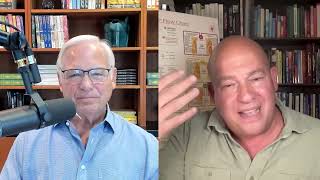
[EP 45] Rewiring the Brain for Bliss: Activating Your Spiritual Intelligence with Dr. Dawson Church

Dr. Dawson Church explains how mysticism is actually four brain circuits you can activate through meditation and tapping. An eight-week program increased emotion-regulation activity by 22.8% on MRI scans. He shares how these practices shift hormones like oxytocin and help with PTSD and trauma recovery.
Chapters
Foreign. Welcome to the podcast, everybody. I'm Jack Camphill and my guest today is Dr. Dawson Church. This is a longer introduction than I usually do, but the reality is this guy is so amazing, I want you to really get a feel for him. Dawson's a health, mental health and spiritual health practitioner. He's a writer and a researcher who's edited and authored a number of very influential books in the fields of health, psychology and spirituality. His principal award winning books are the Genie in youn Genes, which reviews the research linking consciousness, emotion and gene expression. He wrote a book called Mind to Matter which examines the science of peak mental states and Bliss Brain, which demonstrates that flow states rapidly remodel the brain for happiness. And his most recent book, which we're going to talk about today, is called Spiritual Activating the Four Circuits of the Awakened Brain. We're going to delve deep into that today as well as whatever else might come up, which always happens now. Dawson has published many, many scientific papers in peer reviewed journals, collaborating with scholars at various universities on outcome studies of Post Traumatic Stress Disorder, commonly known as ptsd, as well as depression and anxiety. And he's the editor of the journal Energy Psychology Theory, Research and Treatment. So you get that he's a researcher, He's a scientist. He's also the founder and CEO of EFT Universe, one of the most visited alternative medicine sites on the web. He's also the science columnist for Unity magazine and his blog posts on the Huffington Post have been viewed by hundreds of thousands of readers. But most importantly to me, Dawson's an amazing teacher and a facilitator. He's one of the most consistently calm, happy and joyful people I've ever met, practicing all the things he writes about. Dawson's also a member of the Transformational Leadership Council, which is where I've come to know him, admire him, respect him and love him. So, so welcome to the show, Dawson. I'm so glad to have you here today, Jack.
I am so grateful for being here. Thanks for having me. I know we're going to have that transformational time together and just draw everyone into that wonderful energy. So thanks for having this wonderful show and inviting me to be on it.
Well, I just wish we had like three hours, but we don't. But we'll get started because of that. Someone says all time happens simultaneously, but I have a chiropractic appointment in an hour. I don't know if he believes in the same thing. See what happens. Anyway, let's talk about spiritual intelligence. What inspired you to write Your new book, Spiritual Intelligence. And why do you feel that this topic is so particularly relevant right now?
Well, it was the culmination of a five book series that I began working on a long time ago with Norm Shealy. And he was the founder of the American Holistic Medical Association. And he and I wrote a book called soul medicine about 25 years ago together. And he really made me aware of the importance of energy in healing. He was just a walking encyclopedia of energy healing. And so we looked in that book in detail about the influence of these intangible states of consciousness on the body. And so that was really my beginning of realizing that these seemingly woo woo things like meditation, like connection with your higher power, like all the states of consciousness, had actual application and, and the ability to actually shift your physiology. I then wrote the Genie in youn Genes after I'd worked with Bruce Lipton on the biology of belief. I then took that a step further with the Genie in your Genes about how this literally affects these states of consciousness, affect your gene expression. Then wrote Mind to Matter, showing how there's this link between what we think and what goes on in our brains and our minds with the outside reality around us. And then Bliss Brain about these extraordinary states that we can move into. And what I began to realize as I was writing Spiritual Intelligence after Bliss Brain was I actually was writing it as a spiritual book initially, and I had to throw out that draft. Jack and I began to realize that our spirituality and these kinds of extraordinary experiences that we hear about when we read Rumi, we read Mary Oliver, we read St. Francis of Assisi, and we can see these remarkable, inspired mystics clearly are in touch with something that is extraordinary, that's far beyond the average human mind and brain and experience to comprehend. And I began to realize how physiologically based it is, which led to identifying in the work of neuroscientists these four circuits of what's called the Enlightenment Network. And I began to realize that everybody has these. So the book had to be radically changed and shifted to be a neuroscience book because it turns out that we had these, these four unique, distinct pieces of hardware in our brains that literally predispose us to experiencing higher states of consciousness. And that's what we build, that's what the mystics develop. That's what enables us to move into those states and then translate those states into everyday reality. So spiritual intelligence is a physical, neurological reality in your brain right now, for most people, it's turned on occasionally. My goal in writing the book is to show people that they have this hardware in their brains and they can turn it on, they can learn to turn it on at will. So that's of the trajectory of how the book came to be here.
Now in your book you write about the Enlightenment network. Is that what you're talking about, these four channels or something else?
Yeah, there are four components to it and there are four distinct networks that neuroscience has been mapping for a long time. The first of the four circuits is the one to do with emotion regulation. There are people who just like they fly off the handle at a moment's provocation. They are re triggered easily. Other people, they're completely steady, they're under fire, their lives are maybe they're experiencing great difficulty and they're rock solid. And so that's emotion regulation. It's a circuit. In one case history. In the book I talk about a guy who did a meditation course, eight week meditation course, got an extensive set of neuroscience neurological scans before and after the eight weeks. In eight weeks, his circuit for regulating negative emotion grew by 22.8% in two months. So parts of the brain are growing really rapidly, like that emotion regulation circuit, if we use them. And so that's the first circuit I recommend people develop because you're just much less irritable and annoyed and you're just much more stable if you've got that ability, that hardware. It's a matter of physical hardware. It's not a theoretical thing or a, a set of beliefs or practices only. It's actually neural hardware in your brain. And as you grow the emotional regulation circuit, you're just much less easily triggered. So I say, you know, grow that circuit. The second circuit is.
I'm going to ask you about that circuit for a minute. Okay, so you actually do brain scans. You can see that this circuit is actually grown. Is that what you see?
Yeah, the miracle of MRIs. Now the old ones were like, they were like the computers, computer screens of 25 years ago, low resolution new MRIs like the ones I use in my clinical trials. We can see the activity of a single neuron. So yeah, we can, we can see why isn't getting on the brain and how it's growing and it's, it grows in certain people and it shrinks in others as well. So yeah, we can now zoom into that level of a single neuron.
So let's talk about this first circuit for a moment. How does someone grow their emotional regulation neurons in circuit?
The short answer is meditation. And the detailed part of the short answer is body based meditation. And what I sift through in this book and earlier books is which what MRI studies tell us about which meditations are effective. Because the bad news is most of what people do, like what I was trained to do when I was 15 years old in an ashram. So sit there and try and still your mind, be quiet in your body and focus on a higher dimension, doesn't work. People can't do that. They just try and they get bored and all their minds fill up with traumatic thoughts or they get distracted monkey mind. So that kind of meditation that many of us were trained in not only doesn't work, but we then feel like a failure. I felt like a terrible meditator most of my life as a result. So what we need to do is we need to use an effect, effective science based meditation. And that is a typically a physiologically based one. I developed one for my studies called eco meditation, which I've done with you and other transmedical council members. It's all in the body. It's the rate of breath, it's relaxing certain muscles. You have to get the body involved. And when you do that, that's what triggers growth in those circuits.
Now as I remember, eco meditation is available. You can. Don't you have it like on Google
or someplace where people download all over the place? Yeah.
Okay, we'll put that in the show notes because I, Dawson, taught that at one of our, our, our Transformation Leadership Council things. And the whole room was like, we were blown away by it. And then I had my sister do it. She was blown away by it. And I actually taught it in a couple of seminars that I do. And so very, very good. Okay, so that's the first. Let's go jump to the second circuit now.
Yeah, and the other cool thing that happens with emotion regulation as a coda is not only as this tissue grows in your brain again, that's a big growth. 22.8% in eight weeks. Okay. So this part of the brain is growing really quickly as you use it. And when you learn to regulate negative emotions, there's a little known byproduct which is that same circuit can be used to upregulate positive ones. So when I'm feeling joy, like when my wife Christine and I are feeling happy, we say, you know, we're feeling, we're feeling 97% happy. Let's grab that knob and dial it up to 100. And we do. So we just go to ecstasy. And that's what these, these mystics also do. That's why, you know, Rumi and St. Francis and these, these great mystics are able to be so happy because they're also using that circuit to upregulate positive emotion. And then the second thing you have to do is that most of us are self focused and we're worried about things that hurt me in the past and what my future holds and my breath and my body and aging and my diet and money and all this stuff. And that self is built by a part of the brain right over here called the mid prefrontal cortex. And when that part of the brain is active, it's right behind the eyebrows when the mid prefrontal cortex is highly active, which it is in depressed and anxious people. When we feel miserable, we're just all consumed by the bad things in our past and worries about the future. We're not in the present moment. In the mystics, that part of the brain calms down. So that's the second part of the brain you have to learn to calm. Is that self obsession network. What you then turn on is the attention network. And so I know I was terrible at, I was like ADHD most of my early life and now I can sit and stare at a candle flame for an hour and have a really good time. But it took development of that attention network to be able to do that. And then the final network that lights up is really mislabeled. And in neuroscience research it's called the compassion network or the empathy network or the empathy circuit. And it's called that because Buddhist monks that they were studying in the 80s and 90s, that network and that circuit turned on when they were feeling compassion. But it turns out now the newer research is showing that that circuit is the one that governs not just compassion, but gratitude, awe, joy, optimism, all the pro social emotions, they're all wrapped up in that. So in spiritual intelligence. In the book, I call it a single positive meta emotion. And when that part of the brain turns on, it's like you have this tidal wave of bliss that just sweeps you away. So those are the circuits and I have people turn them on in, in sequence in my books.
So first a comment and then we're going to go back to the second one. I now know why we're different. And you're more evolved than I am. When you were 15, you were sitting in an ashram. I was in military school.
Well, my life is at Woodstock.
You got a jump start on me there. That's good. Okay, so let's go back to the second circuit. And you talked about the first one about you Know eco meditation and how that helps body. And so what is the process for developing or evolving or whatever you want to call it, the 2nd Circuit.
So what we find in people with spiritual intelligence is they're highly other focused. And other is a combination of other people, nature and the infinite. And they are not highly obsessed with themselves and doesn't mean they don't take care of themselves, but their focus is that their tent is broad and they are able to really focus on the good of the whole. Mahatma Gandhi is a perfect example of that. And throughout the book, I give examples of people in the Holocaust who had spiritual intelligence and people now, contemporary people who are living or who are near contemporaries that have spiritual intelligence. People from history read spiritual intelligence. So I have a lot of stories in the book as well as a lot of science. And what we find is that typically they're really interested in helping other people. They're altruistic. And what happens when they do that is that they are dialing down their self focus and they're dialing up their other focus. Ultimately, it's the mystics. And when the mystics are plugged in, in non dual states where the distinction between my consciousness and all consciousness disappears, they're in non duality. We find that that's what happens when that selfing circuit is dialed down. There's a flood of oxytocin in the body and you feel completely in love. And there's this love just fills your being, but it's not love for a person or self love. It's love, infinite love. And that then triggers all of these interesting neurotransmitters like beta endorphin. So your knee hurts when you go to meditation. Often you feel the love hit you. Your knee isn't hurting anymore. People's experience of physical pain dials down dramatically in these states. Anandamide, the bliss hormone, fills you, triggered again by oxytocin, the love hormone. So neuroscience is now working out the biology of all of these states. And it turns out they aren't mystical, they are mystical, but they're physiological. And we can map the gene expression, map the hormones, map the neural pathways. That ability to dial down your self obsession is incredibly powerful. And that piece of neural hardware then grows as you exercise it. Just like a muscle grows when you exercise a muscle, when you exercise these neural bundles, they grow.
Okay, so Bob's sitting out there and he goes, yeah, I want to develop that. You told me what it does. And then in my all this good stuff. But what oxytocin and all the research. But what should I do if I want to develop that particular channel? Give me a practice.
Yeah. And I give people practices in spiritual intelligence at the end of every chapter. So every chapter ends with what's called extended play resources. In those resources, we give you links where you can click on the link, go to a website and download those resources so you actually get them. And what you get especially is these physiologically based meditations. So you're able to then listen to one. You don't have to try and figure it out by yourself. Just put on your headphones, listen along. It's just an activity you get guided through. And then you experience these in your body. And again, what you're feeling in your body when you feel good during the meditation is actually that hormonal and neurotransmitter shift. So you're feeling that pleasurable activation of those neural circuits and you're feeling it in your body. And once you get it in your body, like, one woman came up to me at a workshop and said, I decided to do eco meditation, your meditation system. I decided to do it every day for 30 days. And I was just thrilled that she made that 30 day commitment. I said, well, what day are you on now? She said, oh, I'm on day 237. Because she's totally hooked. She's totally hooked on that good feeling in the body. So you need a body based technique like that.
Yeah. Okay, so what you're saying to Bob out there is at the end of every chapter in my book with these four different channels. I have resources where you can go and you can listen to a meditation that will help you develop that channel. Is that what you're saying?
That's exactly right.
Okay, cool. That's a great service for people. I love it. I love it. I remember. I'm just going to throw in two things from my own experience. I was in a couple's workshop once where for 30 days, it was actually six weeks, so it's more than 30 days. And we had to every day do an act of loverness, they called it, for our partner. So every day I had to think about how can I let my partner know I love her? So my focus was on her experiencing being loved instead of me getting love and being frustrated that she didn't love me the way I want and all that good stuff that we do. So I just. It's interesting to know that that's part of what works. And there's meditations to support that. So let's talk about the third channel again, which is what again?
And when you expand that love to nature, to other people, to the world around you, to infinite cosmic consciousness, then your whole world becomes filled with love and your behavior changes. You don't pollute, you don't do harm to other people. You seek the good of the whole. You seek win win situations. So your value shift dramatically when you're in that state. So this produces reverberations throughout your whole life, and your life generally becomes a lot better.
Okay, so let me just. I want to underline maybe and ask you if I'm right here, that what you're saying. A lot of people say, okay, we're going to give you some loving exercises to do and that'll develop your love channel. You're saying if we do this through these meditation practices, the love channel will then bake you or cause you or allow you or encourage you or whatever the right word would be to actually be loving. And you're going to want to love the environment. You're not going to want to pollute because you love everything. Right. Is that that kind of where you're coming from?
Yeah. You feel one with everything. And when you feel one with everything, you understand everything is a part of you. That, that rock and that tree and that bird and that lizard and other people and especially Jack. This is going to be challenging for some people, I know, but you think about the warmongers. People are hurting other people, hurt people who are really violent. And you learn to even hold them in your circle of love. And it's difficult to do that. There are people I find written hard to love out there. They are my gurus, they are my teachers, and I just practice holding, seeing the light in them, and not excluding anybody from that circle of love. So that's what spiritual intelligence brings.
Yeah. I had a recent ayahuasca experience where I. We were asked to forgive the unforgivable. And who popped up but Vladimir Putin. So I basically had to include him in the love and all that. And it was when I did, I saw his childhood and what made him, what his drivers are and why he does it, you know, and then when I finally let go of all that, it's just like a fill, this weight lift off me. It was. It was palpable. It was like physiological way cool. Okay, so third channel.
You know, that doesn't mean you're going to justify acts of violence toward you or toward anyone else in the world. Because, like, you know, right now I, I'm. I've been training school Teachers and therapists in Ukraine via Zoom. We do Zoom meetings, we train them in EFT tapping to help them work with children and others. So, you know, I'm, I'm really in touch with Ukraine. I almost want to cry right now when I think about the, the, you know, the concept that these teachers are, are working with because they're totally traumatized. So it's not like you're indifferent to the suffering of the world. You feel it. What we find in these monks and nuns is they have an enhanced compassion response, they care even more, they cry quicker. But then their brain shifts very, very rapidly into the mode of how can I help? So their brain energy shifts there and then we see what we can do prior to health situations. So you are going to get overlook abuse or bad behavior. It's still at Dodge. It's there just that the person you aren't going to meet hatred with hatred. So the third circuit is that we want to make sure we develop this attention and a lot of us have very split attention and social media and today's world really fragments our attention. And one of the things I really insist people not do, and I say this in the book in more than one place is I say please when you wake up in the morning, be the master of where your attention goes. Now I know you, for example, when you wake up in the morning, you have your intentions on 3 by 5 index cards and you are reviewing them and you have other things to direct your attention consciously. And that's what I recommend people do. And what you don't want to do first thing in the morning is pick up your phone and, and start scrolling. Because then you are handing this most precious asset, you have your attention to somebody else. You want to instead direct your attention toward the infinite. Just in the last few weeks I've had some big challenges in my business. And what happens is I wake up in the morning, immediately go and meditate and I sit there, get really calm, hook up with the infinite. And then as I'm ending my meditation period a while later, I just spontaneously have had brilliant solutions to all of these problems pop into my mind. So you want to set yourself up for joy, you want to frame your day for creativity and well being by meditating first thing in the morning and not handing your attention to somebody outside of yourself. Make sure you direct your attention in a conscious way upward into that creative reservoir. Urban Laszlo, who wrote the book the Akashic Records, brilliant European scientist, talks about the information fields of the universe. You want to be up there where you have access to all this knowledge and wisdom and love, and then you become a channel for that in your everyday life. So your attention is that third circuit and it just gets bigger. That part of the brain enlarges in long term meditators. So now it's like being able to lift, say you couldn't lift 200 pounds a few months ago. Now you're working out every day and you get better and better and better. Suddenly you break through, you reach the tipping point, you can lift 200 pounds. Our brains are actually adding new tissue much faster than our muscles do. As you use these circuits, your parts of your brain are growing spectacularly quickly. And your attention circuit will grow as you practice using it to pay attention to what really matters, which of course is love and kindness and peace and beauty and optimism and joy and all, all of those other things. So that's the third circuit. You want to make sure you build, grow again.
You have resources at the end of that chapter for people to support them in doing that.
Yeah, yeah, okay, yeah.
And then, then talk about the 4th Circuit in a little more depth.
And the 4th Circuit is, it's, it's a, it's actually a whole lobe. So our, our brain, our neocortex has four major lobes. And this lobe is so big it's almost qualifies as low by itself. But it sits below those four lobes. It's called the insula. And it mediates all of these pro social emotions. It has these special. Actually, I won't go into the kinds of neurons it has because I think it's a little bit too geeky for here, but it has special neurons found only in highly social species, which facilitate love and connection with others and with the universe. And what we found, like I did one clinical trial, a randomized controlled trial at Bond University with some colleagues in the neuroscience department there. And we had people go into MRI scanners, we scan their brains with these high resolution pixel by pixel scanners. We then had them do ecomeditation every day for one month, had them go back into Bond University, lay in the MRI scanner, measure their brains again, and we were astonished to find that in only 28 days, anatomical and functional connectivity shifts had happened in their brain. And the insula, that love, that has to do with altruism, compassion, gratitude, awe. In the brains of those people, after only one month, it was lit up like a Christmas tree. They were in such much more happy states than they had been before. They were more compassionate, they were kinder, their behavior reflected those changes. So it doesn't take 10,000 hours. And the old model was, you know, go to a monastery and take Vs and spend years sitting with a master. Go to the Himalayas. You can do that. I did that. That's why I was at the ashram at the age of 15. But it was a slow and painful process. Didn't produce much growth. Now with neuroscience, we can hone in and say 90% of that stuff I did in the ashram was useless. But this 10% really works. Just do this.
Wow. Because I know you have a class that you teach that has to do with like, you know, evolution of your spirituality. And what do you. What?
Yeah, there's. It's called a short path to Oneness and practices to take you there quickly where you don't have to go into the monastery and spend, you know, 4,500 lifetimes figuring this stuff out.
Slow down the number of reincarnations you need. I love it. So I want to ask you a question. So if you're right, which I think you are, and this is something that could be done by these meditations you have and these other, whatever different things you guide people to at the end of the chapters of the book and developing these four channels, talk about how you see that could be integrated into the education. In other words, are these things that children could do and starting at what age? And I think about, I was just talking with someone yesterday who's doing some work with kids, mostly high school students. And I was working with a Native American named Yukwala, who is a medicine man, brilliant, brilliant, brilliant spiritual teacher. And when he was talking and the way he talked and what he talked about, I thought, God, if some of these inner city kids could hear this guy, they put down their guns and they go, I want to work with you. And so here's all this violence going on, all this ptsd. There's research that just growing up poor creates ptsd. And I know you're an expert in ptsd. Can you see getting this work into the schools?
Absolutely. And there's already a lot of meditation in schools, especially mindfulness based stress reduction. And there's also a lot of eft tapping in schools, which reduces stress. And the two work beautifully together because you can tap in about a minute and feel a lot less stressed. And then mindfulness and meditation take up more time. And the research is really clear that when kids get access to this early, it makes an enormous difference in several dimensions. It reduces anxiety, and that includes test anxiety, social anxiety, our newest one on the block, climate change anxiety. A lot of teenagers are really worried about climate change. And another set of studies by another colleague called Lisa Miller is really interesting. What they find, and I talk about this in chapter two of Spiritual Intelligence, is that there's an inverse relationship in teens between spirituality and depression. And teens who are depressed tend to have low spirituality. Teens that have high spirituality tend to have low depression. And it's because the part of the brain that mediates both spirituality and depression is the same part you'll be using it. Either we're lining up that enlightenment network and we're connecting with something higher than ourselves. We're feeling these floods of joy and all the resourcefulness that comes along with them, or if not, that part of the brain is part of the depressive circuit. And that part of the brain actually starts to shrink in people with major depressive disorder, that emotion regulation part of the brain, because it gets smaller.
And.
And not only does the part of the brain that connects the emotional brain, the midbrain, with the prefrontal cortex, the executive center, start to get smaller, the nerve fibers start to fire in the wrong direction. And what's now happening is the emotional brain is controlling the executive centers. So the person feels a negative emotion. They feel pissed off today, and they send a signal now in the wrong direction to the executive centers, which should be controlling them. And it says, I feel pissed off. Executive center of thinking brain. Go find something for me to get pissed off about. So they start to literally control our conscious thinking executive brain, just the opposite of what it's supposed to be. So again, kids who develop this early on, especially like mindfulness in schools, tapping in schools, when they hit those teenage years and they had their hormones, I mean, boys, testosterone rises something like 4,000% in puberty, and they start to have all these social pressures and light pressures. If they have the rock of spirituality and mindfulness to stand on, then they're much less likely to become depressed. And again, that showed up as statistics like thoughts of self harm and suicide, teen suicides.
Well, as I'm sitting here, I'm having this vision way back when there was a guy named George Leonard. I don't know if you knew who he was.
Oh, I knew him. Yeah.
Yeah, yeah, I did too. And he wrote a book about education. I forget the exact name of it, but it was all about how technology and science and, you know, spirituality and all this stuff could come together. And. And one of the things that I. I'm. I'm imagining with this, and I'm curious to your point of view. So Two days ago, I spent two days in Phoenix, Arizona, and I was working with. I. I have a. I'm part of a network marketing company called Young Living, which sells essential oils and the whole idea of aromatherapy and all this good stuff. And everybody in this downline that came to this thing that are in my downline are all spiritual and big time, and they meditate and they do all this great stuff. And so the woman that put together the retreat decided to have us do breath work and listen to Joe Dispenza and do healing with each other and all kinds of cool stuff. And it was all basically on a screen with, you know, YouTube videos. And we were like, there's about 40 of us there, and we were doing this stuff. And I. And I had this. And I. Then I thought, as you were talking about my experience at the. In Iowa, where the Maharishi has his university, there's a school there that. I visited that school. And every morning, all the kids sit in meditation for 20 minutes. I mean, little first graders, you know, it's so cool to watch. And I remember being in the. They were passing in the classroom and these junior high, high school kids. One boy went up to this girl and he started teasing her, and she just looked at him and said, bob, I'm not having a good day today, so I'd appreciate it if you don't tease me. And he went, all right, I'm sorry. That would not happen in a public school normally, you know. And so I went, okay, this is a good thing going on here. But I thought, like, would it be possible for these things that you have these visualizations and guided imagery and the meditations and stuff? They could be a classroom room, either watching on a large screen, or they all have their own earphones with their screen, you know, whatever. Doing this as part of a daily class in school, like, you know, we have all these classes. There's no. There's no personal development class. Like, you know, third period is like growing yourself, self awareness, education, self science, whatever you want to call it, where we could integrate these kinds of technologies in a group setting like that so that these kids would have that experience. Could you imagine that happening?
Yeah. And it is often led by one champion in a school. There's one teacher who is really affected by it, whose life improves by it, and then who carries it into the school. So we found there are these champions in schools who then bring that into the classroom. And, yeah, it's not usually part of the curriculum. It's often an optional thing, but, like, in one teacher I talk to her. Meditation is just having the kids sit there for a few minutes at the start of each, each part of the day and do conscious breathing. Conscious breathing alone is going to do a whole lot to regulate you. And conscious breathing means just becoming aware and focused on your breath. And for the yogis, for the people developing spiritual intelligence, they usually recommend starting with a breath. It's such a simple practice. Every kid can do that. And also then directing your attention to the flow of energy in and out through your heart. So these are not elaborate techniques. I mean, there are some very elaborate techniques in the ancient practices that I recommend and teach in the Short Path to Oneness. But the simplest ones, like breath work, are ones every kid can do. And again, that is self referential and putting you in your body. And from that point of view, you're far less likely to injure other people or be prey to your own negative emotions if you're in your body rather than in your head or carried away emotionally. So, yeah, kids can be taught to do that. And it can be as simple as saying, let's sit down, focus on our breath, breathe in and out through the heart. That's usually a good place to feel breath flowing in. And if they can slow their breathing down 5 or 6 seconds per second per breath, 5 or 6 seconds per breath. So the breathing at that 5 second per breath rhythm, 5 seconds in, 5 seconds out, they'll go into heart coherence. And I've also watched an entire room of people go into heart coherence together. Now you have the effect of the group. You have group coherence. And that's how we start. For example, all of our board meetings at my nonprofit, every board meeting begins with coherent breathing together, tuning into each other, a brief meditation. And we're an incredibly productive board. I mean, we just come up with solutions, have ideas, and carry our projects forward in a powerful way. So it really works in schools, in prisons, in workplaces, people are far more productive and creative. I did one study looking at productivity. I was asking myself, the question, I write about this in chapter six of Spiritual Intelligence is I thought, well, we're pretty good at getting people into elevated states over here, but do they then become detached from reality? Are they still changing their kid's diaper and balancing their checkbook and, and paying their taxes? All the stuff of being a human being. So we did a productivity study and we found to our amazement, that people doing eco meditation for a month became 20% more productive at home and work so massive Increases in productivity as well as just plain feeling better as a result of that meditative practice.
Well, you're right that basically because I did self esteem work in the schools for a year and you usually had to find some champion who wanted to do it. In other words, I always said that if you don't love to fish, you're not going to be interested in teaching fishing. And so you've got to have people that have the experience that you are offering through your book and your work that then say, wow, I want to share this with others, but I'm dreaming bigger than you. I'm seeing whole schools that are built around like the, I don't want to call it the church because then people will think it's religious. But the church Academy or whatever, the Dawson Academy, where every morning kids would be doing this work, all four channels getting developed. Can you imagine what would happen if they came out of that? And I think the prisons are just so, you know, all the people that have gone into prisons, Ram Dass, others have done that with their projects and they teach meditation. I met the guy who is the number one meditation teacher in Sri Lanka. I mean he's a person. When he walks down the street, people stop and pranam at his feet. And the government think of this Dawson. This government tried to have him assassinated because he was becoming more popular than the president. President. And the guy that was sent to assassinate him knocked, this is true. The guy sent to assassin knocked on his door. And this guy who was the teacher said, I know why you're here. You're here to assassinate me. But before you do, let me pray for your family. Because when you assassinate me, you're going to be a pariah and your family's going to be a pariah. And I want to pray for your wellness. And the guy was so touched by this guy's compassion and lack of fear, he became his personal bodyguard. But they had amazing experiences in prison. All these people were learning to meditate and just like total transformation. And you know, most prisons are experiences of fear, not places of love and you know, all the things we're talking about. So I, I love it. Most of the questions I had prepared for you, you asked, you answered already. Let me ask you one of my favorite questions. If it was a question you wish I asked you, that I haven't asked you yet, that you could respond to what be.
One of the personal growth issues we've had to work out at EFT Universe in our trainings is the relationship of PTSD to transcendent states. Because my early research career was on ptsd. I was studying veterans and I was studying school shooting survivors and, and Rwandan, Rwandan Holocaust victims and other people who are highly traumatized. And so I developed a wealth of research around that and published many clinical trials, meta analysis, various other pieces of research. And then I became interested later on in these transcendent states, partly because 2/3 of people who go through a crisis actually do not develop PTSD. Only 1/3 of people who go through a crisis develop ptsd. The other two thirds, and the more normal human reaction is actually move it to transcendence. Those people move it to post traumatic growth. And so I now have begun to again do a, release a whole bunch of new research on that and these elevated states. But there's a relationship between them. And the relationship is that you have to solve your trauma, especially early childhood trauma, and you cannot. The teaching in the ashram where I was, when I was a teenager was transcendence. They said we move into higher states of consciousness, we leave the old self behind. And a lot of Eastern philosophy says the same thing. They say that, you know, you just become a different person, you evolve, you move it to your higher self, your higher being self, and then all of the old stuff just disappears. We found in research that that is categorically not the case. That what happens is if you're moving into transcendent states and you aren't clearing your trauma, aren't clearing your past, it shows up as the shadow, the dark side. That's where pedophile priests come from. That's where the scandals. There have been scandals recently. A big one in Buddhism, several big ones in Hinduism and Judaism, ongoing ones in Christianity. And it is just this belief that many people have had. We moved to higher states. That solves all of our earthly problems. It does not. You have to go into the dark side. You have to go into your past and really come face to face honestly and clear all of that stuff. So you still have to do that. And then you can move into these transcendent states without that dark side, that shadow being there to reach up into your transcendent experience and grab it. So we're now doing both. We're both. We still teach eft tapping to release all that trauma and then giving people really quick ways to move into transcendence. And then you move into these elevated states. The other thing that happens is that there are many, many changes psychologically that happen to people in these states. So we mentor people personally as they're going through that journey, because they report all kinds of experiences. Often their psychic powers become really heightened. They might start to hear other people's thoughts and other people's intentions. They might develop things like precognition, remote viewing. There are all kinds of changes. And one of the problems with these ecstatic states is that they can be mistaken for psychosis. And psychiatry did mistake them for psychosis, actually, for a long time. Only with Stanislav Grof's book Spiritual emergency in the 70s do we get to realize that, hey, not everyone hears voices is crazy. So we now are giving people a framework to understand these experiences. But they are going to radically shape and shake who you think you are. As that me, that sense of me, that sense of who I thought I was, collapses, what is in its place. It's often very disorienting to have your sense of who you thought you were disappear. And that is what happens as you move into these elevated states. And so, again, you want to make sure you're doing them carefully and knowing what they are and with guidance. If you just go to these elevated states without that kind of support system that you built for yourself around you, then it can be disorienting to suddenly have all of these extraordinary things going on with your mind and your life.
No, I think that was the problem with psychedelics in the 60s. A lot of it was unguided, and people had experiences they couldn't integrate. Question for you. So. So the third people that experience PTSD have the trauma they need to deal with it. Is the EFT work you do, is that sufficient to work with it, or do you need other things as well?
EFT will clear basic trauma, and then for certain severe trauma, things like prenatal trauma, perinatal trauma, preverbal trauma, they're really difficult to budge. So we train our practitioners, our EFT practitioners, in those techniques because if you. Again, they're hard to work with because they happen when the brain was developing, either in the womb or just after. And these things are hardwired into the brain, so they're hard to work with. So, yeah, there are things for which you're gonna need specialized help. EFT is really good for doing a lot of clearing. And there's some things where we say, you know, if you're dealing with repetitive life patterns, if you are sabotaging every relationship you have, if you're sabotaging your money, if you're sabotaging your health, if you're on a yo yo dieting pattern, just go see a practitioner. You know, go see someone to work with somebody. Don't try and freelance and figure it all out yourself. Don't reinvent the wheel. Go work with a professional and really get, get, get expert help for that thing. So yeah, there is a place for that.
No, I think, you know, the, the willingness to commit, to make the investment in your own evolution is really important. And a lot of people don't do that. Someone was talking recently about the willingness to sign up for a seminar and he was saying, well, if you want hobbyist results, don't do it. If you want professional results, go take the seminar. You know that that's, you're working with professionals. I mean, you will talk about your, your group, you have a group of people, you've trained lots of them around the world and how people can access those people.
Yeah. So if you go on my website and just first of all download the free meditation track and download the EFT manual because then you'll get that tapping stress reduction method and the meditation and see, just go there and download this stuff. You'll see a link to the practitioners. Just pick one you like, do a free session with them, see if you like them and have that process handy for when you do need extra support. So that's one thing I really recommend people do and then just see what else you need need support with. It's not the same for all of us. Some people might do really well in some life domains and struggle in others. So you want to really focus on the ones now, even the ones you are feeling good about and do well. Strive for. George Leonard's one book is called Mastery. It's like speaking with, doing good at this. Strive for mastery of those things you're good at. And then there are, you know, like you and I know Jack, in the Transformational Leadership Council. We meet some of our heroes and heroines there and we discover they're struggling with stuff. And we're all struggling with stuff. You're struggling with stuff, I'm struggling with stuff. So none of us reach some kind of elevated state of perfection where we have no more life challenges. And so you want to work on yours and have compassion for yourself because everyone has them. And if you meet Dawson Church or Jack Canfield or Marianne Williamson or somebody you idolize and you're, you're meeting them in a live workshop, you'll find that all of us have stuff we need to work on. So work on yours and know that everybody is imperfect and has struggles. And paradoxically, often it's our struggles that are the gateway to opening up Huge areas of personal growth for you. So you can actually recruit your struggles as you work with that traumatic event or that traumatic childhood and you enter that, that virtuous cycle of post traumatic growth. You might find that the tragedies of your early life or your current life actually provide the rocket fuel to give the incentive to move beyond them. So, Jack, I give thanks for my problems and I hit a snag in my life. I say, I'm so glad I have this issue. I don't see my way through it right now. I'm so grateful I had this because through this I will learn and grow. So you start to treat not some things of your life as good and some parts of your life as bad. Oh, this thing happened. I like it. That thing happened. I don't like it. You love all of it and you love all of yourself. You start to love people and yourself unconditionally. And when you do that again, the stress falls away. And the kind of life, the kind of inspired life you then have, I mean, what are you plugging into the universe every day, sitting in the meditation, going into what the ancient traditions call samadhi, the state of oneness with all that is. There is so much love there. There's so much compassion, so much joy, and that just floods your body and mind and then flows out of you. We find that people initially move into this and feel this incredible rush of all those energies inside their bodies. And then after a while it's outside of that them. If you then walk up and go hug Amma, the hugging saint, or you go spend time with one of these masters, you will feel that beautiful energy emanating all around them. And there are people in your life you might even meet. And like this woman who works at a grocery store near me, she's a saint. And I can just feel that emanation coming out from her. So you start to find people like that and you've started to attract them. When you are that bright light, when you are that inspired being, just radiating that light all around you, you are then triggering that same awareness, that vibration in your whole life. And you start to attract people who are like that to you. And suddenly you find you're with all these people who are of like mind, like spirit, they're supporting you. And again, they're like those kids in that classroom who are going to heart coherence together. They're reinforcing each other. So now you've built a whole new community of support for when you are challenged or things are difficult for you or where you are struggling. So that energy that you're then you're one with in that experience of cosmic consciousness, after a while isn't just in you, it's around you and then it's in the community around you. And then again, the life you start to have then is radically different. I want to say one more thing about that and this brain change that happens. So we know now that, that these things are remodeling your brain really, really quickly. And I think that be aware of how fast they remodel your brain. 30 days is worth knowing. What I also have as a theme running through spiritual intelligence is the opposite. People whose brains are shrinking. And I have one image of a dissected brain From a patient, 65 year old Alzheimer's patient who died. And it's photographed on a mortuary table next to a 65 year old healthy brain. And the Alzheimer's brain has shrunk by 70%.
Wow.
That Alzheimer's patient lost 70% of their neurons in their brain before they died. So in Alzheimer's the brain shrinks dramatically, leading eventually to death. And in the studies I describe in chapter two of Spiritual Intelligence, the researchers took Alzheimer's patients and taught them this kind of meditation, body based meditation, and measured their brain volume before and after doing this for six months. And they thought, well, you know, maybe it's going to slow down cognitive decline, maybe it'll slow down the rate of brain shrinkage. It reversed cognitive decline. If reversed brain shrinkage, their memory, learning, emotion control and executive centers began to grow. This is Alzheimer's patients I'm talking about here. So there are amazing benefits to be had from doing this. And you literally are triggering all this neuroplastic positive change in your brain. Whether or not you are in that sort of situation or if you're a healthy person, why not again grow those four circuits? We all have those in our heads. We may as well turn them on and enjoy the kind of light that the Enlightenment network confers on us. Because our life is just so much infinitely better if we do that. So that's really my passion here, is to get the idea of spiritual intelligence out there, talk about its benefits both personally and societally. And then I want to see a whole movement of people where it is in schools, it is in prisons, it is in workplaces, and is in all the places where people need it most. So that's the thrust of the book.
Well, I love it. And I'll just say one last thing. Maybe you can speak to it for 30 seconds because we got to wrap this up. But I would encourage everyone go to Amazon.com, order the book. I looked at it last night on Amazon.com, what I was not aware of is it's a work of art. In other words, you have. It is so beautifully presented as an artistic work. But then everything, it's extraordinary. And what I'm inspired today, what I'm thinking about as you were talking, is like, everyone's got a mansion and they're living in the maid's quarters and there are all these other rooms, these four channels that once they're awakened, it's like you can take advantage of the whole darn thing, you know, and the whole cosmic consciousness, the whole universe is yours to be part of because you are anyway. But you're not aware of it, so you're not experiencing the joy of it. And you've given us a huge gift and tool called your book and all the trainers you've trained to work with people and all the resources you have that you're making available, the eco, meditation, etc. So just again, share. People say out loud the name of the website and then we'll put it in the show notes. We'll put it up on the screen when you say it. But where should they go?
Go to tappinggift.com so tapping like acupressure tapping tappinggift.com and there you'll find a download link for the free tapping manual for stress production, that free eco meditation track, and a link to get the book. When you go to the book's website, spiritualintelligencebook.com, you also get video, you get some other resources and some free downloads. So that's where you go to get the book and some bonuses is spiritualintelligencebook.com or you can just go straight to a bookseller site if you'd like to do that directly. And then to get the manual and meditation, go to tappinggift.com so those two places are the places to go. And again, from those, you'll see everything else that we have to offer.
Well, it's like we just went to dinner at Dawson's house and as we're leaving, he's given us a big goodie basket of things to take with us. I love it. Well, thanks for joining me today, Dawson. As always, it was a real delight. Thank you so much, Jack.
I love you. I love what you do. Thank you for sharing your heart and all of the wonderful resources you do on this show and through your life. Bless you, Brother Bob.
Back at you, my friend. And thanks to all of you who've been watching and listening today. And if you found this conversation valuable, please let your friends and family know about the Jack Canfield podcast and this particular episode with Dawson Church. And make sure to tune in next time, when I'll once again be talking with a transformational leader about how to be more conscious, experience more joy, more love, more happiness, more health, more success and true fulfillment in your life. Till then, again, literally make sure to get a copy of Dawson's book Spiritual Intelligence. I promise you, you will enjoy reading it and it can literally change your life and the lives of those you love and care about to cure everybody. Sam.
More from Jack






[EP 46] Creating Your Own Luck: The Power of Self-Confidence with Veronica de Andrés


[EP 43] Transform Your Life Through Visualization and Emotional Intelligence with Natalie Ledwell

[42] Enhancing Your Health & Longevity Through Peptides and Functional Medicine with Regan Archibald

[Episode 41] The Success Principles 20 Years Later: What’s Changed and What Still Works