Sabrina Ramonov Told My Community Everything. ChatGPT vs Claude, Solo Business, and how to use AI
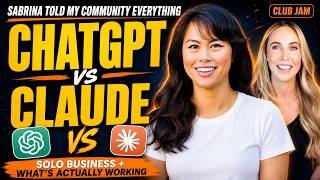
Sabrina Ramonov, an AI educator with 2.5 million followers, runs Blotato solo and prefers Claude Code over ChatGPT for most work. She trains Claude like an internal employee, keeps marketing funnels simple (free content to calendar to payment), and sees AI as democratizing entrepreneurship the way the printing press did.
Chapters
I somehow got Sabrina Rahmanoff to come talk to my group in Club Jam. We talked about whether or not you should switch from ChatGPT to Claude and why. And we also talked about why right now is the best time in history to start a business. If you don't know Sabrina already, she's on a mission to teach 10 million people how to use AI. She's the CEO of Bloatato, and she's actually been working in AI since 2011. So, this is worth some time. Listen in. Well, welcome to Club Jam. Thank you so much for being here. I announced that you were coming like last week and my post said, oh my God, she actually said yes.
Yeah, it's great to be here. Yeah.
Happy to chat. Awesome.
Okay.
Well, we have a few questions over here, but first, just for some people who maybe haven't met you or watched your videos yet, would you mind just kind of number one, telling us who you are, where you're coming from, but I wanna know like, how you ended up here in AI.
Yeah. Um, so hi everybody. My name's Sabrina Romanoff. My background's computer science and physics from Berkeley. And so I took my first AI class actually in 2011, believe it or not. And then when I graduated Berkeley, my co-founder, who's my husband now, but we both were super excited about this AI stuff. At the time, the buzzword was actually big data. If anyone remembers that, big data, Hadoop, Cloud era, that kind of thing. And then over the years it transitioned to machine learning, then deep learning, now generative AI. And so it's been a wild ride, but I've been in AI for that long. My first AI company out of college did natural language processing and speech recognition. So like imagine you're calling into your health insurer support line. Our technology could listen to what you're saying and help the support rep fetch relevant information from the knowledge base and like help answer and resolve your question. And that was in real time in 2015. We, we We even launched a variation of it for meeting notes, uh, which hit like top 3 ProductHunts in 2016, I think. But like people didn't want AI listening to your calls like that. I was the number one objection in 2016. So it's, for me, it's just been a wild ride. I'm sorry, that's my Claude Code notification. Uh, is a cow mooing? But yeah, it's just been a wild ride in AI. I thought I was late to AI in 2015. Oh wow. But to see how every, yeah, to see how everything's evolved and how, um, it's really gone mainstream in a way I, I, I could never have imagined. Like my parents My friends are like sitting there looking like, oh look, I use ChatGPT to do this. And I'm like, whoa. But yeah, I started teaching AI, I think 2 years ago now. And a lot of it was just, I saw a big gap between kind of Silicon Valley type of knowledge we take for granted. And then when I moved out to Salt Lake City, which is kind of where we settled down, we love nature and mountains. Like nobody here knows about this stuff, talks about this stuff. There's a lot of fear around it because of what they see in the media. So I just took it as an opportunity to just like start educating people for free. Like, oh, here's what you can do with it. Here are some small ways that it can help you with your business, help you be a little bit more productive. If you have like, you know, a crazy agenda, you're running the household as well, like here are a few ways ChatGPT can help you with that. Here's how you can use voice mode to vent while you're driving to work. You know, just little use cases like that. Um, and it's since I've started 2 years ago, it's just absolutely bloomed. Um, I'm approaching now 2.5 million followers. Solo, I think I did 45 million views last month. And so yeah, my mission is just to teach AI for free to as many people out there. Um, and then separately I also started a SaaS product called Blotato. Some call it Blotato. And I really built it for myself to like scale myself as a content creator because content creation itself is like a full-time job, but I never wanted it to be. I just wanna keep it something that's a part-time hobby. So I built a tool to help me do that. Um, so yeah, I think that's everything mostly.
That's great. That was great. I remember, I guess it was 2 years ago about, I was following, um, a bunch of AI hype bros for the most part on YouTube, TikTok, Instagram, and I found Brand Nat and I was like obsessed with her and her content and I was just learning from her so much. And then you kind of entered the picture right around the same time I found her. And I thought it was so cool just to kind of, I've been watching you from afar, kind of like grow your. Business and your, your teaching style. And so I just wanna say thank you because I've learned so much from you and I like how I think you and I have very similar styles of, it's like, okay, there's this big complex thing out there and here's the important part and here's how to do it.
Mm-hmm.
Like just kind of get to the point. So I really appreciate your teaching style for sure.
Yeah, absolutely.
Yeah. So now that you're kind of here, I'm just curious. You, you have all these followers, you have a successful company. What does like a Tuesday look for you? Like what are you doing now?
Most of my time is spent building products. People under— so there's a lot of narratives like AI can run your entire company. At least in my experience, that is not true. So just for context, my product has thousands of paying users, millions in annual recurring revenue. Solo. I am planning to hire now a support person. I just decided that today, but it's, it's a ton of work. In fact, I would say I, I'm, I've been growing ever since I started the company. I've been growing much more slowly on social media because the company takes so much time. It's really, even though it's easy to vibe code a version 1 of your product, it's hard to like continually maintain it, make sure it's competitive in the market, then do marketing, figure out the channels that work, scale up those marketing channels, et cetera. It's a lot, it's a lot of work. So a lot of my time is spent building product or building slash fixing systems for core functions. So for example, my AI agent for support, it's like, I look at the tickets, it didn't close. And I look at like, okay, well, is the help documentation missing information? Does it not have access to a tool like my billing system? Maybe it didn't have the ability to issue a discount. Okay. Do I want to give my bot the ability to issue a discount? Will people abuse that? It's a lot of like either pure product building or building the systems that power the different functions in my company. So support is a really good example of that. Marketing systems as well. Um, yeah, it's a ton of work. That is most of my day. And then Friday is when I batch film a bunch of YouTube videos. Saturday is when I batch film Shorts and my newsletter. So I now have two content days per week.
Wow. That is a lot. I was just talking about this with somebody else, how I'm envying people who are starting their company like right now. Because the tools are so much better right now. And I'm finding that I thought things were really cool and great, like a year ago or two years ago, and now I'm spending so much time like redoing things because it's so much better to build it on other things. So how do you deal with that? Do you have shiny object syndrome or like, are you actually moving parts of your business to other platforms all the time?
So I'm actually pretty slow migrating systems. My philosophy is like, unless doing so will significantly increase my revenue, I don't see— or save massive amounts of time in some way, I don't feel compelled to make this switch only because I've learned my lesson with shiny object syndrome. Like every single platform, guys, will have pros and cons and things where it's like, oh, just kidding, you can't do that. Or just kidding, that feature's coming out in 3 months, but it's like 3 years. So I've, I've learned that lesson the hard way of like switching back and forth. Um, and the systems that I have are touching like thousands of paying users. So it's like, do I really wanna try a different billing system? Like, no. Do I wanna try a different affiliate system where like people are getting consistent payouts? No. Working unless I see a, uh, for example, I did recently redesign my website. Using Claude Design, but like that's been on my to-do list for 1.5 years. Like I, my website for the longest time was a Webflow template I paid $50 for. Wow. I just changed like the, it looks so bad, but like, so like only now did I switch it cuz I'm like, oh, okay, now Claude Design actually works really well. And I'm doing more in SEO, so I wanted it to be like, write up these SEO pages, boom. I didn't wanna touch Webflow at all. I tried the Webflow MCP and it's terrible for SEO. So I was like, uh, maybe now is finally the time to upgrade my website.
I'm having the same problem right now. Like I'm having Claude write all of my SEO and it's doing such a good job. I finally, I came up in NotebookLM the other day. Somebody sent me a screenshot. I was like, yes. But yeah, the NCP4, I'm on Kajabi, which I hate. My normal website. Yeah, I know. It was cool 3 years ago, but yeah, it's really hard to connect anything and it's such a headache. But figuring it out.
And the crazy part is like, to your point, tools have evolved so much. I expected the website migration to take me like days. It took 2 hours from start to finish, guys. And I get compliments all day. Like, I was like, your website now is like so advanced. And I'm like, thanks. It was mostly Claude Code. I'll, you know, I'll drop a tutorial on it soon. There wasn't that much special going on, but even I like really underestimated like how well Claude Design would work. I don't think I even tried multiple times. I just gave it one prompt. I was like, oh wait, this looks pretty good. Then I went to a website just to choose a color theme and I was like, okay, make it this color theme. And that was it. It was like 2, max 3 prompts to make my, rebuild my entire website.
So did you use one of those, um, UI/UX skills or did you just use the Claude Design?
No, just Claude Design. I was just like, here's my current website, please redesign it to be modern. And then I went to, if you're familiar with dribbble.com, com. They have a lot of inspiration. I searched modern dashboard and then I personally just look at color themes. So I'm like, oh, do I want it like dark green? Do I want it like pink and purple? Obviously that's what I chose. So I screenshotted it, dropped in the copy, like, okay, use this as the color theme. And then that was it. It was like 3 prompts in total for the entire website. I think choosing the color theme actually took me the longest time. I was like dribbling forever to be like, oh, I don't know, that pink doesn't look right to me.
Feel that. My background's in more of the design aspect, and so I get super nitpicky, but what I'm finding is I just have Whisper Flow and I'll just like speak out exactly what I want and it's so good. It follows directions. It's, it's really impressive. Okay. I wanna talk about Claude specifically because it's my favorite AI partner at this point, and I'm curious, like, is it your main AI tool at this point?
Uh, so I made a very public video one year ago exactly saying I'm leaving Cursor AI for Claude Code. And I remember after that video, there were multiple AI influencers, like big, big people, you know, and they were like, really? Like, I feel like you're gonna regret saying permanently. Um, you might, you know, you might go back and forth, but like even then Claude Code has been my daily. I've been on the Max plan since it came out and it's gotten so much better. In the past year. So one year ago, like I would have to heavily babysit its code changes. Like I don't call it vibe coding, I call it AI-assisted coding. Like I'm very much leading this, driving this, telling it what to do, trying to make sure it doesn't introduce a lot of bugs and stuff. I still do that today, but it's gotten significantly better. So I have a lot more trust in what it can do. MCPs have improved, speed has improved, like it took, it used to take forever waiting for it to like call multiple MCPs, do this, think about this, make a plan. So it's just like rapidly gotten so much better in the past year. Yeah, I would definitely say for sure Claude Code is my primary. So I use Claude Code both for the technical stuff as well as updating my support system, which lives in N8N, but I use Claude Code with N8N MCP to just update it. I haven't touched an N8N workflow. In like months. And then I also use Claude Code for marketing and content creation.
Do you use Claude Code in terminal, in the desktop, or do you use something like Visual Studio?
Yeah, I use an IDE. Sometimes I'll use a terminal. So the way I think about it is if I'm doing content creation where I wanna review the output, it's easier to do that in like Visual Studio Code.
Yeah.
Because I can have Claude open on one side and then the, let's say it's a YouTube script draft, I can have it open on the left side and I can just like highlight the portions, hey, I want you to redo this section, or I can edit it myself. So I don't find that experience to be good in like Claude Co-Work or even the desktop app, cuz I want to, I wanna like get in there and like tweak things in the copy. If I'm doing, so for example, for support tickets, I'm usually just using the terminal because it's like Claude, go clean up all open tickets. Claude, reflect on all the tickets from the past day that I had to manually intervene and figure out how I should update the help docs. There's not a ton of review because the, the, what it's incorporating was already in the support ticket. So if there's a support ticket AI couldn't answer and then I answered it, all Claude needs to do is like take my answer and put it in the help doc. I don't feel I need like a ton of control over it.
I love that. Okay. One question I get all the time, and they're probably, everyone here is probably sick of me and my answer, so I'm curious what your answer would be. And remember, most people here are small business owners kind of starting out with AI. They're, they're probably not using Claude Code as much. There's a few though in here, but they've all been using ChatGPT. So should they make the switch to Claude? And if so, why? What would you say?
Yeah, I have never heard a small business owner regretting the switch from ChatGPT to Claude Cowork or Claude Code. Paying the, at least the $100 per month plan, it truly replaces a lot of other tools. For example, let's say you need to make like videos and, uh, carousels for marketing. You can use like Claude Code is very good at using open source tools that are 100% free, such as Remotion and Hyperframes, and you can literally make unlimited videos using your assets. Um, it'll make like cool explainer videos, or if you wanna combine photos together to make a carousel, you can have it burn music. On top, literally free and unlimited. The comparable cost for things like that, if you're used to like image and video generation, is really, really, really expensive. Um, so that's just one example of a tool you can replace. Now I'll give you real examples. So, cuz I'm also a small business owner, moving to Claude Design for my website saves me $500 per month. So like just, just that because Webflow and other website builders charge you based on like a volume of traffic and I was getting a lot of traffic on my site, so I was paying $500 per month for literally a basic website. No CMS, no blog, no e-commerce. This is not, this is not complicated, guys. It was a 2-page website, homepage, pricing page.
That's not a good deal. Not a good deal.
Right. So with Claude's help, not only did I replace it, but every single person has been like, wow, this website is incredible. Like, it looks amazing. Now, so now we're talking about quality 10x, but, but also it slashed the cost from $500 per month to near zero. My customer support agent used to use Fin AI, which is an intercom. Um, it charges $1 per resolution. At the time I was smaller as a company, but it was costing $1,500 per month. Yeah. With the help of Claude Code, I moved it to open source and it, and I manage it all through Claude Code and that costs me $2 per month to run.
Yeah, I could see that getting super expensive the other way. Yeah.
And there's no hosting fee. It literally runs like just on a spare computer in my closet over there. Like, so those are just 3 examples. There's so many other ones, but I personally have never met a small business owner who has regretted migrating to at least Cloud Cowork. I understand Cloud Code is like intimidating for a lot of people, but get to Cloud Cowork first. Once you get used to that, then you might want to explore Cloud Code.
Yeah, no, I love it. So last week, or maybe it was the week before, I finally talked my husband into trying AI. He's never like he doesn't, he's never been on Instagram. He doesn't do computers. He's just, he's not in it. So I was like, you have to try Claude. You have to just get in there. And it was the first time that I've been inside like a new Claude instance in a long time, cuz I had mine forever. And it was such an eye-opener of like how training it is so important and how telling it who you are is so important from the very beginning. And so this week in our training, that's what we've been working on quite a bit is going through the settings and then we did custom instructions and then today we had it interview us about us personally and about our brand and our business. So outside of those things, would you have any suggestions or tips or is there anything you do to like get your to know you better?
Yeah. Number one, I try to emphasize that it's a continuous process. I never expect it to just like interview me and then we're good to go. Like this skill is like A+ quality. Like at best it's probably like B- quality. And like, I'm saying this as a person who has made so many skills, especially related to content creation and coding. So just go into it with, with the mindset of almost like you're training a new employee. Like you would never hire someone and expect them to just understand everything about you, even if you just talk to them for 3 hours. Because it's like, they're not gonna quite retain everything. They might misinterpret things. Like, it's just not gonna happen. Like, you would continuously give a new hire feedback over a consistent period of time. Let's say 3 months is usually what people budget, right, for onboarding a new employee. In the process, you're gonna find gaps in your own documentation and onboarding. You're like, oh yeah, that wasn't very clear in my playbook. Like, I should probably go update that. Or like, yeah, oh, there's like inconsistent information. I, no wonder they're confused. Like, this is the same process actually with Claude. So your first step might be like, okay, Claude, I'm gonna like tell you everything about me. Okay. But now let's actually use Claude. Uh, okay. Didn't get this blog post quite right. For example, in my newsletter, I'll take the blog post, I'll apply my drafts, and then I'll say, Claude, reflect on my changes and update your skill so that it, so that it better reflects my final output. I have another skill slash learn that's custom, and it's basically like reflect on this conversation. And figure out how you should update the skills to better capture my preferences. And I run that almost daily. So like on a daily basis, I'm trying to teach Claude to be a little bit closer to my preferences. But overall, just have like more realistic expectations is what I try to tell people. Like it's not gonna be one shot and perfect, but give it continuous feedback over a consistent period of time, and it's going to be so much more fine-tuned to your specific use case and needs.
You just made me realize that I need to change what I talk about in all of my keynotes and stuff, because I always go in and say, you know, Claude can be your COO and then you can use other AI tools, but think of them as contractors. And I think it's really like Claude's your intern at first and will work its way up to your CEO as you train it and it learns and continues on.
And it's a two-way thing too. Like as you learn how to partner and collaborate with it, you start to trust it more. I get a lot of questions around permissions. So I'm like, well, in the beginning, would you give your new employee like access to everything and be like, go for it? Like, probably not. Like maybe a few things, maybe read-only access. Maybe they can't like update Stripe and like billing information yet until they are like ramped up and you're confident, you know, that they can handle it. Same thing with AI tools. You can set permissions so that Let's say Claude can only read your data. It can't update it without asking for your permission. So like, I, I really try to use that mental model of like, why, why are you trying to make it do everything on day one? Like, it's gonna take some time and like, you are in process of like learning how to collaborate with it, learning what to trust it to do, and you're gonna find you don't want it to do certain things. Like there are a bunch of things I don't allow it to do, and that's how I like it. But I've learned that over time.
So that's actually a huge topic of conversation all the time in our one-on-ones in our lives is like, what sort of access do you give Claude or these other AI tools? What are your thoughts on just like, because I just want to— I won't preface it with anything because I want your opinion. But on one hand, we're constantly teaching AI tools, large language models about our companies like we want to show up in our GEO. Right. And so we're putting things out on the web, we're having chats, but we also want our information to be really private in our chats. So like, what would you say to somebody who, I'm not calling any of you out from our call earlier, but maybe they work in finance and they have clients, they're consultants, they're a consultant for financial advisors. So there's a lot of like proprietary information. What would you say? What would you say she should not put into her chats versus what's okay?
Yeah, I would say my answer to this has changed significantly recently because open source models have come a long way. For a long time, they were like useless. I still don't trust open source models with coding and technical tasks, but for like all other tasks in the business, for example, marketing, analyzing spreadsheets, you can set up Claude Code so that it uses an open source model like OLLaMA. These are some technical terms, but if you ask Claude to walk you through it, it can set it up. And then, uh, I think of it like, um, it's called like a model router. So if your task is highly sensitive, you don't want any AI knowing anything about it, just switch to the open source model. If it's a non-technical task, it will probably do a really good job. Like there comes a point where it's not so much the model, it's like the, it's more about the context that you're. Feeding into it. And I would say open source models have massively improved in the past year to the point where now I actually feel comfortable recommending this. I wouldn't recommend this a year ago because like then you just get wrong answers and like, that's not great either. Like you kept it private, but then like all, all the answers were just wrong. So, you know, that's one option I really encourage people to check out.
So a lot of times it's like, um, this actually just happened yesterday. Somebody is doing an RFP response and they didn't want to do it in Claude because they were worried that their competition could go to Claude and say, is company X doing their proposal on for this RFP? And I was like, I don't think that's how it works.
Could you explain? That's definitely not how it works. Yeah. So you don't have to worry so much about that. So when you interact with ChatGPT or first of all, any AI tool, I always turn off model training. And if you're a small business, you're probably paying for a paid plan. If you're on a free plan, some tools don't let you turn that off, but that's like step one, go into settings, turn off model training. That way when you're talking with a chat, it's first of all not being, it's not searchable on the internet, right? It's not like you talk to the chat and then your competitor can find out what you chatted about. And then as long as you turn off model training, then your chats are not going to go into like the next generation. Of the model. But yeah, if you wanna take that extra, extra precaution, then I would recommend open source tooling.
See everybody, I told you.
Just kidding.
No, that's awesome. Thank you. Well, let's see here. I have some questions from the group.
That was a great example, by the way, but I'm just like jumping past the beginner interpretation.
Well, that's okay. Yeah, it's, it's funny cuz that example came up literally yesterday and I was like, no, nobody can read your chats. It's fine.
Yeah.
Oh, actually I don't, I don't wanna skip over this one first. So, one of the things that I do a lot, and I know we've talked about before, is kind of like AI tools versus AI thinking in general. Like it's, I think using AI is number one, learning about the tools and what's out there, but it's also kind of like a mindset shift for me. And like, it's interesting to see how people have been using it for so long. Our work days are completely changed from 3 years ago. Like how we start our day, how we think about approaching marketing, right? Like I would never host a meeting anymore with my team to brainstorm pretty much on anything. Like I would first work in an AI and then come to them with what I've brainstormed and then go from there. Do you find like in your training that you do, are you ever focusing on that part of it? And do you have any tips for like changing your mindset using new technology?
You know, I probably should focus on that more. Um, I do notice it all the time. For example, like I'll make a YouTube video literally telling people your instinct should be to go to ChatGPT or Claude first instead of commenting on this video, how do I do this? You're totally right that it is a mindset shift. It actually happened this morning. So I was talking with one of my, um, long-form YouTube editors and He was editing my last live where I was like rambling a lot. I was rambling all over the place. And he was like, I was thinking about hiring a junior person to kind of like filter out the first pass of the transcript. And I was like, well, have you tried it with Claude and this particular open source tool to just to try it out? And he was like, oh no, I didn't, I didn't even think about that. Like, I think there is an instinct to, if you have a problem, it's like, do your instinct to solve it is like do more, pay more, or hire somebody. To solve it. Those are the instincts we've built up as business owners. Like, okay, problem, how do I solve this? This is my toolkit. I'm gonna throw money at it, I'm gonna throw people at it, or I'm just gonna throw myself at it, right? And then just like, just grind it out, whatever. And I think there needs to be a fourth instinct, which is, which comes before all of them, like to your point, which is like, let me go to Claude first, or let me go to ChatGPT first and get smart about it. Guys, like my tax accountants, I'm not gonna be working with them anymore, but they made like a, almost million-dollar error in my tax bill. Yeah. And obviously I'm like looking at the numbers and like, okay, Claude, let's go. Let's go. Before I reply to them, before I say like, what's going on? I'm just going to pull my data. I have it. I'm going to ask Claude, let's just do some ballpark here. I pointed it out to them like methodically and they're like, oh yeah, let me go. Let us go fix that. But yeah, but that's an example where it's like, like, I noticed my instinct.
Yeah.
Oh, I just wanna be like, no, you guys fix this. But I'm like, nope, I'm just gonna take a step back, ask Claude sanity check. Let's just sanity check here. Am I crazy? And then I'm gonna go back to them like informed with data and, you know, doing this analysis.
It's also just like frustrating to work with people who don't also use AI too. 'Cause like if your accountant was using Claude, maybe they could have checked, you know, to make sure things were right before they sent it over to you in the first place.
Right? Like, I, I'm like, guys, this doesn't even make sense. Like numerically, it's—
yeah. Well, I'm glad you caught that. That could have been a tough one.
Yeah. Tax season is fun. I'm glad I have Claude.
We're not quite through it yet. Had to do an extension, so, God, it's rough. Besides Claude, are there any other AI tools that you use every day? Well, probably Bloatato. But besides those two, are there any that you use every day?
AI tools that I use daily? That's tough actually. Yeah.
Yeah.
I use Claude every day.
I guess it's like bringing things into it too. Like, um, obviously with the API, are you using like, why am I thinking of HeyGen? I'm just thinking of other AI tools that go into Claude now. Like, are there any?
Oh yeah. So one of my favorites is called Apify, I think is how you I call it— and so it's basically like they, uh, assemble a lot of different scrapers. So I can be like, let's scrape like what's going on in Reddit right now related to this AI topic. It's not just Reddit. You can scrape TikTok and scrape Instagram. It can analyze your video comments to see like, what are people confused about? What are people asking about? What are people emotional about? So it can scrape all the different social media platforms as well as transcribe videos and stuff. And so that one is— like I, the way I organize stuff, I have only a couple of MCPs on the user level so that I can access it through all projects. And that's one of them. My other favorite one that is really underrated, I don't use this daily, but definitely weekly is Perplexity MCP. 'Cause I found like Claude, if the web search default in there is not very good, like it's okay. Um, but Perplexity for fact checking, source checking is so much better, like 10 times better. So for my YouTube videos where I'm talking about a highly sensitive topic, I cannot go wrong. I have a fact-check skill built out that like heavily uses Perplexity for, for that.
Such a good idea. I love Perplexity, but I haven't thought of like bringing it into Claude, so that's so cool.
Yeah.
Yeah. Yeah. So I just use it separately. And Appify, so, uh, Kevin Ferruggia, he's one of our trainers and I told him I was doing a talk with you today and he's like, I did a video with her. And he said, that's so crazy. What a small world. But yeah, he recently just did a training for us on Appify for prospecting. And so if you guys didn't catch that one, check our classroom cuz that was a really eye-opening one and it's so easy to use.
It's so easy and it works so well. It's like you can be like, hey, just scrape the top 10 TikTok videos in my niche. Yeah. Like boom, returns it with the transcripts, with the stats, views, likes. Events, it can scrape Google Maps. So if you're a local business looking for leads, it can help you scrape all of that information. Yeah, there's a ton, ton that it can do.
Yeah, that's so cool. I am going to ask a couple questions from the crowd now. Hold on. One is a Blatato-specific question from Roya. She uses Blatato. She sells real products though, and so one of the questions was, is there an easy way to kind of bring your own photos and your own videos into Blotato.
Yeah. So I don't know, did she specify she's using the website or the API MCP?
Roya, you can go off mute if you'd like to answer that. I know you're here.
Hey Sabrina, how are you? Hey, doing well. I could be using whatever. I haven't set it up. I have been discussing it with Claude to come up with a strategy to get it into— it told me to do it specifically for Blotato inside Claude Code, and I've been listening to you, watching you to do it. With reMotion, all of that kind of stuff, but I haven't attempted it yet. So I just thought this would be perfect. You guide me and a whole bunch of other people as well, how to set it up so we use our real product images. So the whole thing is real, not AI-generated, if you will. I cannot have AI-generated stuff for my company because I manufacture graduation sashes, apparel, all of it customized, you know. So what is your best recommendation?
Yeah, first I highly recommend using Claude with Bloatato. I have seen just the massive increase in analytics, like results people are getting by combining the two because it's so much easier to customize Claude than it was like Any. Like it's really tough to customize those and get it on brand. And number two, I dropped it in the chat. You can tell Claude exactly this and it will know what to do. Basically, it can take your product photos and videos that are on your computer and just upload them with your social media. Posts and you don't even need Google Drive or Dropbox or anything else. This will take it directly. Just so, just drop your photos and videos onto your computer, tell Claude, okay, I want to do, here's the post, let's use this product photo, boom, schedule it out. And then Blotato will be able to do all of that.
Oh, that's awesome. I didn't, I thought you had to put it in a file, but that makes sense that you used for N8N and Make.
Yeah. You need some kind of like storage solution, but now with, if you use Claude, Antigravity, like any of the AI tools on your computer, you can now just upload without intermediate storage. 'Cause I was getting annoyed having to do that. So I decided to just build my own system.
Of course you did. That's how you roll.
I was like taking selfies for my Instagram story and I was like, ah, I just, I just wanna upload like just the photo and not put it in Google Drive.
So another question that I know you love to talk about, 'cause I've seen a couple lives with you about this is like the social media strategy of it all. And I know you're big on like bulk creation, but do you have any other tips for somebody who, you know, they're posting every day, but they're just not getting the traction? Like what's 2 or 3 things that they could do to blow up in their social media world?
It's so funny. I was just talking to Brooke about this at like midnight. I get a lot of hate for saying this, but I know that this works and I'll, I'll give you my caveats. Number 1 is to copy viral content and you have my full permission if you're in, in the AI space. To copy all of my content. Seriously, people are like, oh, but then that's like not original, but it's really just a learn, a way to learn very quickly what works and what doesn't work. And so I, if you're, if you have been creating content but not popping off, I would challenge you for the next 30 videos, go on TikTok or Instagram, find videos with at least a million views in your niche and copy the first 15 seconds. Exactly. I don't care what you say after. 15 seconds. Like let's say it's, I asked ChatGPT to make me as much money as possible. Like that's 15 sec or 10 seconds. Say whatever you want the next 30 seconds and then post that video. So where people like are opposed to copy, they feel like it's like, oh, but it's not original. But I'm actually just saying copy the hook. 'Cause the hook is what stops the scroll. And if you can't get people to stop the scroll, then like no one listens to the rest. Of what you're saying. And so I know this, I know that this works. People copy my videos all the time. I just found one last night, a guy with like almost 2.5 million followers copied my video word for word, the entire video. Like he didn't even try to make it his own. And it worked. This video got a million views and I was like, wow.
I loved, like, I think it was like 6 months ago or 5 months ago or something. You hosted us and you were like, copy this one video. It was your like how to make ChatGPT more human.
Oh, humanizer prompt.
Yeah.
Yeah.
And he, you were like, let's all do it. And it's so funny cuz all the women in that group, we were tagging each other, but we, we all had the exact same video, the exact same hook.
Oh.
And it's just funny to see those pop up cuz I'm like, oh, they must have heard Sabrina talk.
I say do it for the next 30 videos cuz you can never guarantee one will do well. But like you, you will see like a statistical difference if you do it 30 times. And the reason why I like encourage people to copy in the beginning is like content creation is so overwhelming already. If I were to tell you, pull 20 videos and we're gonna analyze it using this framework with these building blocks here, you will just get overwhelmed. Yeah. That's why I just try to keep it as simple as possible. Like just copy the hook, the first 10, 15 seconds, say whatever you want the remaining 30 seconds. Once you develop that habit and most importantly get one viral video. And viral is relative. When I was starting out, I thought 1,000 views was like, wow, like I almost famous. Yeah. So like, it's all like once you get your first 10,000 view video, it's like really exciting. Your first 100,000 view video. I don't think I've ever been more excited in terms of like a milestone than my first video getting 100,000 views.
I'd be so excited. I'm where you're at. Like, I think I had one hit, oh, this is funny. I had one hit like 8,000 views and I was all excited about it. And then I got a message from some guy and he's like, I think somebody copied your video. And I was like, I wanted to write him and be like, no, I copied her. I actually did tell him. He's like, oh, okay.
Yeah. And like, I think people, you know, it's, they've emphasized the copying, but they don't really understand like why I'm suggesting it, which is that like you, you learn a lot faster from learning from what works. Like, yes, you could fail 5,000 times and you will learn something from that too, but you actually learn a lot faster by, for example, copying business models that work, by copying marketing strategy, copywriting strategies that work, right? Like Pats Agitate Solution. These, these are proven for a reason. Like, try copying the things that work first and then figuring out, okay, this is my style. This is what I like. This is what I don't like. But yeah, just, just do that and it'll work for sure.
So that's a good way to put it. It's like a business framework, like, um, I don't know, I have the $100 Million Offer book, like book, everything. I have it all the time, but it's the same thing. Like those are offers that have been proven that hundreds of thousands of people are using. So it's the same thing with a social media hook and why try to guess these complicated algorithms when other people figured it out?
And, and in this, in the scheme of things where short form fits in the funnel, like it's at the very top of the funnel. Like it's not the thing that's building authority or showcasing credibility. That's my YouTube and my newsletter. It's the long form stuff. That's my community. That's like calls like this, or I could talk for like an hour about any AI topic, but like you watch a 30-second short and it's like, that's cute. You know, like it's just, it's just serving a specific purpose at the top of the funnel, which for me is to just get more beginner eyeballs to my I made long-form content. I'm always driving people to like what I believe to be quality content. You'll also find as you like make more content that the hooks you are stealing were also probably stolen. Yeah. Like, I don't remember the last time I copied someone's hook and it was actually like their original hook. So I always find a predecessor. I learned the same thing on YouTube, like copying titles and thumbnails. I felt so bad copying this one AI guy, but then I learned he copied this other marketing guy like 6 months. I was like, oh, well, you know, I don't feel as bad as anymore. Also, if you actually watch all our videos, they're completely different. It's, it's really just like the title and packaging to get you to click that we're kind of ripping off of each other.
It's a vibe too.
Yeah. Like the actual content and like who you are, how you communicate, what you care about, who you're serving, like all of that is not copyable. Um, I don't, I couldn't even copy that if I tried of the other person. I couldn't.
So I always like to tell myself like, I'm not for everyone. That's fine. You know, but it's, it's interesting to see if like all of us are saying the same things, but people are drawn to us for, you know, our vibe that we put out, what we stand for. So yeah, it's really interesting to see how that all works with the algorithm.
Yeah. And I would also say like there's so many different levels. Like you saw it a bit on this call. It's like you asked this question, I just completely interpreted it like in a different way. It's like, I joke, but it takes me like 3 YouTube videos to finally make a beginner tutorial. Like I made a Claude Code video and like the number one piece of feedback, this is too fast, this is too complicated. Okay, so I make another one, same feedback. This is too fast, this is too complicated. And like, it's really hard for me to even realize it. Like I don't, like, I just wanna be me and this is the level I'm currently at. And this is like, And yes, I might be speaking to a slightly more advanced audience, but like, that's what I enjoy. So like, don't look at the space thinking it's crowded. You know, there's a ton of opportunity. There's your personality, there's a specific level you're speaking to. And there's so many people just at that level. There's so many people like two steps above that level, two steps behind that level. And so yeah, just don't get hung up on copying as like the end and be all of your identity. We're talking about like just copying the first 15 seconds to stop someone from scrolling to the next brain rot video.
I love that. Everybody write that down. Do that tonight. Um, okay. So you talked about too, like that your social media is to get people to understand what it is you actually do and drive them to your Substack or to Blatato. One thing that actually is in all of Alex Hormozi's content too is like, don't overcomplicate your, your offer. And if you can. Have one offer, and that's something that I learned the hard way. So I started JMAI in early 2023, and I didn't figure out my offer until 2025. So it's a lot of floundering. What would you say to somebody who's a small business owner using AI for the first time? Like, how could they— what are some steps they should take to like make a solid funnel, like a solid marketing funnel from you know, putting their content out maybe on social to their purchase now button or make a meeting button. What would you suggest?
Yeah, I definitely think people overcomplicate this. Um, I will say the number one mistake I see is people spend like 95% of their time building this super complicated funnel and like they don't do any marketing. So then when they launch, like none of it mattered because there's nothing, there's nothing going through the funnel, guys. There's nothing. So I would keep it really simple. So let's say we're talking like serv— you want, do you wanna use services as an example, like coaching or consulting?
Yeah, that's a good one for this group for sure.
Yeah. So if, if I was to launch a coaching service, I would just make free content. It's, it's sorry, make content because it's free. So you don't have to pay ads, you don't have to pay for any kind of marketing. Mm-hmm. So post multiple times a day on the social media platforms. In my bio, I would have a link to a calendar, the calendar. Has like, oh, here's what you get. And then you schedule the meeting and pay. Like that's literally it. That's the entire funnel, guys. Not more complicated than that when you're just starting out. I see a lot of people like have a Linktree and it has like 10 different things.
I see too. I'm like, what are you doing?
Yeah. It's like, it's overwhelming for me. Like I don't know what to do. Whereas when I, if I click the link in your bio and it's like, oh, this is what you offer.
Okay.
So I offer, let's just say it's like wellness coaching for $400 per session. Here's my calendar. Boom, just do it. You could have a different funnel. Like I don't wanna overcomplicate it. I think that's like the simplest one to start with. Another one could be a lead magnet, for example, on mine for longest time I had like get 1,000 free prompts. Then you click, okay, you put in your email, you get an email with all of the prompts and now you're in my email newsletter. Yeah. It's like that's another one, but I wouldn't overcomplicate it with like lots of different lead magnets.
It's just, yeah, it kind of is. That's the thing because AI's here, Claude gets to know you so well and it gives you like 100 Great ideas and it's so easy to make these pages, so it's hard to stick to one. But you know, Sabrina said it, I'm saying it too, like don't have multiple offer or landing pages with top of funnel offers. Like try to have just one, two tops. Yeah.
And also just don't forget to do the marketing. Like I think it's kind of sad when people spend so much time on like an amazing offer and they don't do enough marketing. So when they launch it, it's like nobody signs up and they're like, why? I paid, I hear this often. It's like I paid for one-on-one coaching. And we set everything up, but then when we went to launch it, it flopped. And I'm like, well, there's, it's a funnel. Like what's going into the funnel? Like the top is supposed to be the widest part of the funnel, right? And people trickle down. If you only have 10 people going into the funnel, like it's more of a pipe. Yeah. It's like, it's like there's not that much going on, but if you have like 10,000 people going into the funnel, then like everything starts to make sense. You're like, okay, this is the drop-off point here. I could improve, I could use Claude to help me A/B test the copywriting here, right? To get more conversion rate at the next step. But yeah, the number one mistake is just like they don't have anything going through the funnel. Like they built the whole thing, but there's no traffic going into the funnel.
Yeah. Do you do any like paid marketing too? Obviously, Bloatedo is great for organic, but do you have any suggestions on paid?
Oh yeah. So the things I've tried are like paid influencer marketing. So I've tried paid influencer short form. Paid influencer long-form, like YouTube tutorials. That's worked really well, especially for the API portion of the product. Sure. Because it's like, how do I set it up? You know, like people are just confused how to do that. So YouTube tutorials have been awesome. I've been experimenting now with Facebook ads, so I probably poured maybe $15,000 into Facebook ads, and that has been surprisingly effective paired with organic content. So I don't know how technical on the Facebook ad side this audience is, but Like for example, I have custom Facebook audiences of people who just watched my Claude Co-Work videos. I have another, yeah, I have another audience of people who watched my Claude Code videos and I can actually target different, a little more technical, like dark theme for Code, cuz they're probably a little more technical and then like really nice and modern and bright, clean for Claude Co-Work users.
Um, I love that.
I have another audience for like anyone who's ever watched any of my content, right? Because they are already familiar with my face. And so it's, it's definitely been fascinating with Facebook ads. I wouldn't say I'm like profitable, like the cost I think is still 4 months of my monthly cost. So 4 months to recover the ad, which is not bad to start with. Like I just started, so like if I could get that down to 2 months, I would be very happy to recover that cost. But yeah, I think paid marketing can work really well. It's really, really, really, really expensive. Yeah.
Are you doing it yourself, like with Claude, or did you hire it out or?
Yeah, no, I'm doing it myself. I had my friend Mitch like kind of like hop on a couple sessions to teach me how to do it. I'm actually hopping on with him after this. Nice. But like our arrangement, and this was inspired by a Hormozy video, Hormozy was like, pay an agency to just sit down with you for like 5 sessions and teach you how to do it. Meaning like I, I am the one clicking around and like loading stuff up and he just like tells me, do this, or what do you think about this? And so the reason I did it that way, number one, Hormozy said it and I was like, okay, fine. Everything he's given me has worked so far. I might as well try that one. Right, right.
Like how is he so young and so smart? It's great.
I know. This advice like actually works. So it's like amazing. So that was one reason. And number two, I would love to be able to scale up to like $100,000 per month in ad spend. And there's like no way I would feel comfortable doing that unless I know the basics of what's going on. Right.
So I'm actually doing the exact same thing. So it just started 5 weeks ago now. I'm not seeing great returns yet, but I am having them train me cuz of that same thing. Plus with Claude and, um, a lot of us use Manus in this group too. Well, there's some, there's some stuff going on with Manus, but Meta bought them. And so it does do a good job of like giving full reports on your Meta ads.
Do you see like, um, that deal was rejected?
Yeah, we were talking about that yesterday, but it's still in there for now.
Yeah.
Yeah, it's crazy. Okay. Chris Lian, if you're here, I thought you had a really good question about Claude token usage. Do you want to come off of mute and ask that?
Nothing like, um, uh, going into another, uh, email that just popped up and then all of a sudden you're hearing your name over Zoom. So thank you again, Jam. Appreciate it. It's like the third time.
Chris, you have to pay attention when we're in these. Okay.
If I unwrap the tension, all of a sudden my eyes divert and I hear my name. Ah, I'm in trouble again. So anyway, but thank you, Sabrina, for joining our little crowd here today. Question, you mentioned earlier one tactic, I guess, which is to pull— gosh, I have to go back to it. I mind shifted. You pulled one app into Claude and Perplexity, I believe it was. In doing so, Claude, of course, is notorious for chewing through tokens like a '69 Charger goes through gasoline. Anyway, do you save tokens in Claude?
When you pull something in like Perplexity, Yeah, because if you're offloading most of the research then to Perplexity, you will still use tokens in the API call to Perplexity or the MCP call. One, two, or two quick tips for that. I recommend starting with MCP just because it's like easier to set up. Um, but once you're comfortable with it, if you want to continue using it, there's a plugin called Context-Mode and it's a free open source Claude plugin and it massively reduces MCP-based token consumption. Like 70 to 80%. Um, that's if you're still using MCP. I highly recommend this because it's, it's completely running in the background. Once you set it up, it will save tokens on all MCP calls. Number 2, another trick to save tokens though is to move to the API. So you can tell Claude, create a Perplexity research skill that calls the Perplexity API directly. So instead of using MCP, cuz MCP's kind of token heavy. But yeah, just in general, because we're offloading now all of the research to Perplexity API, it's going to significantly consume less tokens on the Claude side.
You know, it'd be interesting. I think Jam knows about what I'm going to suggest or ask next. But it would be interesting to have my favorite little prompt out there. What apps are better than what other apps? Like, for instance, if Claude is sort of your baseline, your main app, then what other apps under the right context or application would be better to use, not only from a quality of output, but also the economy of tokens usage and stuff like that. I'd love to see some grand prompt or something like that. And down the line you could see where, I mean, aside from being, you know, sort of a silly thing to discuss here, you could see where that would have really have some practical value where down the line when you have a number of these things and eventually the shakeout industry sort of shakeout happens down the line and you see which ones, which functions are brought in.
Yeah.
For certain contexts. I'd love to see something like that. Sooner than later.
I'll be looking forward to your graph in your report.
Why did I know that was coming?
There are honestly a lot of things Claude doesn't do well. Um, so image and video generation is one. Like, nobody is like, oh, let's use Anthropic for that. Um, right? Typically like Nano Banana or the new ChatGPT model for image generation. For video generation, there are, like, like I said, open source options, but if you want like AI videos, I recommend probably like Fallo. You make one connection to it and then you have access to all of the top models. So you just integrate that and then you can tell Claude, okay, I want to use new C-dance or C-Dream and make a 30-minute long or 30-second long video with multiple scenes. And it can do that. But like Claude itself would be like really bad at that.
Yeah.
Thank you.
Thanks, Chris. Sabrina, I watched this interview with Boris Cherny today. Um, he said something that I thought was so interesting. He said he thinks the last technical, um, advance that we've seen like this was in the 1400s with the printing press, and it took the world from going from 10% of people could read to 100 years later, um, like 70%. And he thinks that the future of AI is like, you know, 10% of people 2 years ago could build a business, build their website, launch whatever they wanted, make money online. And he thinks with AI in like 3 years, 5 years, everybody's gonna be able to do all this like, like using Microsoft Word. So I know it's almost time, but like, do you agree with that? And where do you think this is going in the next year or so as far as—
Yes, it's funny cuz I, as you were saying that, I was initially thinking vibe coding. Because like very clear that prior to generative AI, only a tiny percentage of the entire world could build an app, like very tiny. Um, and now with vibe coding, it's, it's not 70% yet, but it's significantly higher. Maybe like 50% of the world could hop into Lovable and like within a couple hours, like actually launch their first website, their first web app. I said that, that's an initial, that's, that's what I was anticipating it was gonna be. About, but I also agree on the solopreneur angle. It's so trite to say this, but it's literally never been a better time ever since I have been in the entrepreneurship world to build a company. Like when I graduated college, there were only a handful of people in the entire Berkeley computer science department who could launch a website in a weekend. Like this was like, this was like top tier skill. This was like alpha. Like how did you launch a website in a weekend? It's like clearly they were on Red Bull and Monster and Four Loko, like putting this website together. And like, it's like shocking now how easy it is and how good it looks. You know, in the other community, like I shared my old demo videos and it's like disgusting. But yeah, so I think both axes are true. Very clearly the vibe coding one is, it's still very early days. Like only now we're seeing these 5 coding companies pay attention to security, right? Like, oh, okay, great. Uh, Lovable recently integrated payments, so you can, so without having to like integrate another third party, you can take payments for your app. Like that's, that's huge, guys. Like this was, and so yeah, I'm, I'm very bullish on it for both of those angles. So both 5 coding and kind of solopreneurship or tiny entrepreneurship. Um, it's, it's most of the reason why I do what I do today because fundamentally, like, I could make a lot of money, guys, if I taught AI to big companies. Like, I know that, but I don't believe the benefits actually trickle down to employees. I've worked at a big company. My first startup was acquired by a big company. And it's like, it's not that like people are particularly evil. It's just like, that's literally the incentive structure. Like, it's just, it's just how the system is. So like, it's nothing even personal at all. It's kind of like the impersonal nature of capitalism. And so, I'm just passionate about having more solo people build their own businesses and achieve time, money, flexibility so that they can focus on what matters without having to work at a big company, slave away, or even having to raise a bunch of money, which is what you'd have.
Yeah.
You'd normally have to like raise a bunch of money, guys, to do a business and like have it grow to millions in revenue. Well, one person can truly do it with AI, but I, I would also argue that social media is just just as important. Like all these big numbers on Twitter, it's like, oh, we went from 0 to 100K per month. Like, yes, AI helped, but also like the maturity of social media distribution, like the ability to reach millions of customers for free is unprecedented in the history of entrepreneurship. Like I underestimated this and I'm a con— I can, I still underestimate this and I'm a content creator. So like, don't, don't just look at, look at it at like like, oh, it's just AI. It's, it's like AI paired with social media distribution and like internet access to millions of potential customers for free.
Yeah. I mean, you can grow your digital footprint like never before with all of this for free. Well, I could talk to you for another hour, but I know we're up on time and you have a call. Thank you so much for coming and I hope we can talk again soon. And thanks for all you do for women in the space too. It's been awesome to get to know you and and others in our community. So I really appreciate it.
Yeah, absolutely. Thanks for having me. Nice meeting everyone.
All right. Well, for those of you in Club Jam, maybe we'll see you tomorrow for Caffeine and Convos and have a great rest of your night. Thanks again, Sabrina. Bye.
Bye.
More from Robyn



What the Biggest Brands Learned About AI Content (and How Small Businesses Can Use It This Week)






