4 Simple Breathing Fixes That Could Save Your Life with James Nestor
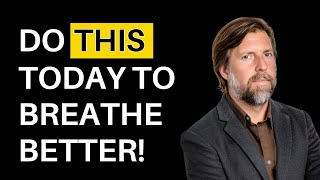
James Nestor explains why most people breathe wrong and how to fix it. Tape your mouth at night to enforce nasal breathing, try extended exhales for anxiety, and watch for nasal inflammation that forces mouth breathing. Proper breathing affects sleep, athletic performance, and even your child's facial development.
Questions this video answers
35 languages
More than 50% of kids (the guest states "more than 50% of kids are breathing through their mouths at night").
Around ages 18–20 (guest: "once our bones are set at around 18, 19, 20").
Starting at around six months (guest: "starting at the age of around six months on, we're very moldable").
Three of the top 10 killers are respiratory-oriented (guest statement).
Chapters
You are a best selling author. Your book Breath has sold millions of copies. This is the area that you're world renowned in.
This is not a placebo effect.
James, what's with the breath work?
This is especially important once we get into midlife and older age. How many people have anxiety, how many people have panic? This is a stress response. You're stressing yourself out.
What are the costs or the consequences of neglecting healthy breathing technique?
I gotta be careful what I say here. What does dysfunctional breathing look like? 50% of kids are breathing through their mouths at night. The way in which you breathe will absolutely affect the shape of your mouth as you grow older. The best thing, in my opinion, if you have the wherewithal to do it, is to do.
Today's special guest is truly special. Jim's Nestor, author of New York Times best selling book Breath. And the subtitle of that book was the New Science of a Lost Art. Truly, it's a game changer. It's been translated into 35 languages. It's hit the best seller list for the Wall Street Journal, the Los Angeles Times, the Sunday London Times and in other lists in Spain, Germany, Croatia, Italy and many other countries. Look, James Nestor is the world's leading expert on breath. What we can do to improve our breathing, how it improves our sleep, our performance, our mindset, our memory, our overall longevity. He's a leading expert. You do not want to miss this. So I hope you enjoy the show. Sit back and enjoy. NZ Mortgages is the proud sponsor of the Lead On Purpose podcast. You can check them out at nzmortgages Co nz. James, a huge welcome to the Lead On Purpose podcast.
Thanks a lot for having me.
Oh, absolute pleasure. Look, you're very in demand. You are a best selling author. Your book Breath has sold millions of copies. It sat on the international bestseller list for months. And it's something, when I'm working with my clients that comes up often. Either they're bringing it up to me or vice versa. And I see it across all things. Musicians that I've worked with, talking about breath, athletes that are playing at the professional level, CEOs, public speakers, people really understanding that breath is crucial. So this is the area that you're world renowned in, you've went really deep in. So I just want to ask you, as humans, do we need to learn to breathe better?
Well, it depends on who you are and where you are, but if you're like 90 to 95% of the population right now, the answer is a resounding yes. You, you do. And I know we don't need another box to check on our daily list, but breathing should be up there. And I can explain why once we get a little deeper into it.
Brilliant. Well, I think it's crucial because I've had some people say to me, james, what's with the breathwork? You've been doing it since day one. We all do it. It's simple. Stop overthinking it. There's nothing to it. People are trying to make something out of nothing. But I have to be honest, as a musician, back in the day, when I managed my breathing effectively, I performed better with more control and less nerves. As a keynote speaker, when my heart rate's at 130 before I go on stage and I sneak to the bathroom and do some box breathing and maybe extending my exhales, my heart rate comes down, I can speak a lot clearer and I'm less nervous. So I feel there's a lot to it. So from your experience, why do you feel we do need to start exploring breath?
I think mostly because we're either completely stressed out or we are suffering from a serious underlying respiratory condition, as so many people are, or we just want to be better at what we're doing athletically or work wise or emotionally. And so for all of those reasons, focusing on your breathing is really important, because how you breathe affects all of those things. And if you don't believe me, you can just get a blood pressure cuff or heart rate variability monitor or any other wearable and breathe differently and see what it instantly does to your body. This is not a placebo effect. This is a biological function that you're taking advantage of when you choose to do some form of breathwork.
And what are the costs or the consequences of neglecting a healthy breathing technique?
Well, just look around, right? How many people have anxiety, how many people have panic, how many people have asthma, how many people snore, have sleep apnea? I mean, these chronic respiratory conditions are just all over the planet right now. And in the top 10 killers in the world, the top 10 things that take the most lives, three of them are respiratory oriented. So we have to start paying attention to how we breathe. And this is especially important once we get into midlife and older age, because our breathing really takes a hit. And if your breathing takes a hit, it's going to be a struggle. And if you're struggling all day to do anything, it's going to wear your body down. That's exactly what's happened to so many.
Of us, really well put. And I guess when you would look at things like overwhelm and burnout, I imagine breathing has a huge part to play in contributing to that outcome.
Well, it depends, right? Breathing can't do everything. But if you are breathing dysfunctionally, it's always going to be pushing you back no matter what you're doing. If you're trying to focus, if you're trying to sleep, if you're trying to run a faster mile, whatever. So I think that by focusing first on normal breathing, just getting yourself up to a normal level, that's what the book is about. There's some fancy stuff in there too, that you can do if you want to go above normal. But to me, the most important thing is to set that proper foundation just to get up to normal. And the vast majority of the people on the planet aren't up to normal.
Wow. And what does normal look like?
Normal looks like this. So you don't see me breathe, you don't hear me breathe. It's very subtle, it's very deep. So that's how someone who is breathing in a biomechanically functional way should be breathing. It's extremely subtle. And a good example of this is look at a healthy dog or any other animal in the wild and look at how they're breathing when they're at rest.
It's very low, it's very smooth, it's controlled, it's through the nose. Then go to any airport and start looking around at how people are breathing. And it's the exact opposite of that. So I think to answer your question, we can start with what does dysfunctional breathing look like? And it usually looks like there's some movement in the shoulders with every breath. The head is craned over like this. You know, if you're listening to this, I'm just craning my head over as though I'm looking down instead of looking down, I'm just pushing my head outward, my mouth is slightly open, I'm breathing into my chest.
And this is how so many people breathe throughout the day. And it's not doing their bodies any favors. And this is not my hypothesis. This is a scientific fact that's been proven time and time again over several decades. Just a lot of people don't know about it because they think that breathing isn't going to have a big impact on their health and well being.
And do you feel like this dysfunctional breathing has an impact on the shape of our jaw, mouth, head?
Yeah, I don't think it, I know it. And this was something That I researched early on because it seemed insane to me that I had never heard about this in any of the high school classes or college classes that I had taken. Even right now, if you look at books and evolution, no one's talking about this. Of how the way in which you breathe will absolutely affect the shape of your mouth as you grow older. So once we're set, once our bones are set at around 18, 19, 20, it won't make too much of a difference. But starting at the age of around six months on, we're very moldable, right? Our bones are very plastic. And so once we set a certain posture in our face, our bodies are going to grow around that posture. And you see this all the time with kids who are mouth breathers or have some sort of condition in which their jaws are always hanging down. So common researchers call it adenoid face. When the adenoids get inflamed, you become a mouth breather. It affects the shape of your face, it affects how you look and it affects the shape of your mouth. All of which make you a worse breather later on in life.
And so I've got an eight year old son. Is there anything I can be doing now to encourage him?
There's a ton of stuff you can do. First of all is to make sure that he is breathing through his nose the vast majority of the time. You know, if he's laughing, if he's out on the sports pitch, if he's doing some other stuff, you know, occasionally breathing through the mouth is fine. I'm talking about habitual breathing. So whenever he watches TV or whenever he's sitting around the house doing something, you know, you know, ask him to close his mouth. There are different devices that can help instill this habit in kids. And it's especially important during sleep because during sleep is when we grow, right? That's when growth hormone is released in a huge profusion. And so you want to be sure that you have your proper posture set when you're sleeping. And more than 50% of kids are breathing through their mouths at night, which is really bad for their lungs, it's bad for sleep quality and it's bad for how they're faces are going to be growing.
Wow, that's fascinating. And I'd never honestly considered that. So from my personal perspective, I've snored heavily for I'm late 30s, I've snored heavily for probably 20 years. If you were to take a quick look up my nose, you would see my turbinates are fully inflamed. There's almost no space there for anything to move. I've been told, james, let's just do some surgery. We'll cut them out. I'm not really in for surgery. I want to try and avoid that if I can. Is there anything I can do to improve or even diminish my snoring? And could I actually impact my turbinates through different breathing?
So it's hard to give a blanket prescription without knowing more. But I can tell you just some rudimentary facts that I've learned from several ents out here. Those are ear, nose, and throat experts who have told me this stuff over years and years. The first thing is you have to determine, is that problem in your nose caused by a structural issue? Is it a bone issue? Is it a cartilage issue? In which case, surgery is probably going to be a good idea for you. If, you know you don't have any inflammation and you broke your nose a few times when you were growing up, like I certainly did, or you have a severely, severely deviated septum, then surgery can be very beneficial. What most people suffer from, however, is the chronic inflammation, the tissues that cover the turbinates. So what do you do about that? You have to figure out the source of the inflammation. If your problem is inflammation, just cutting stuff out, it might fix it for a small amount of time, but the problems tend to have a way of just coming back because you're not fixing the core issue. So the core issue, from what I've learned from a lot of people, is a mild allergy to foods and is habitual mouth breathing. Those two things, being slightly allergic to dairy or eggs or weeds or corn, can cause this constant inflammation up there in your nose. And so a way to avoid that is to try an elimination diet and see how you benefit from that. And then after that, you can start to assess which foods are causing those problems. And I've heard from so many people just doing that, just taking a food allergy test and starting an elimination diet completely opens up their breathing.
That's amazing. I will definitely try that. Maybe start with the gluten, I think a good place to start.
Yeah. You know, and gluten's great. Bread's awesome. And a lot of people don't have issues with it, but a lot of people do. Just be. Be careful. I know we're going a little off track right now. There's a lot of these food allergy tests that are complete garbage. They are not monitored. So these people will just tell you whatever results. Right. So the best thing, in my opinion, if you have the wherewithal to do it, is to do an elimination diet. Have someone guide you through an elimination diet. And for a lot of people, this has a night and day difference. And once you're able to clear some of that inflammation, then become a habitual nasal breather, and those tissues will have a propensity to start to open up, and it will make it so much easier to breathe in and out of your nose from there.
Great advice. Thank you. And I want to think about nighttime, so I do snore. Is there anything I can do at night? Is there any techniques or devices you could be like, James, you've got to be trying this to improve my breathing at night.
So if you don't want to do that elimination diet, it's hard to say. If you have chronic congestion, it's going to be hard to breathe through your nose at night. So you have to figure out the chronic congestion issue. For some people, the nose is a use it or lose it organ. It starts to get congested because they're just not using it enough. So one thing that works for a lot of people is to use a little piece of tape, a piece of micropore surgical tape. This is meant to be put on skin and taken off so it has a very mild adhesive. And you wear that little piece of tape while you're at your computer doing some boring crap like answering emails. Do it for 10 minutes for a couple of days, and if that's comfortable for you, do it for 20 minutes for a couple of days. And if that's comfortable for you, you see where I'm going here? You do it for 40 minutes and then work up. So you can wear this little piece of tape around the house, doing dishes, watching tv, whatever, until you're very comfortable with it. Then try to take a nap wearing that little piece of tape. And over the course of around two weeks, two to three weeks, you can slowly start integrating it into your nighttime routine. And it takes a long time. Took me a couple of weeks to get used to this. But I cannot tell you what a difference wearing a little piece of tape at night made for my sleep quality as a mouth breather my whole life at night. This absolutely had a transformational effect. And I've heard this from thousands and thousands of people. And I know because I track my sleep with various doodads.
Amazing. Thank you. And do you use an Oura ring or a Garmin? What do you use to track it?
I have them all, man. I buy all these Things, I test them all out. At one time, I had three Oura rings and I compared them on different fingers. I have a whoop band, I have a Garmin, I have a pulse oximeter. So when I was hardcore into this, really trying to figure this out, I was wearing all of this crap every night. And I found that.
I gotta be careful what I say here. Some of them offer some interesting context. They're getting better at their technology. But it is interesting to have three identical devices on their hand and get different results, which is probably. Yeah, but. But they are getting better and I think as a general guide, it's helpful. So I've worn all of that stuff and that's how I was able to prove to myself through data, not through my, my own belief system, that this stuff really, really works.
Do you have a favorite of those devices?
I don't. I don't endorse any products. You're never going to hear me doing that. They all have their benefits. People don't like wearing stuff on the wrist, so they wear the ring. There's various ring devices now. They have their pluses and minuses. So they're getting better. You know, aura's fine, the O2 vibe is fine. But again, I'm not here to promote any products. Whatever works for you, I think is the best product.
Thank you. And in terms of energy, so we hear of so many people, leaders, athletes, you know, dipping in energy two or three o' clock in the afternoon. Does breath work and the ability to breathe better, does that help our energy levels?
I'm one of those people. So I always have this very severe dip around 2 to 3, you know, and in ancient Chinese medicine, this is when your Qi is at its absolute rock bottom. So breathing can help. I'm not going to say it's going to do everything for you. It definitely can't hurt, and it's free and it feels great. So in those situations, you can use some more invigorating breathwork techniques. Basically, breathwork revolves around this basic mode. The longer you exhale, the more relaxed you're going to be. And if you hold your breath and you're exhaling, you can get very, very relaxed. Hold your breath, exhale, exhale, hold your breath, whatever. There's a zillion different ways to do this. The more you inhale, not only the amount of time that you're inhaling, but the amount of inhales per minute will also affect you in the way that they give you energy, they wake you up. So if I want to be More awake and more alert. I can.
I can inhale more than I'm exhaling. It's a little awkward but every time you do that, every time you inhale, your heart rate goes up. So if you're inhaling more than you're exhaling, you're getting that heart rate up, you're telling your body it's time to wake up a bit. And I've found that these techniques, especially when I'm jet lagged, can be really beneficial.
And this idea of almost activating the sympathetic nervous system through breath, obviously that energizes us. The extended exhale will activate the parasympathetic, that kind of rest and relax or rest and digest. So Wim Hof, that's something I've experimented with over the years and have found it useful, but also have found it, it can be a little bit intense at times. Are there any breathing techniques that you would recommend the everyday human that would give them more peace, that would give them more harmony, allow them to be at ease?
The Wim HOF method dates back thousands and thousands of years and he's the first to admit that. I know Wim. He's an amazing dude. He's inspired millions of people to help take better control of their health. So his method is very loosely. It's 30 big breaths.
And then you take a huge breath in, exhale about half that breath and hold. You hold as long as you can. Then you go back to breathing about 30 breaths. And you can do this through many, many cycles. If you are very sleepy and you want to wake up, it's great. Another thing you can do and this is called Via Loma Pranayama, it's much simpler and it's much quicker. You just inhale, you exhale, you're gonna be inhaling through your nose once you exhale all that air out. So get all that air out.
You'Re gonna inhale, hold without exhaling, inhale, hold, inhale, hold, inhale, hold, inhale, hold, inhale all the way up. Hold the breath, Clench everything, clench everything. While you're holding your breath, let it out.
Do that three to four times and I think you'll be surprised how caffeinated you will feel afterwards.
Incredible. I'd never heard of that one. I'll definitely try that. And in terms of breathing, I see that you're breathing out with your mouth. Do you recommend in nose out mouth or is there any study around that?
So for these breathwork patterns and practices, they alternate breathing in through your nose, breathing out through your mouth. Some Even have you breathe in and out through your mouth. They're doing this on purpose because the more you are breathing into your mouth, the more sympathetic, the more stressed out you're getting. And these techniques are trying to make you stressed out. This is a pressure release valve for your nervous system. So they're trying to stress you out. So for something like viloma, pranayama, it is such a simple technique. You can breathe out through your nose, you can breathe out through your mouth. Who cares? I prefer the mouth. It's a little more powerful because I'm using this breath to try to amp myself up.
Incredible. Yeah. I watched the Irish rugby team at the World cup, and they had a short little moment in the middle of the game. They came together in a circle, and their shoulders were going up and down, chest in and out. They were obviously breathing together in. In sync. Now, obviously, there's a lot of chest breathing going on there. Would you say that, hey, the more effective way to do it is to be belly breathing, diaphragmatic breath.
These are guys that are consciously breathing a certain way to accomplish a specific goal. I believe Patrick McEwen trained these guys so they know exactly what they're doing. When you're breathing up into the chest and you're breathing through your mouth, again, this is a stress response. You're stressing yourself out. So what they're trying to do, I would assume, is to amp themselves up, get more animal energy, and then go out there and kick ass. Right. That's what they're trying to do. My hunch is these guys have very well developed lungs to be able to do what they're doing. They can breathe this way for a few breaths. And when they go back to the game on the pitch, they're accessing their full lung volume. Because the more you do that, the more you have a larger gas tank. With a larger gas tank, you're able to push even further with fewer breaths. And that is, by definition, efficiency. And if you are into sports performance, it's all about efficiency.
I'm so glad you've mentioned that, because I want everyone to realize that breath work is different for everyone and everyone's needs. And the type of breath work that we do is important that we actually manage it for ourselves. So if you want to relax and calm down. Wim Hof style breathing, probably not the way to go, but extended exhales possibly the way to go. I really appreciate that. James. That's huge. A couple of things before we.
Sure, sure. I just want to mention there's a foundation that everyone can benefit from. Right. And that's what we were talking about at the beginning. Here is to learn how to breathe. Most of your breaths when you are at rest should be low. You should feel a slight expansion around the stomach area. Right. You have to get comfortable, loosen up the abs a little bit, take a nice, easy breath. Should be in and out of the nose. They should be slow and rhythmic. So that's something everybody can really benefit from. And then from there, you can do whatever specific thing you want to accomplish, whatever specific goal.
I love it. The baseline, the foundation, we can build on that. It's amazing. So a couple of things I wanted to say for the viewer and the listener. Please go to the link in the show notes. Grab a copy of this amazing book. Grab multiple copies and give it to some friends. Listen to it on audiobooks. It's on Blinkist. Go and enjoy it. It's an incredible book. It's been a game changer for me. So, James, I want to thank you for that. And one last question before we wrap up. If you were to fast forward way into the future, you're highly aware that it's your very last day here on earth, and a very young person comes into the room and they say, james, how do I go about leading my life on purpose? What would you say to them?
Well, I have a short answer. I have a convoluted answer. I'll try to compound them together and give you one. I think that there is very. We've given kids very poor advice when we say, listen, you put your mind to it. You can do anything that is fundamentally wrong, and you're sending them the wrong message because then they're deluded to think they can really do anything. I think you have to find something that you are naturally inclined to. What is your natural gift? Everybody has that. Then you need to go full bore into it and really apply yourself. Like, if I wanted to be an NBA player right now, there's no way I can do it. So this idea, like, you have to be really tall and really athletic. I'm not, you know, So I think that context is important, and I think having some parameters around your goal, it would have saved me a lot of shooting in the wrong directions, and it would have allowed me to spend more time doing something I loved and was good at.
Incredible advice. There's someone listening right now that needed to hear that. So thank you, James, and I appreciate you taking the time to share your incredible wisdom.
Thank you very much for having me.
Thank you, Nz Mortgages, is the proud sponsor of the Lead on Purpose podcast. You can check them out at nzmortgages co NZ.









