Aaron Golub ON: Defying The Odds
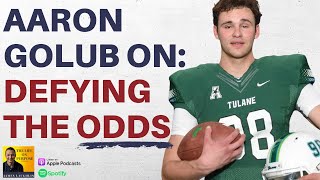
Aaron Golub was born legally blind and became the first blind Division I athlete to play in a game at Tulane University, later serving as team captain. He talks about leadership, the daily habits that got him there, and his shift to entrepreneurship and financial advising, emphasizing starting investments early and building generational wealth.
Questions this video answers
Boston, Massachusetts (USA).
Born legally blind: no vision in his right eye and extremely limited vision in his left eye.
He became the first legally blind Division I athlete to play in a game while at Tulane University.
Yes — he was named a team captain in his senior year at Tulane.
Yes — he trained for pro day and became an NFL free agent (pursued opportunities with teams).
Chapters
Aaron, a massive welcome to the Life On Purpose podcast. Absolute pleasure to have you join us today.
Thank you so much for having me today, man. I'm really excited to finally connect with you and get to know you and have this time.
Yeah, it's pretty amazing how we're connected by our friend Jeff Lopes up in Canada. There he was talking about you and about your story, and I was incredibly inspired. So I thought, hey, I need to get Aaron on the show. I need to find out about your story and where it all began. So please do tell me a little bit about you, where you're from, how you've got to be where you are today.
Yeah, man. So very quick background on me. I live in Boston, Massachusetts, in the United States. I was born legally blind. For me, that means I have no vision in my right eye, extremely limited in my left. Ended up playing football. Became the first legally blind Division 1 athlete to play in a game when I played football at Tulane University. Was named a team captain my senior year, went on to become an NFL free agent, and now I'm an entrepreneur and a speaker.
That's amazing. Absolutely amazing. So let's go back to childhood. So you were legally blind. So as a kid, what was that like? What were some of your challenges that you had to navigate?
You know, I think whether it be as a kid or now as an adult, the things that are the most challenging for me are the things you would never think about. It's the little things, you know, crossing a busy street, cooking in the kitchen, and knowing when chicken is done or something. It's the small things. And I'm sure when I was a kid, it was, you know, even smaller, like learning how to tie my shoes and stuff like that that you just wouldn't think would be a challenge. But, you know, the bigger things in life I've been able to do and been able to find ways around and figure out, but it's. It's those smaller things that you wouldn't necessarily think about that took me a little longer and continues to take me a little longer to figure out when it comes.
And does that in any way, does that ever stop your motivation, or does it do the opposite? Does it motivate you more to accomplish and break through?
You know, I think that it's a really good question because I think so many people rely on that external motivator of, oh, I can't do this, so I should prove everyone wrong and do this. And I don't think that's the way to look at it. I Think that external motivators are phenomenal for a quick fix, a great burst of energy or a motivator. When I was at the gym earlier today, if I'm lifting a really heavy weight, I might think of an external motivator to help get me going, to help me lift that weight, to get through my set. But an external motivator like that can only last so long. It might last a day, a week, a month, but it's not going to last you 10 years in business or 8 years playing football. Whatever it may be, the motivation that you have to accomplish something great has to come from within. And it can't be I want to do this because people say that I can't do it. It has to be I want to do this because I want to do this because I want to prove myself right. Because if you're doing it for other reasons than just like you want to prove yourself right, that motivation is going to stop at some point.
Great advice, great advice. And when you were a young man and you were looking at getting into football, what was the greatest obstacle for you to break into Division 1?
I think getting the opportunity. You know, I wasn't very good as a high school player at the start. I my sophomore year of high school, I was a third string junior varsity lineman. And you know, if you are a sophomore in high school, no matter what the sport is, whether it be football, basketball, swimming, baseball, any sport, you are probably, and you're going to play Division 1, you're probably starting on varsity, you're getting a lot of playing time in varsity. And that wasn't the case for me. And so I had to kind of make two decisions. First off, how can I find the right position for me? And I eventually found long snapping. And for those of you that don't know what long snapping is, I'm the guy on punts or field goals who would throw the football back between my legs to the punter or the holder and then block the person in front of me. And so I found that position. I said if I get good enough at this, I might have an opportunity to play. The second piece was because of my disability and my disadvantage, I need to work 10 times as hard as everyone else just to be as good as them. And it just started of I wake up at 5am every day. I would practice long snapping. I'd go to school, I'd go to practice, I'd lift weights. After practice I'd go home, I'd do my homework every single day for the next few years. Because I knew what I had to do to achieve my goal.
That's amazing. So sounds like you've had a clear vision of what you wanted, then you made it a burning desire to succeed at it.
Yeah, yeah. You know, if you have a goal and you have a desire, it really has to consume you and become your life. And you can't. When you have a goal that's that big, that, that's. That's that enormous, you can't just half ass it. You can't just put 50% of your energy into it. You need to really be laser focused. And if you are laser focused, you can accomplish anything that you want.
That's so inspiring. Really inspiring. And what are some of your highlights from football? Like, if you think back to your football career, what were some of most amazing moments?
Yeah, I think that there's really one that stands out the most. And it was in my senior year when I was named a team captain in college. And, you know, a little background there in my sophomore year in college, after the season, my team had gone three and nine my freshman sophomore year. And so the coach that had recruited me, that staff was fired. And a new coaching staff came in. And at first I sat down with the coaches. They didn't know if I could play because of my vision. They were concerned. You know, it was kind of that whole thing starting from zero again. And, you know, I was very concerned, to be honest, if they were going to give me a shot, and nervous. And I think we eventually just came to an agreement. Let's do spring football. Let's do spring practice, see what happens if we have to have the discussion again. And, you know, maybe I'll take a different direction then we'll have this in May and never had the discussion again. Two years later, I was named a team captain during my senior year. That was one of the best feelings and proudest moments that I've ever had because I was able to shape people's opinions and prove that I was willing to put in the work and show people that I could accomplish anything.
Incredible. Absolutely inspiring. And the NFL free agent, so how does that come about? How do you become an NFL free agent?
Yeah, so when my senior season ended, I didn't want to give up football. It was something that I wanted to continue on with. And so for part of my spring semester in college, for a little bit, I flew out to California and trained with a legendary NFL kicker, John Carney, and some of the other guys there, and got ready for my pro day, which is essentially a tryout in front of tons of NFL teams and flew back to school, did my pro day, performed really well, started talking to a few teams and continued to talk to them a little bit after. And it just wasn't going as quickly or in the direction I wanted with my position. There's, in the NFL, there's one guy per team. It's not like a quarterback where there's three guys on the team. And so if a guy doesn't get hurt or screw up, they're not going to replace that person. And so there's just less opportunities. And I had other dreams and other ambitions that I wanted to accomplish going forward. And I just decided that it was time to make a pivot and time to make a change. I wasn't necessarily giving up on my dream of football. I was making a change to go after other dreams and goals of mine.
I love that. And so tell me about those dreams and goals and how your habits and your success in your football life have really helped you to achieve in different areas.
Yeah, so what I do now is I'm an entrepreneur in the financial industry. I'm a motivational and keynote speaker. You know, I run a podcast and I'm in the process of writing my first book. But I think what football really taught me was dedication, leadership, perseverance, things like that. And, you know, showed me how, how to accomplish big things, how to be a part of a team, how to create the life that you want. There's so many lessons from playing a sport that you can carry on to your, your life as an adult, in business, in your personal life, in any area. And, you know, for me, it's really taught me what is really true hard work, what is perseverance? How do you time block your time, how do you set your daily non negotiables, how do you be a leader and show up every day to, you know, inspire your team and help others? And that's, I think, the biggest thing that came from, from my athletic career.
I love that. And if we look at leadership, you brought up the term leadership. So teams, whether they're sport or whether they're business, are still teams. So what would be your advice to a leader who wants to get the absolute best result from his or her team?
Yeah.
It'S a really good question. You know, I think.
The biggest thing is having, having deep relationships with everyone on your team outside of business or outside of sports, and understanding one another as people. I think that.
You know, whether it have been when I was playing football or now in business, the people that I work with today or played with back then are the people that you spend a significant amount of your time with. And if there isn't that camaraderie, if there isn't that enthusiasm to help each other, to make an impact on one another, to achieve a common goal, then you're not going to achieve that goal. If you want to accomplish something great, you need to have that ability to get along, to be friends, to want to work together. You don't want to go into work or go into your team setting and say, oh, I dread to work with Joe tomorrow. You need to work with people that you like and you understand and you can connect with. Because when you're able to do that, you're, you know, frankly, in a football setting, for lack of a better term, you know, there were so many guys, I mean, most of the guys that I played with, I would have taken a bullet for anyone. But that's how that relationship forms. It's a brotherhood. When you're playing on a football team like that because you go through so much together, and I think most people would say that and agree with that as well.
I get that. You know, I played in a pipe band of all things, so bagpipes and drums. And over in Boston, they have quite a few of them. And we became very competitive when we would go to the world championships. We'd spend our year in Vancouver, Canada, prepping and then we'd fly over and it's the same thing. The bond of brotherhood and sisterhood was huge. So when we think of football, the metric or the outcome is the result. So the points and we think of business, the metric or the outcome is financial. So you guys have developed this, hey, I would die for you, brother. You've developed this amazing team rapport culture of, you know, world class culture. How can someone do that in business? Because obviously business is very different, but it's still a metric. You're still working towards a financial outcome which is similar to a points outcome. What are ways for teams to develop that brotherhood?
Yeah, you know, first off, I think that when you're an entrepreneur and building a business.
Making money and gaining wealth has to be in the top three things that you're shooting for, but it can never be the number one. If your sole goal every single day is make as much money as possible, you'll never be fulfilled, you'll never be happy, you'll never achieve success in all areas of your life. Trust me when I say I want to make money. Of course I want to make money. And I want to make a lot of money, but it's not the absolute number one thing in my life. The number one thing is everything I do. I want to make an impact on others. And when you have something else that's the number one, it becomes a lot easier to work with other people, to build those relationships, to work as a team, because you're not solely focused on how much money can I make. That being said, you do need to focus on that, and it has to be one of your top priorities. You're never going to achieve success in business, but whatever your goal is, there needs to be one thing that is greater than making money.
I love it. And so what are your top. And from an entrepreneurial standpoint, what are your top three priorities?
My top three kind of goals, I guess.
Yeah.
Yeah. You know, I think the first one is definitely making impact on the lives of others. You know, I think number two is.
You know, it's hard because I think that a lot of men blend together. I could say making an impact. I could say showing people that you can accomplish anything that you want. Showing people that the impossible is possible. You know, I think all of that blends into a really big, big goal for mine, for myself. And then, you know, after that, it becomes creating generational wealth for myself and my family. But I think the impact one has to stand above it.
I love it. And so with the impact. So who are your people that. The people that you're trying to help support, who are they? What do they look like, and what are their pain points?
Yeah, no, it can be anyone. Honestly, on the entrepreneurial financial side, it's anyone who is looking to achieve something great with their finances and build wealth and things like that. And I help them in that area. And on the speaking side, it's talking to teams, to companies, to events, and connecting with each individual person and showing them that they can overcome any obstacle. They can take their disadvantage and make it their advantage. They can do anything that they want. And because of that, I'm able to impact so many people on a daily basis, whether it be from the finance side or the speaking side. And, you know, at the end of the day, my goal tomorrow isn't how can I wake up and, you know, make $10,000? My goal is how can I wake up and add value to three new people, make an impact on their lives? Because I know if I continue to make an impact and continue to add value to others every single day, sooner or later, much greater wealth than $10,000 will come to me.
100%. And if there's people listening right now or watching, what would be one or two things you could give them advice on from a financial wealth point of view? A couple of things they could consider to help themselves and their future selves, their wealth generation to move forward. What's a couple of valuable tips you would give?
Yeah, I think number one is start planning early start saving early start that journey. You know, don't just spend every single penny that you make. It's a, that's, that's a common mistake with a lot of people. I think number two is don't be afraid to invest in yourself. Like, yes, you know, investing in the stock market is interesting. Investing in cryptocurrency is interesting. Investing in real estate is interesting. And so many people do that. And I think that, you know, it's obviously important, but, you know, the best investment you can make is in yourself. You know, I could. The best use of $5,000 for me would be putting it into myself and building something with it because I trust that I can create a massive return on that in my business, more than any investment could get me in. You need to get to that belief and that faith and that confidence that you can put money into yourself because you'll make it back.
Absolutely. I'm a firm believer in that as well, Aaron. And for people that are trying to find their purpose. Right. So a lot of people, that's a driving force, like, I want to find my purpose. And then when they find their purpose, they want to align that with wealth generation. What advice do you have for people who are trying to actually uncover that purpose?
I think it's a really interesting.
Topic and honestly, something that I've recently forget where I was reading it, but, you know, my opinion kind of used to be whatever you're passionate about, you can achieve success at because, you know, you. If you put 100% of your effort into it, you can accomplish anything. And while that is true, I don't know if that's necessarily always the case. I forget who, who is saying this, but I was reading some book and someone was talking in it recently and they were saying how, for example, like someone in, you know, I don't know if all of your listeners will know these people, but in, for example, like, the United States, people like in Andrew Carnegie, who built, you know, an insane fortune through, like. I think it was oil.
Yeah, I think it was oil or. No, mine was steel, actually.
Steel.
Yeah, steel industry. Yeah, steel. And, you know, do you think he had a passion for steel? Probably Not. He probably did not have a passion for steel. Are you kidding me? But he saw an opportunity and invested in it and built a business around that. And then when he got older, did things he was passionate about. So, you know, I don't think it necessarily goes one way or the other. I think if you're truly passionate about something and you want to start on that, then that's great and you can build wealth with it. But it might take a little longer. If you see an opportunity, even if you're not as passionate about it, but you see a unique opportunity, then go for it, even if you don't love it. You know, I think everything I do, I'm fortunate that I enjoy, but I don't necessarily love every aspect of everything. But I see opportunities and I go for it. And I think that a lot of people need to understand that. I think that too many people are focused in like, if I don't love every single thing that I do, then I need to switch or I need to find something new. Well, if there's an opportunity, then go for it. You have so many more years ahead of you to live and you can do something on the side that you're passionate about. But just think back to that example. There's no way that Andrew Carnegie was that passionate about steel.
100%. And you talked earlier about, you talked about non negotiables, your daily non negotiables. So once an individual has decided, you know what, this is what's driving me, it's driving from within. I know what I want, I know what I'm after. Obviously they need to set up some structure around their days, weeks, months. So these non negotiables, what are your non negotiables look like? Or how do people define their non negotiables?
Yeah, I mean, I think they're different for everyone. For example, for me, waking up at a certain time every day, you know, I have personal business non negotiables, my personal ones. It's waking up at certain times, going to the gym every day, meditating every day, reading every day, things like that that get me, you know, in the right mood, mood throughout the day. And it's not always.
Do everything right in the morning. Sometimes I meditate in the morning, sometimes I meditate later in the day. It doesn't necessarily matter when I do it, but it's about doing it during the day. On the business side, those can change for me. You know, I have certain things that, you know, depending on the project or what I'm doing, those are the non negotiables that I write down and I have to accomplish every day. But you know, my non negotiables for May might look slightly different than my ones for April, or they might look very different. It just depends how much further and if I've accomplished everything I needed to from the ones in April. So that's kind of how I structure them.
That's great. And in terms of. You talked about generational wealth, so your legacy, what is the legacy that you're building towards?
Yeah, I mean, I think there's two sides of it.
On the entrepreneurial finance side, I want to build an incredible business. On the speaking side, I want to be one of the most sought after and well known speakers in the world.
I think for when I think of my legacy, there's two sides, like I said, and the first side is making impact on thousands, millions of people throughout my lifetime and having my name synonymous on the speaking side of people like a Tony Robbins or Ned Mylett or Les Brown. And on the wealth side, there's not like a number or something I want to accomplish. It's just I want to create generational wealth so my kids, my grandkids, my great grandkids and so on will never have to worry about anything. I want to accomplish that for them because I have that drive and that work ethic and I hope that they do the same. But there's no reason why I can't accomplish it. If I put all of my time and effort into accomplishing amazing things.
Fantastic. It sounds simply amazing. And if you were to sit back, detach a little bit and just look at your current situation, what is your greatest obstacle? What's the one thing that could stand in your way from moving forward towards that legacy?
I think the biggest thing is that I just jump into things. And I know in some senses that could be great. But.
I have like 5 million ideas all the time bouncing around my head and I've really. And I've gotten better at it. But I need to continue to learn more, to take a step back, look at the big picture and not just jump into new ideas, new business opportunities, new things, because I think it's going to work out. Because that's not how you create success. When you have 5 million things going on, it's a distraction. When you're focusing on one thing and you're laser focused, you create a lot of success in that area.
Brilliant advice. And what's right now? What's the one major thing that you're really focused on?
You know, it's funny because then my biggest thing is the financial piece because that's my main business, my main source of income and things going on. You know, I do time block a certain amount of time every day that I do, you know, whether it be going on someone's podcast or doing my podcast or speak it for speaking and outreach for that. But it's definitely not a majority of my day.
I think on that end though, although someone could say, oh, Aaron, you're doing two things though. Isn't that a distraction? Not really, because in my opinion, it's just all networking. Like, this is a speaking related thing, this is not a finance related thing. But we're building a relationship and you never know when one of your listeners will reach out to me down the road or something. You just, you just never know. It's about getting my name out there, building those relationships. And so I consider them one and the same. And just because I'm building two things, it'd be very different if I was like him in finance and I'm also in real estate. Like, you can't do those two things. It's the two things that I'm doing, I think, work together.
Yeah, they're really complementary. It's beautiful. And for those people who are listening and who want to connect with you, what's the best way for them to connect with you?
Yeah. So, you know, two areas. Either on my website, aarangollb.com, you can just submit a form and it goes right to my email. Or if you want to reach out to me on social media, on Instagram or Twitter or LinkedIn, it's aaronj. Golub. On Instagram, I respond to everything. I might not respond overnight, but I will respond.
Brilliant. I'll be sure to put all those in the description, in itunes and on YouTube. And when your book comes out, please let me know. I want to buy a copy, but I also want to share it with my listeners. So it might be cool to have another conversation after the book has launched and talk about the content.
Yeah, no, I. My goal is to have it released sometime towards the end of the year, in the fourth quarter.
It's definitely a journey and I block off a little time every week to work on it, but it's something where I can't sit down and spend six hours a day working on it. So it'll hopefully be out later this year. And when it does come out, you know, we're going to do a whole campaign around it and whether it be going back on tons of podcasts. I've already done or trying to do a lot of interviews and things around that to get it out there. So I'd be absolutely happy to do that and looking forward to it coming out towards the end of the year.
Well, very best of luck. Have the most amazing year ahead. I just want to thank you so much for taking the time to connect with me and my audience.
Of course. Thank you for having me.
Hey guys, if you enjoyed the content today, please smash that subscribe button below. And if you want to become part of my community, I've got an amazing free Facebook group. Please come and join us. The link is in the description below. And also, if you've got any questions about today's session, I'd love to know. Just comment below and I'll be sure to get back to you guys. Have the most amazing day.









