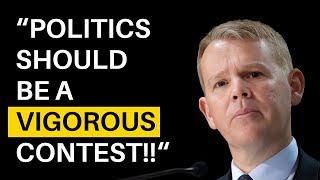
James Laughlin talks with Chris Hipkins about his take on Prime Minister Chris Luxon, opposition politics, and what drives him. They discuss economic inequality and democracy in New Zealand.
And it's interesting, in opposition, your role is to look for, hey, how can I hold people to account and make sure that the people of New Zealand are cared for and looked after? But if we were to look at the positive, if you looked at your opposition leader right now and said, you know what, the one thing I really admire about him, what would that be?
It's always a struggle. You do tend to look less objectively upon your opponent because, you know, in politics, fundamentally, it's a contest not just of ideas, it's a contest for position as well. And so when he was sitting in this office, this time a year ago, he was sort of thinking, how can I replace Chris Hipkins as Prime Minister? And now I'm sitting here thinking the reverse, you know, how could I replace him? And so you're probably not looking for each other's strengths. And.
I think accepting that that's a legitimate part of the political process is actually quite important because, you know, politics should be a vigorous contest. It's not a democracy if it isn't. And so when you're sitting here thinking.
You know, why am I doing this? It's quite negative. It is an important part of, you know, democracy is for the government of the day to be challenged. And I never took it personally when I was on the other end of that, you know, during the COVID 19 response period, some of the stuff that came directed my way from, you know, people was pretty, I can only imagine, pretty aggressive, but I never took it personally. People were lashing out at my position rather than me personally. Although they don't always express it that way. Sometimes they'll express it very personally, but I always sort of made an effort to compartmentalise that and say, actually, that's Chris Ipkins the politician that they're talking to, not Chris Ipkins the person or the dad or the private individual. Because I think, again, that helps you to get through what you're doing in politics. So, yeah, we have an interesting relationship, the Prime Minister and I, but I've also kind of taken the view. I think the job of the opposition is to critique what the government are doing. I don't think it's deliberately to sabotage what they're doing. And, you know, I was on the receiving end of some of that during the time that we were in government and I found that really frustrating. So whether government are doing something which you think, if I was them, I'd be doing the same thing, I'm not going to go out and critique that or criticise that. Yesterday, they Made a really difficult decision around naming China as being involved in a cyber security hack of New Zealand at New Zealand's Parliament. I would have done the same thing, you know, had I still been the Prime Minister. And so I'm not going to go out and criticise them for or try and pick holes in it. I'm actually going to endorse what they've done. I'm going to support them, because actually, I think that's better for democracy than us just fighting for the sake of it 100%.
And I want to talk about a person I look up to a lot, Nelson Mandela. I've read lots about him. I've sat down with some of his family members to try and understand who was Nelson the man. And he had something he was willing to die for and fought his entire life, went to prison for it. That was justice and racial equality for you. What's the thing that you're like? In my life in politics here in New Zealand, this is the one thing that I'm willing to fight for.
Yeah. Economic inequality is the thing that really kind of motivates me to be involved in politics. And it's not just about wealth, it's about opportunity and about the ability to make the most of those opportunities. So there's so much more that goes into the debate about inequality than someone earning more than someone else or someone having more assets than someone else. It's actually more than that. It's about is life a level playing field? To what extent do your chances in life get determined before you're even born? And what we're seeing now in the modern economy is increasingly, people's chances in life are more and more predetermined by the circumstances into which they are born. And to me, that's not what life should be about. Life should give you choices and options, and sometimes you'll be successful, sometimes you won't. But the idea that that's predetermined before you're even born, I think is really tough. And there is overwhelming evidence and it's growing by the day, that increasingly that's the way society's going. So that is the thing that kind of motivates me, is we have to change that. We have to make it so that if you do sort of fulfill that great cliche, you know, you work hard to get ahead, you should actually be able to get ahead from your hard work. And there's a lot of people who feel that they can't. So I guess that's kind of the thing that really motivates me.