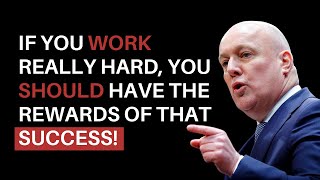
Chris Luxon talks with James Laughlin about leadership and New Zealand's future. They discuss social cohesion, education, and creating opportunities for the next generation.
Chapters
Every time I've taken a new job on, I've often written a draft resignation about week six, I reckon it is, and something like that. I did the same at Air New Zealand, actually. And it's just because it actually does help center you and focus you on what's actually going to be important because lots of stuff happens and it can blow you off course really quickly. And so I learned that I do a stakeholder process of having really good understanding of what the challenges in the business is. It a turnaround job is a sustaining success. What is the challenge that we've got? And then how does my leadership match that moment? And then importantly, what are the critical things that we actually have to get done in that time? And if you do it right, you know, you can have great fun along the way, too.
100%. And I've seen that with you. I've seen you having fun along the.
Way the last couple of years as well.
And the last time we chatted, so my wee boy Finn was one at the time.
Yep.
And we were talking about particularly fatherhood and then New Zealand's teen suicide. And obviously we've got some stats there that I really want to see that.
Turned world class in the wrong way.
100%. Yeah. And so we were talking about, okay, well, here's certain things that we could do as dads and as mums, as parents to show up. So I grew up in Northern Ireland. Very divided country. Beautiful country.
Great, great country.
You'll be welcomed there, you know, but it's divided on religion.
Yes.
And I've witnessed sectarian attacks. I've seen young boys that have been kneecapped by local paramilitaries, watched the police fighting local terrorist. Things I don't want my son to ever witness here in New Zealand. So my question is, you know, if you step in and you lead the country, what's it going to look like for his kids? You know, my grandkids. Your grandkids, if you have them too, you know, what's it going to look like? What would you like to see for our future Kiwis?
Yeah. And that's exactly the motivation, because that's a big motivation for me to do it. Because I think my job as Prime Minister is to fight for New Zealand, to make it a place of opportunity where our kids, our grandkids actually say, this is a place I want to raise my family. This is the place I'm going to start a business and take a risk and make something happen. This is the place I want to give back to the community that I possibly can. And so for me that's the core purpose of what the Prime Minister and the leader of New Zealand is all about. That is what you've got to do is build it for future generations. So what do we want to see? We want to see a much more prosperous country. And what do we have to do to do that? We've got to deliver a world class education system, invest in infrastructure, make sure that we have a really great R and D, science and technology. Ireland does that incredibly well and then make sure that we've got a pro business environment and we've got strong connections to the world. And that's been one of our fundamental challenges is how do we make this a more prosperous place. We're all working hard, but how do we get our wages and our incomes going up? I think on the social side I'm a believer that having looked at centre right parties around the world that actually we want strong levels of social cohesion but we also want to be able to create the, the opportunities for people to be able to have. There's got to be an equality of opportunity in the country. I don't believe in an equality of outcome. I think if you work really hard you should have the rewards of that success. But I do think that 5 year olds in this country should be able to set off irrespective of their circumstances and have an equal shot at their version of the Kiwi dream, whatever that may be. And so I want to see a more a place where that, a place of opportunity where actually people can say, yeah, if I go to school and I study hard and I work hard and I'm in a school system that actually gives me an opportunity to get from a set of circumstances to a better set of circumstances like it did for me, you know, that's what I want for Kiwi kids, you know. And so, you know, so I want to see a place that's economically flourishing. I want to see a place that's built on, you know, strong bicultural foundations, but a modern multicultural country going forward in the world. And you want to make sure that we've got a really special beautiful place here in terms of an environment as well. So, you know, those are the three things I'm looking at, you know, economic, social, environmental excellence and how do we, how do we keep upgrading, keep improving in each of those dimensions?
That's amazing and that's great to hear. You know, I plan to be here. This is home. I'm a Kiwi.
Although I sound like when You're a great example, right? I mean, you left a place and came out here believing it would be a place where you could get ahead, do well for yourself, your family, your community. And that's exactly what we want. And that's what I want, is I want the promise of New Zealand restored, which is essentially doesn't matter where you've come from, it's actually all about where you're going.
And I think that's really important because have conversations with parents, young parents, similarly, as to me, and they're like, it's a private school. We've got to send them there. It's a must to get ahead. And I just pause for a second.
Yeah.
99% of the people I've interviewed who are running companies, countries, and they're doing incredibly well, 99% didn't go to private school. And in New Zealand, I believe you don't need. That's. It's great and there's great private schools, but you don't need to if the education.
And that's where we're building. I'm a recipient largely of a state school education, and I think it served me incredibly well. But I know, unfortunately there are schools in New Zealand, bottom 10% of schools, where 98% of our kids at 15 didn't pass the most basic reading test or writing test, 90% didn't pass the reading test. You know, and so that's what I mean by, you know, we have to work harder at making sure that those rungs on that ladder of social mobility for people are actually much stronger so that you can actually get yourself from one place to another. But, yeah, it's interesting. I mean, I remember sitting down in Chicago with a bunch of CEOs, and I'd had a few friends that have been Rhodes scholars and Churchill scholars who were real brainiacs. And I've often felt they. People don't always realize their potential because ultimately you've got to be smart enough and curious enough to learn or unlearn things. But ultimately it comes down to can you communicate, can you resolve conflict, are you curious to learn new stuff and do you have good character? And I think those are the things that fundamentally determine ultimately where people go to in life as they go through 100%.