He Ran for 101 Hours with No Sleep – Sam Harvey’s Ultra Human Story
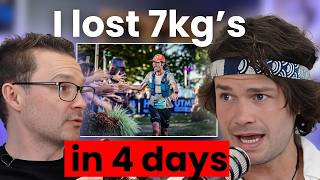
Sam Harvey, a professional ultramarathon runner, ran 677 km in 101 hours with almost no sleep in a backyard ultra race. He discusses how he transitioned from multisport to ultrarunning, the mental and physical toll of extreme sleep deprivation, and what separates amateur from professional preparation.
Questions this video answers
677 km
101 hours
6.7 kilometers per loop
Run one 6.7 km loop each hour; you must be in the corral to start the next hour or you are eliminated.
Dead Cow Gully, Nanango, Australia (a cattle farm northwest of Brisbane)
Chapters
Today you're going to get to hear from Sam Harvey, a professional ultra marathon runner who set the world record for 677km in 101 hours. You're going to want to listen in and understand how someone like this operates at that level. I promise you there will be some gold nuggets. Sam Harvey, a huge welcome to the Lead on Purpose podcast.
Thank you, brother. It's good to be here.
So glad to see you. Like, we're both in the 03 here in Christchurch. We literally live across the hill from each other. And about a month ago, I had three people. Within a day, three independent people say, james, you've got to meet Sam Harvey. I'm like, okay, there's something to this. When one person says it, I'm like, we'll see. But three people one day, One of them in Dunedin, one of them in Christchurch, and one in North Island. I was like, yeah, okay, I need to look at this guy. So I was really glad that when we got a chance to chat that you were up to coming in and sharing your story. And I mean, you're at the beginning of your story, but what you've achieved at the beginning is mind blowing. And I look at ultra marathon runners and they fascinate me, they scare me, they inspire me. And I think that there's something quite unique about how they. They handle this thing, the top two inches. And so I just thought it'd be great to jump into how you operate, what got you into it. And I guess for those who don't know what an ultra marathon is, what's the definition of an ultra marathon?
I guess an ultra marathon is anything longer than a marathon, so anything longer than 42.2. But I mean, we traditionally start at 50 kilometers and then work upwards.
Amazing. And there's often this idea that ultramarathon is one thing, but what you're sharing with me actually is that there's different types of ultramarathon.
Correct.
So we've got the backyard ultramarathon. So just give us a brief overview of what backyard ultramarathon means.
Backyard ultramarathon is a 6.7 kilometer loop. And you run one loop on the hour, every hour. You've got 60 minutes to complete it. If you finish the loop in less than 60 minutes, you get that time to eat, drink, sleep, do whatever you need to do. However, you need to be in the corral to start the next hour. If you're not in the corral, you get kicked out and you basically.
Continue like that hour after hour. If you take longer than an hour, you get kicked off the course. If you can't start the next loop, you get kicked off the course and you just keep on going until, well, so long as there's at least two people left in the race, you keep going indefinitely. So there's no set period of time or distance that it's going to take. It might take a day, it might take four and a half days. Yeah.
Unreal. Now the question I want to start with is why? Why do you put your body and your mind through such strenuous, arduous activity?
I don't know. I guess I'm a bit of a sucker for punishment.
Have you always been like this? Like as a young kid were you into sport, an activity that really challenged you?
Less so I'm just very stubborn and I found a sport for stubborn people.
Yeah, I love it. How did you stumble across this?
I guess probably like in late high school years, early university. I want, I had delusions of grandeur and wanted to be a, a professional athlete and never really knew my pathway but it was always kind of there in the background and yeah, did university, did lots of professional jobs in the agricultural sector and elsewhere and yeah, always, always dabbling in sport, endurance sport, the likes of triathlon and mountain biking and running and then boxing and rugby and anything else that I could get my hands on really. Running didn't really come along until like maybe 2017. Prior to that it had just been like something that you do to keep fit. I mean most people run to keep fit for their other things.
And then yeah, 2017 started racing 5K and that became ultra marathon 2018 and it was, it was a very slow progression. It was like 2018, first 50k won that, that felt really good. 2019, first hundred k, that almost killed me. That didn't feel so good. 2020 did my first 100 mile, that also wasn't great. And then 2021 I did my first backyard ultra and did 37 hours, 250 odd k's and came second to one of the most established ultra marathon runners in the New Zealand scene. So I went from kind of.
Nobody knew who I was to I had, I had staked my claim. And then it wasn't until the following year 2022 where I was like being a jack of all trades and a master of none, done lots of sports all at the same time thinking that that was going to be my, my niche was doing all the sports. But I want to be world class. I want to be the best in the world at one thing. And, and so I kicked everything else to the curb and just focused on ultramarathon and then went shopping and just found what I could. Kind of reverse engineered my pathway and I figured, right, I want to be world champion or go to the world championships. How do I do that? So I found all the different disciplines of ultramarathon running, found their world championships, put them on the calendar, and then reverse engineered the, the qualification pathway to get there. What races would I need to do or could I do within the calendar to get myself to that point?
I love it.
And then started ticking them off.
Really logical approach, like you knew what you wanted. And I think the big determining factor here that everyone listening and watching should, I think, highlight, is that you realize that by diluting your focus, you were diluting your results. And so you went from many activities, many sports, to one thing and going deep with that. So I think that's a real, like, for me, a big takeaway is like, don't try and be the legend of everything. Get clear on the one thing that you're pretty good at and you really enjoy. And then go deep.
Yeah. Find the thing that lights a fire under you and then just chase that.
I love it. And I love the whole idea of, you know, what gets scheduled gets done. Like if you're going to commit, put it on the calendar. It's. There's got to be a date and then work back, reverse engineer that. Now I want to, I want to share just with the listeners something. So this blows my mind. You're the New Zealand backyard ultra record holder for 677km. It's a big run.
It was a big run. Yeah, that was a big run.
How many hours?
101 hours.
Okay, 101 hours. Now I need a lot of sleep across 101 hours just to do basic function. How many hours of sleep did you have across? 101.
Very little. Yeah, very little. I mean, with the backyard ultra, you're continuously going out on the hour, every hour. So regardless of if you even manage to get to sleep, then you're only going to be asleep for a number of minutes before somebody wakes you up to send you off on the next loop. But at that point in time, I hadn't really finessed my approach. It was just.
Attack in whatever way, shape or form I can and survive. And at that point in time, yeah, I was getting one to five minute, maybe maximum micro naps. And that was good. Like it's better than zero, but it wasn't great. Now I'm a little bit faster in my running and as a result I get longer sleeps. But at that point in time, yeah, it was.
A number of minutes worth of sleep over 101 hours, which wasn't great. I was very sleepy and I was a little bit hopeless, a little bit sad.
I bet, like emotionally it must be really challenging when you're in the depths of sleep deprivation.
Yeah, yeah. Sleep deprivation does some wild things to people. I bet.
So another record that I think is fascinating. World record, Backyard Ultra 2023. Where did that unfold?
Yeah, so that was that race. So New Zealand record and it was the, the backyard record. I matched the, the record with that 101 loops and that was held at Dead Cow Gully in place called Nanango in Australia. It's like two hours northwest into kind of the middle of nowhere of Australia from Brisbane. And yeah, it's just on a middle of nowhere cattle farm. And you run, you run around in circles on that farm for, for days at a time. So I matched the world record and assisted the new world record at the time on that venue last year and then I won it this year and it only went for 69 hours this, this year because we didn't quite have the international lineup that we had.
Wow.
Like last year.
But yeah, seriously amazing. And what I love about this is that you're now professional. So this is what you do. You run, you coach and train and, and consult other runners around the world. And you obviously have, you know, a pipeline of sponsors that see your mission and believe in your mission, want to get behind it so it allows you to do this full time. What's the difference between now doing it professionally versus trying to do this while having a job and all the other things that go with it?
I mean, again, doing less things so I'm spread less thin so I can focus on what's important. And now I don't do much outside of running and coaching runners, which means it's getting all of my bandwidth and therefore the quality of what I'm putting out is much higher. It's much easier to do what I'm doing. I mean, at the end of the day, like to become a good runner, you've got to run a heck of a lot. Like in my, at my level, you need to be running 160-200km a week on average. And if you are holding down a proper job and doing other things, yeah, that all makes it a lot harder. It definitely, definitely reduces the ability to recover because yeah, you're you're putting nine hours a day into a. Into a real job. So, yeah, I've done that. It can be done. But I would prefer not to sell my time to somebody else when it could be focused on my dreams and my goals.
I 100% agree with you. You know, the people I see performing at the absolute best in whatever field, that's their thing. That's their main ingredient. They stick to it and they're not looking for all the extras. They stick to their main course. And I could see that with you. The main thing is the main thing.
Exactly.
I love it. So let's go to 2023 New Zealand Backyard Ultra, breaking this record. Lap one. Talk me through how you're feeling at the start. Like your energy, your mindset, maybe a little bit cocky.
I, I've, I've traditionally always had a reputation of opening with a hot lap.
To, to just whip and round, like.
Whipping around real fast to the point where people are like, this guy's an idiot. And yeah, I'm an idiot.
But. But you had fun doing it.
Yeah, yeah. It's like, bust down the door, I'm here.
Is there a sense of, like, competitiveness? Like, the All Blacks will have the haka and that's like, oi, we're here to race. Like, look out. What we mean business is a little bit of like, hey, guys, a little shot across the by. I'm here and I can move.
Yeah, sometimes I love that. Yeah, I. That was also me with a point to prove. Now that I'm in, up there within the top in the world, I. I feel like I've got a little bit less to prove. Like my performance, my performance reigns through and all I've got to do is show up and do my job so I don't have to showboat so much. But I do like to bring a bit of professional wrestling showmanship to Ultramarathon because it just makes it a little bit more entertaining.
Of course, everyone would be following along and loving it. Yeah, this makes for a good Netflix. That's what I'm thinking.
Exactly.
So first lap fresh, Feeling good, bit cocky. Okay, let's say go to 10 hours in. So we're 10th hour, 10th lap. How are we starting to feel?
So like 10 hours through to 24 hours, even like up to 48 hours. And, and the really deep ones, the ones that go for four, four or five days, I see that first 10, 24, 48 hour period is as the death of your mortal self. Like, you turn up as a human and you, you shed that mortality in the first 24 to 48 hours.
What do you mean by that?
I mean you shed your excuses.
You shed your boredom, you shed your pain and eventually you just accept that like that is just a fundamental aspect of what you are doing.
And so during that period of time you're just kind of like encountering problems and excuses. And I find typically that's the hardest part of the job, especially when you've got the bulk of the work still ahead of you.
Because you're like, oh, I gotta do this again, I got 75 hours to go. This is crap.
But eventually you kind of just come to terms with it all and you remove, yeah, you, you remove the normal human from, from the equation and then you achieve, I don't know, it's almost like a running God mentality. Like you, you transcend your mortal self and, and that's when the real race starts after that.
And there's probably no degree of overthinking. I imagine at that point it's very much being and just getting out there and doing it. You probably don't get a lot of thought to overthink.
If you overthink, then you're out, you're dead, you're gone. Yeah, yeah. If you're thinking more than you're doing, then you're not long for this world.
And we see those people leave the race. That's when you're able to just lock in and be present and do your jobs and not think about it too much. That's when you achieve success in the backyard ultra at least.
So if you're easily distracted, which I think many of us are like, we're addicted to these bloody phones of ours. Some people will be watching or listening on their phone right now. But these devices can distract us and we see that in performance, people can't sustain focus. I imagine you work on your focus, train your focus to be able to do these 101 hour races. How do you manage your focus when you're starting to hit a little bit of sleep deprivation?
My performance has kind of.
Continuously improved.
I'm less so dealing with sleep deprivation at all as, as, as a factor. It was at that 101 loop race primarily because I came with an approach of I ran a little bit slow to conserve my legs so I didn't beat them up too much. But at the same time I wasn't getting enough sleep. Now I'm running much faster and sacrificing maybe the integrity of my legs, getting more sleep. Sleep's not an issue for me anymore, and I know that.









