How to rank #1 on ChatGPT with Kasim Aslam
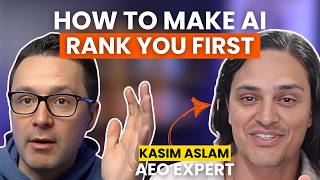
Interview with Kasim Aslam on Lead on Purpose about Answer Engine Optimization (AEO) and modern hiring. Kasim contrasts AEO with traditional SEO (schema markup, personal-authority ranking, social mentions vs. link-building), explains why personal branding and clear schema matter for LLM-based answer engines, and shares a seven-step, tactical hiring process emphasizing paid trial projects, strong job distribution, and paying top talent. He also promotes free resources (aeo.co, thehirebook.com) and urges action: "ship it."
Questions this video answers
aeo.co (not aeo.com)
thehirebook.com (free book, workbook, templates, audiobook, global job board)
17 businesses
Sold it 'in October 22nd' to a SoftBank MacMartech company for eight figures (as stated in the interview)
Chapters
Today's guest is Kawsam Aslam. Enjoy the show. Kawsim. A huge welcome to the Lead on Purpose podcast.
James, thanks for having me, buddy. I appreciate you.
Oh man, I'm so excited. Just in our pre conversation, like, oh my God, we should be recording this. This is gold. So you mentioned something and you showed me a book, your most recent book, it's called aeo. What on earth is that? So I would love to talk about AEO if you want to hold the book up. Now, for those that are watching and for those that are not watching, I'll describe it. It's the AEO blueprint. I'll put a link to it in the show notes. So SEO has been this thing that everyone's been talking about for years. I was chatting to someone yesterday in Australia and they were like, yeah, no, we're spending tens of thousands a month on SEO and yeah. What do you feel about that?
Well, first what I'll say is I started my career in SEO 20 years ago and so I'm a, I'm a proponent. I'm not, I'm not here to just shit on an industry arbitrarily. And SEO has already experienced a degree of forced obsolescence that I think is obvious, to be frank, and quite a few people aren't aware of, which is sad. You know, it's like being a dinosaur after the meteor hits. There's a moment between the meteor striking and the dust cloud getting to wherever you happen to be. But that said, SEO is so beyond irrelevant that it's laughable. And I've been called a lot of things recently because I've been hitting the AEO drum. And it's usually by SEOs that are just, they're just terrified of their own obsolescence. And what a lot of SEOs are saying is it's the same thing, it's the same process, just a different window. And I can prove them wrong. I have a team, I have a six person team that's done nothing but study how LLM source recitations for the last 12 months. I have hundreds of millions of data points at this point. I have more data on this than any human alive. Except maybe Monic Bond. Monic is the guy that owns Search Atlas. He's a friend of mine. He's in my mastermind. But he takes a different approach and different tech than I do. And what we have found is answer engines like ChatGPT, Perplexity, Claude, Gemini, etc, they catalog and reference information in a very different way than SEO. Here's Some specific examples. In the world of SEO, link building is the single most important key for him. Key performance indicator for ranking. So much so that you could say SEO is just link building. And people would fight me on that and say no, content is king quality content. That's lip service. It's the reason companies like SEO Co Posi Rank and the Hoth exist, because when you go to those companies, what do they do? They sell links. Yeah, that. I mean it's a marketplace for links. For AEO links do not have the same premise. Guess what the single most important key performance indicator for ranking from an AEO perspective is.
Really good question.
Reviews, ratings.
The. Well, that's a. That's a phenomenal guess and it's close. I guess that would be top five would be social proof. Number one in the. In the space of AEO is schema markup. Here's a fun fact about schema markup. I didn't know what the hell schema markup was, dude.
I had to go back.
Yeah, nobody does. You know what I mean? So like my. I've got this data team that I've hired to study this thing and they're like that. The one thing that's coming back over and over and over again when we look at these LLMs and what information they're referencing is super clear and transparent schema. And then I'm like, well, what the hell is schema? And you know, I sold websites 20 years ago, so I remember the word. But when you can go to schema.org schema is. And I have a 10th grade education case, so I'm going to explain this like an idiot and then somebody who's smarter than me can come and explain it in a better way. Schema to me is kind of the table of contents to your website. It's a certain type of metadata that tells computers what stuff is. Here's what's interesting about that, is it puts us back in 1995 search engine land, where all you needed to do is keyword stuff and you would rank if you have really clean schema. LLMs love that. Which kind of makes sense. We trained a bunch of computers to go out into the Internet and find answers for us. And surprise, surprise, the computers like it when we tell them what the information is. Now, I would anticipate this having its own expiration date because when a douchebag like me gets on a podcast like yours and start telling everybody how to game the system, they have to make an algorithm change. But for right now, schema markup is critically important. Following schema markup and you already hit the nail on the head, I think, really, really hard. The, the equivalent to link building in LLMs is social mentions. But you don't need a domain name. And this is a huge paradigm shift. LLMs do not rank websites, they rank authorities. And that's, that's a different way of thinking about something because in, from our perspective as marketers, you know, having been the, the business for a million years, we assumed that people wanted to hear from moz.com not from Rand Fishkin. And it was moz.com that got the domain authority, got the references, and, and Rand was just the owner of Moz. Well, LLMs have said the domain doesn't matter, it's the person that matters. Why? Because a person can write a book, a person can get a PhD. A person can invent something. A domain name is transient. So what ends up happening is the most important thing that can, that you can do for yourself from an AEO perspective is begin to establish yourself as an authority. But the authority has to be personal brand, not business brand, which is actually catastrophically damaging for some of us. I own 17 businesses, dude. I own Pareto Talent, which is a staffing agency. I've driven Mastermind, which is a mastermind. I own AEO Co, which is, you know, answering. And so if I want to show up and say I'm an authority, well, then the LLM goes, an authority and what? Right? Whereas a person who goes, all I do is study optical lasers. And now the LLM, if you ask a question about optical lasers, the LLM is like, oh, Jeffrey's a doctorate in optical lasers, has studied optical lasers 20 years, publishes content on optical lasers, has a business on optical lasers. Obviously, obviously, obviously this person is an optical laser expert. And then you have people that go, well, I don't want to be out there, I don't want to be visible, I don't want to be the expert. Well, good luck to you because your competitor does so. And then there's a key man insurance problem, right? If you launched a business and then you put one of your employees in charge of creating the content, writing the book, managing the community. Now you end up in the world of, like, my buddy Brandon Turner, if anybody knows Brandon, he's the best selling real estate guru in the world. Brandon was an intern at Biggerpockets when they launched their podcast. Took the podcast over because nobody else wanted to do it and ended up being even bigger than Biggerpockets. And now Brandon's famous Nobody knows what the hell BiggerPockets is. So LLMs favor personal authority over business authority. They favor schema markup over link building. They favor social mentions over website presence. And here's the craziest part. It's not the website that matters. For SEO, you're worried about optimizing one single URL. For aeo, it's about optimizing your global presence, which means multimodal content, all of your social networks, your nap. Obviously if you're local business links, directories, Reddit used to be the gold standard. It's not anymore, which we can talk about if you want to. But I might be boring you at this point, so no, this is fascinating me is staggering.
Just a really quick note to say thank you. Thank you for buying my book and helping me get to number one best seller. Habits of High Performers is available now. If you haven't got a copy, please grab a copy. You can get it from any good bookstore in Australia or New Zealand or go to thehabitbook.com I've been very humbled by the endorsements by best selling author Robin Sharma, by our former Prime Minister, also the former head of Adidas North America and many others. So it's just been very humbling process and deeply delightful to get the feedback from you, the reader. So thank you for your support. I want to talk about it because recently we had an inquiry and I shared this with you earlier, but somebody wanted to find a keynote speaker who speaks on leadership or high performance for their Fiji conference. They went to ChatGPT, typed it in, who's the best in Australia or New Zealand? Boom. I came up top of the list and I have no idea how it happened. I'm delighted about it, excited for Fiji, but I'm like going how do I get more of that? Like that's interesting. So trying to like figure out what is going on. So I've got featured in Forbes recently, Men's Health, Sydney Morning Herald. I'm like, is that what it is? Or is it the fact that for the last seven years I've been focused on one thing, high performance leadership. And it's a personal brand and I've wrote books on it, articles on it, consistently on socials, people talking about it, reviewing it. What do you think?
Yes.
If you don't mind me making this a little more complex and let's say more three dimensional. Your consistency has absolutely helped you. All of those mentions have absolutely helped you. But there's another factor to consider that you don't have to consider from an SEO perspective. SEO was.
Objective in its ranking. You could actually like. I built the number one ranked Google Ads agency in the world. I sold it in October 22nd to a SoftBank MacMartech company for eight figures. Well done USD. And it was the number one ranked in the entire English speaking world. Anybody who spoke English went and said Google Ads agency and Solutions 8 was the first organic agency listed. Now, we've given lip service to the idea of contextual search, but there really was no such thing. Context changed things by 3, 5, 10% at absolute most. The other layer of complexity here that's interesting is as important as you, your presence, your mentions, your consistency and all those things is the person searching because the LLMs know those people to a degree that is horrifying. When you talk to ChatGPT or perplexity or Cloud or any of those things, it's caching information about you and it's caching more than you realize because there's what you tell it and then there's what it can intuit based off of what you tell it, right? So it knows things like who's cheating on their spouse, who's going to declare bankruptcy, who's a heroin addict. And it knows those things without you having to tell it because you say the things that let it know how to place Sherlock with you in your life. So if the person looking for you, let's actually sterilize this a little bit more so it's not quite as incendiary or maybe more incendiary, but not quite as personal. Let's say that somebody who's looking is anti vaccine. Right? Which in the US is a big, big, big question. I don't know if is that a.
Problem very big here as well in New Zealand, Australia.
So pro vax, anti vax and both sides say the other one is satanic. Right? Like we're all evil. So if the person looking is anti vax and you're anti vax, even though your topics have nothing to do with that, My opinion is based off of what I've been able to see from the data points that we're gathering. The LLMs are looking for consistency from an echo chamber perspective that that might not feel connected topically to whatever it is that you're doing. The LLMs are trying to. And this is the thing that's why horrifying. It's actually really scary. They're not trying to deliver you the quote unquote best information that's peer reviewed, double blind, scientifically backed. They want to give you whatever you Want.
Yeah.
So if you're anti vax and you're looking for Vax Info Chat GPT will talk to you about why vaccines are satanic. And if you're proax and you're looking for Vax Info Chat DPT will talk to you about why vaccines are an absolute necessity to all, necessary to all humanity. And so the person searching for James.
Has demographic and psychographic profiling factors that for whatever reason the LLMs felt were aligned with you, who you are and that, that who you are could be. I don't know dude, it could be like politically, spiritually, epigenetically, racially, religiously, linguistically, blah blah, blah, blah, blah, blah blah blah blah. So for the first time ever, you're not just trying to match with the sterile query that is a search term. You're trying to match with the search term from the perspective of your ideal prospect and or prospects. Which means that if somebody else searched for who's the best high performance coach in Australia, New Zealand, they might have gotten a different result even though they're searching from, they do the same place, you know, geographically or whatever because they're positioned different, differently demographically and psychographically.
That's so fascinating and that's quite exciting as well.
Yeah, it's. Dude, it's good and it's bad. Like it's, it's, it's horrible because the echo chamber we're about to build for humanity, it's inbuilt confirmation bias to a degree that will never allow for conflicting information. Like we're all radicalization.
This is probably a very dangerous thing.
Instantly, dude, like the whole world is about to be instantly radicalized by whatever your pre existing beliefs are. It's like instant indoctrination. And the flip side of that coin is our access to the information we want to need. It's instant, it's because it. And that's the other thing that's interesting about the LLMs that's mind blowing. They intuit intent so you don't even have to be really smart. That's why prompt engineering is such a stupid. My business partner Perry Belcher, who's I think one of the smartest prognosticators in the world, he said this three years ago, he goes. Prompt engineering will not be a thing when, when AI reaches a degree and it still happens in its infancy, but when it, when it begins to fulfill on its promise. You don't need to engineer shit. You're. You just have to. The tool's job is to figure out what you want so you can be an idiot and you know, you're, you're sitting there typing with your palms, barely smarter than a chimpanzee and the super intelligent trillion dollar computer can start to say like, I think I get it what you want and it knows what you want more than you do. And I'm not saying that to be, I'm not trying to incite violence. I actually really mean that. There's been more than enough studies to show that people really do not know what they want or what they need.
I 100% get that. As a coach, the first question I ask, what do you really want? And most people start with.
They have no clue. Absolutely zero clue.
Yeah. And it takes them months and years. Right. That's like the Freudian thesis, right? Is this going to take you 20 years of just talking to yourself to even begin to scratch the surface? And here are these mechanisms that can go, yeah, and get to your like million brain or your lizard brain or whatever. I have a 10th grade education so I don't know what brains are. The brains that are supposed to be gotten to from a subconscious perspective, but that's where these things are getting and they're getting there fast.
It's seriously exciting in a lot of ways and as you say, scary as well. So aeo, we need to be chatting about it. I'm going to put the link for people to go get the book right now. I'm going to order books free.
By the way, you can go to aeo.com for excuse me aeo.co not calm because that's American Eagle. Aeo.co free. You can have join the free community which is free forever. Download the book which is free forever. The reason this is all free by the way, I'm not the Mother Teresa, but my thesis right now is my ability to crack the code on this endeavor is increased in direct proportion to the number of people that are feeding me data.
Yeah.
So I can either charge for all this access and make a little bit of money, but also hamstring myself from a learning perspective or I can make all my research free with the expectation that other people are going to come and join me in the research endeavor and then I get to be, you know, king of the mountain and the one with the most access and the most visibility. And so that's the direction that I'm heading.
I love it. I'll put it in and I'll encourage all my clients, friends, listeners to go get that. One of the things that you are a world leading expert in and I've had a few other hiring experts on the show, but you are totally unique in your perspective is how do we hire great people and where do we hire them? So over the years, as I've grown my business as a founder from nothing to six figures to seven figures. Okay, I need to hire people. I can't do all of this. I'm going to burn out. I've hired people from here in New Zealand, in Australia, in the Philippines, India, Pakistan, the uk and some of it's worked great and some of it hasn't. You understand what works? So as a listener right now going, I need an executive assistant. And I think every leader should have an executive assistant. That's like the starting point of freeing up your. Your time and having more options.
Yeah.
Where do they start?
So a paradigm shift first. Actually, it's seven steps in my book. Can I just give you the seven steps and you can tell me what. So I mentioned this to James before we started recording is I. I'm going to say two things. One's horribly arrogant, and then one, hopefully will pop that bubble a little. I think I wrote the greatest book on hiring ever written. Arrogant. And none of this is mine. Dude, I stole all of this. It's just 20 years of me shamelessly stealing from all the smartest people in the world and then cobbling together Frankenstein's monster of hiring. So I feel a little.
I don't know, I feel emboldened to say it's great because it's not mine, it's other people's, and I've just been the one that's pulled it all together. We're taught to hire exactly wrong. And for reasons that become obvious when you really start to realize it. The first thing that people need to do when they hire or when you set off to the endeavor of really attracting top talent is you have to change the way you look at people. And step one is the only ethereal, ephemeral, impractical. Let's say step. All subsequent steps are about to be very, very, very, very tactical. So my ask to the listener is, stick with me, and I'm about to stop, like, jump on a crazy soapbox that's going to feel almost pseudo religious. And then I promise we're going to get to, like, the button.
Good man.
James, you reel me in if I go too far, because I get kind of weird when it comes to this stuff, dude. So how do. How do you feel so far? I'm okay.
I want to know. I want to know more.
All right, step one. Paradigm change. Every human is a miracle. Every human being is a miracle. Every human is a splinter of God and a manifestation of all that which is divine. And even if you're not a religious person, that's okay. As a matter of fact, I think an atheist would have to be even more amazed at this ultra intelligent chimpanzee sitting on this floating, spinning rock, launching shit into space and solving problems like, people are extraordinary and they're capable of truly extraordinary things. And so take that idea for a moment, put it on a shelf, and there's something called the Pareto distribution, which is what our staffing agency is named after. It's the most important mathematical principle in both business and in life. And the preto distribution technically says that the square root of the total participants will equate to 50% of the outcome. But that's too hard to say. So people call it the 8020 rule. The 8020 rule says that 20% of people or 20% of the inputs results in 80% of the outputs. Which said in practical terms, and it's true, in every organic ecosystem, 20% of your customers are worth 80% of your revenue. Or 20% of the criminals commit 80% of the crimes and 20% of the employees do 80% of the work. Now, what people don't realize is that's fractal. So when you say 20% of the employees do 80% of the work, everybody goes, yeah, I know, because I've owned a business or I've worked in a business where I've seen that to be true. But look at it from a mathematical perspective. In a, in a. To use easy math, because I am not good at math. Taking an organization with a thousand employees, okay, the Pareto distribution would say that 200 people are responsible for 80% of the work, which isn't that bad. It's kind of like, all right, that's obvious. We've all seen it and we know that output is based off of leverage. But zoom in on those 200. This is where it gets crazy. Thousand person organization, 200 people doing 80% of the work. But zoom in on the 200 and you find that 40 are doing 80% of that work. Zoom in on the 40 and 8 are doing 80% of that work. Zoom in on the 8 and what you'll find is one per. In a thousand person organization, one person is doing approximately 25% of the total work. Which is mind blowing.
Is mind blowing, and it should piss.
You off a little bit as an employer. And here's the crazy part we can index towards that one. The one can be unicorn. But you can absolutely index towards the 8. As a matter of fact, most organizations are repelling that eight out of a thousand. They're trying to push them away. And we can talk about why.
Yeah, why is that?
So going all the way back. Humans are miracles. Miracles compound. And the paradigm shift that you have to assume this is, the thing about people being miracles that cuts both ways is if you think people are miracles and are capable of incalculable value, you also have to hold that standard. When I hire somebody, it's like you're a miracle and you are capable of things that should blow my mind, by the way. That's my expectation. My expectation is you come in here and that's the only thing that a small business has from a. What would you say from a value proposition perspective? Because big businesses beat us on every other level of analysis. They can spend more, they have more ip, they have more backing, they can bulk buy. They have everything that we don't have. Except they have to treat people like commodities. They have to. Because of the way bureaucratic systems and large organizations work, a person can't be viewed as a unique, special snowflake and miracle because there's no lens through which a big business can view a person that allows for that. It's not scalable. So that's the thesis. That's step one. And then I'll talk about why big businesses repel these people in sequence with every subsequent step. Because it happens in every subsequent step. So let's say that you come with me on that these miracles of a human are worth incalculable value. Here's the thing you have to do. Step two is you have to what I call, build your sales pitch. Build your sales pitch. We are no longer recruiting. We are selling. This is a sales endeavor. Why? You are trying to attract one of the greatest resources in the world to come work for you. So what does that mean? You want a winner? What do winners want? Winners want to win. How do we keep score? Money's how we keep score. So we're taught to hire people like commodities. Well, how do you buy a commodity? You pay the least and you get the most. So if you're buying petrol or corn or insert commodity here, I want to pay the least amount of money, get the most amount of commodities. And that's how entrepreneurs are taught to hire people. So if the window is 80 to 100 shekels or 80 to 100 rubies, then an entrepreneur is taught to pay 79.9 rubies and get the best, most adept person they can for 79.9. And what they don't realize is you were, you were automatically repelling top talent because top talent wants to win. And I tell people you have to pay 10% more than the high water mark. And then they go, oh God, custom. You don't understand my margins and my, my business model and my, and I'm like, no, you don't understand math. Yeah, because when you get this top performer, you don't get 10% more output or 50% or 100%. You get five times, 100 times, a thousand times. When I sold my agency for eight figures, one person out of almost 100 employees managed 40% of my revenue. That's what happens when you lean into the predator distribution. So you can, and you can index towards these people. I had 40% margins in an industry that aims at 15% because all I did was hire peak performers. So you have to pay more. And not just pay more in money. You have to pay more everything. Pay more in flexibility, pay more in meaning, pay more in love. Be a place that these people would want to work. Build your sales pitch. Build your sales pitch in your job posting. And this is very, very, very tactical. Write a job post that sings. That would make somebody who's a true peak performer and wants to make an impact on the world come work for you. Why are you awesome? What are your mission, vision, values? Why are you a peak performer? What about your, your, your job or your endeavor changes the world. This is what peak performers want. And you create a job post that really attracts people. And it's funny too, when you go to job posts, go to jobbing or monster or whatever the big job board is in your region. And if you read them, it's like, comply with all rules and regulations or you will be publicly flogged. You know what I mean? It's like absolute epic. Just dribble. So you write this amazing sales pitch. You give them more than anybody else is willing to give them. Not just in terms of money, but also in terms of flexibility and meaning and, and all those. And you think to yourself, for all the employees are like, oh, I can't afford that. Great, go be mediocre. Yeah, that's, that's, that's the alternative.
Go elsewhere.
Go elsewhere and be the most mediocre. And good luck to you. By the way, In a post AI world where the K shaped economies allow 20% of all organizations to scale to little infinity and 80% percent of everybody else Forced obsolescence and universal basic income and superfluous to the economic environment. The only thing left is excellence. And what's sad but exciting is most organizations.
Won'T. Aren't trying to be the best, they're trying to be the most mediocre.
So, like I look at any business, you have to have a problem that you're solving for, and you need to really radically know what that problem is, and you need to have a unique solution. So for me, and for years I've thought this, the only problem that I solve for is mediocrity. And why do people come so much?
Dude, that's great.
It's funny that you brought up the word. It's like, that's it. And the guy's talking with our deputy prime minister recently and he was just saying, like, James, a problem for New Zealand and Australia is mediocrity and people aiming for mediocrity in our economy, in our gdp, and that's going to be the killer. And so I firmly believe that you're onto something. And we've got to aim for way above that, and we've got to hire for that.
You have to hire. You have to hire with the expectation of excellence. And you mentioned something. When I've hired domestically, it hasn't worked. I'm gonna say some things that are incendiary, and then the whole world can send me hate mail. Because that happens every time I talk about this. I'll preface with I was. I was raised by a blind single mother living on Social Security, which is welfare, in Albuquerque, New Mexico, which is the armpit of America. It's the worst place in our country by far. If you've seen the TV show Breaking Bad, that's Albuquerque. That takes place in Albuquerque. So it's just meth and green chili. That's all Albuquerque produces. So I'm a welfare baby, okay? Raised by, in what Americans would term as poverty. And here's what's really interesting about that. Welfare, if you really want to look at it. What's the difference between welfare and a trust? I'm the United States government decided to feed me, clothe me, house me, and educate me. I'm a trust fund baby. The entirety of the quote, unquote, Western world, whatever you want to call it, in order to be PC, We've won the fight against necessity. People in these emerged nations do not have to work for better or for worse. I'm not saying that's good. I'm not saying it's bad. Maybe it's beautiful. I don't know. And the need to work.
Has been.
Removed, which there's a level of entitlement there, right?
Absolutely. And this is where I get the hate mail. So when you're going to hire in Australia, New Zealand, uk, Canada, us, most of Western Europe, you're dealing with people that don't have to work. Now, do we produce peak performers and extraordinary talent and phenomenally brilliant people. Yeah. And they have exposure to opportunity. They get to go work for ivory terror organizations for, you know, massive paychecks, huge benefits, great titles, etc, etc, Etc. Etc. So what are we left with? The leftovers. I have a brother like this, by the way. He's a cousin technically, but we were raised together. He's. Dude, he's a phenomenal father, he's a phenomenal brother. He's a phenomenal racquetball player, he's a phenomenal DJ, he's a phenomenal 50 other things. And at 51, he's a employee. I have to go 51 things down the list. And he makes 120,000 USD being a supervisor at a call center. You know what I mean? Like, we don't. That's, that's the labor pool. So I'd have to get to 120k USD, which is high here, in order to get somebody who could go work at a call center. You know what, I'm. Or I go to Latin America, all of Asia, Eastern Europe, North Africa, and I get triple PhD talent that, God forgive the world, they were born on the wrong side of an arbitrary line. And yet you want to tell me that India or the Philippines or Vietnam or Malaysia doesn't produce the same amount of extraordinary talent as New Zealand, Australia, us Obviously not. And yet they have a fraction of the opportunities we do.
Yeah.
And so when you go international, I think you index towards massive talent. But then people say, well, no, I've hired out of the Philippines, dude, and it went poorly. But then dig into that. It's like, well, what happened? First of all, they tried to pay the least.
That's exactly it. I did that when I first started. I started in India and I went to Philippines and it was all about, what can I get, you know, in terms of an assistant for $4 an hour? That good? Okay, I'll do $5. And I was just like, you know what? I'm getting what I pay for here.
This is ridiculous. Exactly right. Go 10 exit. See what happens when you pay. Pay somebody. Because here's the thing, like when, when I was hiring in the Philippines, the average Filipino EA at the time was making $500 a month, which shows you how old I was. I paid 1500amonth and dude, it rained. So here's actually back to the steps. Here's what happens. You write your sales pitch and you go as broad as you can go. Step number three is distribution. So here's what people do that I think is hysterical. They post one job posting one time on one job board and then they just hire whatever the cat drags in and they're like, well, I hope I get somebody good. And it's like, what if marketing works that way? What if you, you ran one ad, one time on one ad network and thought to yourself, I hope I get some customers. You need a carpet bomb. The ecosystem. If you have a good offer, tell the world. Post to every job board that exists multiple times for a long time. And job boards, by the way, don't all look like job boards. Sometimes they look like Facebook groups or LinkedIn groups or WhatsApp groups or school communities. Like, don't be that person that does it without permission. Ask permission. But usually that's an opportunity that people that moderate these communities distribute. That's what a sales pitch needs. Traffic.
Yeah.
A good offer with a good distribution strategy will lead to. You should, if you have a really good offer. If you're doing what I'm telling you to do and paying 10% more than the high water mark and pushing this across as many geographies and as many job boards and as many distribution channels as you can, you should get thousands. James. I've gotten tens of thousands of applications for one role, which is sad and exciting at the same time. Now then the question becomes how do I tend to that? You do what I call filtering the stack. This is step four. Every job posting I have the top of it says in order to apply your subject line must read. I actually read the instructions. And if they, if they send an email and the subject line doesn't read, I actually read the instructions. Zapier plus ChatGPT allows me to filter those out. My EA never even sees it. It. And when the email lands, guess what they have to have done? Actually read the instructions. Because the instructions will have what I call fly traps and I use a lot of them. So there will be like four, five, six fly traps in the job posting. I'll say send. When you send your resume, send a link as a PDF attachment with this naming convention. Do I care that it's a link and not an attachment? No. Do I care that it's PDF and not word no. Do I care about the naming convention? No. I want to know that you can slow down, follow instructions, that you're not just sitting there batching and blasting every job posting available. I'll ask him to take an English Proficiency Test. If that's important to me and important to the role, I want to see one or above, let's say, and the English Proficiency Tests are free. I'll ask them questions like, what is this? I have a quote that I really love by Khalil Gibran that says, work is love made visible. And I say, what does this quote mean to you? Because I want to know how they feel about work. You could ask them what a Bible verse means to you, if that's important to you and your culture. I'll ask them, like, if you're an animal, what type of animal would you be and why? You know, like just four or five different questions that make it hard. And then there's there's the obvious, but then there's also the not so obvious. How's their formatting? Are there. Is it just one word answers or do they actually put some thought into this? Do I feel like they just use chatgpt or are they telling me, you know what I mean? Like, so you go through and you filter according that which is objectively true, and then you filter according that which is subjectively important. Now, do not filter by resume yet because resumes tell you nothing. Resumes tell you absolutely nothing. Instead, now that you have your thousands of applicants, or if you're domestic, hundreds of applicants and you know you have, you know you've hit the nail on the head. If your offer is good and your distribution status is good, you should have way more than you can manage. You filter according to all the fly traps and if you still have more people coming out of the bottom of the funnel than you can manage, add more flight traps until you get to something manageable. Now, what's manageable? I think the number is probably 10 to 50, depending on what you're hiring for and how many people you're hiring. Now, step five. Here's what's really interesting. All entrepreneurs are taught to hire according to resumes and interviews. Resumes tell you nothing. Interviews tell you absolutely nothing. So here's what I do. Let's say you apply for a job. I'd say, James, thank you so much for your application. I love that you followed the instructions. I'm looking for somebody with attention to detail. You are awesome reward for following. Thank you so much. I want to be positive in this Engagement. I've been hiring for 20 years. I've learned that resumes and interviews tell me nothing until we've worked together. Here's what I'd like to do. I'd like to pay you in advance for two hours of your time. I'm going to give you a trial project. I'm going to pay you in advance to do this. And I'd like to just see how we work together. If you agree, send me your PayPal or Venmo or Zelle or whatever is applicable in the geography. And Everybody says yes. 95% of people say yes. They send me their PayPal, I pay them in advance, and I don't follow up and I don't send them the trial project. Now what's funny is people go, wait a minute, you want to pay in advance? That's so expensive. Is it? Because in the Philippines this is 10 bucks. In Latin America it's 20. In the US it's 50. So let's say that I do this with 10 people and I'm paying $50. Worst case scenario, there's $500 with the greatest insurance policy in the history of humanity when it comes to employment, because there's nothing more expensive than a bad employee. Say I do it with 20 people and it's a thousand dollars. That's so worth it. You pay for two hours. You're not trying to make them rich. You're trying to tell them a couple things. One, I respect your time. Two, I'm going to hold you to the standard of a paid project. I send them the money. I don't send them the project, and I don't follow up. And I wait to see who follows up with me because now I get to see, are you willing to ghost me for 50 bucks or 20 bucks or whatever it ends up being. You get to filter out for integrity, and you get to filter out for people that aren't. What would you say? Proactive? I can't tell you how many people email me back and say, hey, dude, a couple weeks ago you sent me $40 and you never sent me the trial project. And I'm like, yeah, thank God I didn't hire you person who very clearly needs to be micromanaged. So I wait for them to come back to me. Statistically speaking, about 60 to 70% of people do. They'll come back and say, hey, you sent me money yesterday and you didn't send me the project. Great, I send them the trial project. Now this is the real key, and this is step five. This is Run the trials. You have to create a trial project that really shows you who's a peak performer. If you're hiring for a graphic designer and the trial project is, here's exactly what you need to do. These design guidelines, these outputs with this distribution and these pixels. The hell are you learning? Yeah, ChatGPT does that shit. Instead. You want to come back and you want to say, hey, look, here's my problem. I've got a client. This is the offering. This is their avatar. Here's what they're trying to accomplish. We want to run a marketing campaign. We have no idea how to approach it. What would you do? Because now you're going to get what a person who thinks. But I get sneakier. I'll say, here's the project. How long do you think this is going to take? I always ask, I never tell, because I want to know you can manage yourself, manage your time, manage expectations. Let's say it's Friday and you tell me you're going to get it done by Monday. Fantastic. Or it's Monday and you're going to get it done by Friday. I don't care. You know, it's going to take seven days, it's going to take two. Doesn't matter to me. But it's. Let's say it's Monday and you tell me it's going to be done by Friday. Awesome. Just so you know, all the assets you need to complete the project are inside of this box file. Here's a username and password for everything that you need. Have fun. I send them the wrong username and password and then I wait to see how long it takes for them to figure it out. Because if I get a frantic email Thursday night, now I know you're a procrastinator. Or I'll send them a project that makes them iterate. And this is true for every role that you can hire for the trial project's the most important part of this process. Build a project that, that. That takes everything that's hard about the job and shows you and forces them to show you what they can do. At Solutions 8, one of the hardest jobs I had was the client manager. I'm spending your money on your behalf and there's a human that needs to interface with you and give you all the bad news in a way that doesn't make you fire me. So what I would do with my client managers, I'd say, here's the campaign. Here's what just went wrong. Here's what we're going to do about it here's what we think is going to happen on the horizon. Shoot a loom video and deliver this bad information in a way that's very honest but still offers promise on the next 90 days and doesn't get us fired. Any job that you can think of, you can build a trial project that forces them into an ecosystem that lets you see how they can attend to it. And I like to do projects that are a little Pavlovian. They're a little prompt response. They make them come back and I get to see how we engage. And it's never with me. It's always with the department head or whoever it is that's managing the interview process. When you get to the end and they deliver this, the trial project, which is the end of step five, you now have. If the project is good, that's the key. Some of the projects are going to suck. We filter those people out. If the project's good, you have bloodthirsty killers, deadly assassins, the best people you ever work with in your entire life. And what's interesting is at step six, you're no longer. We're no longer talking about talent acquisition. We're not talking about employee management. Because employee management starts before you hire them. Because what I do in step six. Step six is you conduct interviews. You conduct interviews with anybody whose trial project you like. And now what they don't realize I'm doing is I'm taking everything that sucks about this job and I'm making them sell me on why they'd be good at it. Instead of waiting for them to get the job and start to tell me why everything sucks so I could say something like, hey, listen, just so you know, you're gonna have to deal with some irate customers, people that are gonna be very happy. Can you talk to me about your ability to do that? And then they're gonna sell me on it, which means when they start the job, number one, I haven't bait and switched them. And then number two, they now have to attend to that. As somebody who's been told upfront, what's a lot of employers try to hide their skunks. I throw my skunks on the table. James, let me tell you why you don't want this job. And then I make them talk me into it. And they're going to want to talk me into it because I'm paying them more than anybody's willing to pay. I'm letting them work from home on a semi flexible schedule doing meaningful work. I'm an awesome employer. Step seven is once you've hired whoever's awesome. And I very frequently hire more than one person for a role, even if I only have one, if I'm on a growth trajectory because there's so many badass people that come in. And I like hiring people in groups because they train better. Step seven is you onboard for success. The worst thing employers do is they get peak performers and then they ruin them. And they ruin them by micromanaging or delegating tasks, not projects. Or by, you know, doing all the things that employers do that melt good employees. And if you do this process, you end up with what I have, which are people that are better, smarter, faster, stronger, more depth than me on every level of analysis. And all I do, dude, is get out of their way. I don't manage. I don't think middle management should exist in organizations like ours.
I don't think they will. Fast forward five, 10 years. I don't think they will.
How could they? Because middle management basically says, somebody has to watch you do your job. Nope, I'm paying you more than anybody else is willing to pay you. You watch you do your job. And if you can't do that, you're fired. You know what I mean? Like, that seems easy to me. It's like you're a miracle. I expect miracles. Go be a miracle and I'm going to pay you like a miracle. And when you do this, you end up with things that are so profound and so impactful, dude. Some of the people that work for me, AEO is a good example. Do you know what's so funny? My name's on this book. Do you know how many words in this book I wrote? 2.
10%.
First name and my last name. I wrote nothing in this book. This young man, Julian Lopez, I hired from Latin America, he's in Colombia. Brilliant, brilliant, brilliant guy. Born on the wrong side of an arbitrary line and is in an emerging nation where he could make, you know, I don't know what he makes, 300 bucks an hour or 300 bucks a month working at a call center, whatever Colombians make. You imagine paying somebody like that three grand and you're like, oh, God, I can't afford that $3,000, are you kidding me? And it's like, well, how about he manages my entire six person data team, built the entire community, wrote the entire book. He's the one that conducts the zoom calls entire business from me from the ground up. And he's one example of 17 that I have because I own 17 different businesses. None of Which I manage. When you crack the talent code, there's nothing else to crack. There's nothing left to use. An entrepreneur, it's exciting to hear.
And I think someone like Robert Greene, he hired a guy called Ryan Holiday to be his apprentice and researcher.
I didn't know Holiday came from Green. That's so funny.
Yeah. And then Ryan Holiday has hired his apprentice who does a lot of his research for him. It's like this makes sense. And I'm glad you do that. Aeo, I need to put that link in the show as well, the book. So I want to give me the link. Thehirebook.com yeah.
If they go to thehirebook.com they get the entire book for free. And not just the book. Also get all the resources that are accompanied with the book. So they get the book, the workbook, the cheat sheet, the audiobook, all the templates that I talked about, like, you know, the, the job offer template, the follow up template. And my team created a global job board that shows every job board we could find on the Internet, separated by region and by category that we're updating regularly. All of this is free and there's no ascension, there's no course on the other end of this. I'm not going to sell you anything. I have a staffing agency where you can hire one of my EAs. We're super expensive and we're, to be honest with you, only for the US market because I believe in time zone alignment. So if you're in New Zealand, Australia, go hire in East Asia, go hire in the Philippines, hire in Vietnam. Use my process to do that. If you want somebody in Latin America, great. But I will not staff for off hours.
We've got.
They're going to work on their time zone.
And Canadian listeners, we rank in Canada often the Apple podcast charts, so we will have some North American listeners for sure. But I'm going to put all of your details here. Kasim, it's just been seriously awesome chatting to you and I think that there needs to be multiple conversations to unpack some of this stuff at an even deeper level. I think the AEO thing is something where we need to get you down here on a stage in New Zealand and Australia talking about that because that is the future. So if someone's listening right now, that's got a business conference coming up, I think AEO is what you need to be talking about. So get car down, fly them down for that. Is there anything else you'd like the listener to know to take action on.
Today I have a free forever community that teaches people entrepreneurship called 3x freedom. You can go to Kasim me k a s I m me. It's all my socials, my free community, my free books. Everything I do is free until it's not. I'm either free or a massive premium.
I love that.
That's sort of the way that things have worked for me, you know, And I'm not saying that's the right way to do it, but I'd love to help.
You've got the facts to prove it. You know, you've got multiple exits at that seven and eight figure. Like, it's incredible what you've done there.
I appreciate you, man. Thank you. It's been a lot of fun.
It's been incredible. Can I ask you one last quick question?
Yeah, please.
If we fast forward many years into the future, you're highly aware that it's your last day here on earth. Someone really young walks into the room and you love this young person. They say, kossum, how do I lead my life on purpose? What would you say to them?
Ship it.
Dude. This, you know, this is going to get really offensive. I don't believe in planning. I don't believe in. I hate like, even, even annual plans. I just think it's like, it's like, what could you possibly know? People play life and business like a golf game. And I don't like golf, but I understand it enough. You have 18 holes and let's say every hole is par four. So you have whatever 18 times four is. And if you mess up one swing one time, the whole game is shot to shit. That's not life. Life is a driving range. You go and you smack a ball and smack a ball and smack a ball and smack a ball, smack a ball and smack a ball. And as long as you mitigate your downside risk, you have as many smacks as you want and you just need one. Jeff Bezos talks about this. He has this phenomenal quote that talks about the out.
Outweighted leverage available to entrepreneurship because you can, you can try 10,000 times and every failure you can mitigate the risk of. But every success could be worth a billion dollars.
So true.
Stop. We have this. We have actually, there's a, there's a, there's an epidemic of learning, which is a weird thing to say. We've been taught. All you need is education. People love to watch, love to listen, love to read, love to take courses. Stop that. Every hour of learning, you should spend three hours doing index towards Action. Do smack, ship, create, push. Just get out there. What's funny, dude, is I'm so much more successful than I deserve to be. We think about great successes as like, very polished, very academic, very. And it's the opposite. It's like, get out there and just ship shit. And. And it, it will shock you that some of it actually lands. Throw as much spaghetti against as many walls as you possibly can be messy. And then like, you know, I've got what is. I've built six. I'm working on my seventh million dollar business. I've had three exits. I own 17 entities that are all cash positive in some degree. I'm a seven figure business or seven figure income earner. And I'm not. You know what I mean? Like, I don't really deserve any of that. I just. I am the world's greatest failure. I am full of hubris and piss and vinegar. I'm just willing to try. And all these really hyper intelligent, very educated, very hardworking, very industrious people, they're behind me and they don't deserve to be. But I ship and they don't. You know, you look at anything that I've done, you can go read my book and be like, oh, I could have written it better. You didn't watch any business that I've built. I could have built it better. You didn't. You know what I mean? Like, everything I do is done poorly. And everybody. And it's so funny too, because people come out of the woodwork. You read my social comments. It's like, oh, you're delighting on YouTube. Video is not good. Great. But I have a YouTube channel and you don't. Oh, there's a typo in your book. Great, but I published and you didn't. You know what I mean? Like, I. You didn't do this, right? All right, fine. Go do it. Do it better. Like index towards action. It's the verb, dude. We have so many nouns and not enough verbs.
We need to hear more of that, Carson. That's brilliant. Because for years I spent money on courses and got upsold and upsold on learning, learning, learning, and implemented nothing. And it was like one of the year that I stopped learning and started implementing was like the year that changed everything.
Yeah, well, dude, you're talking to a guy with 3,000 books in his house. I love to learn, but that's what I love to do, you know? It's like, what? Learning doesn't make you the money. It's implementing what you learn that makes you the money.
Exactly. Well, costume. I want to honor your time. I'll say a huge thank you for being on the show, and I look forward to welcoming you back again in the future.
Yeah, I appreciate you having me, brother. Thank you.
Well, thank you. Cheers, my man.









