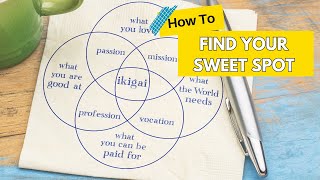
James Laughlin explains ikigai, a Japanese framework for finding purpose where four things overlap: what you're good at, what you love, what you can be paid for, and what the world needs. Centenarians in Ikaria and Okinawa lived longest because they had this sense of purpose.
Questions this video answers
NZ Mortgages (nzmortgages.co.nz)
Four
Via Caroline’s team website (carolinejlochlund.com) and via LinkedIn/Instagram; also show notes and in-video/text send functions.
Chapters
This episode of the Lead On Purpose podcast is proudly sponsored by NZ Mortgages. You can check them out at nzmortgages.co nz feeling lost, stuck or unfulfilled? Well, you're not alone. But there's a way out. Discover the ancient Japanese philosophy of ikigai, a powerful tool that can pull you out of the rut and give your life a profound new meaning. Look, I want you to watch this video to find out how ikigai can help you overcome negativity and, and unlock your true potential. For those that are listening to this on Spotify or Apple, you can check this out on YouTube, but there's no need. I'm going to take you through it step by step. You won't need to see anything. But for those that are here on YouTube, great to see you all. So I want to talk about ikigai. Sounds something quite interesting and peculiar to some of you. Others you might go, I know exactly what you're talking about. Look, I've geeked out on for many years. How do we find purpose? That's why I run the Lead on Purpose podcast. I want to find out what does a purposeful life look like, feel like, sound like, et cetera. So I've done this for many years, I've interviewed so many people, and at the end of every podcast, I always ask them, what would your advice be to lead a life on purpose. And it's just been fascinating, the responses I've got. Look, one of the greatest tools that I encourage my clients to use is ikigai. It's a real simple Japanese philosophy of finding a meaningful career, purposeful existence where you're industrious, something that you're doing to make a difference in the world. It's so simple, yet so powerful, and I want to share it with you. And you can do it right now. Super simple. So if you're ever thinking, you know, am I really happy with the work that I do do, I really love it. Oh, the grass is looking greener over there. I had a client recently who goes, I've been doing this for 15 years. I'm number one in the country at it, but I'm a little bored and I want to go and do something totally different. So I always say, look, stop, let's assess, let's slow down, you don't need to jump at anything. Let's just take stock. And one of the couple of different tools that I use, but one of the key tools is ikigai. And there's four questions, four components to ikigai. I want to share them with you. Look, I was actually speaking on stage, delivering a keynote for a corporate bank, and there were about 50 people in the room, just their executive leaders for their national team. And afterwards, a few of them came over individually, quite quietly to say, hey, how do I find more purpose in what I do? I'm not finding it. There's lack of meaning. So I literally wrote these four questions down. I said, look, answer those four questions, send me a message on LinkedIn, and happy to give you a little bit of a feedback and a little bit of coaching, just a little bit of soundboarding for you. And one of them reached out and said, here's the answers. And they actually realized that their job did have meaning and they stayed where they were. The same has happened where someone's reached out and it sent them in a total different direction because they realized there was misalignment. So I'm going to ask you four questions and I want you to think about what the answers are. Number one, what are you good at? Difficult question, right? Not at all. What are you good at? I'm not asking. World class, best in field at say, what are you good at? Is it communicating? Is it writing? Is it leading others? Is it coding? Is it time management? Is it project management? Is it.
Looking after others and their needs? What are you good at? Is it tiddlywinks? Is it golf? Is it tennis? Is it knitting? Is it speech writing? Look, write down four or five things that come to mind. What are you good at? As I say, not world's best at, but good at. And if you happen to be the world's best at something, put that down too, because you're damn good at it. Next question. What can you be paid for? Right. Sometimes we're good at things that say it's tiddlywinks. But the chance of you being paid to play tiddlywinks, pretty slim. What do you know the world will pay for? Right. So if you're an accountant, well, you know, bookkeeping is one of those things. Maybe it's teaching someone a new skill. Yeah, you can be paid for that. Maybe it's mentoring someone. Maybe it's leading a team, maybe it's writing a piece of software. What can you do that you know the world will pay for? You know, platforms like Upwork and Fiverr, where I've hired many contractors over the years, they have lots of ideas of what you can be paid for. You'd be surprised what people pay for. But I want you to think about specifically for you. What could you be paid for? There might be different things you've done in the past that you haven't done recently. There might be skills that are on the periphery that you thought, oh, I could charge for that. Maybe you make great cakes and you just do it for friends for their birthdays. Guess what? You could be paid for that. I'm trying to heighten your awareness here a little bit and just challenge you a little bit to go, hey, there are things I do that I could be paid for. Maybe you're a professional athlete, former professional athlete, and now you've got a family, you've got kids. Well, guess what? You've got so many skills from your previous years of being a professional athlete that you could be paid for those skills now. And they could be wide spanning. So I want you to think about that. Next question. Very important one. What do you love? What do you love? Not like, but love.
Is it fishing? Is it hunting? Is it growing vegetables? Is it being around animals? Is it dog walking? Is it doing art? Is it standing on stages talking to people? Is it making videos and sending them to people to brighten their day? Is it editing videos like everyone's different? Is it taking photos? Is it mountain biking? Is it long brunches? I don't know. What do you love? What is it that just brings joy to you? Write down three or four things, maybe more, if you can think of them. Maybe it's spending time with incredible people. What do you love now? Last but not least, what does the world need? Something that the world needs. I want you to think about that. Now that can be a more challenging question. What does the world need? Well, for me, I think about it. What does the world need? The world needs more love. The world needs more connectors. The world needs more humanity. The world needs more structure. The world needs more focus. All these things just come to mind randomly. For me. The world needs more community. So what do you think the world needs more of? Just a few things that come to mind. Is it a sense of vision? Is it a sense of compassion? What is this world need more of? Now those four questions, pretty simple. What are you good at? What could you be paid for? What do you love? And what does the world need more of? Those four questions are the components that make up ikigai. And I want you to think about how they overlap. If you were to draw four circles and they're overlapping each other, right in the middle will be the sweet spot. That will be something that you would do that would make a difference in the world. When we look at studies of centenarians, groups of people who are living over 100 years of age, there's certain parts of the world, icaria in Greece, Okinawa in Japan, there's a place in California, there's a number of places, a very small number, that have ridiculously large numbers of centenarians. When you go in and you study them and you look at their, the crux of what they do, one of the biggest things is that those people who are living happily and healthily and in a mobile way into their hundreds, they have a massive sense of purpose. It's a massive part of us living a good life. Maybe you don't want to live to 100, but do you want to live in a happy, content, fulfilled, purposeful way up until the day you die? I imagine yes. That's why you listen here. So I'm the same. That's why I chat to people and interview them because I want to make sure I can live a purpose filled life and help others do the same. So that process of ikigai, I want you to actually write it down. If you're driving, obviously you can't do it, but those four questions are super simple. My team will pop those four questions in the show notes so you can take a look at it and I'd love to know what comes of it for you. Please do not be a stranger. I love nothing more than hearing from you guys. So please drop me a line on Instagram LinkedIn. You can send my team a message which is carolinejlochlund.com or there's a little mail functionality. If you go down below you can see send me a text and I'll get that as well. So folks, I just want to say a huge thanks. Please if you've got a minute, hit the subscribe button if you're on YouTube, if you're here on Apple or Spotify again, follow me and leave a rating. If you're on Apple. It just, it's a huge help. We've been so fortunate to be charting in Spain, Germany, Ireland, New Zealand in the top 10, top 20 and even number one in a couple of those countries. So that's thanks to you. I really appreciate it a lot. And please join me on the next episode where we've got an amazing guest. So please for now get out there and lead your life on purpose. This episode of the Lead on Purpose podcast is proudly sponsored by NZ Mortgages. You can check them out at nzmortgages co NZ.