Life on purpose weekly - Full Interview with Pek Cowan
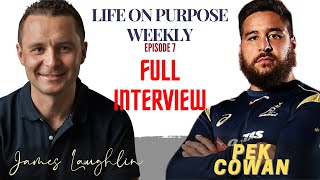
Rugby player Pek Cowan talks about growing up bilingual in Māori New Zealand, his parents' split, and moving to Australia at 13 to play rugby. He spent 12 years with the Western Force in Perth, then moved to Japan in 2018. Now he focuses on fatherhood with his three kids and modeling emotional safety, shaped by his father's death in 2010.
Questions this video answers
December 23, 2020
About 13 years old
Late 2004 (to join in 2005)
Since May 2018
Shimizu Blue Sharks, situated between Yokohama and Tokyo
Chapters
How's things going up there in Japan?
Yeah, not too bad, not too bad. I managed to get away for a little bit to obviously play a bit of super rugby with the force again this year. But, yeah, obviously back here now. Yeah, it's good to be back. Good.
And so whereabouts you based in Japan? Are you near Tokyo?
Yeah. So the Shimizu Blue Sharks are situated right between Yokohama and Tokyo. So I've kind of got the best of both worlds there, choice of both cities. So, yeah, it's a good spot.
Fantastic. Well, hey, I want to say a massive thank you before we get started. Thank you for taking the time. I know your time's precious. I know you're very busy and very focused on what you do there professionally. And it's thanks to Andrew Katoa that we're actually speaking. So Andrew, the owner of the Naked U brand, he. He got me connected with you. So I really appreciate that you're repping his brand right now. So he's going to be very happy.
Yeah, I thought I'd chuck the shirt on just in case. Just in case he was watching. I have no doubt he'll be watching with great, great interest. So, yeah, should be good.
Well, I just wanted to ask you to get started. What's your story, you know, what led you to this point with your rugby career?
Yeah, so, like, I was born and bred in New Zealand. I grew up going to a bilingual Mori school. So English was kind of like my second language. I grew up there until I was about 13 years old. And from the age of 13, my parents had split up. I was living with my dad at the time and my brother was living with my mum. So my dad had met a new partner and he decided to move to Australia. So naturally I thought, okay, I'm going with you. I moved to Australia with my dad and essentially it was during the school holidays. So it was great. You know, I thought, fantastic. Like, I get to go there for about six weeks and then from there it's likely I'll just come back home to New Zealand. And I guess, long story short, I never. I never left Australia until three years ago. So I did all my schooling in Sydney at an Arabian sports high school, finished off year 12, and then from there things happened really, really quickly. Kind of through year 11 and year 12, I obviously took up playing rugby. I played a lot of rugby league in New Zealand as a kid, but I was. I was actually playing a lot of golf, actually. So I went to Narrabeen Sports High School and I had a Golfing scholarship there. But then one of my friends asked me, you know, you're from New Zealand. Like, surely you know how to play rugby? I was like, yeah, of course. You know, that's what we do. And I went down to the local club, played with my local club team, the Newport breakers. And, yeah, from there it happened really, really quickly to year 11 and year 12. I kind of made Australian schoolboys. And then 2004, the end. Halfway through, towards the end of 2004, I signed a contract to join the Western Force in 2005. So pretty much straight out of school, you know, I was there for. For a very long time, about 12 or so years, and it's gone in a flash, to be honest. And a lot of great people. The axing, I guess, of the Western Force, and. And that was pretty massive because essentially what it. What it meant to me was, you know, like, that was kind of like my family away from home. That was my home away from home, Perth. And, you know, I knew a lot of people there and it felt like, you know, a part of me was being told, you know, you can't do what you love to do anymore. And that was pretty sad. You know, I kind of struggled with that a little bit and, and that. That kind of is how I ended up in Japan. You know, I kind of refused other options to kind of plan in Australia. And I just thought, well, why not actually play this game for the. For the reason why I started? And that's just for pure enjoyment and. And new challenges, you know, you kind of. I was very comfortable where I was in Perth, and maybe that could have been the reason why it hurt even more, you know, how I had to kind of step out of my comfort zone. As much as it kind of sounds a bit of a cliche, I had to step out of it in order to continue doing what I love to do. Otherwise I think it would have just got stale. And that's kind of why I'm here in Japan. I've been here since 2018 or the end of 2017. Sorry, May. May 2018. I was. I was here. Yeah, been here kind of since.
Well, Pekahu, thank you so much for actually sharing that. And what's taking you to get to this point in your rugby career? And it sounds like there's been hurdles, adversity, sacrifices along the way that you've had to make. So for other people who are out there and watching this live or on replay, if they're facing hurdles in their lives and, you know, their lives get upended whether it's through, if it's young kids watching this, like, if their mom and dad have parted ways, or if it's people that are trying to establish a career and all of a sudden the rug gets pulled from beneath their feet. What would you say is a great way to respond to obstacles or respond to adversity?
Yeah, I think. I think for me, like, it was always whenever something bad happens. So, for example, when my parents split up, like, I was only really young, but I still remember quite vividly. So I've. For myself personally, I felt that pain, and I was only, like. I would have only been like seven, eight years old.
So, you know, that type of thing with my parents splitting up, you know, I kind of use that as my motivation to make sure that if I ever got married, if I ever had kids, that I would do everything in my power not to have my kids have that feeling of, who do I pick? Why did this happen? You know, that you're out of control. You're out. Sorry, you're not in control of that. As a kid, it can be quite hard. Like, you know, I used to sit there and wonder, you know, was it me or could I have done something different? Could I had been a bit of kid, you know, like, I was a bit of a handful as a child, you know, so for me personally, I try and learn from whatever happens. So if something bad does happen, I really make sure I understand, or eventually I understand how it happened. And I try and make sure that I put things in place to make sure that I can avoid them, you know, in terms of, I guess, sport and myself, professionally, irrespective of what's going on around me, I can control what I can do, and I'm in control of the choices that I make. And, you know, and saying that you don't necessarily always make the right choices in life, and sometimes your timing is horrible, and sometimes you sit there scratching your head as to, you know, why did I choose to do that at that point in time. But I think. I don't know. I continue to learn, and it's probably something that I've probably been good at is learning from either my mistakes or mistakes that have been made before me. Adversity is inevitable. At some point, whether your life is perfect or not. You know, people could potentially look in from outside of a professional sportsman's life and think, you know, how good is that? You know, you get to do what you love and. And you do, you know, you really, really do. But, you know, obviously there's Pressures that come with that. Like. Like I said, I am married and I have three beautiful children. And, you know, just living apart from them, you know, it's kind of. By the time my season finishes.
It would have been 12 months since I've seen my family. And it's.
Yeah, it can be tough, very tough.
But like I said, if. If you're not winning, you're learning. And I'm learning how to deal with, you know, just time away from my family, friends. And.
Yeah, I think irrespective of what goes on in your life, whether it's, you know, things get flipped upside down, I think it's important that you almost step back and reflect before you react. I've always been a guy that in the past, like, I've always been reactive to what happens. Like, instinctively I react straight away. And, you know, on a football field, that's fine. You know, it's. It's what you need to do to. To be successful.
You.
You can't sit there and dwell. But.
You know, in life and, you know, I've had a few hurdles myself. Like, nothing's ever. No good decisions ever made. I guess when something really bad's happened and, you know, you feel pressured and you're upset, no one's ever made a very clear and decisive decision based on anger, frustration, disappointment, whatever it might be, sadness, you know, you never necessarily make that the right choices in the moment. And if you can, you know, that's fantastic. And you've obviously learned a lot along the way before you've been able to get to that point, I think. And I like to think that I'm still learning as well. Kind of didn't give set points, but, yeah, it's kind of.
That was amazing. What you just shared was amazing. And what I want to just take a moment to honor you for is when you're talking about your family, I can see the emotions that come up, and that's amazing that you can show that vulnerability. And I think that anybody who's watching this live or on replay, you know, for someone in your position who's a high performer, who's in the public eye, who plays rugby, it's a man's sport, it's very physical. It's beautiful to see you go, hey, life is tough. And that can affect us. Being removed from the people we love, that. That's not easy. And one thing that really stood out, I remember you posted a wee while ago, not too long ago, it was your wee boy's birthday and you put a post on your instagram and it brought a tear to my eye and I feel emotional just talking about it. You missed his birthday and you're in Japan. But what was beautiful is that you didn't forget and you acknowledged it. And of course you'll make up for that. You'll be back there, you'll be connecting with him. So what is the legacy that you're leaving? You know, because obviously family fanow is a big part of who you are. So what's the legacy that you're writing for your kids?
Yeah, I don't know. Like, I guess I've never really thought of, you know, what kind of legacy am I going to leave? But I guess that's a good question.
I just guess I don't know that, that their dad was.
Well, firstly loved them very much.
And I guess like, it's hard to say you sacrifice time or you sacrifice being with them because at the end of the day I also make the choice as well. So although I do, I do choose to be here, I guess, hopefully, you know, when they look back they'll, they'll realize that.
My achievements weren't just for myself personally. They were eventually my values changed and it actually is the reason why I continue doing what I do because I hope someday they'll understand that it wasn't just because I love doing what I do now. It's because I love them so much and my family and my extended family as well. Like people live through.
Success, but they live through your ability.
To.
To be you for one and to do what you love and it be something that people value, I guess, especially in New Zealand. You know, like people love rugby and although they don't understand the full ins and out of it all, I think, you know, I'd like to think that just through what I'm doing is enough for them to see that I love what I do, but I do it because I love them almost more. So I'm prepared to sacrifice or make the choice to sacrifice the time with them now in the hope that they will just know that, you know, I did everything for them. I guess the legacy put down simply is that, you know, hard, hard work can get you any, anywhere and get you anything that, that you want, providing you're prepared to at times you have to make sacrifices, you learn from your mistakes.
You do miss the things that you love, but you have that goal and you're prepared to do what it takes to get to that goal.
You know, there's no blueprint to any form of success. You know, anyone who's Ever succeeded, never got given that blueprint. And you know, I think many guys in my situation, especially professional sportsmen, they first did it because they loved it. And that's probably one thing I'd love for my kids to, as part of that legacy, just do what you love to do. You know, I love socialising with my friends. It just so happened that my friends played rugby, so that's what I did, you know, so good. And yeah, that's beautiful.
Absolutely beautiful. And I think, you know, we should do a bit of a shout out to your kids. What are your kids names?
So Jackson, Harper, my two, my two boys. So Jackson's my oldest, Harper's my, my next son. And Georgia, she is my youngest daughter and she's three. So they're 12, 11 and three. And it's funny you mentioned their birthdays because Christmas is always like the best time of the year but obviously being away, it's the hardest time because my kids are kind of born towards the back end of the year. So September and December, September and November. So they're kind of like right towards the back end of the end and there's Christmas. So normally, you know, the last three months of the year are kind of the most exciting.
Because we have all their birthdays aligned and then we move into Christmas and obviously move into the new year. So, you know, being away this year just, it makes, it kind of highlights how important they are to me even more and if anything it just kind of reminds me that I need to cherish those moments when I get to be back with them as well. So Harper, Jackson, Georgia.
That's beautiful. Three little legends. I can't wait to meet them one day.
Yeah, definitely.
And if you think about fatherhood, because I'm on a mission here in New Zealand, I've been living here 15 years now and I worked at a school in Christchurch, I'm still in Christchurch. And you know, during my time there I witnessed several kids that, you know, took their own lives and you know, that's incredibly tough on their families, on the community. But it's not an unusual thing to happen in New Zealand. And you know, we have massive statistics. High teen suicide, we have high domestic violence, one of the highest in the world, and high child mortality rates. And I firmly believe that fatherhood is one of the key ingredients to creating a different future. And I think as a dad, as a young dad, I'm new, I've got a four year old boy, I'm still learning every day. But I think it's important for us to like, think, okay, how are we shaping these little minds? And monkey see, monkey do. Like, these kids are modeling what we do, not what we tell them to do. Yeah, they like, hey, what's the words that are being used? What are the actions? So for you, when you think about it, you know, what does it mean to be a good dad?
Oh, man. I think, I think firstly, like.
For.
Me, as someone who not only is loved by his immediate family, so his wife and his children, but his entire family and, you know, the first person that comes to mind there is obviously like my own father.
I lost him 2010. And that was pretty tough. That was really, really tough. It was right at the peak of, like, my, my rugby career. Just kind of started playing a lot of super rugby. And.
I think I debuted that year as well, which he was there for, which was great. But I think about it and.
You know.
He wasn't just like an amazing dad. Like, he was a really good friend. You know, he had.
So many friends as he. He had a. We had a big family, so he had 12 siblings. And as. Even as one of the youngest, I think it was for second, maybe third youngest, he was still the person that everyone wanted to see, everyone wanted to get advice from. He was almost in a way, like a leader, but not necessarily as you may think a leader might lead. He led more by example and not necessarily by words. And I think for me, like, trying to replicate that, I guess there's always things that you think I wish my dad was better at talking. For example. Like I said, he led by example, but he didn't necessarily say, peck, I love you. I love you so much, and I love to be with you and be super affectionate that way as we're. His actions would almost be his words. And I think, you know, now that I actually think about it, it's like I'm kind of replicating that in a way anyways. But, you know, I think good fathers are obviously someone who your children, your family need to feel safe around. They need to feel like they can speak to you. They need to feel like you're not going to judge. You know, they need to feel like they can be who they need to be, not who they, who you want them to be. I think, you know, you need to be here. You're. You're a partner, you know, you're not necessarily the leader. You're not necessarily the follower. You're a partner in life with, obviously your wife or your partner, you know, however that may be, however that looks and your children and however that may look, whether they, your biological children or, you know, we at times we would find AI and bring kids in, cousins and they would live with us for, you know, five, six years at a time. And irrespective of who's in that circle, I think it's important that they feel like they belong. And you know, for me, I think, I think that's probably the biggest thing is feeling like, you know, as a parent, you have the ability to make your, your children and you know how, you know, their friends feel like they belong, feel like they're valued, feel like they're important and you know, it's a juggling act with trying to do all those things and not spoil your children at the same time. But I think, you know, I take a really big lead off my wife like Meg, she's, you know, she's a, she's a pretty, pretty good woman. You know, she's, she's, she's amazing and.
She'S probably half of the real, most of the reason why. I guess I've been able to.
Show a more emotional side because my wife's a lot more emotional obviously than I am. You know, at the, when I was younger I really struggled with that because I didn't really know how to deal with that because I like words. Wasn't something that I was great at and speaking to, speaking out about my feelings and how things make me feel and you know, frustrations that I might have because I didn't necessarily have the words at the time to say it in a way that might be constructive most of the time would just be, I feel it and I just say it. And most of the time it wouldn't be all that constructive at all. So I found it was easier for me to be silent sometimes and then wait a bit, think about it and then deliver. But my wife's amazing at that and takes the lead there. So softened me up to a point that I'm able to at least connect that way with my children better than I feel like, you know, my dad and, and, and his family were able to do. Maybe they were a little bit more old school in that, in that sense. But like you've said, you know, New Zealand has a horrific rate, suicide and self harming and domestic violence. And it's definitely something that, you know, I wasn't witness to as a kid, thankfully. But it's definitely something that needs to be addressed. And like you've said, like fatherhood is definitely something that I think can help change that trend. You know, you, you have the power to mold this child or these children or siblings or, you know, their friends, for example, like, give them somewhere where they feel like they're safe. Give them somewhere where they feel like their voices are heard. Give them something that.
Just makes them feel like they belong. And you know, as a dad, like I always felt that as a kid, as a child with my father, but there were still things that I, I definitely know that I lacked and those are the things that I try and fill the gaps with with myself personally.
I love that. I really love that. Thank you for going deep and sharing that. That was amazing. And the one thing I love about what you do and the level that you do it from a professional standpoint is your ability to manage your mind. And of course, we're human and we have, you know, we have good days, we have bad days, we have stressful days, we have overwhelming days, we have emotional days. What do you do to manage your mindset? Obviously there's a physical health set that you work out and you train and you eat well. What do you do to manage your mindset?
I think I just have clear goals. Like I make sure that I just know where I'm going. So irrespective of whether I'm bouncing left, right.
Things aren't going well, I'm injured or, you know, for whatever reason, you know, you have an argument on the phone with your wife or you know, your child doesn't come home from school and you're stressed out. I think for me, I need to be just very clear on what my goal is and what I want to do. There's all sorts of things. Like obviously there's the physical stuff that I do and that helps, you know, physically, but mentally and emotionally, well, obviously I speak now, I speak a lot more to my wife and I can express any frustration that I have because she's obviously the one who's a lot more level headed and.
Gives pretty good advice really. And she's quite a, quite a mindful person. Like she's can really read up on, on just the way that I'm speaking, that I might be a little bit uptight, I might be a little bit frustrated. You know, what is it that's wrong?
And I've actually found that being able to speak openly and honestly more often actually has the same, if not a better effect for me physically. Like I sleep better, you know, I, I'm more energized. I feel like I want to be at training, I feel like I want to play, I feel like I want to see People and socialize like there's a lot to be said about, about a lot of things. And yeah, just being clear with what you want and what you value, I think is a big one too. Like sometimes things aren't necessarily perfect and you just want reassurance and then sometimes, you know, people's values don't align so you don't get that reassurance. But understanding your own values and sticking to those always set you in, in far better stead than trying to follow what.
Has been said or you know, necessarily what's been. What's the status quo? You know, it's. Sometimes it's just doing you that's, that's able to kind of keep you going and keeping, keeping you, your mind and your kind of your soul happy at the same time.
I love that. That's amazing. It's really amazing to hear a high performing rugby player talk about that stuff and the importance of that and also the importance of partnership. And when we look at anybody in life, nobody in life has any degree of success, fulfillment or joy if they do it alone. When you do life with other people, that's when you get true success and fulfillment. So I want a big shout out to your wife as well. She sounds like the most amazing person.
Yeah, she's amazing. She runs a family daycare from home. She's obviously got three kids of her own.
You know, sports, school, you know, training, you know, all this kind of stuff. She's juggling it all. So, you know, I sit here sometimes feeling sorry for myself. And then you actually put things in perspective and you're like me, you know, I've actually got it pretty good at the moment. Like I only have to worry about myself, you know, I only have to get up when I need to get up, do my training and stuff. So yeah, she's, she's doing it tough some days, of course, like some days are great, you know, some days, you know, the kids just, you know, can't find this, can't find that. You know, obviously running a family daycare from home, she takes on three other kids. So she's constantly got children at home and very, very little time for herself, you know, and she's, she's actually a person who loves to have her quiet time for herself.
And just gather her thoughts and just chill, you know, she likes to be within her moment and quite enjoys being away and almost being by herself just to just take time for herself and she's not able to do that at the moment and she can still function, you know, I Don't even know how she functions sometimes with the amount of.
I guess, responsibility. And she essentially is a single mother at the moment, because I'm not there physically, I'm there for them, you know, emotionally and things like that. But, yeah, it's tough for her. So she's doing incredibly well and, you know, I just can't wait to get back there with her and with them, just so I can kind of just help ease her load a bit and allow her that time for herself, which I think is really important.
That's beautiful. And it's an amazing that you took the time and the space to acknowledge her for the amazing woman that she is. And, you know, I think your family, your friends, your fans, they all look to you for inspiration. And the fact that you're living your dream, that's the most amazing inspiration for your kids, for them to go, oh, dad did that. Whoa. He went and did this and did that. And during the toughest year on human history, 2020, you know, don't underestimate what you're doing and how much it inspires me, how much it inspires your family, how much it inspires the next fan that comes along. I think it's. It's pretty amazing what you do. Pack.
Yeah, thanks, mate. I. Yeah, I do love doing what I do, and I think I'm happy to keep doing it, providing that, obviously, I'm happy holistically, so I'm happy emotionally as well as physically and mentally and things like that. So for now, it's fine. I think once I get home and reset next year, you know, obviously you make that decision. What do you do from that point.
But, yeah, and one thing just to wrap up, because I know your time is precious, I know you've got lots on the go all the time there in Japan. But one thing I wanted to ask, you know, in a rugby scenario, you've got coaches, you've got mentors, you know, you've got therapists, martial therapists, you've got everything that's going on there in life. Is it important for people to have a sounding board? Is it important for people to have mentors and coaches?
Yeah, definitely. I think so. I definitely think so. I think not one person has all the answers. That's one thing I definitely learned. In sport especially, you have people that are specialized in certain areas. For example, you have a defensive coach, you have a skills coach, you have a forwards coach, you have a scrums coach, you have a, you know, attacking coach, your head coach, you have all these, you know, different areas of just sport, just the game, you know, then you have like, guys like, you're leading teams that are all about, okay, how do we, how do we, how do we convince ourselves before we even done it? You know, we haven't had much success, so how do we know that what we're doing is. What we're doing is the catalyst to something better? And, you know, in life, I think it's the same, like, you need to have people that obviously you can speak to, but they hopefully, depending on what it is that you want in life and what you want out of life, you know, you need to be able to reach out to people who are actually, I guess, masters in that area or, you know, that's what they do. Like, you wouldn't put a full, a full back in the front row and vice versa. You wouldn't just chuck a front row and chuck them and fall back and be like, you know, you know what to do back. There's like, I can give advice, but I have no idea what I'm doing. Do you know what I mean? So.
I definitely feel that, yeah, having mentors is definitely of high value. Obviously, people that you just need to respect them and love them for what they do. I think that's first and foremost the important thing, because then naturally you're going to speak to them more openly and honestly, and whether they can offer the best advice or something that can be of value to you, I think can only be a positive for you. It can only make you a better person. That can only put you and steer you in the direction that, you know, you need to be going in order to be, I guess, happy with. With what it is that you want out of life and what it is that you want to be doing at that time or whatever your goal is.
Yeah, because just relying on one person or relying on yourself is, Is hard. And if you can make it easier, because as we all know, life's hard enough as it is, irrespective of what you do. I think if you have people that you can call on and ask for advice or, you know, ask for ideas or ask for, you know, their thoughts or anything, I think can only benefit you. And, and at the same time, you know, you're drawing from their experience as well. So it's most likely that the person that you're asking is, is probably a little bit older than you or probably a little bit more experience in the area that you're in. But you, you need to understand that you definitely don't have all the answers and different perspective isn't necessarily a bad thing. You know, it's a, it's a good thing just to see it from someone else's eyes and understand it how someone else understands it could just help trigger, you know, the thing that you're missing. So, yeah, definitely, that's amazing.
Like, for those who are listening, please think about that. Pack's a high performing athlete and plays at the very top level and has played for many years. And the one thing he said is like, hey, you, you don't need to have all the answers. You don't have all the answers. But it's important to be able to reach out. So if there's any dads or moms there who feel like the weight of the world is on their shoulders, they have to know everything and do everything and be the perfect parent. You don't. And it's okay to reach out to someone like your own mom or dad or an auntie or an uncle or someone who's a bit further down the road a couple steps ahead, say, hey, what do I do here? Like, I'm not sure what to do. I'm not sure how to handle this situation. So, Peg, that was golden for me as well, to take that away. I've been taking mental notes and I'm going to go back and watch it and take lots of physical notes. What you shared was just amazing. So thank you very, very much.
No, no worries. Thanks. Thanks very much for having me, like, and reaching out. You know, you kind of reach out at a time that was perfect. Really. When I was. I think I was in. Might have been in lockdown or. I might have been.
Yeah. Lockdown or.
Quarantine? I think at the time, potentially, yeah.
I think it was quarantine. You were quarantined in Aussie. You just. I think you were an extra five weeks.
Yeah, yeah, yeah. I just landed and yeah, thanks so much for reaching out again. I was like, you know, if there's anyone I need to be speaking to while I'm stuck in a room that's like 3 meters by 3 meters probably, it's probably you, like, just give me.
Thanks, man.
I need to feed off something I needed. You know, I was doing some training and stuff in there, but, you know, your brain just goes numb otherwise. So, like, yeah, thanks very much for reaching out at that point as well.
Really much.
And yeah, it got me through, it helped get me through and. And here we are today. So.
Well, thank you. I look forward to meeting you in person once. All this Covid craziness goes down. I want to come watch you play and meet the family and I want to wish you all the best for an amazing 2021, a beautiful Christmas. And I'm excited to see that reunion for you and your family next year.
Yeah, I can't wait as well. It's either January, February, it's either March or May. So May would be 12 months. March would obviously be 10. So, yeah, I'm really looking forward to that and getting home. So, you know, I've got a job to do here and I, you know, I do that as well as I can, as always, and then I'll try and get home. So, yeah, cheers.
Now we'll have an amazing Christmas and I look forward to connecting with you next year.
Yeah, I can't wait.
Thanks a million, buddy. You take good care.
Take it easy. We'll speak again soon.
Cheers, Peck.
Cheers, mate. See you later.
Hey, guys, if you enjoyed the content today, please smash that subscribe button below. And if you want to become part of my community, I've got an amazing free Facebook group. Please come and join us. The link is in the description below. And also if you've got any questions about today's session, I'd love to know. Just comment below and I'll be sure.
To get back to you guys.
Have the most amazing day.









