Life on purpose weekly - Full Interview with Jeff Lopes
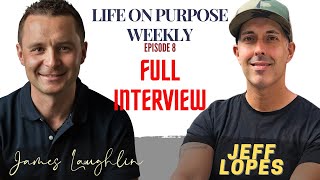
Jeff Lopes, CEO of Kimura Ware and True Blue Homes, talks about balancing business and fatherhood. He wakes at 4:30am to protect family time, and shares how his son's four-month stay at Sick Kids Hospital and cerebral palsy diagnosis shaped his approach to fear and parenting while building companies.
Questions this video answers
Kimura Ware and True Blue Homes.
December 30, 2020.
He wakes at 4:30 a.m. and follows a set morning routine (breathing, brief workout, morning to-do list).
Spent the first four months at Sick Kids Hospital and was later diagnosed with cerebral palsy.
Entrepreneurial Dads.
Chapters
Jeff Lopez coming in from Toronto, Canada. Jeff is an amazing individual. He is the CEO and the founder of Kimura Ware and True Blue Homes. And he's also very uniquely a dad Entrepreneur coach. Hey, Jeff. How are you, brother?
How are you, brother? Do you hear me?
Well? Absolutely great, buddy. Awesome to see ya.
Thank you for having me, brother.
How's things going? You're in Toronto, right?
Yeah, yeah, yeah, yeah. The weather's getting a little chilly here, I bet.
I love it. Well, thanks for making the time, man. What you do is simply amazing. I'm excited for people who are watching this live and for people watching this on replay or wherever on Instagram, Facebook, or on the podcast. I'm excited for them to connect with you. And I just introduced you as the CEO and founder of two amazing companies, Kimura Ware and True Blue Homes. But also, one thing I love is that you're a dad Entrepreneur coach. That's badass, man.
It's something I found that there was a slight need and a slight separation there. And over the last 12 years, I've really worked hard to master it. So now I'm trying to give back as much as I possibly can. For the last three years or so, I've been coaching young entrepreneurs. Giving back. I never charge anything. It's more just giving back my time. And over the last seven or eight months, I've really focused an area down to fathers that are entrepreneurs, and really. And I'm coming up with a coaching platform as well for that. So just really trying to focus on that. Helping fathers and entrepreneurs that are dads to find that balance, find that time that they succeed on both sides, that's epic.
I seriously love that. I think there's a big need for that. As a young dad who's. I'm still a rookie as a dad, you know, I'm 44 and a half years in. I'm still learning every day. So when you've been working with dads, what you find have been some of the common challenges that they've had to kind of come across.
It's that separation from when you do start a business, especially when you first started business for the first time as a young entrepreneur or a young parent. It's. It's that finding that balance and balance in time. And I think a lot of them don't understand how important schedule is. Scheduling is probably my most important aspect when it comes to creating that balance. So I use my schedule every month. I focus my schedule around my family time. So what I do is I get my schedule I create my family time and I'll give you a little thing what I do after but I create my family time scheduled and then I create my work balance around it and what I've mastered and what I've done over the last, I would say 12 years is. And the our time doesn't fall perfectly aligned but I coupled to three to seven. So I try to be home every single day for three to seven. And for the last 12 years I've had dinner with my family every night and I focus on that and dinner is a very important part of our family, being able to talk with our kids. My daughter's 14 now, my son's 12. They're starting to become teenagers. Being able to talk to them, communicate them and I find sitting down with the meal is probably the easiest, best time to communicate with your family. Right. So but to sacrifice that. I've learned how to manage my time and what I do is to give myself the pleasure to be with my family. I'm up at 4:30 every morning. So I get up at 4:30. I got a very set routine every single morning from my breathing to a little workout to taking care of everything, doing my morning do list. So my morning routine is so important. It sets, it's like the morning and the night. I call it the bookshelf of the day. It sets me throughout the rest of the day and it allows me by nine in the morning I got a big chunk of my day already completed. So it allows me to then just focus and finish my day. And by 2:30, 2:45 on a perfect day, I'm out of the office, I'm on my way back home to my family. And then around 7 o' clock I finish off with about an hour, two hours, my home, office, emails, whatever I have to do business wise. Then I'm in bed early, then I start the day again fresh next day. So that scheduling is very important for me. Right.
That's amazing. I think for everybody that's watching, please take note of that. The scheduling and the importance of the morning routine and the one thing that you just said, Jeff, reminds me of one of your fellow Canadians and I think that you do follow and interact with him. It's Robin Sharma and he wrote that great book was the 5am Club and I learned a lot from that a few years back around the importance of those morning routines. A lot of people think I'm crazy and possibly some people around you maybe think good. Getting up at 4:30 and 5am Right?
Yeah, it's a habit Right. It's anything. If you do something for a long enough period of time, it becomes part of your routine, becomes part of your fabric. Right. So to me, it's nothing at this point. It's something I just usually do. And you get up, and if I don't do it, I feel incomplete. So I need to be able to follow this tight schedule. And like I said, the tight schedule is so important to me. And there's other parts of the schedule, too. So I purposely create blank spots on my schedule, what I call them white spots. And those white spots are just. Just as important as the filled spots, because those white spots are the times I'll call loved ones. I'll take time to call friends I haven't talked to, or if I know I'm gonna have a busier night with kids event or something at school or a sporting event, I'll use those white spots to bump up certain appointments, and I'll use those as my appointment time or phone call time. So the schedule, like I said, everything keeps falling back to the schedule. The schedule is so important to keep everything balanced. Right.
What it sounds like, what I'm hearing from you, is that when you're coaching these dad entrepreneurs, you're actually coaching it from a place of knowing, a place of doing. You're actually walking the walk like you're scheduling. You're thinking about your family. So when you're working with these dad entrepreneurs, it's not like you learned it in a book or at a course.
Or in the school. No.
It'S been, James, honestly, the last 12 years. And I'll give you a little quick story that I think I ran through it with you a bit for the audience. Twelve years ago, my son was born, and he spent the first four months of his life at Sick Kids Hospital. And. And that turned our family upside down. For four months of our lives, we were in a hospital almost 24 hours a day, just focused on getting him. That was our purpose, to get him home. And when we finally got him home, he was diagnosed with cp, cerebral palsy. And we're told he wasn't going to walk. He wasn't. He was going to be wheelchaired. And that became my purpose, and that became my purpose to get him from wheelchair to braces. Pay off from braces. Now at 12 years old, he's running 45, 50 minutes, getting ready to run his first little marathon. And that purpose allowed me to understand a whack of different things. So one of them is how important passive income is. And that's where my other company, True Blue Homes Comes, which is a vacation rental business, where I built a portfolio of vacation rent rentals. And that passive income has allowed me to sit back and focus a lot more on my family. But at the same time too, I've learned so many factors as a parent being so hands on, where for example, fear, fear is something that a lot of people talk about and a lot of people talk about fear of not taking that challenge or fear not taking that job, or fear of not starting a company or social media platform. People live in this constant fear of what their surroundings are going to say, what social media will say, what their family is going to say, and it stops them from conquering a lot of things they're able to conquer. So I think fear is not something we're born with. I think fear is something we're taught. And as a parent, I think a lot of times when you hear, you sit back and think of yourself as a child and you can hear your parents ringing like, Jeff, don't touch the oven, you're going to burn your hand or don't run down the stairs, you're going to fall, these constant things are saying to your children, you're building this fear factor in them. And then as they get older, it just accumulates and accumulates and accumulates. So it's one thing as a parent, another lesson I always do is, is as a family, we try to do once a month something that our children have they might have a fear on and actually challenge them. We do as a family challenge, whether it's public speaking or jumping off something, whatever it is, and we try to do it as a family to conquer it. And that starts making them feel that if they could accomplish something and conquer it and that award and that feeling of oh my God, I did it, that's just building that self esteem and building that, building that, that fear is something that can be broken once you accomplish it. So it's just teaching these lessons when they're young and building this framework. And I think those, that's another important thing is eliminating fear from your children.
Showing them, I know this is from entrepreneurs, it's becoming a parent talk here. But another thing is children. A lot of people reward their children with presents. So if they are children, their child does something well, they get an A at school, they do well at a sporting event or a dance recital, they're rewarded with a present. And I found very quickly that when you do give a present, the kids are, of course they're happy, but are they happy for the present or are they happy because their parents are realizing their accomplishments and rewarding them? So at that point I realized, let me try something different from a young age. And what I do is, is if my child accomplishes something, I'll take them instead of giving them a present, I'll spend the day with them, I'll pull them out of school for the day and we'll just go, my daughter, well, let's go do, go do her nails, let's go have lunch together. And you reward them with your time. Because the end of the day, children want love, they don't want presence. And I think that's the biggest misconception is rewarding them with something because you're making them feel and grow up with that mindset. If they do not get a present or get rewarded with something, they haven't accomplished something. And I think that goes on as they get older as well. Right.
100%. That is truly amazing what you've just said. And as we're coming up to Christmas right now, as we're chatting, that's a great thing for some parents to really embrace because not all parents can afford to get the thousand dollar present and the new laptop or the new iPhone. But to realize, actually you could just say, hey, here's a couple of small gifts and in the new year I want to take you out for the day and we're going to go do this in the city or we're going to go. That's amazing, Jeff. Thank you for sharing that.
Yeah, 100%. Like I said, it's rewarding them with your time. And I think that is you're also building memories. And this is something like I learned from my dad. Like my dad was a blue collar factory worker and we didn't have a lot and as kids we had very little presents and we would get presents twice a year. One small present for Christmas, one for her birthday. But it wasn't that my father had the opportunity to work every weekend. He worked for Ford Motors, which is a car company. And on the weekends you were paid time and a half and he had the opportunity to make a lot more money. And it took me, you, years and years as an adult that I can sit back now and look at my dad and realize even though he was an entrepreneur, wasn't an entrepreneur. He realized that wealth was measured by freedom, by time. It wasn't. Success was measured by being able to spend time with your family. He was doing this years ago and I didn't realize until I became an adult, though I saw it, like every weekend. He was always home, every opportunity. He never missed a sporting event.
He.
He was there, he was sacrificed, whatever he had to do to be with us always. And now seeing that as an adult, I realized he built these building blocks that actually taught me a lot of things that I'm actually trying to pass down to my family now, which was so important to us. Right.
Sounds like an amazing, amazing man. And I think you're very intentional. Just by chatting to you, it sounds like you're really intentional around the dad that you are and who you want to be. So if you were to fast forward, let's say 50, 60 years, and your kids were talking about you, how do you want to be remembered as a dad?
Present, always present, always there. And just this filled him with love. A dad that filled him with love, and it was always present. I mean, even. It's funny because I actually, I have, during my podcast, I actually, at the end of my podcast, I asked all our guests a question. I always say, if you were to be. If you were to pass today, how would you want to remember it? And the guests threw that back at me there, Dan, like, how would you run? You know, when you ask these questions, you never. And I said, for my friends and family, they're close to me. You want to be that person that they remember that it was always there for them when they needed them. When you needed you, you were always there for them. So it's that mindset of just being there and being that kind of the caregiver kind of way. Right.
I love that. That's so beautiful. I think, you know, as you say as a podcast host and you're asking these questions, often when it gets thrown back at, you're not expecting it. That's beautiful that someone did that.
What would you say defines you? Like, what defines Jeff Lopez?
There's so many layers of me, right? I mean, I mean, work ethic is one thing that I'm, I'm very proud of. And it's something, I don't think, I think that separates the top tier entrepreneurs that are starting off or trying to succeed is you never want to be the smartest person in the room. You never want to be the most successful person in the room, but I'm sure going to be the hardest working one in the room. And I always had that mindset where I want to be the one working when everybody else is relaxing, I want to be the one that's always ahead of everything. And I had that from a young age. I was Always hustling, always trying to find a way to get ahead. I wanted to be the first to doing everything. It's almost that winning mentality. And I think that's when you even look at the top athletes in the world. I just talked about this the other day. You align 20 or 30 of college football players, for example, in the U.S. and if you go through them genetically, most of them have the same genetics. When I'm talking about it, they're all aligned very equally. But what's going to stop that? One of those from turning prone, becoming a star? It's a work ethic. The mindset is being able to push themselves harder than anybody else. And I think that's something that is part of my fabric. I want to be the leader. I want to be the top, but I'm also. I want to be the one leading by my work ethic. Right.
I love that. I love that. And you wanted to lead from the front. I've been reading a lot on Nelson Mandela this year, and just he was my, like, leader of choice. And a lot of what he said just resonates with what you said about leading from the front, walking the walk. And the more I chat to you, the more I realize that this is not theory. This is like practice.
It's amazing. I love that. And I think it's so important for people to see that and know that. And that's why I would say you have such a great following. That's why you've had such great success at what you do and in terms of what you've done professionally and to become more financially independent and free? What advice would you give to a mom or a dad or anybody out there that wants to either start their own business or wants to take their business and get it to six and seven figures? What advice do you wish you had of got at the start?
I mean, you. The first is very basic, is you have to be passionate about it. If you're not truly passionate about what you're doing every single day, every single day is a moment where you're looking forward to the weekend, and you have that mindset where you're looking forward to the weekend. You're not truly living your passion. So first is find something that you're truly passionate about. So you wake up every single day and you have that energy and that drive that you want to be there, you want to see it grow. That's the first. The second is.
Always look at, if you're in a market, find a market that no matter what happens, pandemics things, they're still viable.
If you working on a very niche market, there's things that happen. Competitors, big boxes, they don't crush you. So you want to be able to figure out a competitive market that no matter what happens in this world, there's still going to be a need for your product. And then once you find that product, you have the passion about it or that industry that you have a passion about that, that there's a want and a need for hustle. Work harder than everybody else. And I always say too is you're gonna fail. This is common sense. We all fail in business. There's gonna be moments, you finish second, finish third. What I always say, and I always tell my kids, if you enter a competition, you finish third. I'm okay with that. But I want you now to sit back and look at the second place and study everything they did. Now look at the first place, study everything they did, learn everything they did, and then reflect on yourself and figure out what you did wrong. So when you get in that opportunity again, which you don't get many opportunities, you're ready and prepared for it, right? So as long as you're prepared to fail, but prepared to learn from your failures and continue growing and you're passionate about what you do, you're going to succeed at everything, man. It's just hard work and commitment to it.
I love that. That's seriously absolutely amazing. And I think you're right. Looking back at 2020, you know, a lot of people have had adversity, failure, challenges. So if I was to ask, you know, in 2020, what's been your greatest lesson? Looking back, we're nearly at the end of it. What have you learned about yourself or about the world?
It goes back to work ethic. I mean, when, and I was on a couple podcasts and a lot of people are very weary when they talk about this, but 2020, I'm okay with talking about it, has been, business wise, probably the best year of my life. And I don't feel bad talking about it because it's, it's because I've been so successful and I'm, and it's opened up so many more doors in my podcast with helping coaches by me succeeding, I'm allowing myself to help so many other people. So if I wasn't succeeding, I wouldn't be able to help so many other people. Right? So I'm okay with that. And it's, and it's, and it comes down to my drive. When everything shut down, my two main companies James the first one is Kimura where we design and manufacture martial arts equipment. And what happened was that company, we wholesale directly to gyms. We deal with about 1800 Gyms in North America all but overnight the gyms all closed and we were stuck where we had to let our staff go. And I was stuck, was like, okay, we have no income on this business now and we still have the bills. And then my other business, which is the vacation rentals, the government put a shutdown on Stas, which is short term accommodations. They shut everything down. So all of a sudden now we have both businesses down. So I had to revamp both. So now my Kimora, where I went more direct to consumer and I really ramped up the online really quickly. My short term accommodations, I found a loophole in the system where if somebody had been misplaced by their, by some reason, unfortunate reasons, the government allows you to still rent them. So I figured out a way to get around that. Every. All my guests somehow were misfortunes and they needed a place to stay. So I was able to shift and, and alter just to make sure I had enough income to pay the bills. But at the same time I could have sat back and just relaxed. But at the same time I started the podcast, I started, I got a two book publishing deal, my first books out in January. I started the posted business.
I.
On top of the coaching business, I'm creating this coaching platform. So instead of sitting back, I said, you know what, let's go. Because I knew a lot of people were going to sit back. So this is my opportunity to jump ahead. So if you had that mindset where you're just constantly going, going, going, and if you're knocked down, you get back up, you go, go, go. You're constantly, you're constantly, it might take you a little longer, but you're constantly going to get where you want to get to.
That's amazing. That's the gold and like the thing that keeps coming up to me as you're talking there, I'm like, look, Jeff said if the resources get taken away, if you know, a pandemic or a natural disaster hits or whatever, it's not about the resources, it's about the resourcefulness. And it sounds like you're a badass with resourcefulness.
And it's also, James, is the shifting, right? It's learning how to be ahead of the curve and how to shift the business. For a good example with Kimora, when we first started the company, which is this January is 15 years, we've had the brand. And when I first started the company, we started as an apparel company and we really blew up really quickly. And then I realized that there was a lot of bigger brands that had a lot more money for sponsorships to athletes and stuff like that, and we couldn't compete with them. So I automatically saw the curve and I saw there was being come. It was getting overpopulated. I shifted towards equipment. And then as we took over and dominated the equipment industry, I saw there's a lot of new brands coming equipment. I automatically shifted the brand to doing customization for gym. So now we outfit gyms from start with all custom equipment. So I've always been. And now with the pandemic, I shifted more to finish stuff. So you're always shifting the business. You don't just sit there and over my customers. You got to go there and create it and find them. So it's being able to see. Forecast what is happening and be able to shift your business to actually accelerate in a new field or a new spot. Right.
That's incredible. And you're absolutely right. Yeah. I think the ability to pivot and I work with some companies, some are larger companies where there's a lot of kind of paperwork and a lot of red tape. But there's the smaller companies that are starting up and they've got the 20, 30, 40 staff and they can pivot so quick. And it's been amazing to watch them in June 2020 and Covid pivot really quickly and serve their customers and meet the market where it's at. So I love that you're all about that. That's incredible. Yeah. They tell me about this book. You've got a book coming out in January. I want to know what it's about, how can we get it?
Where can we get it? It's. It'll be releasing galleries. Entrepreneurial Dads. That's actually the name of it. Entrepreneurial Dads. We simplify it. And it's. It's just. It's just lessons. Lessons that I've learned over the last 12 years as a dad is very short, very readable. I just wanted something that come out and give dads a short, quick read on and they could actually utilize these seven or eight lessons and utilize them towards their life. So that was pretty much it. It's the seven or eight lessons where you can utilize it towards your life. And it's just understanding.
Things like pivoting your business, but also breaking the fear with your children. I talk about things that I'm very passionate about, like developing Photos, I think that's a lot. Start from a lot of. A lot of fathers. A lot of families don't develop photos. They take a photo. Everything's put in the cloud or put on your phone. But how often do you look at them? And there's something special about the feel of an actual photo, the smell of the photo, touching the photo. So I really appreciate developing photos and having albums and it doesn't pass. Every couple of weeks, I'll go up to my upstairs in our house and I'll see on a Sunday afternoon, my kids are looking on the floor, going through old albums and laughing and looking at messages, memories. It's priceless. And I'll give you another example. The other day, a couple weeks ago, we were at my dad's place and my son was talking to his grandpa about the army. And Grandpa Joe brought in, went upstairs and grabbed an album, old pictures of me in his army. My son was just like ecstatic because you could tell the story, but having the visual, which is the nlp, having the visual is so important and be able to preserve it. And the first thing my son was like, dad, Grandpa, can I take one of these things home? He has it out in his bedroom like something that is priceless. Right. So develop photos and, and build memories that you could. Like I said, build memories that you can develop these photos and have them in albums and something you're going to pass down from generation, generation, generation. Right. These stories.
That's beautiful. And that's a really good reminder for me because, yeah, look at my. My iPhone. And sometimes there's 30 or 40,000 photos, but where are they around the house? Let's get them out. So that's an amazing reminder. I appreciate it.
Yeah.
So when this book comes out, I want to buy a copy and I also would love to get you on after I've read it, get you on and chat about the book. So as you're going through the launch phase, please, let's connect again. I want everyone to grab a copy.
I appreciate it. I gotta get you on my podcast too. So we're gonna talk after this. We'll get you on my podcast as well to get our audience to get some love from you as well.
That'd be a pleasure. I'd absolutely love too. And one last question for you.
What do you think is the connection between fatherhood and entrepreneurship? Where's the intersect?
I think the connection right now is just is. That's an interesting question because the connection is as a parent, you have to figure out your Priorities, right? The end of the day, be honest. The thing, this is pure off topic from your talk about between those two. The thing I actually put us higher than being a father and being an entrepreneur is your health. And I put health above everything because if you, we always talk about this. If you have that portion of drive where you're in a hospital bed, it means nothing. So if you're not healthy, be able to spend time with your kids and be active with your kids. I think that is the biggest ball. So health is first, family's always second. You have to put your family on top of the business because the business will be there. And if you don't have time to make time, work little later, get up a little earlier. So the business will be there and there is a big connection. I mean if you're a successful entrepreneur, you that the whole idea of being an entrepreneur is being able to have the freedom. You're not stuck to a 9 to 5 desk, having the freedom to get home at 2 in the afternoon or get come home for lunch with your kids. So you understand that. And the problem is with entrepreneurs, they end up working more hours than the 9 to 5 person because they're so focused on growing the business. But you have to understand is creating that balance. Once you create that balance and understand it and appreciate it, everything else will come together, everything else aligns.
That's amazing. That's seriously phenomenal. And it's so interesting when you talk about entrepreneurship and then we talk about maybe say a leader who's working in a structured organization. So I chatted to Sir John Key, he was our former prime minister here in New Zealand. And what you said is really, it really lines up with what he said. So he said, look, on a Saturday morning he would let his cabinet or the government know like, hey, don't book any appointments, any openings of any businesses. I don't want to do anything Saturday morning that's rugby time. So New Zealand is rugby mad, right? And he's like, on Saturday morning I want to go and watch my son and his school team play rugby. So he created the family time first and wrapped everything around that, then got to work and did things in the Saturday afternoon, Saturday evening.
So and if your schedule is busy, work around it and join things together. So I'm very much into aligning your times to multitask. For example, like fitness wise, like I work out with my kids. So you, you can actually align your workouts once your kids get old enough. Like mine's your 12 and 14. Their workout fanatics is align your workout. So now I'm working out, but I'm also spending time with them. Another thing as an entrepreneur is I really focus on my drive times because I do drive a lot of. So the morning time, I always focus as educational time. So I'll listen to a podcast, listen to audiobook when I'm driving to the office and are you still there?
You're still there.
And the midday, because I do drive around, I'll use that as. As business time where I'll make my business calls, I'll schedule my business calls in my phone, drives home and stuff like that. And then in the evening time, if in the car, I use that as downtime where I'll actually just listen to music, enjoy myself, relax, and kind of bring my vibration up. So when I get home, I'm in a positive high mode.
Right. That's amazing. I love that. So it's really intentional use of time. You're not just jumping in the car and getting into phone calls. You're actually through the mind and the spirit.
Yeah. Because if you. If you could actually schedule and focus on multitasking those times, it's going to free up.
Just.
All it does is frees up more time. Right. And the more time free is more time with your family, more time to grow your business. So you just have to be able to multitask as much as possible.
That's amazing. I love that. And I think you're right. It's just about going from one task to the other and trying to create a flow and multitasking that way. That's beautiful. Now, Jeff, where can people come and check you out? So people are listening to this or watching this on replay. What's the best way for them to come and connect with you?
My platform. I'm on all the platforms, but my main platform is IG Instagram. So you follow me on Jeff Lopes on Instagram and. Yeah, I appreciate this. This has been awesome, James.
Been absolutely amazing to connect. I look forward to that book coming out and we'll definitely talk about it once I've read it. Thank you.
And I'm gonna send you a link so we can get you on our podcast. I appreciate your time and I appreciate your audience and I appreciate you having me on. Thank you so much.
Massive. Thank you. A heartfelt thank you so much, Jeff. We'll talk soon, man.
Thank you.
Cheers.
Cheers.
Hey, guys, if you enjoyed the content today, please smash that subscribe button below. And if you want to become part of my community, I've got an amazing free Facebook group, please come and join us. The link is in the description below. And also, if you've got any questions about today's session, I'd love to know. Just comment below and I'll be sure to get back to you guys. Have the most amazing day.









