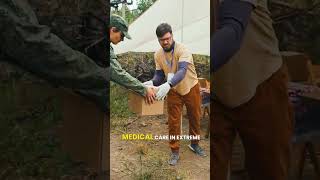
James Laughlin describes operating near Ukraine's front lines as a medical professional, where drones have become the primary threat. He contrasts this with earlier dangers like missiles and artillery, then recounts a near-fatal crocodile encounter while crossing the Kunaini River that taught him to manage panic under pressure.
Chapters
We're operating in Ukraine and we're operating close to the front line. So fire. There's drones everywhere, which have changed the whole thing completely. Whereas before it was just missiles and just artillery that we had to worry about, now it's drones that follow you. The particular professional world that I work in, which is working with medical teams, delivering high level medical care in extreme environments. When you're transporting a casualty, it's a game of chess. You've got to think five steps ahead. You don't expand your casualty rate by putting your own people at risk. About 15 years ago, I was on a recce on the Kunaini river, which sits between Angola and Namibia. The three of us, we got, you know, swam diagonally, got in line with a rock. We were coming towards a rock. Couldn't have been better when we were about five meters away, when this rock stood up on four scaly reptilian feet and sinuously slid into the water. And when there's one croc, there's always more than one croc, I started to panic in mid river and then I suddenly realized that it wasn't the croc that was going to get me that potentially was in the river beneath us, it was my panic that was going to get a grip and drown me.