Sir John Key on his priorities as Prime Minister: managing the Global Financial Crisis and Christchurch earthquakes, strengthening the economy, and moving people from welfare to work. He discusses his legacy through education and homelessness, and why he pushed for a flag change.
And if we go back to your time as Prime Minister, what were your priorities? Because you can't focus on everything, you can't keep everyone happy. Of course you're going to have your critics, but what were the key things and objectives you were focused on?
Yeah. And funnily enough, actually, I'll tell you one thing, I'm chairman of anz, which made $2.3 billion yesterday, so that was quite a good day. The office, funnily enough, actually, I know it sounds like a lot of money, because it is a lot of money, but. But we have massive. I mean, we have a $220 billion balance sheet, we've got $20 billion of capital invested. In bad times, we lose money. So, yeah, I'm not defending it, because, actually, I think it's a good thing. The banks are strong and they're making money, but they don't always make money. But the woman who's the CEO I appointed, Antonia Watson, she's awesome. She's doing a great job, and she's probably been, excuse me, in that job about four years now. But I always say to her, look, however long you think you'll be at the top, it might be less than you think. I mean, I don't know. But in political terms, the day you start is the beginning of the end. I think it'd be true for a sports person. It's fundamentally true in any business. Anything you do. I mean, we only have a limited time on the planet, so you only have a. And I just said to her, look, when I look back on being Prime Minister, the only things I ever think about was, did I go fast enough on some of the things that I wanted to do and what were the things that I. I wanted to achieve? And so, because we don't live in this magical world where you can just ignore the environment that you're in, we live in the real world. So when I came in, we had the global financial crisis, which was huge. Then we had the Christchurch earthquakes, then we had various other sort of financial and other issues that went on. Then we had a bunch of different things that we were trying to resolve. And so. So the first thing is that the priorities were really, how do we get through those different things to make the country stronger? But I suppose if there was one underlying thing that you wouldn't write down, I wanted New Zealand to feel more confident at the end of it. And the infamous sort of changing of the flag was really nothing to do with the flag. I know it sounds stupid, but, yeah, you know, I Kind of. I mean, I cared a lot about the issue, but the flag was just a symbol of who we are and that having more overt signs of patriotism. So when you go to America, you see flags. And I spent lots of time in the States and they would just fly flags everywhere, even Australia, I tell you. I mean, their flag is pretty similar to ours, like kind of AKA identical. And you can't tell apart in halftime. It's another reason I wanted to change, because it got put in front of the Australian flag so often. But the. But the reality was that when we want to show pride in New Zealanders, we wear a silver fern, right? That's what we do to. If you were in Istanbul this afternoon, you wanted to walk down the street and show people you're a Kiwi, you wouldn't put a T shirt on with the New Zealand flag first. You probably don't even own one. But even if you did own one, you probably wouldn't do it because people would go, g'. Day. They'd think you're Australian or they'd think you're something else, but actually you'd wear the silver fern, right? And I just sort of think philosophically, we are famously the last bus stop on the planet. We're a little country at the bottom of the world. No one knows us living. But if we could be more confident, more globally engaged.
More of the view that we were going to win.
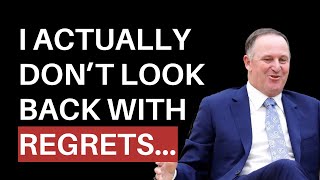
Then I think actually we would be a better country for it. And I do worry, like, if I'm really, really honest, I look at today and I go, okay, so you've got virtually no migration allowed into the country. It's slowly starting to change, right? So unemployment's at these incredibly low levels, right? You've got every employer I can think of screaming for workers, but got 420,000 New Zealanders on a benefit. Now some of them will legitimately be unable to work. You know, they've got all sorts of issues, physical conditions, mental health issues, whatever. You know, there's a variety of reasons. I'm not taking anything away from that. But what I am sort of saying really is that the only pathway out of poverty is work. And the vast bulk of people who are in poverty live on a benefit. That's just blunt reality because actually, income rates are low. And so the question for me was, how do you actually put in place those drivers to make people work? I think, because I thought if you do that, actually you'll transform their lives, you'll make them do that. And there's a Proven fact, by the way. Like, you go and ask the Ministry of Social Development, they'll tell you. If you go through, say, Maryvale, pick a suburb at 2 o' clock in the morning, the lights are off. If you go through Tokoroa, two o' clock in the morning, the lights are on. I'll tell you why they're on, because there's a lot of partying going on at two in the morning because they're not going to work the next day. And as soon as they get one person to get a job in that household, everything changes. Because then they get up and they make the kids go to school and they go off to work and everyone sees that their life is changing. So, you know, so I guess my point would just simply be whatever the things that you think are important. And they were some of them for us, some very practical and some more high level, just have them in mind and go after them because your time will run out. And I actually don't look back with regrets. I mean, I think it's a journey, not a destination. Being Prime Minister, you know, you're always gonna, you know, gonna leave some things. But, you know, I do kind of think that that's, for me, anyway, that was. Look, they always say infamously, you know, the definition of a good Prime Minister is when you leave the country in better shape than you found it. And that is hugely subjective. So yesterday I was driving along the motorway and. And this woman, I just happen to notice the car was a Toyota Swift, spent most of the time between Northcote and the Harbour Bridge pulling the finger at me. Now, it could be that I cut her off, but I was seeing my wife at dinner this last night and she said, well, you're notorious for changing lanes. Without indicating. I said, I didn't change lanes. She said, you're notorious for being on your phone. I said, hey, I have hands free. I was on. I was on my phone, but I was like, hey, hands free. And she said, my wife eventually says to me, what do you think the reason this nice woman did that 10 times to you? And I said, cause she hates my guts, honey. And she said, oh, yeah, yeah, it's plausible. I believe that. Yeah, I believe that, I get it. And so my point being, in the eyes of that woman, if this was the reason, which I suspect it was, it's like it was just me, she'll always believe I didn't achieve that. And then in the eyes of some people who were supporters of mine, they. They'll say, you did do that. So the point is you're never gonna please everyone all the time. But you have to.
I think that is true, that a good prime minister does leave the country in better shape. And I think if that's the argument, you have to work out what better shape looks like. And some of those things are hard. But there are education standards and homelessness and all sorts of things.