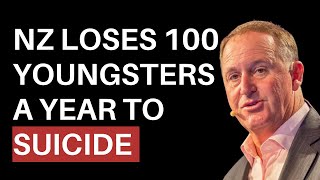
Sir John Key discusses New Zealand's youth suicide crisis, citing roughly 100 deaths under 18 and 500 total annually. He notes most victims are Māori boys and points to social media, family breakdown, and deprivation as drivers, while acknowledging the difficulty of identifying who is at risk.
Questions this video answers
About 100 youngsters a year.
About 500 people a year.
He states about 90% are Māori boys.
Chapters
What do you think drives the mental health statistics that we have, particularly for our young kids and Maori Pacific specifically? Yeah, so the tragedy is, you're 100% right, that we have quite high stats, to your point. Yeah. Places like Italy, they're deeply Catholic countries and they won't admit that people are taking their own lives, so they underreport. But nevertheless, nevertheless numbers very high. So I.
Got. I started looking at quite a bit because actually my son's school, he was at King's College in Auckland, they had a number of kids take their own lives. And I mean, I'd obviously seen stats and read stuff about it, but I guess when he started going to funerals, like far too many funerals and like all parents worry about children taking their own lives and if we're honest, everyone worries about that, I started thinking, well, yeah, what could we do about it? You know, like, I'm theoretically in this position to do something about it, so what could I do about it? So there was actually a guy, believe it or not, he was a world expert in suicide, and particularly youth suicide. He came out of Norway or somewhere in Scandinavia. I think it was Norway or Denmark, and he was in working in Masterton. And I rang him up, the Ministry of Health said, this guy's a world expert and he's here for two years. And so I rang him up and said, hey, will you come and see me? And it was kind of interesting. He goes, no, I'm very busy. You come and see me. I said, okay, I like his style. I go, yeah, I got nothing else to do. Yeah, sure, no worries, fella. So I thought, no, stuff it. So I got in the Crown Car, you know, we went over the hill, went to Master. Anyway, he's a very interesting guy on many fronts. First one thing he said to me that was very scary. He said, you know, okay, the stereotypical, that young person that might kill themselves is that they withdraw in themselves and they go in their room and they don't talk. And all the signs are there, right? Well, firstly, a lot of young people do that, go in their rooms and go through patches. That's the first thing. The second thing is that doesn't mean they're going to kill themselves. The second thing is apparently 30 or 40% of all young people that commit suicide show no obvious symptoms or it's just not obvious. In fact, the last kid that killed himself at King's, when Max was there.
Was.
He was the. Max said to me, of all the people that did it, he would never pick. He was the happiest kid in the school.
So he was actually, you know, the guy that writes in the Herald. Died himself, actually, recently. Brian Gaynor was his son, David Gaynor. And David's a lovely kid. I knew David Gaynor a little bit, and honestly, you'd never have picked it. So this first thing is he just said, whatever you think, there's just gonna be a group of people. And he said, the reason it's very challenging is everything in your normal mental state is to stay alive, which is why people will survive with very little food or water. It's why they'll cut their arm off with a pen knife if it's, you know, trapped under a boulder. And, you know, they'll do. Everything in your instincts is to live right? Whereas actually you're fighting that. So why is that happening? And then in New Zealand, if you really want to know the stats, this is the horrible reality. They may have changed a little bit. I don't think they've changed much is that we lose about 100 youngsters a year. About 500 people a year commit suicide, but a lot of them are a bit older, and some of them have got terminal illness. And maybe in the modern world, they. That invoke euthanasia laws that are there, which is why I was voted for euthanasia. But of the hundred young people which I think are 18 or below, 90% of them are Mori boys. Okay. And so the reason that the boys die in big numbers and the girls don't is typically the pattern has been girls take tablets and boys hang themselves and girls will often find them, and so we can save them.
Whereas boys. There's no coming back from hanging yourself. And so basically, then you go back and say, okay, well, so I got really interested and we actually started. We did a lot of stuff. We did a huge amount. And this is what happens in government, which is the crude reality is. Yeah, I think it probably made the news for five minutes one night, if you're lucky, and they wrote the odd story, but it's not interesting, like, you know, Trevor Mallard belting tohenoray in the thing, you know, whatever. Yeah. And so that dominates things. Whereas serious stuff actually doesn't get nearly enough attention because it's not controversial, you know, you're just doing something, you know, so. But anyway, I reckon if you want to know what I think the driver is, I think a huge amount of drivers are social media now. I think, firstly. Okay, yeah, we're better at recognizing it. Maybe if you had, you know, whatever. Whatever conditional Symptom of mental health. 30, 40 years ago, we probably didn't recognise, we probably didn't do anything about it.
But if I was to look at many of the girls Max has dated, right, which has been quite a long list, but let's say they're all, honestly, all lovely girls, all beautiful, I don't think he's dated a single girl that honestly hasn't had anorexia or bulimia or shit. It's a real worry, eh? You know, it's a massive worry. And I think they get on the Internet and it's not just girls. I mean, you're too fat, you're too thin, you're too this, you're too that. It's all these trolls. See, I don't look, see, I don't look at social media. I had social media when I was Prime Minister, obviously. And if you think about how fast and far the world has come, right, so Helen, when she was pm, didn't virtually had no social media, wasn't even really there. Like when we started, we thought we were cutting edge because we had Instagram. We put up the odd picture. You know, there's no messaging on Facebook. We started building an audience. I mean, Jacinda's got massive Facebook, big international Facebook following, actually huge, huge numbers. And so that's the media under which we all communicate. But if you go and look at the trolls on that stuff, I mean, it is ugly. So even today, I don't even bother, you know, I don't bother reading any of it. I never have. And, you know, because if you really read that stuff, it would do your head in. But go and tell that to a 15 year old and then I think there just are social issues. I mean, if you're really honest, some of these Mori boys, they're up north or they're in Gisborne. The very low levels of deprivation, maybe no father in the household. Like, I went to Huntley High one time and it's a very low decile school and the principal said it was after school, it was like about 3:30, and they had these kids and they were young, larger, young Mori boys, and they were running around playing rugby or doing something or whatever, and the principal said to me, there's about 50 of them. He said, what he knows about those boys? I said, they're all Maori or Pacific. He said, they're large, yeah, but no, I said, they're all under 15 or something. He went, no. We went through about five things and eventually said, none of them have got a father. None of them have ever had a father so I'm not saying. I mean we live in the real world divorce rate's 40% doesn't make you a bad person because you get divorced Lots of people get divorced. My sister's had more husbands than I've had hot dinners but, you know, as long as they wear a name badge actually the current one's fantastic guy they've been there 20 years all be good but the point is she went through a few prior to that but, you know, but. But the simple facts of life are that I think, you know, you do have some of these households where there may be no. No father, no family figure could be quite a lot of drugs could be. Could be abuse and we sort of wonder, you know, why these things are going on so I don't know but it's probably always been there but man and it's just not an easy thing to resolve 100%.