The Art of Staying Calm in Extreme Conditions with World Champion Freediver
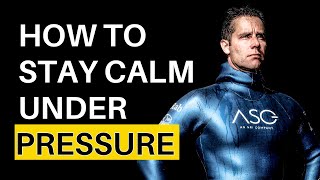
A recorded interview (YouTube/podcast) hosted by James Laughlin with world-champion freediver Ant Williams. They discuss what freediving is, safety (blackouts), and Williams's training emphasis on mental preparation over physical warm-ups: techniques include pre-performance self-talk, thought-stopping/replacement, body-to-brain posture work, and rhythmic/box breathing. The conversation connects these practices to business leadership (preparing Time-minus moments, worst-case-scenario rehearsal, creating familiarity, enabling deep work/flow), touches on cold-water exposure, and briefly mentions a successful—but NDA-protected—world-record attempt. Practical takeaways: prepare the moments before performance, manage physiology to influence psychology, and incrementally build skill and resilience.
Questions this video answers
July 31, 2024.
James Laughlin.
At its maximum, eight minutes.
Yes — he states the world record attempt was successful but details are under NDA and not disclosed.
Chapters
You're a world champion Freediver.
Sometimes we are our own worst enemies. It's okay not to be perfect. Blackouts are not good. They don't hurt. You just kind of lose consciousness. Your body learns it as a coping mechanism.
How long can you hold your breath for?
At its maximum, eight minutes. Man. I hope you've bought your A game today where you want to back out of your challenge. I do this thing that sounds super arrogant. I'm almost embarrassed to explain it to you, James. It leaves me buzzing, like, genuinely buzzing. I was over in northern Europe in the middle of winter in a very cold location, trying to break a new world record. And when I broke the surface, how.
Did the attempt go?
I can't say.
What's the most effective way to actually confront it or actually to engage with fear?
This is a difficult one. These things are bloody terrifying. For me, being fearless is actually about taking positive, calculated risks. The way I think about how to control my own fear and anxiety is to.
This week, you're about to sit down with the world champion Freediver, Ant Williams. We're going to talk about leadership, we're going to talk about psychology, we're going to talk about performing under pressure. If there's anybody in the world that can talk about this, it's Ant. So please sit back and enjoy the show. This podcast is brought to you by NZ Mortgages, our valued sponsor. You can check them out at nzmortgages Co nz. Ant, a huge welcome to the Lead On Purpose podcast.
Thanks for having me.
I'm so glad to have you because I've been following you, following what you do, trying to understand what makes you do what you do. So you're a world champion Freediver. Let's start there because some people will be going, james, what on earth does free diving mean? So what is freediving and what got you started on it?
Yeah, a lot of people think freediving is when you go out to maybe some high cliffs and you jump off them into water. It's not that. So free diving is where you go out into deep water, you run ropes down.
Maybe off a barge or off a boat, and it's a competition to see who can reach the greatest depth on a single breath of air, retrieve a tag from the bottom and then make it all the way back to the surface without blacking out.
Wow. Okay, so that sounds like my worst nightmare, personally.
Why would you do such a thing?
Yeah, it's a good question. It's not a popular sport, or at least it never used to be a very Popular sport. It is gaining a lot of momentum today because it's so good for posting on Instagram, those sorts of things because we go to tropical locations and do this crazy sport. I started freediving back in 2000 when I was, I was working with a motorcycle racing team, MotoGP, and I'd be working with athletes that were all doing really extreme stuff. Base jumping, wingsuit flying, cage fighting. And then I always found myself working with motorcycle riders who were, you know, were racing bikes at 330km per hour. And I loved it. Like, I'd never really been good at sport, but my whole background was that I had had a fascination for sport, a love for sport, but had never been good at it. So I'd come through this path of wanting to become a coach or, or a trainer, maybe someone who taught physical education in schools. And I studied sports psychology. So there I was in the south of France with this motorcycle racing team when it dawned on me that I was a total fraud. Everything I was teaching these athletes who come out of a textbook and none of it was from lived experience. So I decided it's time for me to take up a sport. And seeing as all my athletes do dangerous sports, I will look around, I'll find a dangerous sport, and I'm going to apply what I teach athletes to myself to see if it works. And the three sports that caught my eye was bull fighting in Marseille, wingsuit flying near Toulon, or free diving under the ocean. And here we are 20 years later and I'm still free diving.
Wow, those three sound horrifically scary, but amazing that you picked one and went deep with it. Literally. So the one thing I want to ask about, you talked about blacking out. Has that ever happened for you?
Look, it did happen for me quite frequently. Well, frequently is probably the wrong expression. So in the first 10 years, every year I'd probably experience one or two blackouts if I was really pushing hard in competition. Blackouts are not good, they don't hurt. You just kind of lose consciousness and then you wake up 30 seconds later and realize that you're disqualified. It's not the worst experience, but when you start having like, if you have one or two blackouts in a month, then you need to have a really large break because it's more likely that your body learns it as a coping mechanism. So when you start holding your breath a long time in the next competition, your body goes, haha, I know what to do here. I want to get out of this. I'll just shut you down. And then someone Will rescue me. So it's like, you don't want to get in this pattern. In the last 10 years, I haven't blacked out once. You just get to know all these internal signals of when you're getting close to blackout and. And then, you know, right, this is my time to come up.
That's incredible. You learn that, I guess, awareness of your body physiologically, but also psychologically, and then you can learn to control it. And in a minute, I want to talk about, okay, how does this apply to everyday life? How does this apply to business and when we're trying to run our general lives? But just for a second, take me through what it's like to go out into the middle of the ocean and step off that barge or that boat, and what do you do after that? What's the preparation physically and mentally like? And then where do we go from there?
That's a great question. I like it because people would automatically assume that it's about the physical preparation. And it's interesting, in a lot of competitions that I go to, everyone focuses on the physical preparation. They'll do two hours of yoga out on the boat, and I'll think, you're probably going to black out because you're putting all this effort into doing stuff that you don't normally do. You don't probably normally do two hours of yoga before you train. Why are you doing it now? I put all my focus and attention into the opposite, so very little, if anything at all, into the physical preparation on the day and everything into my mental preparation. So that mental preparation might be.
What I say to myself. The routine that I go through before I dive, which could start for hours out from the dive, it'll be my internal dialogue around when I'm looking at other athletes, when I'm walking around the boat, all these things that are playing to me, creating a sense of absolute confidence and conviction that I will be the deepest diver on this day, and that there's no doubt in my mind that I will make it to my depth and I'll make it back to the surface. So I have a number of techniques that I use to do that. But ultimately, I want to perform personal best or close to it under the pressures of competition to do that. It's a focus only on those mental things, not the physical things that are going to get you there.
Makes total sense. And I think that whether it's public speaking, whether it's doing what you're doing, a sport of any kind, that often we do focus more on the skill Set like the physical skill set, and neglect the mindset and even the belief systems that are coming up. So you talked about. You speak to yourself. You say things on game day. What are some of those things that you might be saying to yourself?
So the things I say to myself, well, there's two types. So there's the things I say to myself before I dive, and then there's the things I say to myself when I am actually diving. Now, that's the easy one to explain why I would do that. So when I'm diving, if you don't have things that you. A pre program that you say to yourself during a dive, your brain will sabotage you. It'll say things to you halfway down, like something's wrong. It doesn't feel right. I didn't get enough air. Holy shit. I better turn up, turn around, gear back, or there's no way I'm going to make this. Everyone else is better at me in this competition. I've even had my brain say to me once at 50 meters, you're dying. Like right now, I'm dying. And all of these things lead to panic. I mean, sometimes we're our own worst enemies. Everyone can relate to that. But voice on the shoulder telling you, you can't do this. You're an idiot. This is stupid. Feels bad and that you're being judged and you're looking really bad. So to prevent that from happening or to counteract it, you've got to have. Well, I call it this technique called thought stopping, where you get really. Well, what's the word? Well, you just practice this whole idea of every time a negative thought pops into my mind, I learn how to stop it. And eventually I learn how to replace it. So that during a deep dive, I'm replacing all the things that my brain would typically say with things that are incredibly positive. Like, I basically have engineered my own coach that sits on my shoulder and tells me what an epic dive this is. So that's the main thing. Thought, stopping and replacing. In the lead up to a dive, I do this thing that sounds super arrogant. I'm almost embarrassed to explain it to you, James. But I will walk around a boat, I'll walk around a swimming pool, if it's a big competition like a world championship. And I deliberately walk around and I change my posture, my breathing, the way I walk, everything to exude confidence. I do it for myself. But I also look around at people, and when I see my main competitors, I will say to myself things like, man, I hope you bought your A game. Today, because you are going to have to give it 100% if you want to have any chance of beating me today.
Now, the reason I do this is because sometimes your brain has difficulty what it does, it has difficulty in discerning between real and imagined experiences and things that you tell it. So I want to engineer the situation whereby my brain completely is convinced that we're going to win this competition. And all of my best results have come when I've done that well.
And that's something we can all do. It's something that's tangible and achievable and self talk. I guess we're taught that when you talk to yourself, you're crazy. But actually we're all talking to ourselves constantly. And I imagine that most of what we talk about, from what I understand, the self talk side of it, is very negative. The negativity bias would wire us to be 60 to maybe more 70% negative thoughts. So what you're saying is we can stop the negative thoughts and even more powerfully, we can replace them.
Well, there's a dimension we haven't touched on yet, which I think happens in both my sport, but also happens in business, especially if you're in a leadership role. And that is the fear that creeps in when we have to perform under pressure. So in my sport, those moments are pretty obvious. I've got to go and hold my breath for eight minutes to beat the slot next to me. I've got to go on this really deep dive and try to get to 100 meters. These things are bloody terrifying. So I'm going to be judged, there's going to be a big group watching and there's a risk of blackout. There's a risk of other things happening as well. On a deep dive which are very unpleasant, we don't need to go into at the moment. But there's a certain amount of fear that that evokes in me and other athletes. And so when you have that, then you've got to count. Then that's another factor we have to think about in the self talk because our default position is to move away from things that are going to be terrifying or create fear and anxiety. And in business, I think it might not be risks that are the same magnitude. Yeah. But it might be having to have a conversation with someone about their performance. It might be having to give some difficult feedback. It might be having to talk to a team about a restructure that you have to make or to break some units. Unpleasant news. I mean, there's always times I Think where we're called upon to perform, where we don't necessarily want that responsibility, or it creates a sense of unease in each of us. Those are the moments where I think the way that you approach them mentally makes all the difference.
100% agree. And at times I imagine you want to maybe give up, give in, procrastinate, avoid. What are the mental tools that have worked really well for you to help you get through that?
Well, I use a number of different things, but the main thing I try to share with people that ask me that question is.
Think about it in a really simplistic terms. Imagine that someone's filming you as you go through life and then at some point in time you come to this moment of time, which is a challenge. So if there's all these frames of this film that makes up your the movie of your life, and when you come to this time moment of a challenge that's ahead of you, then think about how you move into those time moments. Because there'll be many of them during our lives. In fact, daily, weekly, most of us, when we think of a time moment, think of that moment as being something that we really focus on. How am I going to appear? What am I going to say? How are people going to respond to what I have to say? We really focus on that moment of time. But what sports psychology teaches us is to focus on those moments before time. Time minus 1, time minus 2, time minus 3. And how you prepare for that moment. Because ultimately that time minus one moment just before you have to do something that creates anxiety for you is that moment you've touched on where you want to back out of your challenge, where you want to yield, you want to give up, you want to procrastinate or put it off. But it's how you manage yourself, your internal state and those moments just before you perform is where all the self awareness comes from, all the learning.
Each of us have things that we're triggered by and say to ourselves when we're under the pump, even before we perform. But if you learn how to master those moments, those moments before you step on the stage, before you give that feedback, then they will ultimately determine how well you go in your performance.
That's massively helpful and it's interesting because I find there's certain things that say surgery, if I had to go for a surgery, a major surgery, that's the time moment. But days or weeks, I'd be stressing, focusing concerning. And so it's getting the tools in place there to know that when this Time comes, I'm prepared mentally, so I'll share with you something recently that happened. I had to go for an mri, and I'd never done an MRI before. New territory. So I get to the building. Hadn't thought too much about it at all. I thought, well, this will be interesting. Got there within about a minute and a half of getting to the building. I was going into the machine. I was like, this happened real quick. And they came over the speaker, is everything okay? And I said, no, everything's not okay at all. Can you please come into the room? So the two technicians come in, they say, what's up? I said, I am incredibly anxious right now. Can you just for a moment talk me through the process, tell me how the machine works. I don't think I've got any metal objects in my body, but I may have forgot something when I was three, so just work me through this. And honestly, having their reassurance tell me about the actual physical mechanics of it allowed me to get my mind to focus on something better. So how important is it to have coaches or advisors or external voices at times when we don't have the confidence to perform?
Look, I think that that works really well, but I also think it's outside of your control to some extent. So I like it if you have access to a good coach or a mentor or someone who you can bounce ideas off when you're in that moment where you're feeling that anxiety. But I don't think we should also rely on it. I think there are things that you could have done before, before going for that MRI that would have helped immeasurably, that you would have had control over. One of them is building familiarity. So I'll give you an example from sport. So I worked with a young BMX rider out of New Zealand who was going to compete in a world championship event in BMXing. But the problem was he was going to go over, arrive only a few days beforehand, and then arrive at this track and try to beat all some of the world's best. I'm like, have you ever been to this country before? He's like, no. And his dad was saying to me, so, what should we do? What should we do? Like, how are we going to help him overcome his anxiety? I said, well, do you know anyone over there? If you do, get them to go and film the hotel that he'll be staying at. Get them to film the trip from the hotel to the BMX track and then get them to walk the BMX track right from the start gates and film it, the whole thing and then send it to him and then I'll work with him to watch all that stuff and to talk about what are you going to do here, what are you going to do there and what do you like having for breakfast and do they have it at the restaurant in that hotel? And what I was trying to do is create this sense of familiarity. And he watched it over and over and over. When he got there, he performed incredibly well. Guess what he said afterwards. I just felt like I knew this place.
There you go.
You know what, if you have that, there's just no surprises. But it's incredible. In sport, most athletes don't do that. And I love.
100, no 100%. It's apply. I think it applies in both settings. And I think back to some of my, like as a kid competing at the World Championships and if the venue changed, you know, the venue was always the same and then the venue changed, I would notice that my performance dipped. And then the next year when it was at the same venue, I was more confident. So I love that piece around familiarity and also going back to fear because a lot of things that we struggle with as leaders are driven by fear. Fear of failure, fear of disappointment, fear of letting others down. So when we're dealing with fear, what's the most effective way to actually confront or actually to engage with fear?
The way I think about how to control my own fear and anxiety is to look at the time moment that's coming up. The moment where I have to perform and I just do this simple game called worst case scenario. So what's the worst case? How bad could it really be? And when you look at it, it's normally not that bad at all, but we kind of obsessed about, oh, it's going to be terrible. So if you play worst case scenario and just game it out, like, what's the worst that could happen? So for me in my sport it's like, oh, maybe I black out and then I don't get the result I want to. But I don't think anything worse than that is going to happen. Then it starts to reduce the salience of that fear for me somewhat. So I think that you can play worst case scenario.
I think there's other techniques as well that you can play that you can try that just reduce that sort of sense of gravity over the fear as well. So I think by being familiar with your scenario that you're heading into and also by this is a difficult one, I'm going to explain A concept to you. And then we'll work back to the how do you do that? So the concept is that in order to perform well, when you know you're walking into something that's going to elicit a lot of fear and anxiety for you, it comes down to you.
Trusting in your ability to cope with whatever comes your way. So here's the thing. We have fear because we don't know the outcome. It's uncertain to us. So by playing worst case scenario, we can kind of game it out a little bit and go, well, if it really goes bad, what would I do? And is it that catastrophic for me? But equally just by knowing and trusting in your ability to cope with anything that comes your way and knowing that if you stay relaxed and you stay calm, then you'll have access to your best facilities. Think about someone who gets up on a stage to give a presentation and they've rehearsed over and over and over and over again the content of what they're going to say. They step on the stage and then they can't remember the first sentence. So why have they forgotten it? It's unlikely that they've forgotten it. What's getting in the way is that their anxiety and fear has blocked them from accessing those parts of the brain for retrieval of that memory. So all they have to be doing is to be relaxed and present and breathing correctly. And then they would telling their body.
The body's telling the brain, I am relaxed, I've got this. And so I practice a lot of body to brain where it's like that example I was given with you earlier, James, where I go, I'll walk around the boat, I'll walk around the swimming pool and I'll hold my shoulders back, my chin's up, I'm looking around with a grin on my face going, I'm going to beat the light of you. Well, what that's doing is we call it body to brain because it's sending these really powerful signals up my brain stem to my brain, saying, I'm in control, I've got this. Whatever comes my way, I'm ready to go. Now, if you think about the alternate, which is, holy shit, I'm scared about this. And I droop my shoulders and I slow my walking down and my breathing is shallow now. Doesn't matter what I say to myself, oh, I'm ready to go, I'm powerful. Doesn't matter what I say because my body's betraying that. And guess which is more powerful.
Body, brain is more powerful. So if you're able to control that and control your breathing and your relaxation before doing these things, then you will learn how to master those moments of time.
I love how you put that. Honestly, it's like the physiology is overriding the psychology. It's almost dictating it. But often we're taught it's all with thoughts and get the right thoughts and your body will follow. But actually the body keeps the score. The body knows what's going on. So how do we do that? So, like, for example, you know when I'm speaking, so if I'm going on stage to speak, usually about 10 to 5 to 10 minutes before I speak, I'll feel like a little tickle in my throat. I'm like, oh, hey, here it comes. It's a little nervous tickle, right? And I now know, like, that's awesome. That's excitement. Like welcome. Like I welcome it in. But I'll excuse myself and go and find a bathroom and I will take a look at my heart rate. It's usually like 140, and I'm like a little bit too high to speak. So I'll do some breath work, some box breathing or some extended exercise, and I'll bring it down to 90s. It'll be in the 90s, and I know in the 90s I'll speak with excitement. I'll be present. If I'm in the 60s, I'll probably be asleep and so will everyone in the audience. But I try to manage my breathing, to manage my body, and then I know that my mind doesn't take over. I don't start doubting myself. Will I remember my words? What if a difficult question comes up at Q and A? That stuff disappears when I'm in my body, but when I'm in my head, it's like it's going round and round. So what are some of the techniques you use to be more embodied?
Yeah, I use a lot that you've touched on. So the breathing ones are first and foremost. My go to is things like box breathing. And I'm not sure if you've explained box breathing on your podcast before, but for me, box breathing is slowing down my rate of breathing and making it really very rhythmic. So each breath, the cycle of one minute of breathing might only be four breaths that are 15 seconds long each. And I have an equal measure of time breathing in, holding that breath and then exhaling and holding the exhale. And I find it by doing that, that really just lowers my heart rate. The same experience that you've Had. But then I'll couple that with thinking about the audience, and in this case it might be a large audience I'm going to go and speak to. So I'll think about what are the audience going to feel if I were to go out there and show a bit of anxiety or stumble over my words a bit, you know what, that'd probably just humanize me. And if I took a little break and walked to the other side of the stage and said, let me try that again, then people would have a chuckle with me and it wouldn't be the end of the world. And it allowed me to relax. So I try to think about how I want to appear and I want to be really authentic and how I come across and it's okay not to be perfect. And so if I do that and then I match how I want to come across with my, with my posture, with my breathing, with the way that I walk, where I hold myself, then I'm controlling how I show up. And again, that's that combination of the breathing and the way that I'm showing up, that that's what works for me. Now, it won't necessarily work for everyone, but I find those things incredibly powerful to shape my experience. And what I've found is that when I do these things and I get on stage or I get in front of that person, I've got to give some performance feedback to or deliver a hard message to my team, then I'm ready to go. And I do it in a really authentic, genuine way with a lot of empathy and connectivity to my audience because I'm not so focused on my own fears that get in the way of us delivering a message.
Well, that's powerful. It's less about me and more about we is what I'm hearing. That's amazing. And I guess the question that I get often, so I run mental skills for a professional rugby team, but I also work with corporates and you're doing exactly the same thing. So it's like, I get this question, James, what on earth would high performance sport be able to teach business? Like there's no connection. What do you have to say to that, Anthony?
Oh, look, I think, look, in honesty, I think there's some real validity to it and. Sorry, I hope that doesn't shoot you down, James.
No, not at all.
But let's talk about the validity of that statement. There's no connection or relative merit. And by comparing the two is the argument. So I think that in certain areas that's true. Like in sport, you are measured constantly. Every time you step on the field or into the pool, whatever it is, onto the track for training or competition, you're being measured and you're going to get instant feedback on it. So it's a different situation.
When you're doing it. We just don't have that in business. Some of us only get feedback once a year.
The fortunate ones who have a great leader are getting it hopefully each week, and maybe some of us are getting it daily. That would be unusual, I would find, in my experience. So what we find then is that in business, we don't often think of it in terms of competitive performances, where today is that day where I have to really show up and do well, it just seems to all blend in together, doesn't it? So, therefore, you could argue that the two are very different situations. The thing that I would say, though, is that there are areas that have some similarities that are close enough that we can learn from each other. And those similarities are, is that there are always moments where we have to perform. There are always moments where we have to learn how to show up in our best self in order to get the outcomes that we want. And I also think that there's a risk on the business side that because there's no instant measurement and feedback system in place, that it's easy to become complacent where there's low energy, there's low motivation to get stuff done with intensity. And, boy, we nail that in sport. And I think we could learn from.
It in business 100%. And we're seeing that more and more with focus. And I think focus has a lot to do with motivation. So when you're motivated, generally, I feel that your focus is elevated. So in your sport of freediving, how important is your ability to stay focused?
Well, we have this saying that, well, when I say we, the people that I've trained with over the many years that I've been in the sport, we always say to each other, isn't it amazing? Whenever we're doing this sport, we've been here now for three hours out in the ocean, and I haven't had a single thought about business or anything else outside of what we're doing right here, I'm genuinely in the moment. And it'd be hard to find, like, a sport that.
Has more of that sense of immersion and in the moment than freediving, because you can't. If you're thinking about the last kick that I did, then I'll. Then I'll have a desire to breathe. If I think about the next kick, then I'll have a desire to breathe. I've got, just got to be present in where I am. And so we're very focused in the moment on the experience. And that gives this, this ability to, if you translate that to the business world, to know how to find that same extent of focus, to shut down outside distraction and lock into this idea that we call being able to do deep work. So deep work are those moments where there are no distractions. You find a state of flow. You do your best work at the highest intensity and it's enjoyable. And time seems to just evaporate and you get to the end of this, or what you're trying to achieve in a few hours took a couple of hours and you go, I've achieved more in the last two hours than I'd normally get done in a day. Being able to tap into that as a leader or getting your team members to know how to create that sense, that ability to focus like that.
That'S where the gold lies.
It's interesting you talk about flow. I love that you mentioned that word flow. Over the years I've been studying how do we get into flow? So I think back to my standing on a stage, performing as a soloist on an instrument. I was in deep flow like nothing else was happening. I'd get to the end of a seven minute performance and be like, I don't remember any of it. I don't remember the last seven minutes. And I go, why did that happen? So Mihaly Csikszentmihalyi obviously dedicated his life to understanding flow. And the three things I remember was one, you've got to focus on doing one thing at a time to achieve flow. That thing's got to be something you actually enjoy doing. And it's got to be at the outer limits of your comfort zone. It's got to be borderline uncomfortable. And if you can meet those three things, and there may have been others, but those were the three dominant things that he really talked about from memory, then you will experience flow. So do you feel like freediving meets all three of those needs for you?
Oh, absolutely, it meets those three needs. I think we just get possibly too much on that last one that you mentioned. So there'll be oftentimes when you're, I find this anyway where I'm going for a maximal performance. And then it's hard to get into a state of flow because the level of challenge and level of discomfort is so high during that challenge. That pulls you out of a state of Flow.
But all your best performances in sport come when you're in that. When you're able to access that thing, that state. Right. And I think you can get it in business. You've had it. Music. We find that any performers who go on stage are able to access this with practice. They can do it more easily and they can engineer ways to get into that space, that zone, more easily. And it's the same in business. So just take that whole idea of doing deep work for maybe an hour or two a day, then ask yourself, like, when do I seem to do my most productive work? Morning, midday or the end of the day. Okay, interesting. Are there any patterns or themes there? This is what we do as athletes. We look at all the themes from where our best performances came from. How long was I able to stay in that state of flow or do my deep work? How long did it last? What music was I listening to? What did I eat beforehand? Who was I speaking to? I want to know everything. I journal all this stuff so that I can go right, I'm going to put all these elements together and that's going to help me get back into that zone and I'll do it in the morning because that's when I seem to be able to get into the zone the easiest, and that's what I'm going to engineer. It's no different to what I do in my sport. Most recently, like last month, I was over in northern Europe in the middle of winter, in a very cold location, trying to break a new world record. And these principles are the exact principles that I was using to feel familiar in the environment, to get myself into the zone, so that once I started swimming, I would know that from the very start, I'm already in the state of flow for this whole swim.
And it's not always easy to engineer, but I wanted to make sure. Is my routine right? Have I got my prep right? Am I saying the right things to myself? Is everything in place to give myself the maximum chance of getting into a state of flow? Yeah. And so these principles, they might sound a bit esoteric and a bit airy fairy, but boy, they work. And if you're not doing them, you're missing out on a trip.
Yeah, absolutely. And may I ask, how did the attempt go at the world record breaking it?
So the world record attempt was successful. I can't say what that world record attempt was because it's for a large television network and it's going to be coming out in October, so please keep an eye out for it.
We definitely will be promoting it.
Non disclosure agreement. I can't say what the record was, sorry.
Well, hey, congratulations on achieving it. And we will definitely be following and making sure to be promote it when it does come out. It's just incredible.
Thank you, Griffa.
Now you're saying northern Europe and you're saying cold. Okay, so cold water immersion therapy, ice baths, cold showers, Wim Hof breathing, it's a big thing. It's moving across the world at pace right now. So is it good for us and are there any things that we should be aware of or wary of when stepping into trying cold water therapy?
You know what? I really don't like the cold.
I don't know who does. So the world record attempt I've just done was a world record done under the ice. And I hate being cold.
When it comes to things like cold water therapy, I'm probably the same as you and many of your listeners, James. I'm still experimenting. I don't like it enough that I, that I did like months of cold water therapy leading up to this world record attempt. My philosophy was I'm going to be as warm as possible and wear a thick wetsuit so I don't get cold. That didn't happen by the way. It was damn freezing the entire time.
But I do believe that it works. So I've read some research on it. I've met with some people who are fanatical about it. One gentleman, his name is Laird Hamilton, who is very famous in surfing circles because he was one of the greatest surfers of all time. Big wave surfer, invented tow foiling, invented foil boarding. Incredible. At windsurfing, you name it. This guy's an absolute legend and he swears by the cold water immersion therapy mixed with the warm sauna treatment, that sort of thing. So I spend time with Lead and he convinced me that there's really something in this. And I know for myself that when I do that cold water exposure therapy that it leaves me buzzing, like genuinely buzzing and energized for two to three hours afterwards to the extent where I'm going to put in a sauna and a nice bath at home.
I love it. That's huge. I get more and more people that I know are doing that and not even professional athletes, just people wanting to increase health, focus, longevity, the reading studies, that this stuff actually works. So it's really good to hear.
I don't like it at the time, James. I like it afterwards.
I love it like anything.
I love it.
And what about change? Because I Imagine you could prep. And this goes for the business leader or somebody that's working in the corporate world. You've prepped for everything, everything's set, but then something changes. What's your approach to dealing with change?
Well, I think change is the big challenge because of the uncertainty that comes with change. And so when you're so. I think the sporting model is the easy one. So when we were. When I was getting ready for the ice dive world record.
We were at one lake getting ready for this record. I did my preparation there. And then the day before the world record, they said, there's lots of snow coming, we're going to change lakes. And we all flew an hour away to a different lake. And then the next day I'd go into a world record in a lake I'd never seen before. And that was a massive challenge for me mentally. But it's no different than the change that happens in organizations. When we tell people there's a change coming. Because normally we say to people there's a change coming, the normal reaction is, yeah, but it won't affect me. And so we've got to tell them over and over there's change coming. And then when they get into the change, usually our reaction is to fight it, that we don't like the change unless the change is like, okay, everyone's getting new MacBooks and iPhones, then we love it, and we get through that change curve really fast. But unfortunately, most change that we go through in organizations isn't of that nature. There's a downside to it. You've got to learn a new system, a new process, stop doing things that are comfortable, that we're familiar with, that we feel that we're gifted at and have invested so much time and effort into learning and mastering. And this other interesting thing happens when we go through change in organizations is that we start to question whether.
We'Re being told the truth. Because there's so much uncertainty with change that a lot of leaders, they think to themselves, well, I can't tell everyone everything because not everything is set in stone yet. In fact, I can't tell them much at all because I don't really know much to share with them. And so what happens is, as leaders, we fail to communicate enough and to really talk to people and engage them with good conversations about what the change represents for them, how they feel about the change. Because we're also worried that people are going to resist the change and talk about the change in unfavorable terms and create this toxic environment where no one wants to bloody welcome this change, so we don't talk about it enough. And when we don't talk about it, people make up their own minds about the change. And guess what? Do you think they go, oh, this is going to be amazing. I trust everything my leader is saying, oh, this is going to be the best thing ever. Or do you think they go the other way? Which is, I think this is going to be shit. Well, guess what? Pretty much all of us, we go to the latter of the two. In the absence of information, we fill in the blanks. So it's difficult. I think leaders, most of us are experiencing.
Change fairly frequently, if not all the time as leaders. And I think that how we manage ourselves and others through the change is so vital.
I think that you said that in the perfect order, how we manage ourselves and then others, it's about self management. We can't lead others until we learn to lead ourselves. And I really love that you put it in that order. The other thing I wanted to talk about was in this current world, we're expected to do things very productively, very efficiently. It's about speed, it's about getting things done effectively. Let's go to freediving. Is it about speed or is it about going, okay, I've got to get to that depth and back and I've got to survive. I've got to use my resources well, I've got to manage my thinking. What's more important than freediving? Is it speed and productivity or is it managing your resources effectively?
In freediving, there are no awards given out for speed. So it is all about achieving the outcome, the objective, be that, the depth, the distance. It's about those things. The only award that we give that is to do with time is who can hold their breath the longest. The award's given for the slowest speed in that particular case. So speed is an interesting one because I think sometimes we conflate speed with better outcomes and we encourage people to always look busy and to be seen as being busy. And that's what we elicit, is the behavior we get from our team members is busy work and looking busy all the time. And we wear it like a badge of honor. Or we convince ourselves that working extra long hours is what the boss wants. None of this is true. None of this adds any value, any merit. But it's easy to measure because I could just see how often you're at your desk and how fast you seem to be moving, right, in terms of getting some paperwork or whatever or tapping away on that keyboard, it seems like we can see it and measure it, therefore its success on a platter for us. But the reality is it doesn't equate to good outcomes. It's not an effective measure. But by focusing more on outputs and outcomes and intensity of work and finding out how people like to work, then I think that that's where the real gold lies, is actually engineering the environment where yes, there's some performance tension, some positive tension for people to do their best work, but we focus on the things that really count and then create the environment for others to really excel and do their best work. And so that's where I think there's this amazing window of opportunity now that people are spending more time working from home to help them engineer those environments where they get what they want around them, but also are highly productive in those moments. And I think we've been sliding from initially being really productive through the pandemic to now finding that people working from home are far less productive than initially. But I think that there's a leadership challenge and actually tapping into again, we don't have that measure now that we could say, oh, is James doing enough work? Because I can't see him now. But we've got to get, we're going to get a lot smarter and more creative in terms of how we incentivize people, how we monitor performance, or whether we monitor it all, or whether we put more effort into focusing on James. What makes you get into your zone so that you're pumping out the best work? And how can I help you with that?
Yeah, I think that we need to be leaning more into that. And I've seen some incredible studies, case studies done with companies that went from five days to four days. And the effectiveness, the outcomes, the output has been massively improved. So people are working less time, but the intensity has increased. They've got this freedom and flexibility with their three day weekend and all of a sudden that discretionary effort, they're giving it where it really matters. So I think we're at the start of seeing that big change unfold, hopefully.
I'm really keen to see if that's going to play out like that in the long term. I think that any organization that takes that on and says you're now going to get a three day weekend, that would spike my motivation too. But how long would it keep me motivated for? I think if you started paying me more to do the same job, I'd go, this is great. I feel special and unique. But then after a month I'D come on and go. I think James should be paying me some more and I'm no longer motivated like I was three months, months ago. So the jury's out for me on whether or not this is going to be enough or long term motivator to keep that level of productivity and intensity up in the four days or in the 10 to four day work week that you're now giving me. I hope that is the case. But I think it comes back to being a leadership challenge. It all comes down to the conversations that we have and how we help them structure those environments that enable them to do. When I say them, I mean team members to do their best work.
And everything rises and falls on leadership. Like everything we look at countries, companies, teams, our own selves, it all comes down to leadership. So, Ant, I'm 100% on the same page and I've got a couple of last questions before I ask them. The person that's listening or watching right now, please, we're going to put in the show notes. Please go and follow Ant on Instagram. If you're on LinkedIn, connect in with him on there. We're going to put all of his channels on there, also his website. So please do go and check it out. It's all in the show notes and Ant does a lot of speaking all around the world and he's an amazing keynote speaker. I've read an amazing amount of testimonials. I've seen him speak online. I'm going to see you in person one day soon. But please, if you're thinking of looking for a speaker that's doing the do, I would call it like actually out there performing, putting himself under pressure, then taking it and working with teams. Ant, you man. So I'll put all the details in there for that. Antman, two questions. One, how long can you hold your breath for? At its maximum, eight minutes.
Okay, so that's mind blowing. I think I've done three to four minutes. At one point I thought that was pretty good.
Eight minutes, It's a long time.
Where's the danger zone for like, if someone was like, I want to go straight to seven minutes. Of course our brains aren't maybe built for that. Do you have to kind of build up to 8 minutes?
Most people do. There have been situations where we've found odd examples of people being able to hold their breath for seven minutes on their first go, but they're very few and far between. So most of us take quite a lot of time to get there and we have A lot of deeply inbuilt human signals like contractions in the throat, contractions in the chest, head feeling flush, the CO2 building up, that feels genuinely painful for most people. That prevents them from going too far and holding their breath. But not always. So sometimes we push through these signals and then yes, it can be a dangerous sport. I think of the sport as being a very safe sport so long as you know the rules and you follow them. Where people have, my own friends included, have broken those rules, some of them have ended up in hospital or worse. Because if you're holding your breath and you're not supervised, things can go bad very quickly. So it is a safe sport. But yes, most of us have that benefit of knowing when a breath hold's getting uncomfortable enough that we want to quit and then maybe try to increment by 10 seconds on the next breath hold. So for me, it took me two years before I got to a four minute breath hold.
That's incredible. Yeah, it took me multiple years as well, but I couldn't imagine going five, six, seven, eight, I'm done at that. Three or four minutes.
It gets progressively more uncomfortable.
Well, I just admire you and the work that you do. It's incredible. I want to ask you just the very last question, so I'd love you to just fast forward many, many years into the future and you're highly aware that it's your very last day here on earth. Someone that you care deeply for, you love them, are a very young person, they come into the room and they say, ant, how do I go about leading my life on purpose? What would you say to them?
The advice I would give them is to not be afraid to put yourself out there and to try things and fail. Because every time you do that, you're going to learn about yourself, you're going to build in self awareness and you're going to grow as an individual. I would say don't be afraid to take on risk, to put yourself out to places and situations where you don't know if you'll really be able to come through unscathed, but to trust yourself back yourself. And even if you don't get the outcome you really wanted, I bet you learn a whole lot about yourself and by doing this repeatedly throughout your lifetime, you're going to become a fully grounded version of what you're capable of being. You'll understand your true potential and.
You'Ll have a more vibrant life as a result of it. And you'll be more useful to those around you no matter what sort of project you're working on. Because if you do the opposite and you play it safe and you sit in your comfort zone through your life, you'll never really understand what you're capable of being. No one has ever achieved their dreams or aspirations by playing it safe.
So the choice is yours. That's the advice I provide.
Wow, that's simply incredible. And there'll be someone listening, many people listening right now going, I needed to hear that today. I needed to hear that in this moment. I need to go and take a bigger swing. I need to go and get after it. So. And I just want to say a massive thanks for the work that you do. Thanks for taking the time to connect and I can't wait to hear you speak on stage one day soon.
My pleasure. James. I'm stoked to be on this podcast. Thank you so much for having me.
Absolute pleasure. This podcast is brought to you by NZ Mortgages, our valued sponsor. You can check them out at nzmortgages co nz.









