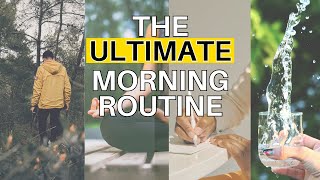
Short motivational/prescriptive podcast episode by James Laughlin (Lead On Purpose) describing a four-part morning routine used by high performers: 1) avoid phone use for the first hour after waking, 2) practice a short meditation/mindfulness exercise, 3) morning journaling (gratitude and lessons learned), and 4) drink water (with lemon suggested) before coffee. The host frames these as small daily habits that compound into long-term performance gains, offers practical tips (old-school alarm, wristwatch vibration, start meditation for one minute, use a Moleskine or digital journal), and closes with an event promo for a Town Hall in Christchurch in October and a sponsor shout for NZ Mortgages.
Questions this video answers
NZ Mortgages.
Town Hall, Christchurch — scheduled for October (year not specified in the transcript).
Chapters
NZ Mortgages is the proud sponsor of the Lead On Purpose podcast. You can check them out at nzmortgages.co nz what if your morning routine could change everything? Today, I'm going to share the secret habits that set high performers apart. No phone, no distractions, just pure focus. Are you ready to transform your mornings and your life? Let's get started. So I'm very fortunate that I get to sit with, interview, coach, work alongside some of the best, best performers on the planet in sport, in business, in writing, in thought leadership, in politics. I'm very fortunate to get to ask them questions, to try different experiments with them to see how it impacts their performance. Look, success leaves clues and I firmly believe when we look to great people and we've got a large portion of these people that we can look at, we will start to see patterns emerge. I'm going to share with you some of the most critical things to set your morning up for success. Master your morning, Master your day. Don't skip over your morning. Now, I'm not telling you to get up at 5am, not going to tell you what time to get up. That's up to you. But when you do get up, that's what's most important. Joining the 5am club. Do it if you wish. There are benefits to it for sure, but not everyone is a morning person, so let's get clear on that. We have different chronotypes, which means we're either at a nighttime oriented person or a morning time oriented person. I tend to be more morning now. I'm not 4am Used to be, not anymore, but I'm early and I like that. Now when we do get up, there's certain routines that if you follow them, they'll set you up for success. Why, you might ask? Well, we are creatures of habit. Habit means something you do regularly, over and over, until it becomes automated. It's an automatic behavior, right? So I want you to think about that. The routines that you follow become habits. They set you up for either success or failure. Now you have a choice to be responsive or reactive. Now when we wake up in the morning and we're on our phones and we're checking social media and we're maybe consuming things that aren't that great for us. We become more reactive. We react to things our emotions elevate. So I want you to think about being responsive, so responding to things in an intentional way with the emotions that you want to respond with, as opposed to being a reactive person. So let's get into the actual tactics. These are things that work incredibly well for the highest performers. Doesn't matter whether you're an athlete, whether you're a student, whether you're a CEO, whether you're a parent. This applies to us all. Number one, no phone for the first hour. I'm sorry, you heard it here first. No phone for the first hour. Hour. Ah, I might hear you say this. Ah, yes, James, but my phone's my alarm. Okay, great. I've got a solution. Get an old school alarm for like 10 bucks. Put a battery in it, set it up, put it beside your bed, get your phone and put it outside your bedroom. Or put your. Turn your phone off. Physically put it in a drawer. Not flight mode off, pop it in there. I want you to come up with other solutions so that you don't rely on your phone to be your alarm. If your phone is your alarm, it means it's the very first thing you look at. If you're waking up and putting blue light in your face, that's hitting your brain right away through the eye and it's setting you up for more cortisol, more stress to start with. Look, we've got enough cortisol running through our bodies in the morning. That's what gets us up and gets us moving. We don't need to add to it. Often when your phone is your alarm, you go into automatic behavior mode because you've built a habit. So you'll turn your alarm off and without even intentionally knowing you're doing it, you're straight into Instagram messages or you're scrolling or you're checking that email or looking on LinkedIn. These things happen. Or maybe it's TikTok, depending on what area you're in. That is an automatic behavior. We've got to break the pattern because when we're on our phones first thing in the morning, we are wiring our minds for stress. We're responding to other people's needs. Turn that bad boy off. Keep it off for the first hour. I challenge you to that. That is your challenge. Get an old school alarm. Or I use a watch. I've got a Garmin watch. And no, I do not get any sponsorship or royalty or kickbacks from Garmin. But I really love it. Why? Number one thing I love it for is that it wakes me up just with a gentle vibration. No, beep, beep, beep. Because again, that sends the old cortisol flying. It's a gentle vibration. That's how I wake up. Okay, number two, meditate.
Lots of high performers make space to meditate. First thing in the morning. Now, you might not like the word meditate. Maybe it doesn't work for you. You can call it mindfulness or call it mental training, but doing something to focus your awareness first thing in the morning will give you control, will heighten your ability to respond throughout the entire day. Okay. There's so many studies around the benefits of meditation that I'm blown away. It's not taught to us as an official subject in schools. It's one of the most powerful things to manage our biochemistry, to manage our mindset, to help us perform better. You look at some of the greatest athletes, you'll see them meditating. Nowadays, you look at great performers before they go on stage, their eyes closed, focusing on breath. So if you haven't meditated before, a couple of things. I'll get the team to put something in the show notes. Actually, there's a couple of different YouTube videos that you could check out around meditation that are really good. And just start small. You don't need to buy something for it. You don't need to start with 20 minutes. Start with one minute a morning. And even if it's just closing your eyes and focusing on your breath and noticing your belly go out and in, out and in. And if you find yourself getting distracted, great. That's meditation. Come back to the breath. Out and in. And then you get distracted again. Great. Awesome. You're winning at meditation. If you get distracted, come back to the breath again. Being a good meditator is just being able to identify that. Oh, another thought came in. I'm distracted. And going back to a focal point, in this case the breath. That's excellent meditation. Excellent meditation is not blocking your mind of all thoughts for hours at a time. That not possible. Okay, number three, in the morning journal. Particularly with gratitude. So journaling in the morning. Get yourself a journal. I've got this bad boy here. I use a Moleskine journal. And again, not endorsed by them, but just love them. Carry everywhere. I was in Phoenix and LA a couple of weeks ago. Took it Brisbane before that. If I go out and see a client, I bring it with me in case the client's lit or I get there early. I can journal. Get out of your head and onto the page. Most of the reason high performers perform well is because they take consistent action. When we don't take consistent action, we're known as procrastinators. Procrastinators are stuck in their own thoughts. So that's why journaling is a powerful tool. Now, the Olympics have just been you'll notice there's a lot of people pushing Olympic journaling books and whatnot. They're just simple journals because Olympians know that for them to perform well, they've got to get out of their head, out of their own way onto that page so they can get running. So I want you to consider doing the same thing. Get a journal or a digital one, preferably with no notifications, and write down some things each day. Now, a couple of questions that you could answer each day is what went well today? That could be at the end of the day you would ask that. Or if you're journaling in the morning, which I highly recommend, what went well yesterday? What didn't go so well yesterday? What did I learn? Those are three really powerful questions. If you do that regularly, you'll start to be able to move forward. You'll start to be able to learn lessons from maybe some of your failures or challenges. Okay, last but not least.
Get your water in before you have your coffee, preferably with a little drop of lemon. Why? Lemon water alkalizes. It's going to be great for your system. Disease does not thrive in an alkaline environment, only thrives in an acidic environment. I have a friend who's got A grandmother who's 104, I believe, just turned 104. Every morning for many years she's been having lemon water. There's something to it. It's a really good, healthy practice. Then have your coffee. Coffee is an acidic substance. It's not something we want to put in right away at the start. So if you can just right before your coffee, have a quick, short, small glass of water, preferably a large one. But if you can't do that, start small. But these small things make a big difference. And high performers, when I look at them, do small things consistently every day. Over the long term, when I interview people who are making the most money, when I interview people who are winning the most races, interviewing people who are running countries, and I ask them about the simple things they do. God, they are literally so simple. Their routines are almost mundane, but they stick to them like glue. And that's what allows them over the long term to get incredible results. There is no get rich quick scheme. There is no get famous quick scheme. There is no win the world championship quick scheme. It doesn't exist. The same thing for being a good parent doesn't happen overnight. It's constant, not never ending. And it's small little 1 percenters. So I'm going to challenge you to think about that. So I'm just going to quickly summarize those things for you. Number one, no phone for the first hour. Number two, meditate. Number three, journal, preferably with some gratitude. And four, water before your coffee. If you don't drink coffee, that's cool. Water before your tea, whatever it might be. But I want to thank you all. I'm looking forward to seeing many of you soon. Our event is going to be sold out at the Town hall in Christchurch in October this year. Cannot wait to connect in with many of you. I think there might be one or two tickets left, if that. I think we did sell out and then a couple of people had to fly away to the Northern hemisphere, so there's a couple of tickets available. I'll make sure the team puts the link in the show notes. If you want to come and join us, it's going to be a phenomenal event. We've got Sir Wayne Smith coming to join us. We've got Zeon Armstrong, who used to be the president of Adidas North America. And we've got Adahia Bennett, who was the CEO of of NI Taho for over a decade. It's going to be phenomenal. So I look forward to seeing some of you there and I look forward to connecting in with many of you on social media. Please do come and say hello and thanks for continuing to support Lead On Purpose for now. Please get out there and lead your life on purpose. NZ Mortgages is the proud sponsor of the Lead On Purpose podcast. You can check them out at nzmortgages.co nz.