Unconscious biases – Jan Cisek
This is a recorded webinar (YouTube) by Jan Cisek on unconscious cognitive biases, framed for both general decision-making and specifically for feng shui practice. Jan defines bias versus preference, explains why biases arise (learned defaults, fears/desires, cultural roots), and describes common biases (confirmation, confirmation-testing, fundamental attribution error, clustering illusion/apophenia, Dunning–Kruger). He gives feng shui-relevant examples and case studies — e.g., cultural avoidance of the number 4, mirrors affecting sleep via light/reflection, toilets and historical plumbing explanations, and a detailed client case where a hair dryer’s electrosmog delayed sleep — and shows how careful questioning and evidence-based checks found the true cause. Practical guidance includes observation vs interpretation, pattern-recognition questions (what changes, is exaggerated, repeated, or missing), an "AND / OR / NOT" heuristic, and a mitigation checklist (pause, question, seek diverse evidence, consider rival theories, inspect data). The talk ends with recommended readings and a call to learn, unlearn, and remain open-minded; slides and links were posted to chat for attendees.
Chapters
So I'm going to move on now to Jan. I'm going to introduce and hand over to Jan Yan Cizik, really been here back in the day. Jan, one of the original members of the founders and members of the Feng Shui Society, and he's been involved in feng shui for over 40 years. My goodness. Yan, that is. That is a long time to be in this feng shui, but Vastu Shastra interior design. He's also an environmental psychologist and he's working on his PhD, so really looking forward to him completing that. And his passion is about the integration of science and wisdom, ancient wisdom, modern science, which is just wonderful. Transpersonal psychology, consciousness and human potential. So really, all the things he studies makes him just the perfect person to do this talk on unconscious bias. And Jan, I'm going to hand over to you. Thank you very much.
Thank you. Can you see my slide presentation beautifully?
Yes, indeed.
Okay, excellent. So my name is Jan and I'm biased. So can you hear me? Can you hear me? Can you hear me?
Yes.
Yeah, good.
So, sorry, sorry, I've just put my microphone back on. We can hear you. Could do with a bit more volume, but we can hear you.
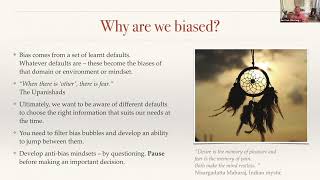
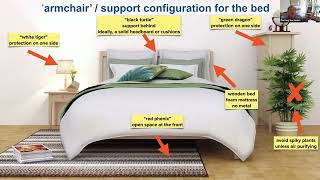
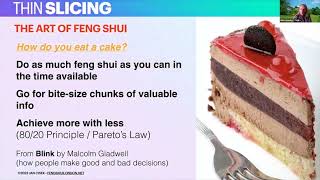
Okay, I'll just get closer so we can. Right, so just a quick overview of the talk. So why do we need to look at the unconscious bias, especially in feng shui practice, but also personal lives? What is bias? Different types of unconscious cognitive biases, and then kind of go into solutions. Pattern recognition, information gathering questions, lots of examples from feng shui practice. And I kind of finish with checklist, summary, and then Q and A. But feel free to write your questions in the chat box as we. As we go. Right. So why is it important? So. So I've got a good quote from Donald Rumsfeld, who famously said, there are knowns, the things that we know we know. We also know that there are known unknowns. That is to say, we know there are some things that we do not know, but also unknown unknowns, the ones that we don't know, we don't know. And that's an area of study in unconscious bias, because most people don't even realize that they have them. So we're going to explore that in the feng shui context, but also generally for making decisions in your personal and professional lives. So feng shui is a good servant, but a bad master. And unfortunately, a lot of people put their life into feng shui and that causes all kinds of false problems and feng shui biases. So obviously put feng shui into Your life is just a tool, it's just another way of looking at this world. And obviously there's a lot of bias coming from different places. But in feng shui there's a lot of bias and superstitions and kind of false problems that I'm going to talk about. So obviously you're going to become a better critical thinker if you are aware of your unconscious cognitive biases. And also it will help you to take your feng shui or whatever you're doing to the next level of operation so you get better, quicker and longer lasting results because you're going to use more kind of evidence based practices and you're going to make better decisions. So these are the benefits. So what is unconscious bias? So there are different names, unconscious implicit cognitive bias, different offers kind of make slight distinctions, but it boils down to just biases. But the classical definition of cognitive bias is that cognitive bias or thinking or brain bias are systemic errors in thinking that affect decisions and judgments that people make and they can affect you in different ways. Later I'll show you some books that I recommend. And one of the books is that unconscious bias can get you killed. So it's a serious subject. But generally speaking, biases are tendencies, assumptions, perceptions, opinions, limited kind of views, beliefs, ways of thinking about the world and that some things, ideas, people are better or worse than others. And usually they're unconscious. That's why most people sort of stick to this term unconscious bias. But some of them are conscious and you're probably aware of them as well, but maybe you haven't thought about them in that kind of framework. So I want to make a decision between biases and preferences because they are different, although there's an overlap. So preferences are if you like, I prefer tea over coffee. And that's based on your experience. You tried tea, you tried coffee for periods of time and you decided that actually you prefer coffee or tea, it doesn't matter. But biases, usually unconscious, are just kind of unconscious opinions and they're not based on reason or actual experience. So for example, all men are bad. That's definitely a bias because obviously we don't know all men and we have an experience with all men. And obviously these kind of two things, preference and bias, can affect each other. So one cause the other or the other way around. And kind of sometimes people start with the bias and becomes a preference. So sometimes people start with a preference and can become a bias. I'll give you some examples later. But so it's a useful thing to think. Oh, is it am I biased or just my preference because of the experiences? So it's a useful way of thinking about the whole subject. So why are we biased? So the bias. Most biases are kind of learned defaults. We learn them because of the upbringing, society, all kinds of things. And then they can become dominant in certain domains. Social, personal, business or environment or kind of general mindset. But I think that behind general bias is there's a fear. Obviously there are desire as well. This, you know, behind all the things that we're doing, those fears and desires, kind of our lives kind of oscillate between those two things, fears and desires. And Gina mentioned that there's quite a bit of fear in recent years. Yeah, but when there is other, there is fear and that's from a punishment. So whenever there is something different, people kind of might feel different. But some biases are inborn. And I'm not going to go into kind of the history of how they've studied it, but some bias can be inbound as well. So obviously you want to become aware of different kind of defaults, how you think, because that can affect how you make decisions and how you pick information that suits your needs at the time. Because things can change and your biases will change as well. And also you kind of think in terms of kind of bias bubbles. So you have a one particular type of bias and you were because this group of people think like that and maybe you want to join them because of the bias that you like or maybe you want to avoid them. Yeah, so yeah, so that's kind of general awareness of different types of kind of group of biases will help you to kind of maneuver between them. And obviously ultimately you want to have a kind of anti bias mindset. And that's kind of the purpose of this workshop, to kind of instill some of the principles and thinking. But basically it's about questioning. Once you learn to question things, then you'll be able to see whether they come from bias or not. And the kind of useful thing, especially before you're making any important decision, is pausing. You know, just pause and think about it. Don't rush, especially if it's an important decision. So obviously there are different types of biases and different groups of biases. Some domains have less or more bias. So physics, maths or kind of core sciences have less bias because, you know, you kind of can't have a bias. You know, about maths, for example, two plus three equals four, you know, people accept that as a fact. Yeah. Or you know, water H2O2 or physics, electricity or facts like, you know, general facts like Paris is the capital of France. There's no bias really. I mean, today it is. We don't know in the future where it's going to be, but at the moment that's a fact. But once you move to an area where there are people, people in social issues, science, health, politics, climate, et cetera, anything, then there's more bias, actually that creates humans interactions, opinions create a lot of bias. So, you know, I could mention a few words, keywords, and this video would be banned on YouTube. Yeah, on Google. So, for example, Paris is a romantic or dirty. It's just bias. Yeah. So you see this picture on the right and it's a famous picture and it's presented in a particular way. Spoiler. It was staged. You see, just knowing, you know, you might think, oh, and I've seen, I've had clients who thought it was the real picture and they like it, they put it in kind of, you know, to enhance the relationship. But once I said, sorry, but it was staged, that's the fact. Then suddenly it changes how they see this picture. Interesting. So you can change your way of looking things depending on the facts, but I still like it. It doesn't matter even knowing that it was primed and set up, but it's still a nice picture. It tells you something and it's kind of a story, if you like. So your mind will frame experiences in different ways depending on your memory, literally depending on your memory and expectations. So Google is biased. So let's give you some examples. So definitely it censors most of the information and has dominated 9% of the search market. Yeah. I'll give you some alternatives to go, but it's a useful thing to think about your bias as a kind of social, personal censorship. Yeah. So that's another way of looking at your bias. So in Feng shui, we have lots of kind of superstitions and kind of socially or culturally specific mindset. So for example, number four has kind of bad reputation, basically because in Chinese number four sounds similar to the word death. But it's interesting enough, I had clients who literally rejected a perfectly good house just because of one criteria that it had number four on it and they were not Chinese, so that wouldn't actually affect them. We don't have a similar negative association. If I was from Chinese background and I didn't like the word deaf, I had problems with this concept. Maybe I would avoid a house with number four or just remove it. So in this case, there's a picture. Somebody tried to rectify this problem with number four by painting red because red color is good, number four is bad, but red car is good. But maybe you can see, but it's on the left side. The lamp is not working. They forgot about fix the lamp. I think that's more important. And obviously if you expose the same information again and again and again, you start to think that it's true, but it might not be. So a lot of people kind of avoid in kind of Eastern countries, hotels don't have the number 4 floor or the number 4 doesn't appear on doors and so on. And people go to hospitals, they avoid number four bed. So again, so it's a culture specific bias. And toilets, notoriously toilets have bad reputation. Feng shui, if you look at books on feng shui, always say toilets are bad. You know, I had so many clients calling me and asking, oh my God, I read, you know, this book, you know, I'm not going to mention the name of the book. It would be fair on Lillian too. And the toilets are bad, you know, and I start questioning them, you know, what happens? It's like, you know, did you have any problems before you read the book? Not really. Once I read the book, it gave me a lot of false problems. So you need to be aware of that as well. That, you know, not everything that is written is true. And obviously directions, it's a big thing in feng shui directionality. So facing good or bad directions can affect your performance. I'll give you some examples later. And astrology, so then we have the interpretation, prediction bias and so on. Now just for the record, I'm not against classical feng shui, astrology, all those things. Yeah, I look at them and evaluate them and I see what's good about and why people have that sort of perceptions. But if it works for you, by all means use it. But also it can give you false problems. Seem to be aware of that. So another example, mirrors in bedrooms are bad. A lot of books on feng shui state that. And the kind of classical view of that is that Oriental people thought that, you know, when you leave, when you fall asleep, your spirit leaves your body. And if it sees yourself in a mirror or if it's coming back to kind of to the state of awakefulness, it can get lost in the mirror. So that's kind of a slightly superstitious, but maybe there's something in it. Yeah. So we know, we don't know really. Maybe they have a perception that it might be true. But this you know, when you look at evidence, there's no evidence in, in terms of the research, but evidence based luxury suggests that light obviously can affect melatonin production. So if you've got lots of kind of light reflecting objects like mirrors, that will affect how your brain works and it will affect your sleep. So there is something in it. So maybe it was just kind of observation start, but then they came up with this explanation about the spirits. We still don't know. I actually personally believe that actually your spirit, your soul kind of leaves your body, but we don't really have a study on that yet. And obviously psychologically or kind of physically seeing your reflection in the mirror at night can startle you. So it's not a good idea generally speaking, but during the day it's not a problem. So most people cover the mirrors for the night and as long as it's not reflected it's not a big deal. But in the case of this picture, a bigger problem I can see is the metal bed. That will definitely create some problems because it can amplify electro smog and that definitely will affect your sleep. So the two problems here in this, but the wallpaper, again that's preference. I wouldn't be biased about this. Whether I like it or not doesn't matter if the client likes that soft wallpaper, it's not my problem. So there are lots of different types of biases. There are over 100 biases, so I'm going to pull out a few that are kind of important. So confirmation bias. So profession noticing, seeking and recalling information that confirms your mindset, cognitive models, preconceptions and beliefs. So you know, you start to see whatever you want to see. You'll start to see more of that in your, in your world. And I'll give you some examples later. Congress bias. So testing ideas by seeking evidence that supports rather than refutes them. So instead of looking at the kind of competing theories or opposite or different evidence, you're just looking for evidence to support your bias. Fundamental attribution error. So there's a tendency to place blame on external events and unfortunately that's a quite a big problem. Feng shui, A lot of people blame their problems, personal, professional, whatever on physical environments for the physical stress. And to some extent it's true because sometimes it is the case, but most of the time it's not actually. So the environment will affect you and will kind of prime you for certain things. But it's not the only thing you can't say that, you know, environment made you to do Something. Yeah, I mean in some cases may, maybe, but it's. It's an error in thinking and clustering illusion, seeing kind of phantom patterns in random events. And I'll give you some examples later. So first step, awareness of the problem. Once you know that we're all biased and it's very difficult, we'll talk about that later. It's very difficult to get rid of all the biases, but recognize your bias and start managing, kind of start the biasing process. So less bias is obviously better than lots of bias. So I give you an example. So I'm biased and I'm biased against Microsoft. And the reason is that I actually never use Microsoft all my life from the beginning when I got my first computer was a Mac computer. And Obviously I use PCs from time to time, but I don't really have a lot of experience of using Microsoft. So if I had a lot of experience like using it more or less the same time as I'm using Macintosh computers, then that will become a preference. But at the moment I don't have much experience in using Microsoft and I'd use it and I didn't like it and could be kind of preference. So that's definitely my bias and I recognize it and I can live with it, it's not going to harm me. And obviously I've got more friends who use Macintosh computers that friends who use PCs. Obviously more people use PCs, but kind of gravity to people because we exchange information, how to use it better then do meta search for things. So seek definitely information from different sources to make some kind of generalization, talk to others, have diverse group of friends listening to the opposite point of views, learn how to read scientific papers. A lot of people kind of frightened of scientific papers for no reason and especially to focus on methodology and quality and obviously statistics, yeah, can be frightening. But there's some good books now. You read one or two good books about how to read scientific papers, how to understand science, how to understand statistics, and literally no time you'll be on top of this subject. You're not going to be probably statistician because you don't want to be, but you understand how it works so you can pick up better quality research. It's not about the amount of research because you know there are lots of research papers on certain things, but the bad research, the methodology is bad, it's not well designed, et cetera. So the quality of the research is more important than the content. And obviously top scientific papers are about that. Most top scientific papers will reject just the first draft of 95% of research that comes their way is rejected just almost automatically. So and also that's obviously you're going to use Google, but for research you go to Google Scholar. Much better. I'm sure you've heard this phrase, garbage in, garbage in, garbage out. If you ask the wrong question, Google will get lots of irrelevant information. Now Google gives you suggestions you probably don't remember. Long time ago Google didn't give that option and they realized that people were not very good at search. But Google score useful for scientific research. And there's a new search called pre search which I recommend you try and it promises that it's better than Google. It's more objective, it's more diverse. Obviously you can use all the other search engines within that Pre search search and plus you can get paid for searching on it. So you have to register and you get points and you can kind of, you know, you're making kind of money in tokens if you like. So the key thing is question things and learn how to ask good questions. And that's the next section of this presentation. So one of the checklists is learn how to recognize patterns because patterns will help you to make better decision. And the first one is a very simple three words to remember and or not. That's the most basic algorithm. All the algorithms that run all the technology, including your computers now are based on obviously very complex algorithms. Algorithm is like a recipe. Think about algorithms. So you know you've got an algorithm for baking a cake. Yeah. So you've got a steps and the certain things. So those three words and or not is like a gatekeeper. So you know, you're looking at information and then you start to connect to other bits of information or you look for alternative or not. That's not the case, not relevant. So those three words kind of. And we do that automatically. We just maybe not consciously, but we do it. We're doing it this sort of algorithm decision making. Naturally, obviously when you're looking at information, you're going to analyze it, but also you're going to synthesize this to make some generalization. So you're breaking things down but then putting them together in different ways. And obviously there's a difference between observation and interpretation. So if you look at this picture on the right, there's a lady and she's leaning forward and she's trying to figure out the numbers. So the interpretation will be there's a lady, it's a fact, she's wearing a suit, looks like a woman and she's leaning forward and that's observation. And maybe that's why she can't see the numbers. But interpretation would be, oh, she's not very bright, she should look back, she should stand back to see it. That would be interpretation. So as feng shui consultants or enthusiasts, we need to look what. What's factual and observe. Switching on the observation mode is more important than kind of interpretation. You can look at that later. But don't start to mix the observation interpretation because you'll get confused. And kind of basic pattern recognition questions. What changes the most? What is exaggerated the most? What is repeated the most? What is missing? So obviously in your environment, you have places where there's a lot of change. Staircases front and back, inside and outside. All the areas, different rooms have changed. So you look at those spaces and that inform you about the general kind of energy flow or whatever you're looking for. What is exaggerated? Too much of something, the whole place is white or the whole place is made of wood or whatever. Too much of one element or the other that will inform you about certain things and what is repeated. People repeat things, especially representing things, what's happened in life. And I've seen it many times that single people have a lot of pictures of themselves walking on an empty beach or on a desert, and they're surprised that they're single. Obviously that's a representation of the state, but also it primes them and kind of hooks them or locks them in this pattern. So by changing the images, they prime themselves for a different outcome. And obviously what is missing. I'm going to give you an example in a minute. But generally it's looking for difference in sameness. And our brains are amazing. There's a quote here. So we have 300 million pattern recognizers in the neocortex we designed to recognize patterns. You wouldn't be able to listen to me if you didn't recognize the pattern of sounds that sound like English with a Polish accent. So an example of kind of this missing. You know what's missing? Yeah. And also there's a. There's a Dan in Kruger bias, thinking we know more than we do and underestimating what we don't know. So the client and she had a particular sleep problem. She had only one problem, and her problem was she had problems falling asleep. She didn't have a problem sleeping, but she had a problem. So it would take her sometimes one hour, twice, sometimes three hours to fall asleep. So before I came, she asked two kind of classically oriented practitioners, and they tried different things they thought maybe the position of the bed wasn't aligned properly. So they moved her bed around. She didn't like it. She was very neat. She had a very nice neat place. Everything was organized, kind of slightly symmetrical and you know, it messed up interior design of her bedroom where she had to move the. She didn't like. It didn't work actually. And they check astrology, why was happening this particular time and so on and still no improvement. So she called me and I start asking questions. Yeah, so the first question I asked is, is the time where you don't have this sleep problem? So what's missing? Yeah, so she said, oh, when I'm going to sleep from Friday to Saturday. Saturday, Saturday. I don't, I usually don't have a problem. I can quickly, can fall asleep. So I thought just work day, maybe it's kind of work, work related. I said, do you like your work? And she said, no, I love my work. I'm very good at this. She was very proud of this. She was a PA and she was well, well paid. So I'm very organized. And so I'm thinking maybe she brings work to her personal life and maybe that's why she's processing before, before she goes to sleep. And I said, do you bring work from home? No. 5:30, I finished because I'm so organized, you know, I never bring work. So, you know. So then I ask, run me through your evening. What do you actually do? I said, well, you noticed, I'm very organized. Everything is neat, everything has its own place. So before I go, you know, to work, next day, I organize my clothes so I know what I'm going to wear. I have a bath, I wash my hair and I maybe read a bit some kind of inspiration and go a novel, whatever. And then I can't fancy so already check lots of different things in her van. So she actually read my blog about bedrooms and she already, you know, she was switching the WI fi. She had a foam mattress. She didn't have all kinds of things she was doing, but still she couldn't fall asleep easily. And then I said, de, dry your hair after you've washed and said, yes, of course. And that was the problem. The hair dryer. So her hair dryer was zapping her brain with electrosmog and inhibiting melatonin production. Now it's not universal. A lot of people who dry their hair are problems with me. But in her case she was kind of hyper electrosensitive to this particular frequency. So she changed the habit and her problem disappeared. She then later look at, you know, different hair dryers that have low radiation. Some of them were better than others, but she still kind of had to kind of wash her hair in the morning. And so the point I'm making here is that questioning it doesn't matter whether it was classic feng shui or intuitive or evidence based function, it doesn't matter. Questioning got me to the right answer. And then obviously I wrote a blog about it because I realized like I knew about it because I knew about that thing, but it wasn't obvious in the environment. You know, her hair dryer wasn't lying there so I could notice and I could be, oh, maybe it's a hairdresser. So I had to go through this questioning process to find out what, what was wrong. And, and even if you don't know much about feng shui, you can get that free, right? Questioning you get if it wasn't, if it wasn't working, obviously it worked, it wasn't working. I'll keep going. I would find the, the real answer to that problem. So it's not just that we don't know what we don't know, but also we don't really know how to ask good questions. Kind of be like a kind of Sherlock Holmes. So I put my Sherlock Holmes hat and that's how I figure out. And actually there's a book about that. I'm going to share that with you later. So there's a little joke here. So, dude, why did you try to rob the bank without even a mask but I had put lemon juice on my face to make me invisible? And that's the Dunning Kruger effect. And it's a joke. But in real life there were similar cases. There was one guy who robbed the bank and he demanded the money. He had a mask, but he demanded his demands that I want money or I'll kill you on a piece of paper that he pulled out from his bag. He didn't check that. That piece of paper on the other side had his bank details and his address. They caught him in two minutes flat. So that's that example. And there's lots of other examples where people rob banks and they made stupid mistakes. So random events, there's a name for that, apophenia. Apophenia is kind of spontaneous perception of connections and meaningfulness in unrelated phenomena. So sometimes there's random events and sometimes there is a pattern. So in this case there is a pattern. So if you look at those shapes in red, they kind of look normal, but actually there is a Pattern. So sometimes there's no pattern, but sometimes there is pattern. So you kind of start to look at those things in those concepts. So if you haven't seen this picture, to most people it look like a landscape with two horses, one rider. And some people already see a pattern. Are you seeing faces?
Yeah.
Yeah. So some people see face. Maybe you've seen this picture before. So some people say, so I'll show you all the faces. So the 13 faces. So now you're seeing them. So even if you haven't noticed this face on the right side, I point that to your eyes, nose, mouth, and looking up to the left. And then it looks like a face. So we can agree all of us look like a face. Yeah. Now try not to see it. And you see, that's the recognition bias. You start to look for certain things. You see them. People see faces in clouds. There are no faces in clouds. It might look like face, but they're not. So people can. Most of that will start to prime you. So you know people who have certain images in their homes, those images will prime them for certain things. Yeah, so you need to be aware of that as well. And find the five below so quick. You know, it's not random, but lots of digits. And usually most people kind of stand back and kind of look and they just notice those fives. Yeah, but also there are other numbers. There's like three and there's eight. So your mind has this amazing ability to notice what you're looking for, but also notice other things because you have two kind of types of attention, kind of narrow focus. I'm looking for five, but also broad vision. I'm noticing other things. And that kind of broad vision is even more important because it helps with survival. And unfortunately, because of the little devices called mobile phones, we lose peripheral vision. And that's important when you do a feng shui, you need to see more, not less. So I'm sure you've seen this little kind of puzzles. So is it a rabbit or dog? Depends how you look at it. And on the right, is this an old lady or young bright? So I'm sure you've seen this kind of change your perspective and you see something else. So let's talk about truth. So truth is just a concept. There's no such thing as the truth. Yeah, because it can change. Even, you know, the capital of Paris, you know, it might change in the future. We don't know. So it's not forever, but. So it's kind of personal truth, if you like, or a truth so but there are two types of knowing. So the kind of factual propositional facts. Yeah. And in French and in German they have word for it. In English we don't actually, which is a shame. So in French savoir or German wissen. It's kind of about that factual knowledge. So Paris is the capital of France. It's fact. H2O is water. It's true or false. Is Paris capital of France? Yes. Is Berlin the capital of France? No. And there's another type of knowing, kind of normative process knowledge where you're kind of learning and developing and basically learning. And in French is connetre and in German it's canon. So it's to know place like Paris. Yeah. So you know, I've been to Paris a lot of times I can't call myself Parisian. I know it quite well. I like. But you know, not whole Paris yet, but they'll be a Parisian and they know very well they've been. They live their whole life, they've seen all the areas and they can call themselves a prison, but they're still learning, see. So it's another way. So you need to distinguish between actual facts, this kind of proposition knowledge and kind of this encounter knowledge, if you like, where you learn things all the time. So let's get to some other checklists. So kind of basic things to things and we'll have a later session about checklists. So kind of develop this as well. And actually I did a presentation 2010 and you can watch that presentation on my website. I'll give you the links in the chat shortly. So a story is not a fact, it may not be true. A fact is not data, it may not be representative of that fact. Data is not evidence may not be supportive. So again, the quality or the quantity of information or data will inform you. Evidence may not be the proof, it may not be universal. So that lady with sensitivity to hair dryer, a lot of people don't have that problem. It doesn't affect them. But it was true for her. Correlation is not causation. Because two things worked put together doesn't mean they cause each other. And that's also correlation policy. So is it true? Only if yes is it a fact. Is it representative? Only if yes is it data, is it supportive? Only if yes is it evidence. So you kind of ask those questions, you know, once you start to question, they become kind of a default and you now notice things much quicker than you know before. Another checklist and let's call cognitive bias mitigation strategy and the diagram Is slow. So slow. Sure. What about and why? S for sure. What about and why L for look at that data. What is lucky? You know, what's missing? Oh, what is the opposite, you know, so you're looking opposite point of view or opposite theory and the worst case scenario scenario, what else this could be, you know, so you're always open to other explanations. So can you keep an open mind? So make yourself aware of the cognitive biases practice that of gender alternatives. Yeah. Look always at rival theories. Be mindful, this is important. So a lot of people go into kind of default automatic way of thinking when they're under stress, fatigue, mood or you know, not well, extreme happiness as well. So it's not kind of, you know, negative things, but also extreme kind of happiness. You know, fall in love and suddenly your brain is working a different way. You know, your love is kind of clouding everything, multitasking, you know, they can affect your decision making. So plus question your intuition hatches most of the time they'll be accurate. But also check. Yeah. And this idea of pausing is very useful. Yeah. So pause especially before making important decision and I'll help you to shift the perspective. And also in the whole process you're going to learn. Yeah. And be aware that there will be other points of view that can contradict your established norms or beliefs and it's useful to be exposed to them. It doesn't mean you have to take on them, but you can kind of exercise them as faults. So in summary, everything comes from a particular point of view and your judgments, your decision, your values will be affected, including feng shui. Seek diverse information, surround yourself with challenging points of view or challenging things. But people are still free to make decisions even if they're not in the best interest. So if somebody believes that number four is bad and they're not even aware of the association because they read it in the book and that's their belief that it will kind of affect them. So maybe they shouldn't bite. Yeah, yeah. You know, so. Or east facing houses, you know, the directionology. There's not much evidence about directions. I probably have two papers on directions and one is about the axis of east and west and how people sleep when they're facing those directions. And the other one is kind of more animal based studies where north, south. And then a lot of animals when they sleep, they align themselves to the north so the head is pointed to the north. And in many cultures in Estonia and Poland, a lot of people try to sleep with the head nose because they kind of believe that, so there is some evidence, but also there's a belief system behind it. But you know, if it works, as long as it works and it doesn't give you a false problem, it doesn't give you fear or stress, doesn't matter really. Yeah. So use tools, you know, access the information. I list most of my resources and references so people can check and make the decision. Yeah. Most of the time, my advice, kind of evidence based. Yeah. And if it's not like astrology, I'll tell them at preemptives, like, look, there's no, you know, I know astrologers have PhD in astrology. There's a lot of research into astrology, but there's no evidence how it works. And because of the interpretation. Yeah, they agree on a lot of things. And I'm not saying, I'm not saying it's bad. I pull out, I use astrology and people ask me, I'm happy to kind of. But most of the time, you know, it'll be a particular type of astrology which is very positive. You know, I'll never predict anything bad because you can't really, you know, you can't predict anything as such. So use different tools and kind of list your references and then be open to any ideas because even if they're nonsensical. I learn a lot through superstition, through kind of false problems. Yeah, because you learn something new, you start to unpack why people would believe that, you know, why, for example, toilet in the northeast part of the house is a bad idea in Vastu Shastra? Well, because in the old days, the plumbing and the whole mechanics of toilets was very advanced. And actually northeast part of the house is the coldest part of the house. So there'll be more mold. But nowadays that's not really a big problem. But people made this kind of interspersive because gods or whatever is affecting you from that direction. And they kind of. So useful thing is like if people tell you something like why do you believe that? You know, where is the evidence? You know, can you explain that? But if you dig deep enough, usually it's a practical explanation that why ancient people or you know, in different cultures had certain beliefs. Yeah. And. And finally. Well, not finally, but so Niels Moore said, you know, when they asked him about feng shui, he used the shoe. Horse, sorry, horseshoe, horseshoe over his. His dog. And that's feng shui for prosperity. And they asked him why using this man of science and you believe in the superstition. And he said, I understand that it works Whether you believe in it or not. He went beyond his own belief system. Yeah. So it's not harmful, it's nice, people like it, it's kind of fun, you know. And you know, it's not a big deal really. So he used that obviously he studied different types of biases. I'll give you some books. There are lots of biased trainings or tests. Most of them are kind of for organization and companies, but ultimately seek diverse information, look at it from different points of view and that will give you a bigger picture. Open your personal vision as well. So this is a long list. So I've speed read over 100 books for you so you don't have to read them. So this is the list. I'll put that link in the chat so you can go to that page and you see all the books and But I pull out a few books for you. So this book I mentioned earlier, cognitive bias could get you killed. So it's kind of a detective story, kind of factual books and you learn about some basic bias. It's kind of fun thing. And at the moment I think it's free on Kindle if you've got the subscription. And then Henry Priest got two books basis and heuristics. So like 50 biases and then for business 101 biases. Yeah, and Think again. Adam Grant is kind of how people think and then masterminds. Marina Kournikova. It's about how kind of switch on your Sherlock Holmes kind of deductive thinking and lots of books about how to think like shortcuts. I really recommend start to notice things in a different way, in a more kind of factual way. So kind of start with this and so I'll finish with this. Become wise and knowledgeable. So obviously the illiterate of the 21st century will not be able will not be those who cannot read and write, but those who cannot learn, unlearn and relearn. That's an old quote, but we've got a better quote from Lao Tzu. If you want to become knowledgeable, learn one new thing every day so you get more information. If you want to become wise, unlearn one thing every day. So I hope you learn some new things, but also you're going to start unlearning some things. But how do you go beyond that really? Because you know, in personal development go forever in a personal development is almost infinite. There's so much you can do. So we've got some information and advice from again Lao Tzu and this Indian mystic, Nisargata Maharaj. And they suggest that, you know. So I'll read the quote from the Maharaj. So a quiet mind undistorted by desires and fears, and that's the basis of most biases. So a quiet mind, undistorted by desires and fears, free from ideas and opinions, clear on all levels, is needed to reflect the reality. Be clear and quiet, alert and detached, and all else will happen by itself and the same from now. So you can be still, look at it, detach yourself, so you can see how things are and then things will start. So you're moving to a level beyond this. You can't solve it on the Ultimately, you can kind of manage it on the level of personality. We have to go beyond kind of transpersonal level. So that's kind of useful way of looking, how to go beyond that. So it's kind of a shortcut if you have and I finished with this quick story. So Asclepius and Two Travelers Asclepius was once sitting by a small stream in the countryside outside Athens, having his lunch. Just at that moment, a traveler came by. Excuse me, said the man, I'm going to Athens and I've never been there before. Have you any idea what it's like? Where have you come from? Asked Asclepius. Piraeus. I think Christian will correct my pronunciation. So. Piraeus, said the man. Well, what's that like? As Asclepius? Oh, it's a dreadful place, said the man. Full of traffic and noise and dirt and unfriendly people. It's a terrible place. Don't go there. Well, I expect you'll find Athens just the same, said Asclepius. Oh dear, said the man, and he walked slowly on his way while enjoying his lunch, when Asclepius was interrupted by another traveler. Excuse me, said the second man. I'm going to Athens and I've never been there before. Have you any idea what it's like? Where have you come from? Asked Asclepius. Piraeus, said the second man. Well, what's that like? Asked Asclepius. Oh, it's a wonderful place, said the man. Full of life and gaiety and colour and friendly people. It's a fantastic place. Well, I expect we find others just the same, said Asclepius. Oh, good, said the man, and he walked briskly on his way. Asclepius smiled and took another bite of his bread and feta cheese sandwich. It was delicious. So my name is Jan. I'm still biased less because I've worked on this presentation. So I'll put some links to the chat. So I've got. Actually, I did a blog some time ago about this thing, so I'll put some links in the chat. I don't know if you've got any questions or good time for questions.
Jan, do you want to unshare your screen? Everybody's made it over. And also you can put your contact details in the chat as well. That was fantastic, Jan. Very full, very good insights in there. We may well have questions, but we are coming up to a break. Okay, so let's see if somebody has a question on the chat. At least we can log them on there and we decide how we handle them. But we've got other gaps today where we could do that. You've got you shared about the blog post. What about. Do you think you might make your PowerPoint available to people?
Oh, yeah, of course. Yeah. I mean, obviously this is recorded, so.
Yes, this is recorded, but there's some very good data there. I mean, I just absolutely. In source. The power of a question. There are books just written about questions, asking good questions. That's really great.
Okay, I've just posted in the chat all the links that.
Okay, well, nobody's flagged up a question yet, so shall we go? For our scheduled break, it's 11 and we've got on the schedule for people to have.
More from Jan
Feng Shui Logos – How to Design Logos and Business Cards with Feng Shui Principles – Jan Cisek UK