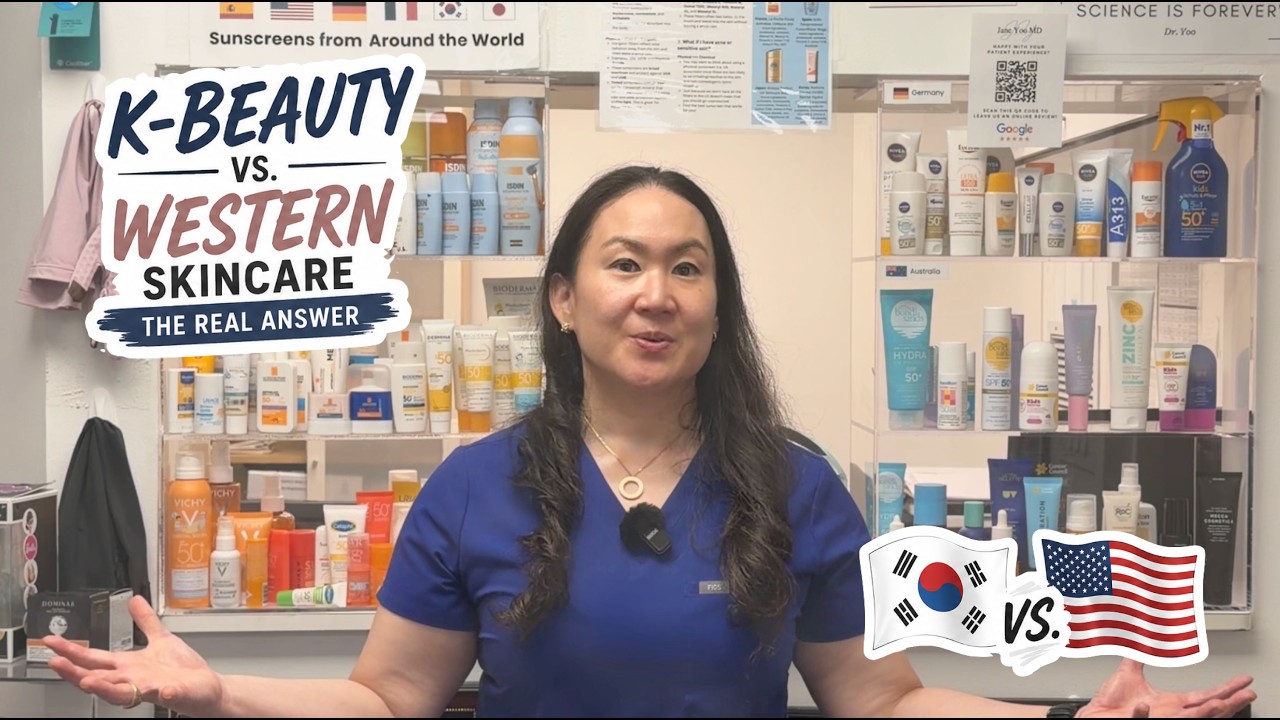
In this video, board‑certified dermatologist Dr. Jane Yoo compares Korean (K‑beauty) and Western skincare philosophies, highlighting their distinct focuses, strengths, and innovations. She explains that K‑beauty emphasizes prevention, barrier health, gentle layering, advanced device technology, elegant sunscreen formulations, and sophisticated ingredient delivery, while Western dermatology prioritizes regulatory rigor, prescription‑strength actives, and an evidence‑based, condition‑specific approach. Dr. Yoo argues that neither system is superior; instead, she advocates an integrative routine that starts with a Korean‑style barrier‑first foundation (gentle cleansing, hydration, layering, high‑quality sunscreen) and adds US‑regulated prescription actives (e.g., retinoids) when clinically indicated. This combined strategy leverages the preventive benefits of K‑beauty and the therapeutic potency of Western dermatology to provide patients with the best of both worlds.
Chapters
Hi everyone, I'm Dr. Jane Yoo, board-certified dermatologist and Mohs surgeon. Today I want to talk about K-beauty versus Western skincare, where the two approaches actually differ, and what I recommend to my patients. Although I'm Korean, I trained in the US and I've spent years studying Korean dermatology and devices. Patients constantly ask me which approach is better. The answer is that I don't think one is necessarily better than the other. Because they're built around different philosophies and I think there are benefits to both. Korean skincare culture is largely built around prevention and barrier health. There's an emphasis on layering, gentle daily maintenance, and taking a long-term view of your skin as something you protect over decades. US dermatology tends to be built more around concentrated active ingredients and evidence-based, condition-specific regimens. Think prescription-strength retinoids and targeted treatments for specific diagnoses. Neither approach is wrong. They're just different starting philosophies, and I don't think they need to be framed as competing with one another. Where I think Korea generally leads is device innovation. The pace at which new HIFU and radiofrequency platforms come out of Korean manufacturers is faster than almost anywhere else. Korea also does an excellent job with sunscreen cosmetic elegance and filter technology, which I've talked about in some of my other videos. And ingredient delivery systems, meaning the way certain actives are formulated to penetrate the skin and remain stable, can also be viewed as very sophisticated. Where the US system really leads is in regulatory rigor around efficacy claims, access to certain prescription-strength active ingredients that aren't available over the counter, and a deep evidence base specifically for medical dermatology. This becomes particularly important when we're treating an actual diagnosed skin condition rather than focusing primarily on cosmetic concerns. In my own practice, I don't pick a side. I like to borrow from both approaches. I might build a Korean-style barrier-first foundation with gentle cleansing, hydration layering, and a well-formulated sunscreen. Then, when clinically indicated, I can layer in US-regulated prescription active ingredients like a prescription retinoid or another targeted treatment for a specific diagnosis. That combination is what I think can give patients the best of both worlds. You don't have to choose between K-beauty and Western skincare. You can take the emphasis on prevention, consistency, and barrier health that Korean skincare does so well And combine it with the evidence-based treatments available in Western dermatology to build a routine that actually works for your skin.