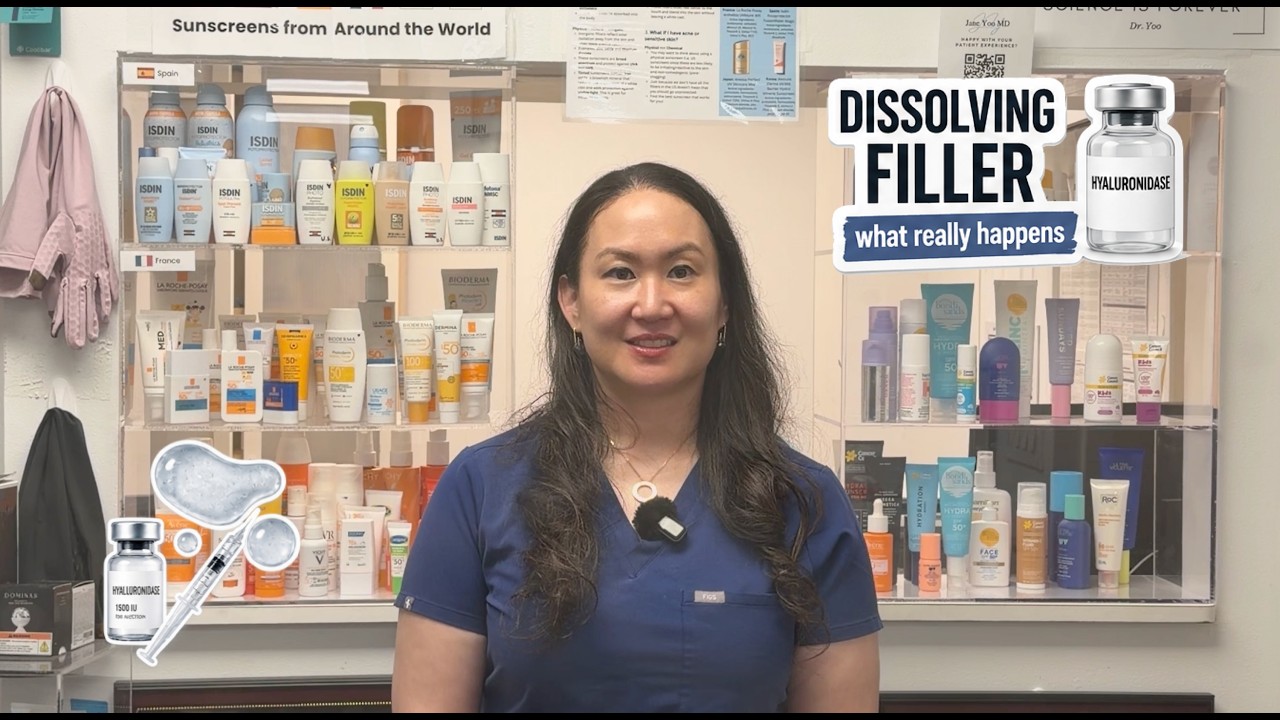
Dr. Jane Yoo explains why under-eye filler often causes regret: the skin is paper-thin, hyaluronic acid attracts water, and the anatomy is complex. She warns against dissolving filler without ultrasound imaging first, since what looks like migration might actually be aging fat pads, and unnecessary removal can leave hollowness.
Chapters
Hi everyone, I'm Dr. Jane Yoo, board-certified dermatologist and Mohs surgeon. Today I want to talk about under-eye filler migration, why the area is so unforgiving, and what you need to know before having under-eye filler dissolved. The under-eye is one of the least forgiving areas of the face, and it's where I see a lot of filler regret. If you've had tear trough filler and now feel like you look permanently tired or puffy, This is for you. Under-eye filler problems can show up as persistent puffiness, a bluish or grayish discoloration, or a distinct ridge or bag under the eye. The under-eye has extremely thin skin and very little room to accommodate extra volume, so filler that is placed too superficially or in too great an amount can become very noticeable. And unlike the lips, this area can sometimes look fine initially, and become problematic much later. This is also not an area where I think you should start dissolving without first understanding exactly what's there. There are a few anatomic factors that can help explain why this area can be so difficult to treat. First, the skin around your eyes is some of the thinnest on your body. There is very little tissue to camouflage filler that is sitting too superficially. In an area like the cheek, a small irregularity may be much less noticeable, but under the eye it can be immediately visible. Second, hyaluronic acid is hydrophilic, meaning that it attracts and binds water. That property can be helpful in certain areas, but under the eye it can contribute to persistent or fluctuating puffiness. This is one reason someone with under-eye filler may notice that the area looks puffy puffier in the morning or at certain times. Third, the anatomy of the tear trough is complex. There are ligaments and different tissue planes that affect where filler sits and how it appears. If too much product is placed, or if it is placed in the wrong plane, it can create visible fullness or irregularity. Now, if you have a bluish-grayish or slightly translucent appearance under your eye that wasn't there before filler, You may have what is commonly called the Tyndall effect. The exact optics behind this appearance are actually more complicated than the classic explanation you may have heard about light scattering, and the mechanism has been debated in the literature. But clinically, the important point is that this type of discoloration can occur when hyaluronic acid filler is sitting too superficially beneath thin under-eye skin. No concealer or skincare product is going to change where that filler is sitting. If superficial hyaluronic acid filler is causing the discoloration, dissolving the filler can improve it. But there is another distinction that matters even more, and it's one that gets missed all the time. Under your eyes, you naturally have fat pads. As we age, changes in the ligaments, skin, bone, and surrounding soft tissue can make these fat pads become more prominent. That can create a bulge that looks like an under-eye bag. That is not the same thing as migrated filler, and if the fullness you're seeing is primarily your own fat rather than hyaluronic acid filler, hyaluronidase is not going to dissolve it. In fact, unnecessarily removing filler from an area that is already volume deficient could make an under-eye look more hollow. A lot of people who come into my office convinced they have migrated under-eye filler may actually have a combination of things going on. There may be residual filler, age-related changes in the fat pads, loss of support from the midface, or a combination of these factors. Trying to treat all of these things the same way is how patients can end up hollow and disappointed. Another story I hear all the time is, I had tear trough filler several years ago. It looked great, and now I look puffy. But I was told that the filler should already be gone. Hyaluronic acid filler can persist much longer than the duration patients may have originally been told. Imaging studies have demonstrated residual hyaluronic acid filler in the face years after injection, although much of the published imaging literature involves the midface rather than the tear trough specifically. At the same time, your face continues to change around that filler. Skin becomes thinner, the cheek and surrounding soft tissues change, and the under-eye anatomy changes with age. Filler that wasn't noticeable several years ago may become more apparent as the surrounding tissues change. This is why I use high-resolution ultrasound before treating complicated under-eye filler cases. Ultrasound can help me determine whether filler is actually present, where it is located, what tissue plane it is sitting in, and its relationship to the surrounding anatomy. That can be especially helpful when I'm trying to determine whether an under-eye bulge is related to filler or whether I'm looking at the patient's own anatomy. The under-eye area is also a highly vascular area with important anatomy, so I would rather know exactly what I'm treating than making assumptions based on appearance alone. Ultrasound guidance has become particularly important in the discussion around filler complications and vascular compromise. In elective dissolution, I use that same principle to make treatment as targeted as possible. I want to treat what I can actually identify rather than treating based on a hunch. So what does recovery look like after under-eye filler dissolution? Well, you can expect swelling after hyaluronidase, and because we're dealing with the under-eye, even a relatively small amount of swelling can look dramatic. What you see immediately after treatment is not your final result. You may also feel like you look more hollow once the filler is gone, particularly if you've had under-eye filler for several years. Remember that you're not necessarily returning to the face that you originally had when you received the filler. Your face has continued to age and change during that time. That's why I like to give the area some time to settle before deciding what, if anything, should be done next, and I don't the answer is always putting filler right back into the tear trough. For some patients, the better approach may be addressing midface support. For others, it may be a treatment focused on skin quality. And if the primary issue is prominent under-eye fat pads, the appropriate next step may be a surgical consultation rather than more filler. The goal isn't to dissolve filler just because something looks puffy under the eye. The goal is to figure out what exactly is causing the problem. Once you know whether you're looking at filler, your natural anatomy, age-related changes, or some combination of those things, you can choose a treatment that actually makes sense.