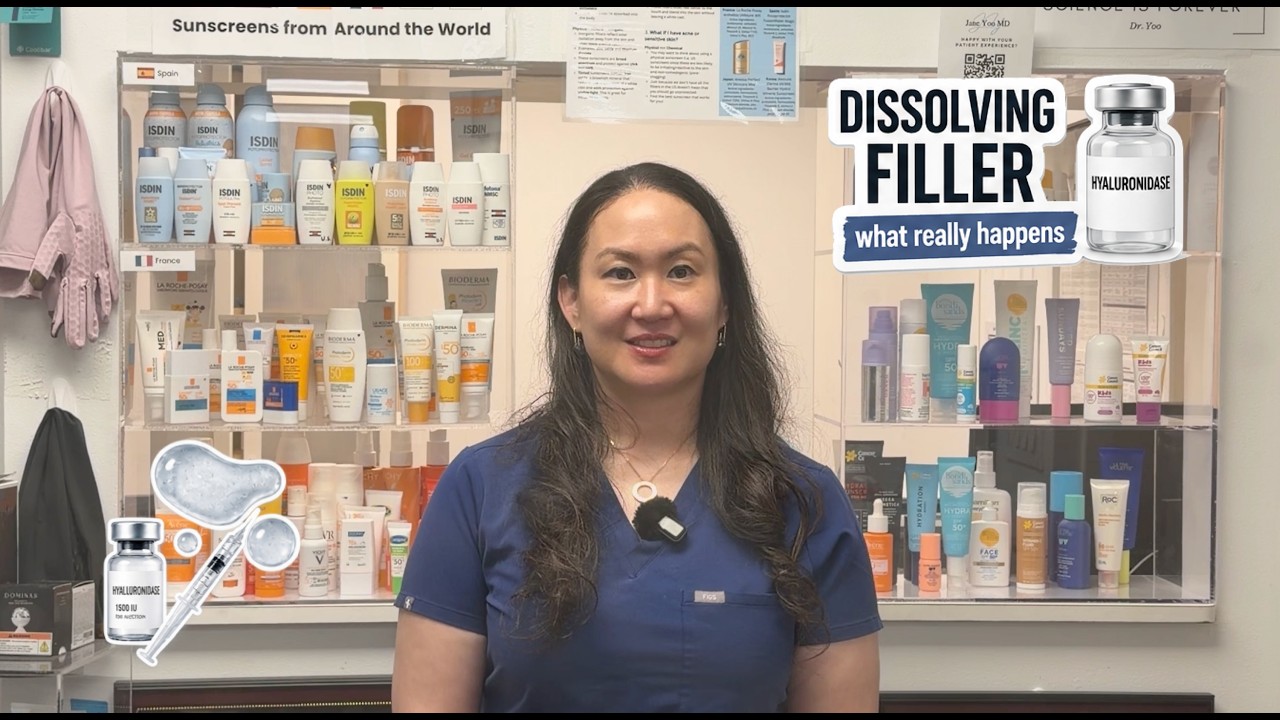
Dr. Jane Yoo explains how hyaluronidase dissolves hyaluronic acid fillers like Juvederm and Restylane by breaking down the polymer. It doesn't work on non-HA fillers like Sculptra or silicone, and highly cross-linked fillers may need multiple sessions. High-resolution ultrasound helps identify filler type and location before treatment.
Chapters
If you've been told you need your filler dissolved, or you're looking at your face thinking something is off, I want you to understand what dissolving actually is before anyone injects anything into you. Hi everyone, I'm Dr. Jane Yoo, board-certified dermatologist and Mohs surgeon. A meaningful portion of my practice is treating patients who come to me to have filler taken out rather than put in. Let me give you the direct answer first, and then I'll explain the parts that actually matter. Dissolving filler means injecting an enzyme called hyaluronidase into an area where hyaluronic acid filler is located. Hyaluronidase breaks down the hyaluronic acid that makes up the filler. Once that structure is broken down, the filler loses its volume and your body clears it out. It starts working quickly, sometimes within minutes, although the visible result continues to evolve afterward. And importantly, hyaluronidase only dissolves hyaluronic acid fillers, including products like Juvederm, Restylane, RHA, Bellatero, and Teosyal. It does not dissolve Sculptra, Radiesse, silicone, or other permanent fillers. That's a simple answer. Now here's what people often don't realize: your body already makes hyaluronic acid. It's naturally present in your skin, your joints, and your eyes. Your body also has its own hyaluronidases, which are enzymes involved in the natural turnover of hyaluronic acid. When a company makes a hyaluronic acid filler, the hyaluronic acid is cross-linked. This is a chemical process that connects the molecules together so the gel holds shape and lasts much longer in the tissue. Different fillers are formulated and cross-linked differently. Some are softer and more flexible, and others are firmer and designed to provide more structural support. That difference matters enormously when you go to dissolve filler, and this is the part that often gets skipped. Different fillers can respond respond differently to hyaluronidase, and more highly cross-linked fillers may require more enzymes or more than one treatment. A softer filler in a delicate area may require a very different approach. If somebody approaches every filler and every area with exactly the same dose and technique, you can end up dissolving too little or treating an area more aggressively than necessary. And if the product isn't hyaluronic acid at all, hyaluronidase isn't going to dissolve Sculptra is made from poly-L-lactic acid, and Radiesse is made from calcium hydroxyapatite. Hyaluronidase does not break down either of those materials. This is something I see in my practice. A patient may have already undergone multiple dissolving treatments somewhere else without getting the result they expected because what was there may not have been hyaluronic acid filler in the first place. Hyaluronidase itself works quickly. In the treatment room, I can sometimes see and feel A lip that feels heavy, for example, may already start to soften while the patient is still sitting there. But that doesn't mean what you see immediately afterward is your final result. You can also have swelling from the injections themselves, so the appearance can continue to change as that swelling resolves. This is why I tell patients not to judge their final result right away. I've had people send me photos a few days later convinced something went wrong, and then once the swelling settles, Things look completely different. Some swelling after dissolving can happen and is generally temporary. Another thing patients need to understand is that one session is not always enough. If you have filler that's been in your face for years, especially if it has been layered over time by multiple injectors, I'm not necessarily going to try to remove all of it in one visit. And in many cases, I don't think you should. Older fillers can be more complicated to treat. Chronic filler may be surrounded by fibrosis or tissue changes, and the enzyme needs to actually reach the hyaluronic acid filler in order to break it down effectively. I plan multi-session dissolution for many complicated cases, and I tell patients that up front. The number of sessions depends on what product is there, how much is there, where it's located, and what we're actually trying to correct. Now, you've probably also seen the phrase over- dissolved online, usually attached to a photo of someone who looks hollow afterwards. Here's what's important to understand. Hyaluronidase can act on both hyaluronic acid filler and some of the naturally occurring hyaluronic acid in your tissue. Your natural hyaluronic acid, however, is continually being turned over and being replenished by your body. There's another reason someone can look dramatically different after having filler dissolved, If you've had a significant amount of filler providing volume and structure for several years, removing that filler can reveal a face you haven't seen in a long time. Your face has also continued to age during those 3, 5, or 8 years. That can be a very real and sometimes distressing experience for patients. But that is different from simply assuming that hyaluronidase has permanently eaten away at the tissues of the face. I actually like patients to look at photographs of themselves before they started getting filler so we have a realistic idea of what we may be returning to. There can also be temporary irregularity after dissolving, particularly when treating a small or delicate area. That's one reason I prefer a more targeted approach in complicated cases, and it's also why imaging can be so useful. I use high-resolution ultrasound before dissolving most of my complicated filler cases. Here's why that changes things. When you look at a face with a lump or an area of fullness, you can't always tell from the surface exactly what you're looking at. What product is it? What plane is it in? Is it superficial, deep, the tissue, or close to the bone? How much is actually there? Ultrasound gives me much more information before I start treating. It can help identify and localize filler, show me where the product is sitting relative to important anatomy, and help distinguish filler from other structures in the face. For example, an under-eye bulge may be related to filler, but it also could be the patient's own anatomy or fat. That distinction matters because dissolving something that isn't actually caused by hyaluronic acid filler isn't going to solve the problem and could potentially make the area look worse. Ultrasound can also allow hyaluronidase to be delivered directly to the filler rather than treating based only on what we see or feel from the surface. Ultrasound guidance is also being used for filler-related vascular complications, where precise localization and targeted treatment can be particularly important. Not everyone with imperfect filler needs to have it dissolved. If your issue is mild asymmetry shortly after treatment, you may still have swelling. If you have too much volume in one area or a small irregularity, sometimes the answer is a targeted correction rather than dissolving everything. And if you've had a true allergic reaction to hyaluronidase in the past, that needs to be taken into consideration before treatment. Also, if you have significant pain, your skin is turning white, dusky, or mottled, or if you have any change in your vision after filler, that is not a routine dissolving consultation. That is an emergency that needs immediate medical attention. Filler can compromise blood flow, and the treatment is time-sensitive. So before you have filler dissolved, there are a few things I think you should ask your provider. First, who is actually evaluating you and performing the treatment, and what is their training and experience with filler complications? Second, how are they determining what product is in your face and where it is placed? Third, how many sessions do they anticipate you may need? And finally, fourth, what is the plan in Dissolving doesn't completely resolve the problem. If you're considering dissolving your filler, the goal shouldn't simply be to inject hyaluronidase and hope for the best. The first step is understanding what product is actually there, where it is, and whether dissolving is even the right treatment. From there, you can build a treatment plan that is targeted to what's actually happening in your face.