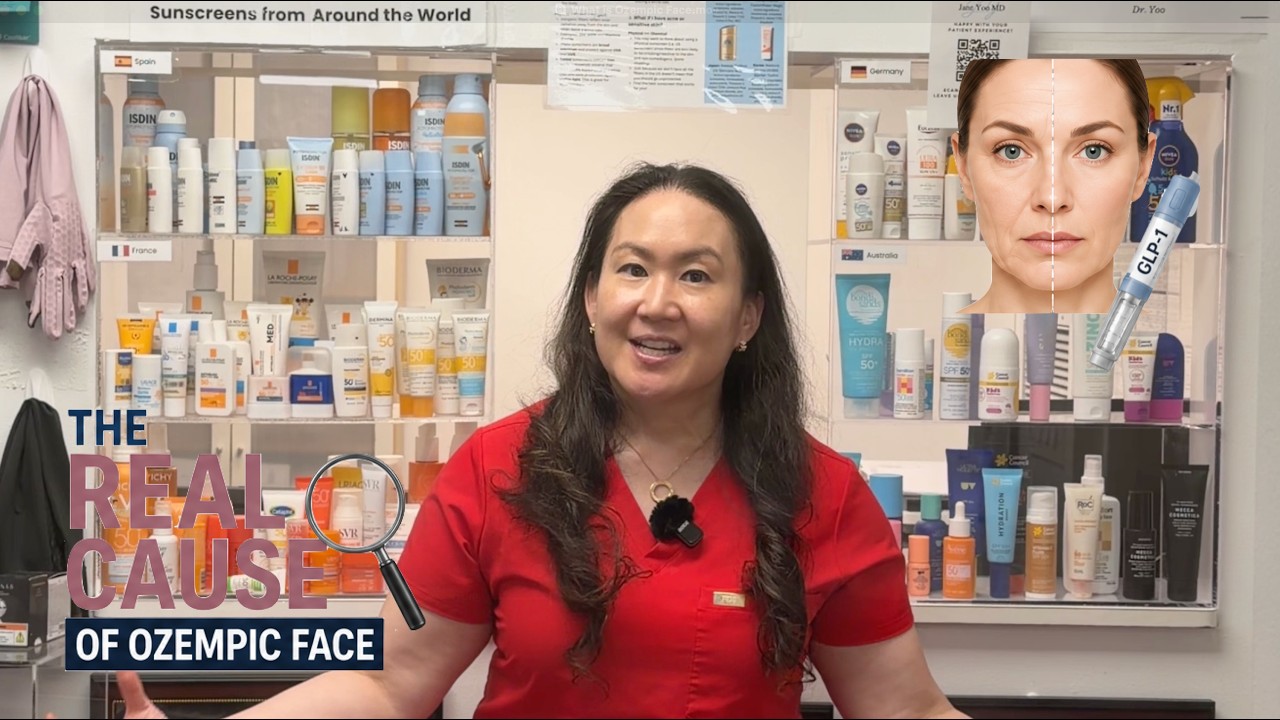
Board-certified dermatologist Dr. Jane Yoo explains that Ozempic face is facial volume loss and skin sagging from rapid weight loss, not a drug side effect. Two things happen: fat pads shrink and stretched skin doesn't bounce back. Prevention means losing weight gradually, staying hydrated, and protecting skin from sun. Treatment combines fillers to restore volume and energy-based devices to tighten skin.
Chapters
Ozempic face is one of the most searched skincare terms right now, and almost everything that comes up is either a celebrity before and after or a scary headline. I'm Dr. Jane Yoo, board-certified dermatologist and Mohs surgeon, and today I'm going to give you the actual clinical explanation of what's really happening to your face, why it happens, whether you can prevent it, and what actually works to treat it. No fearmongering, just the real answer. First, despite the name, this has almost nothing to do with Ozempic specifically. Ozempic face is really just a catchy name for facial volume loss and skin laxity that happens after rapid or significant weight loss. It happens with any fast fat loss, such as GLP-1 medications, bariatric surgery, and aggressive dieting. It doesn't matter the method. Semaglutide and similar drugs just speed up weight loss and cause what we now know as Ozempic face. So if you're on a GLP-1 and worried specifically about the Ozempic face, really what you should be thinking about is, I'm losing weight quickly, and here's what I can do to my face regardless of how I'm losing it. Here's the part almost nobody explains clearly. There are actually 2 separate things going on, and they matter for treatment. Volume loss. Your face has fat pads around your cheeks, your temples, and under your eyes that give you a youthful face and fullness. When you lose weight fast, those pads shrink faster than the rest of your body might suggest. Skin laxity. Your skin has stretched to accommodate more volume, and it doesn't always snap back at the same rate. The fat underneath disappears, so you end up with skin that looks loose or crepey relative to the smaller structure now underneath it. These 2 things often happen together, but they're not the same problem. And this is the important part: they don't respond to the same treatments. That's exactly why a generic answer to how do I fix this usually falls flat. Not everyone gets this to the same degree. Skin quality, age, genetics, and probably the biggest factor, the rate of weight loss, all play a role. Slower, more gradual weight loss generally gives your skin more time to adapt. Very rapid loss tends to outpace what your skin can keep up with, no matter your age. To some extent, yes, but let's be realistic here rather than promising more than skin biology can actually deliver. Slowing the rate of weight loss where that's medically appropriate for you, staying hydrated, protecting your skin from sun damage, and keeping up strength training to maintain muscle mass— all of that helps your skin adapt more gracefully. But if you're losing a significant amount of weight, especially if you're at an age where skin elasticity is already declining, some degree of volume loss or laxity is close to inevitable. That is not a personal failure, and it's not something lifestyle changes alone will fully prevent for everyone. If you're currently losing weight and want to minimize this, the best time to talk to a dermatologist is during the process, not after. There's more that can be done proactively than most people realize. Now, let's get to treatment options. Since these are 2 different problems, we approach them with 2 distinct categories of treatment. For volume loss, dermal fillers are the most direct answer. Restoring volume in the cheeks and temples can seriously soften that hollow, aged look. If you want a more gradual approach that stimulates your own collagen rather than an immediately filled look, Sculptra or Radiesse are worth discussing. For skin quality and laxity, this is a different problem, and it's where skin-boosting treatments and energy-based devices come in. Instead of adding volume, these work on your skin's own repair and collagen processes to improve texture, tone, and resilience over time. For skin tightening specifically, particular radiofrequency and ultrasound technology, which is honestly a cornerstone of Korean aesthetic medicine, can help address looseness directly by stimulating deeper collagen remodeling. No surgery required. These tend to be the right call when laxity. Not volume is your main issue. And realistically, most people need a combination. I don't believe in a one-size-fits-all protocol for this. What you actually need depends on the specific balance of volume loss versus laxity, which is something I assess directly in consultation, not something you can accurately self-diagnose from a mirror or a before and after photo. Quick but important note. Everything I just said about volume loss versus laxity applies to the rest of your body too. Upper arms, abdomen, thighs— same fundamental issue: skin that hasn't kept pace with what's underneath. Treatment tools differ by area, but the underlying principle is the same. If that's what you're dealing with, that's a whole separate conversation worth having. Short answer: to a meaningful degree, Yes, but reversible doesn't mean instant, and it doesn't mean going back to exactly how you looked before you lost weight. With the right combination of volume restoration, skin quality treatment, and time, most people can significantly improve how their face looks and feels. It's a process, not a single procedure, and managing your own expectations matters as much as the treatment plan itself.