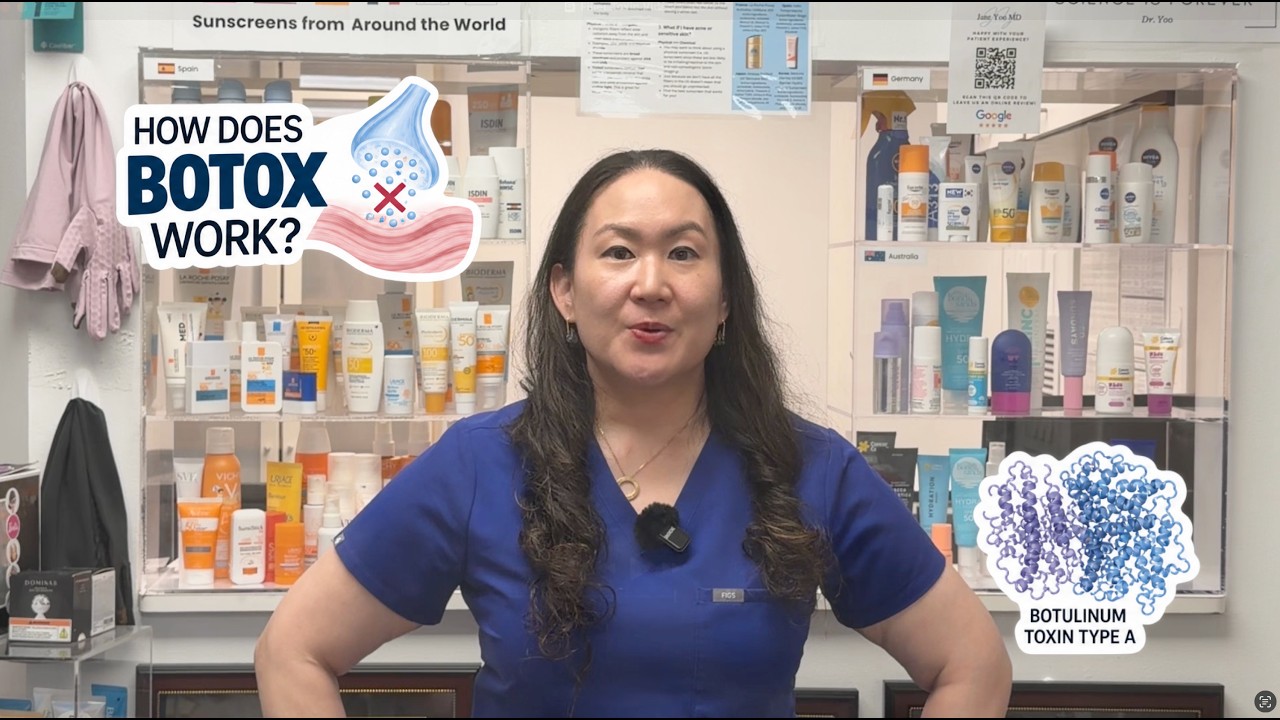
In this YouTube explainer, board‑certified dermatologist Dr. Jane Yoo clarifies the true effects of Botox (botulinum toxin type A) and why many patients are disappointed when expectations are misaligned. She describes the drug’s mechanism—blocking acetylcholine release to relax muscles—so that only dynamic, movement‑related wrinkles are softened. Dr. Yoo distinguishes dynamic from static wrinkles, outlines exactly what Botox cannot correct (volume loss, loose skin, sun damage, under‑eye fat pads), and provides a typical timeline for onset (days 3‑7) and full effect (days 10‑14) with a duration of 3‑4 months. She emphasizes the safety advantage of its temporary nature, compares it to filler, and discusses preventative Botox, citing a twin case study while cautioning that sunscreen remains the best anti‑aging tool. Finally, she offers a pre‑treatment checklist for patients: identify dynamic vs static lines, understand expected changes, know which muscles are targeted, verify injector credentials, and have a plan for adjustments if results are unsatisfactory.
Chapters
Most people book Botox without knowing what it actually does, and then some of them are quietly disappointed. Not because it didn't work, but because it was never going to fix the thing they were bothered by. Hi, I'm Dr. Jane Yoo, board-certified dermatologist and Mohs surgeon. Let me explain what this drug actually does. Botox is a brand name for botulinum toxin type A, a purified protein. It works by blocking the release of acetylcholine, which is a chemical messenger your nerve uses to tell a muscle to contract. When that signal is blocked, the muscle relaxes and the skin over it stops folding. So Botox softens wrinkles caused by movement. It does not treat wrinkles caused by sun damage, collagen loss, volume loss, or loose skin. Understanding that distinction is the difference between being thrilled with your result and feeling like you wasted your money. Here's a mechanism in plain terms. Every time you raise your eyebrows, a nerve ending releases a chemical called acetylcholine into the tiny gap between the nerve and the muscle. The muscle receives that chemical and contracts. That's true of every muscle in your body. It's how movement works. Botulinum toxin interrupts that release. It's taken up by the nerve ending and cleaves a protein the nerve needs in order to release acetylcholine into that gap. No acetylcholine, no signal, no contraction. The nerve isn't damaged. Over the following months, it regenerates the machinery it needs and function returns. It also grows temporary sprouts along the way, which then retract once the original terminal is working again. That recovery is why the effect is temporary. Nothing is destroyed and nothing is permanent. And to answer the question people are actually asking, yes, It's related to the toxin that causes botulism. What's injected into your forehead is a purified protein in a dose measured in very small units. Botulinum toxin has been used medically for decades. Its medical use actually came before its cosmetic use, including in ophthalmology for conditions like crossed eyes. Now, this is probably the most important distinction to understand before getting Botox. Get a mirror and relax your face completely. No expression at all. Look at the lines you're bothered by. Are they still there? If the lines disappear when your face is at rest and only appear when you frown, raise your brows, or smile, those are dynamic wrinkles. They're creases created by muscle contraction. Botox treats those extremely well. If the lines are still visible with your face completely still, those are static wrinkles. The skin has been folded so so many times over so many years that the crease is now etched into the skin. Botox can soften them somewhat because it stops you from continuing to deepen them and gives the skin a chance to partially remodel, but it will not necessarily erase them. Most people, as they get older, have a mix of dynamic and static lines, which is completely fine, but you need to know which one you're treating because static lines may need something else layered in, like resurfacing, a collagen-building treatment, or in some cases, a small amount of filler. Botox alone may be the wrong tool for a line that is already deeply etched. Now, let me be specific about what Botox does not fix, because this is where expectations often go wrong. It does not fix volume loss. If your face looks hollow or deflated, that's a volume problem. Relaxing a muscle does not add volume, and in some cases can actually make hollowing more visible. It also does not fix loose skin. Jowls, crepey texture, and laxity along the jaw are skin quality and structural problems. Botox is not going to tighten significant loose skin. It does not fix sun damage. Fine, crinkly texture, brown spots, dullness, and broken capillaries are not muscle problems. That's photodamage, and it needs treatments directed at the skin itself, along with sun protection. And Botox does not fix under-eye bags caused by fat pad protrusion. This comes up constantly. Relaxing a muscle is not going to flatten a protruding fat pad. So what should you actually expect after treatment? During the first few days, you may notice very little. That's completely normal. Around days 3 to 7, you'll usually start noticing that the muscle feels different and the lines begin to soften. By around days 10 to 14, you're generally seeing the full effect. That's when I want patients evaluating their result. And it's also a useful time for a follow-up if something needs to be adjusted. After that, you generally have a period where the result is relatively stable, followed by a gradual return of movement. For cosmetic facial treatment, the effect often lasts about 3 to 4 months, although that varies by the area treated, the dose, and the individual. If you're at day 14 and essentially nothing has happened, that's worth a conversation with your injector. People sometimes treat the fact that Botox wears off as a design flaw, but I actually think of it as an important safety feature. If your result is too heavy, asymmetric, or an eyebrow is doing something you don't like, the effect resolves over time. Compare that with filler, which may require an enzyme to reverse if it's hyaluronic acid filler, or surgery, which obviously isn't something that simply wears off. There's also another benefit. to it being temporary. Every few months, you get to decide whether you still want the treatment. You can change your dose, change the areas you treat, or decide you don't want to continue at all. Then there's preventative Botox, which I get asked about constantly by patients in their 20s. The logic makes sense. Static wrinkles develop in part because dynamic movement repeatedly folds the same skin. If you reduce some of that repetitive folding, you may delay how deeply those lines become etched. There's a well-known case report involving identical twins where one twin was treated regularly with botulinum toxin for 13 years and the other was treated only a couple of times. The regularly treated twin had noticeably fewer etched forehead and frown lines at the end. It's interesting and suggestive, but it's also one pair of twins, so I would not treat that as definitive proof. I think preventative treatment can be reasonable in someone who already has visible dynamic lines and a strong habitual expression, like someone who is constantly frowning. It is not something every 22-year-old with a completely smooth forehead needs to start doing. And the strongest preventative intervention you have for skin aging is still daily sunscreen. If this is your first appointment, there are a few things I would want you to understand before anyone injects you. Which of your lines are dynamic and which are static? What is the treatment actually expected to change? Which muscles are being treated and why? Who is injecting you and what are their credentials? And what happens if you don't like the result or need an adjustment at 2 weeks? If someone can't explain what they're treating and why, then the conversation is too focused on units and not on the actual result.