Artisan: Stop Hiring Humans, with Jaspar Carmichael-Jack
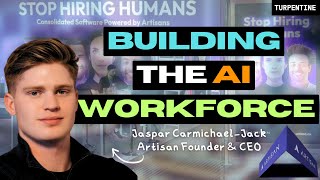
Jaspar Carmichael-Jack, CEO of Artisan, discusses AI agents that work like employees. The startup's Ava agent automates outbound sales prospecting, and Artisan just raised $25 million Series A led by Gladebrook's Paul Hudson. The "Stop Hiring Humans" campaign was marketing buzz; Jaspar says humans still provide context AI lacks.
Chapters
We create AI employees that we call artisans, and then we build software for them to live within alongside human teams. People think we hate humans. That's as much as I have to build, but say, stop arguing. We're hiring lots of humans and we love humans. I do think there's some things that AI will never replace humans in. Humans are inherently, for the foreseeable future, going to always have significantly more context than an AI. So I think there's always going to be value in human labor. and to an extent more value when everything is AI generated. But it's about creating a balance where we, we automate what we can and we try and support humans with what we think they can do better.
Welcome to Tech Finance. I'm your host, Sasha Orloff, repeat founder and current CEO of Puzzle and self-professed finance nerd. On this show, we dive into the pulse of B2B fintech from newly funded startups, transforming the office of the CFO to major industry shifts, deals and partnerships that are reshaping how we think about finance. You'll hear the most important developments, essential analysis, and of course, AI innovations. This show is brought to you by Puzzle and the Turpentine Podcast Network. Let's dive in. All right. Hi, everybody. Today, my guest is Jaspar Carmichael-Jack, the co-founder and CEO of Artisan, one of the most sought-after companies from that little incubator accelerator Y Combinator in 2024. Raising $12 million out of the batch, beating me by a long shot. And I thought we were like a big one right back in the day with $2.5 million, but they just announced another $25 million. And if you are in San Francisco, you will have for sure seen these Stop Hiring Humans. And that campaign projected them to one of the hottest companies in the Valley right now. You just can't miss their ads. But why did I have them here? Well, Jaspar got me pretty good. So I think one of the best April Fools campaigns I've ever seen, and given my My birthday is on April 1st. I get the brunt of it and there are some good ones, but this one was the best. So Jaspar Carmichael-Jack, resigned as CEO to replace himself with an AI CEO 'cause he said it was just that good and it was so well done. If you haven't watched the video, we'll link to in the show notes.
You gotta go watch it.
But at the bottom there was a form and it said, do you want to be, do you want to try our AI CEO? And I was like, yes, this is great. And I found out later that it was a joke. Somebody on my team, Dasha, was like, No, no, no. That was just a marketing play. I was so sad. I was so excited to have an AI Sasha chatbot respond back to everybody that didn't respond to my emails. But anyway, I invited Jaspar on to tell the story because it's just one of the coolest stories I've ever heard and it has such an implication on the future of work and hiring. So Jaspar, welcome to the show.
Thank you very much. Yeah, great to be here.
All right, so for anybody that hasn't seen your ads, wasn't at TechCrunch disrupt hanging in your lounge, like all the stuff, what is Artisan and what was that aha moment that got you started?
Yeah, so high level, we create AI employees that we call artisans and then we build software for them to live within alongside human teams. So we try and consolidate the endless stack of point solutions you have in every vertical into one cohesive ecosystem. And then we build an artisan into the platform to automate a specific job function. So our first is Ava, an AI BDR, automates the entire outbound sales function and this outbound sales consolidated platform. Uh, but as you said, maybe we should be making an AI CEO so you can have a real—
I could spend more time building, doing podcasts and less time, uh, actually I could just have my AI do the podcast maybe.
Yeah.
Yeah.
Yeah.
What was that? What was the moment where you kind of, like, I, we hear about this stuff like in the blog posts and Twitter and whatever else, but like, what was the aha moment where you were like, this is either possible or this is what I'm going to do next?
Yeah, so I think the, I'd had the idea sitting in the back of my head for years and it was just never really possible to do. I think the real moment where I clicked, okay, this is going to be possible very soon was when the first release of ChatGPT came out. And it was clear that soon we were going to be able to build apps that would go beyond what traditional software was doing and could actually take actions and be creative and productive on, on human's behalf. Um, so that was the, the moment where I was like, okay, this is time to actually start building this.
But at some point, I imagine it wasn't working. I mean, you, you say now that like 1 in 10,000 emails has a hallucination, and, and the models of AI have gotten so much better. I mean, just like all the time. But what, like, what was the moment in which you were like, I can, I think I can actually sell this now? Because ChatGPT, the first release of that, it definitely wasn't possible, uh, a long way. So When did you think like, all right, well, now is the moment?
Well, we just started building, uh, like as soon as we could and then sold a product early on that didn't work very well. The first iteration of Ava was not very good at writing emails. Um, just the LLMs weren't good at writing emails at all then. So it was kind of an impossible problem to solve. Uh, and then as the models have evolved and gotten better, it's become much easier to make the output of the emails high quality. But when we first launched, it just wasn't particularly good, but we were just iterating as fast as we could and trying to improve it. How—
actually, let's start. So Ava is your AI BDR, which has sort of become the face of, of downtown San Francisco for all intents and purposes. What exactly does Ava do?
Ava automates the entire outbound demand generation function. So prospecting a list of leads, we have hundreds of millions of leads in our database, everything from classic B2B leads that you find on LinkedIn, the local brick-and-mortar leads that you typically find on Google Maps, full coverage across everything. So prospects, leads based on target criteria, or otherwise based on intent signals that you can set up a Watchtower campaign, which we just launched, and do things like de-anonymize your website traffic and sequence them based on that, or look for companies posting specific roles, look at a bunch of different triggers and signals and have more warm and intent-driven outbound. And then she prospects for leads, writes messaging that's relevant to each individual lead. So finds a personalization from all the data that we have available on the specific lead, everything from their LinkedIn posts to their Twitter posts, to their activity in company news, their company blog posts, or company website. We aggregate dozens of sources together and use it to find the best possible personalization. And then Ava creates a personalized sequence of emails and LinkedIn messages to automate the outbound demand generation process. And basically delivers lead to sales team.
And, you know, all of this, I think one of the things we're learning and seeing really excitingly is that these sort of like the built on top of AI and having the workflows and having them trained and tuned is like really powerful. There was an early prevailing thing of like just the model's going to automatically take care of all this. And what we're seeing at least now is no, there's actually like workflows that are needed in training. When you, can you just share a little bit with the audience about how much do you break down the design of workflows, the software, the model tuning to the actual model? Like, I don't, I don't know, like either as a balance or a formula, how much of each of these things matter?
Yeah, each individual agent within the platform doesn't actually have that much freedom to do its own thing. Like we, we don't just say to the LLM, okay, write an email for this lead and, and make it high quality. It's a chain of different agents doing different steps in the workflow and a change of different combined agents and just classic good old-fashioned software that do different things. And LLMs are nowhere near good enough to take tasks from end to end. So you have to build this workflow and pull in different LLMs with different prompts to do different actions.
Like how many, just to paint a picture, is it like behind the scenes, you talked about sort of this interconnected powerhouse of agents? Is this, is this like 2 or 3 agents? Is this like 10 to 20? Is this like 100 small agents doing all these tasks you're tying together?
It's like dozens.
Dozens. That's incredible. Um, and so from there you decide from Ava that you're gonna launch Aaron, the inbound SDR, uh, and Aria, the meeting assistant. Tell us a little bit more about how, how do you know when and, and what to work on next?
Yeah, so we're trying to build other artisans that are going to have high leverage from our existing ecosystem. So it makes sense for your inbound and outbound lead flow to be flowing through the same platform and to be interacting together. Um, and then the inherent next step you're going to have after you get a lead inbound or outbound is a meeting. And if you have all the context of where that lead came from, all the data that they came with for the meeting, then you can create a better meeting assistant and a better meeting copilot that to support the, the rest.
Do you think that we're at a place right now where it's just a matter of time before, uh, you can build artisans for everything? Or are there other breakthroughs in models that you think are, are limiting what you're capable of? Like, they'll happen eventually, but just, it's limiting what you can build today.
There's a lot of limitations, and we're staying on the cutting edge of what's possible, and whenever those limitations are lifted, we will be the first to do these different things. But there's not high quality, low latency, live humanoid video that doesn't exist in a good form yet. The voice models are okay. You still know that you're talking to an AI, unless you're elderly. Elderly people seem to struggle realizing if they're talking to an AI or not. But most people know if they're talking to an AI. And it's just not at a point where it's human enough yet to do a lot of different use cases, like a sales call or a CS call. You, you can't do that yet.
Do you? I'm just so like my, I'm so excited. Like I just, I love this stuff, obviously. Do you imagine a world? I remember there was, um, there was a, an interview a while ago, uh, with the founder of Bumble, the dating app. And she was saying, you know, in the future, your AI is going to talk to somebody else's AI and they're going to like kind of pre-screen everybody. And then you just do like the fun dating stuff. Do you view this as like the potential of like a two-sided marketplace where like I as a company might say, You know, now we're at sales, but like maybe it's like, I need these tools or you understand my business and what are the things that are, are needed in the company and you just go out and like go meet all the agents in the world and figure out, is there a better solution than how we're solving things today?
That's not the direction we're building in right now. It could potentially be that in 5 to 10 years. I don't think the tech is anywhere near far enough along yet. Um, there's also a really good Black Mirror episode, Hang the DJ, where they have concept that Whitney Wolfeharder was talking about where the two AIs date each other and have to figure out what's going on. So yeah, who knows, maybe in, maybe in 10 years.
I love it.
I love it.
Hey, we'll get back to the conversation in a moment after a word from our sponsors. All right. One of my favorite tools that I use and we use is Notion. Notion is used by thousands of startups around the world as their connected workspace for everything from engineering specs to new hire onboarding. To fundraising. Notion has a special offer for listeners: 6 months of free Notion with unlimited AI, value of over $6,000. So you can access the limitless power of AI right inside of Notion to build and scale your company and team with one tool. Get 6 months free of Notion with unlimited AI along with custom templates when you apply for notion.com/startups/puzzle. Once again, that's notion.com/startups/puzzle. Www.puzzle.com/startups/puzzle.
Go for it.
Building a company is hard enough. You shouldn't have to second-guess your numbers too. One day an investor might ask you a question that you just can't answer. The next, you realize your books aren't as clean as you thought. Sound familiar? Puzzle is rethinking accounting from the ground up with an AI-first ledger that eliminates repetitive tasks and gives you real-time financial clarity so you can focus on running your business, not fixing spreadsheets. Accounting should work the way you do— fast, intuitive, and built for the future. Come check us out at puzzle.io. What are, what are some of the things that you're getting really positive feedback on and where are places like where is it really good right now and where do you think it will go over the next 2 to 3 years?
Yeah, really good right now is finding data that otherwise a human would have to spend a very long time discovering. Um, like we have the most robust local data set on brick and mortar businesses, and we have personalization data from everything from Instagram to Facebook to a bunch of other sources. Um, so that aspect of finding high quality data to use in outreach targeting and personalization is very good right now. Um, the copywriting has gotten to a point where it's now starting to be very good. And up until recently, it's been extremely difficult to make email copy sound good, but it's getting better and better. And we now give our users a lot of control over it. We have this coaching feature where they can coach Ava to talk in a different style and they can basically get the outbound emails to sound however they want. And the part where it's lacking right now is having enough context to do autonomous responses effectively. So that's something that we're building out that we did roll out and then on a beta and then rolled back because the tech isn't quite good enough to do fully autonomous back and forth up until the point of the meeting. So I think we'll get there this year.
That's awesome.
That's awesome.
I mean, this is so exciting. If we turn it now to like some of sort of the story behind this, we had a little bit of the inspiration to where did you get immediate investor interest? Was this just something that, because it's, it's right now it seems so obvious, but you started this a while ago where it might not have been that obvious a couple of years ago.
Yeah. So I started trying to raise on day one, like when it was just a Figma file and nothing else. And obviously got a lot of nos. I got a lot of nos and then got very, very lucky and got one yes from our first investor, Oliver Jung, who gave us just under $2 million. And he's continued to reinvest and he reinvests in our Series A and a bunch of times before then as well. Um, and he invested when we had literally nothing but a deck, a Figma file, and a completely non-functional prototype that you couldn't even really log into. Uh, so, so got very lucky, got a lot of nos, and then got one yes that catalyzed everything and propelled us forward.
That is awesome. Do you think that Artisan is the inflection point of the simulation?
Inflection point of the simulation?
Is this the moment where we look back, where we look back and this is all a simulation? We're just— this is the the start of the revelation we're entering, or like future generations. My kids are actually just part of the simulation, or their kids are part of the simulation. That this artisan is the moment that this happened.
Maybe we're all just Westworld characters and we'll find out one day.
So you get your round of funding. What changes between, you know, you have a Figma file, you raise round 2, like the largest, one of the largest rounds, if not one of the largest rounds I've heard of in your YC batch to this late. And then tell us a little bit more about this latest raise.
Yeah, so, um, we, I raised that money before we did YC. So we got into YC and already had like $2 million. So we didn't really need money when it got around to demo day. So even though I would say we weren't further ahead of other people in our batch and we hadn't done anything dramatically different, because we didn't need money, we had a lot of leverage going into conversations and we were building in a relatively hot space. So there was a lot of inbound interest. So we managed to leverage that to. To get great terms and to do a bigger round. It was kind of by accident, to be honest. It was a lot of luck. Uh, yeah.
And then what, what made you, what, what, what catalyzed this round coming up or that just, you just announced?
Yeah, this round. So this round was an introduction. So Oliver, who led our seed round and who continued to reinvest as last year went on, introduced us, uh, almost a year ago to, to one of his friends, Paul Hudson, who's the founder of this growth fund called Gladebrook, who led our Series A, and we'd been building a relationship with them for a while. And then Paul called me one day and said, I want to give you a term sheet. Um, and we just knew we were in the right hands with him and have a lot of trust with him. So he decided to just do it earlier than we'd planned to.
Lovely. And then what is this? What do you think this enables for, for Artisan?
Yeah, so immediately, uh, it's enabled us to hire a new CTO, uh, who's amazing. Ming, he just joined the team. Uh, he was a VP at Deal before and ironically was at Rippling before that. Uh, so he's joined the team. Uh, we've had a bunch of new engineers join. We've really built a powerhouse in the engineering department and we are doubling down on that as the next few months go on, as the next few quarters go on. Because we, we know in order to win this space, we just need to have the best product by far. We, we're good at distribution. We need to make sure that Ava is better than any other AI outbound product on the market. And every product we release is better than any other version of it available. So we're really focusing heavily on product and engineering.
How do you just tactically from an operational level, because we have a lot of people listening who are in the finance world and are thinking, oh my God, like this could generate more revenue at a lower cost potentially than, than the current human. It also allows you to scale faster because hiring, it just, it's time consuming. By the time you realize you have maybe product market fit or you're scaling, just like the moment you realize, the moment you can get somebody and train them, get them to speed, hit quota or whatever is like is like pretty insane. But at the same time, we also have a lot of founders who are building and building with AI. How do you balance sort of the factors of the releases of models coming out so quickly and new capabilities coming out so quickly and sort of this battle of capabilities across, you know, the 5 major sort of like foundational models or more with the continual improvement just on your roadmap and refinement of prompts and software for Ava within, how do you know when it's time to launch the next Artisans?
Yeah, it's a lot to balance. We've actually shifted model providers twice, um, and we have shifted model versions like 3 times. And every time you change, the prompts need to completely change to make the output stay consistent or get better. Otherwise, the, the quality almost always degrades if you switch without any prompt change. Uh, so you really have to work it into the roadmap and you have to spend a lot of time before you do any, any big shifts. We're focusing right now very heavily on making our outbound product the best in the market by far before we release any other product. So Aaron and Aria, the next two artisans, will not come out until we're confident that our outbound product cannot be beat by any other combination of tools. So right now, the next few sprints that we've got are fully focused on releasing additional products that are going to give Ava more leverage to do outbound more effectively. So we're seeing it as win the outbound market clearly. Launch inbound, launch the meeting assistant, and then put everything into making sure we have best-in-class solutions across the board.
And when you say outbound today, I think back to your other comments, at some point the latency and quality of real-time video might be better, maybe audio. Is this outbound? Is this email? Do you do any other channels? Is it calls also, or video calls?
Email on LinkedIn. We're launching a dialer for human calls where Ava will guide the human on what to say and on on what, who they're talking to. We don't want to do AI outbound calling yet. I just, I'm not comfortable with the quality of AI voice today. Maybe Q3, Q4, it'll be good enough to a point where we're happy to say, okay, yeah, we want our customers using this, but we're going to hold off for the moment. And eventually we will do some kind of video call version of each of them. I think it will likely be a situation in which you would use an AI AE for your, for for your lowest quality leads to say a 1 to 5 employee company, employee company comes through and you're a sales-led motion. You don't want an AE to speak to that person because it's going to cost you more than the deal's worth. In that case, you route them to an AI AE where it can run them through the sales cycle autonomously.
Yeah. One of the things that I'm the most excited about, and as I guess like maybe as a nerdy accounting and a finance person rather than, you know, I guess maybe somebody creative enough to come up with something like this is, um, it really, if we think about it as changing the equation of ROI, you know, the ways that we can make something ROI positive to a threshold that for whether for venture public markets is you can increase your cost, you can increase revenue by raising pricing and adding more features. That's usually hard and more expensive, or you can lower the cost to acquire. What I think this does in such a powerful demonstration is it has the power of reducing the denominator. So at the same amount of revenue, you could raise down here. Why that is so important is when we look at the, the framework of the market and the industry and the businesses sell to, like that used to make enterprise kind of the only real market that venture could attack. Successfully. And then as we got more efficient with software development, everything, it brought things down to the mid-market tier and you could build huge businesses in the mid-market. There aren't a lot of longstanding successes in small business, of which there's millions of, of which there's so much opportunity to make small businesses more effective. But the cost of selling and reaching and explaining, you know, if it's the same amount, sometimes even more than the enterprise, then like, you know, you're always going to go for the biggest, the biggest, the biggest whale, like, because, because you can. And I think small businesses are drastically underserved. Does that resonate? How are you seeing the demand of where Artisan really becomes like most effective today?
Yeah, we mostly target selling into mid-market. SMB is a difficult segment to sell into because as much as they want the product and they try and use it and that happy to pay for it to an extent. They're often not successful because they either don't have product market fit or don't have any experience with outbound or understanding of how to do outbound effectively. So there are pretty high churn risks. Um, so selling into SMB specifically with the outbound products is high risk. So we do sell, but we sell predominantly into mid-market, mostly mid-market B2B SaaS or things like QoS systems.
Sorry, not like who are Artisan clients, who are Artisan clients, who are, who are your customers targeting? Are your customers targeting sell to small businesses?
Across the board. So you get very high response rates with SMBs, um, like much higher than with enterprise because they're just interested in, like, excited that someone's emailed them. Um, especially this local dataset we have, which is based on every Google Maps business. You get very high response rates emailing local businesses. They just often respond at a much higher rate than anyone who's in a B2B LinkedIn dataset. Um, but we have everything across the board. On the small business side, we have very good data there. On the enterprise side, we have very good data and we're building a lot of triggers and signals that will help people target SMB, mid-market, and enterprise. So you can, you can remember everything.
I love it. I love it. I mean, to me, I think this is the most powerful source. I mean, small businesses, there's always the talking point. Small businesses are the backbone of the American economy and et cetera. They, they are, and there are millions of them. And so much of the venture world is not structured for. Fast growth and like all of the things needed on an ROI threshold where the small business or even the larger small business can be a really good target. That's why we see, you know, Mailchimp took 20 years to get to a place where it could grow and QuickBooks 40 years for something like that. Like there's, there's not too many venture-backed or technology businesses at a large scale that can serve small business. Anyway, I know that's probably not your business plan. I get really excited when I see stuff like this because I think about the— one of the most powerful things is shifting who you can reach, who artisan clients can then— their clients, um, can reach. So I think it's, I think it's pretty exciting. Um, long way. Sorry to hog this. I'm supposed to be interviewing you, but I just, I love, I love what you're building. It's so exciting.
It's an exciting time. It is.
What is like, what do you think is like the endgame for AI coworkers? Is there, is there a final stop where we don't think this is going to happen anywhere to every job?
Yeah, I think the path that we're moving down is staying on the cutting edge of what's possible. Initially, we're sticking within first outbound sales, then sales, then go-to-market, trying to create that one ecosystem. Our long-term vision goes beyond that. We want to create the most value wherever we're able to. But I think that it really depends how the foundational technology changes and how the foundation models evolve. So it's kind of up to OpenAI, Anthropic, and xAI on which direction everyone goes in.
What do you say to the skeptics who, you know, are saying AI will never replace humans in the nuance or the structure of sales or comms or marketing, et cetera, et cetera?
I do think there's some things that AI will never replace humans in. There's other things that humans can do that AI can't. Like humans are inherently, for the foreseeable future, going to always have significantly more context than an AI. Like I got a cold email yesterday actually that someone said, oh, I saw you at the gym earlier. Are you planning on building a voice agent? We can help you. And I was like, Ava could never do that because she didn't, unless someone wears glasses where Ava sees everything that they see and then can do facial recognition and, and pull in IDs to do cold emails. Feels a bit overkill for cold email. Um, but there's a lot of things where a human touch becomes more valuable because you look at that and you think, okay, there's no way that AI generated that message. Um, so I think there's, there's always going to be value in human labor and to an extent more value when everything is AI generated because you'll notice it and you'll, it will stand out to you. But it's about creating a balance where we, we automate what we can and we try and support humans with what we think they can do better, like outbound calling, like highly context-driven things, in-person events, things that just AI is not going to be able to do potentially ever.
And what do you think is the biggest misconception about Artisan right now?
People think we hate humans. That's as much as all the billboards say, stop arguing with humans. We're hiring lots of humans. And we love humans.
You are a masterclass in marketing, but yeah, that's funny. What's— given you're sort of leading the charge in this particular space, what's another AI product that you either really respect out there or that you wish somebody else would build?
I actually saw the product, what was it called, that one of our product managers used yesterday. To make a song, which was crazy. It worked so well. Was it— it was called Suno. And I've never seen it before yesterday. And it was crazy. You can get it to make a song about anything in any style. And it does it extremely well. So that was a product I thought was really, really cool. I personally use ChatGPT like 20 times a day. So I am an OpenAI guy. There's so many people building so many cool things that you stumble across something new every day. It's difficult to keep track of, but there's just an insane amount of amazing product being built in every vertical and for consumers and for prosumers and for businesses. It's insane.
Shout out to Suno and a future customer with me because I have some kids' birthdays coming up and I'm going to start making them a magical song for them along the way. What do you think is like one of the funniest either use cases or things people tried to do with Ava?
Yeah, people try a lot of things. Usually we filter them out in the sales cycle because we know they're not our ideal customer, but some people have tried to use Ava. We were product-led with the beta for a little while. Horrible decision. We, we learned pretty fast. But, um, some people tried to use Ava to do outbound for them to get a job. So using Ava as their personal recruiter. Uh, and people have used Ava for a bunch of different things, for VC outbound, um, for anything where you can imagine sending a message, people have done. Someone's asked us to make a version of Ava for dating apps where she She can swipe for you and do your Tinder messages or whatever. Uh, so yeah, there's, there's been a lot of weird requests and things people wanted.
I love it. I love it. Where did the name Artisan come from?
You know what, this, um, this actually isn't a very inspiring story. I was, uh, coming up with ideas for the name. I knew the idea that I wanted to build and I was Googling synonyms for the word worker, employee, that kind of thing. And Artisan was one of them. I was like, okay, that sounds like a good one. I'm going to, I'm going to go for that.
Love it. It's such a memorable and easy name.
And then Ava's name is from Googling the top 10 US baby names for women. And then Ava was one of them. I was like, oh, that sounds like it goes well with—
I love it.
I love it.
Um, last few questions. Let's talk a little bit about the, the founder journey. You know, what are, what are some of the lessons learning about going from sort of like powerful idea to huge walking around coming out of YC, taking over a tech restaurants, taking over at least downtown San Francisco, probably other places to sort of one of the breakout companies. What are, what are some of the lessons you're learning going along the way?
There's a new lesson every day and it's a constant learning and iteration experience. So I wouldn't say there's any one specific lesson that's, that's great advice. It's just more broadly taking everything, assuming you know nothing and getting ready to be proven wrong 20 times a day, uh, going in with, with assumptions and going in confidently. But the moment you get a hint that you're potentially wrong with the assumption, just being okay, yeah, I understand that I wasn't correct there. So I try and do everything with high conviction, but with a lot of flexibility and malleability to being open to new ideas and to that I've done things wrong. But the ideas that I was having 18 months ago, if I look back now, I probably wouldn't invest in myself, which is kind of ironic. But I think it's just a journey of learning and being open to information and assuming that you don't know anything.
If you could go back to day one and tell your day one Jaspar, before you got started, one thing that you've learned now, what would that be?
Ideally, I'd love to give myself loads of implementation details on how to build the product because it was so much more difficult than I thought it was going to be. But if not that, you know what, there's nothing. I think the way things have played out, I wouldn't want to jinx it. So I'm happy with the direction we're on. but implementation details, I'd love to tell myself which data providers to use, which LLMs to use, all those, all those kinds of things.
Just go faster, clearly conviction and focused on, uh, on building the best, uh, software there. How can people find out and who are the right sort of target for good use cases for Ava right now?
Yeah, so we predominantly sell into mid-market, um, some SMB, anything above 50-ish employees, um, within a company. We mostly sell into B2B SaaS, although some POS systems we work really well with. Anyone targeting local brick-and-mortar businesses typically do very well. And we are selling Ava right now. Um, you can find out more on our website, artisan.co. Still working on getting that.com. It's been a, it's been a war. Uh, so, so artisan.co for now.
Jasper, thanks for coming on the show. That was amazing. Everybody out there, go to artisan.co and, uh, get started with Ava. You won't regret it. All right, talk to you soon.
I appreciate it, Sascha. Thank you.
Thanks for listening to Tech Finance with Puzzle and Turpentine. If you got value from this episode, please share it with anybody building or funding the future of technology, and please leave us a review wherever you're listening and tell me about what you want to hear more of. If you're looking for accounting software you'll actually love to power your company, check out puzzle.io, the modern accounting platform for the AI era. Tech Finance is part of Turpentine, the awesome podcast network behind Econ 102 with Noah Smith, Turpentine BC, Complex Systems with Patrick McKenzie, and so many more.
More from Jaspar



The pros and cons of using AI agents as early employees | TechCrunch Disrupt 2025
Founder Fridays: Go Viral or Die Trying with Jaspar Carmichael-Jack, Artisan & Monica Perez, Notion