The pros and cons of using AI agents as early employees | TechCrunch Disrupt 2025
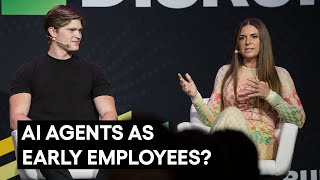
In a TechCrunch Disrupt 2025 panel titled “The pros and cons of using AI agents as early employees,” moderator Speaker A interviews Jaspar Carmichael‑Jack, founder of Artisan (creator of the AI outbound sales rep “Ava”), and Sarah Franklin, former CMO of Salesforce and current HR leader at Lattice. The discussion opens with the provocative “stop hiring humans” ad campaign, prompting debate over public perception and marketing shock value. Jaspar explains how AI agents have progressed from early, unreliable prototypes to a more functional BDR agent, highlighting incremental improvements in grounding, cost, and handling back‑and‑forth conversations. Sarah frames the conversation from an HR perspective, emphasizing AI’s potential to amplify human work, reduce bias, and manage information overload, while warning about governance, security, and the need for equitable performance‑review processes. Both panelists discuss practical limits of current models—hallucinations, non‑determinism, token cost, and loss of conversational context— and outline metrics for evaluating AI agents, such as lead conversion rates versus human teams and confidence scoring. The panel also touches on broader societal implications: the future of work, UBI, AGI, the possibility of solo‑founder unicorns powered by AI, and the importance of upskilling. Audience questions probe confidence assessment, security concerns, and hiring AI talent. The conversation balances enthusiasm for AI‑augmented productivity with caution about bias, security, and the human purpose of work.
Chapters
We have to talk about the ads.
Oh, here we go. Okay, straight in. Let's go.
So, okay, for those of you who don't know, you all had to get up here by going up an escalator. And there's the big activation that says stop hiring humans. That's Jaspar's company.
Yeah.
And earlier this week, Bernie Sanders posted an ad and asked, how will those displaced workers survive when there are no jobs or income for them?
He actually also said great idea. So let's look at the balance.
I think he might have I know that might have been sarcastic, but what would you say to him in response?
I would say, first of all, thank you very much for the free sponsored post. That was very kind. We got a lot of leads from that. So first, thank you. Secondly, I would say AI in its current state, as much as we say stop hiring humans and we have very dramatic advertising, if it continues on the path it's on now, I actually think could create more jobs than it would take. Unless there's some significant advancement in AI that likely isn't an LLM, I do think it's going to be like a single-digit multiple of productivity and going to be taking over the mundane repetitive work that humans don't enjoy doing. The messaging I would say is it's shock value. Yeah.
Sarah, you're approaching the question of AI agents from more of an HR perspective. So what's your reaction when you see ads and discussions like that?
She can't say anything positive because that would ruin them.
No, I mean, former CMO of Salesforce, I have deep respect for great marketing and provocative marketing. And so to be at the epicenter of relevance is always going to be controversial. So you get people's attention, and that's really great for marketing. On the topic, though, at Lattice, We do deeply believe in the opportunity that AI brings for people and really amplifying us, not really talking about the Copilot, but more like from the HR lens, scaling ourselves in a way that we can have better understanding, remove biases, and yes, remove the rote mundane, but also scale us in a way that it just wasn't possible for AI to know as much as we can, because AI can distill everything down for us in a way that can give us better understanding, to have more human conversations.
Yeah, and I saw that you wrote in a blog post last year that of 3 decades in the tech industry, the AI boom is the most dramatic shift you've seen. So I wanted to dig a bit deeper on that, and like, what was the moment that you knew that this was such an impactful moment.
Yeah, I mean, I've been around. I'd like to think I'm younger than I am. But, um— You have a very cool dress. Thank you. You know, the dress and the shoes. Got to have the pink velvet pumps, right? Mm-hmm. So I've seen the shifts. I've seen cloud, social, mobile. And AI is more transformative because it's not just a technology. It's transforming the way we work. And it is so happening so fast. And so that's the thing where it's, yes, it's a technology transformation, but more than ever, more so it's a people transformation. It's a change management and it's happening so fast in a way that we need to be very diligent in paying attention to not just how it can be helpful, but how it can be hurtful. Um, you look at some of those trends, like I mentioned, social and mobile, two technologies that were incredibly transformational, democratizing voice, democratizing access to information. But we didn't ask ourselves, like, is this gonna make us anxious? Is it gonna make us addicted to our devices? And it took us like a decade to even put controls in place. So being so transformative, it's important that we also take this moment right now to ask ourselves those questions so we can do it responsibly.
Do you think that, like, I feel like the conversation around AI, like everyone has a really, really strong opinion. Jaspar's very much leaning into that strong opinion to drive marketing. Do you think that people have such a strong reaction because we've seen how within our lifetimes, like social media has changed, smartphones have changed, like things are totally different within a span of like 20 years?
Short answer, yes. The longer answer is this remains the same, that the fear, the uncertainty, and the doubt is very prevalent in us as humans. And marketing, you know, that says don't hire humans, it does, it creates that like, whoa, what's happening? Am I not gonna be relevant? But it's a wake-up call to all of us. It's an opportunity right now because We are all on the same starting line. We are all learning this now. And so I look at this also as an opportunity for potentially equalizing things because whether you're a woman, whether you're a man, no matter where you live, it's an opportunity for us to all learn now, no matter our age. You know, it's an opportunity for us to all learn and be part of this new transformation that we're seeing, uh, in, in the industry.
Yeah, and something I've been thinking about throughout Disrupt is that like last year, the year before, I also moderated panels related to AI and just the amount of like what's theoretical and what's tangible shifts so much year to year. And it's such like just a time capsule of where we are year to year. And so on the topic of hiring AI agents, I feel like last year that's something that like didn't seem as possible, but now it's seeming a bit more possible. Like, how do you think that this has evolved recently?
Yeah, I can jump in there. So a year ago, the models were so early and the capabilities were so early, and everyone was racing to build products and racing to build different types of agents and different app AI companies. But you could see that the majority of the time it wasn't working well. Like, even our product a year ago, did not perform particularly well. Like, we were trying to, to manipulate the models into creating a good, a strong output for sales, but it was extremely difficult at the time. We've really had an inflection point in customer outcomes and in the ability for Ava, our AI BDR, like outbound sales rep agent, to actually drive real results this year. And especially in the past 6 months, there's been this— it's not that there's been dramatic improvements, it's that there's been improvements in the areas that were really strongly lacking and strongly holding back companies like us from creating these real AI agents that can actually do productive work for you. So I think we're going to continue to see that shift over the next couple of years where even if there's not dramatic improvements and dramatic leaps forward, even with incremental improvements, we're reaching a point where a lot of use cases and a lot of more simple, mundane, rote, repetitive junior roles are able to be automated and able to be augmented with AI, whereas before they weren't as much as people were trying to.
It's interesting when you think what a difference a year makes. So about a year ago, last year at Lattice, we actually had some innovation within our product to document digital workers as employees, and we shared that innovation. Very simple LinkedIn post, no marketing dollars behind it. It went viral, people went bananas, and I got all kinds of lashing because this idea of putting an AI in the org chart, they're like, that girl is crazy, I don't know what she's talking about. I got clown emoji, all the things, right? It wasn't 6/7 then yet, it was anyways, but I'm not that cool. But I got like a visceral reaction. People said, you're making AI human, and it was not the intent at all. It was a big misunderstanding, was what we saw was we saw what was coming, And we said, this is going to happen and we need to be ahead of this. But a year ago, people were not willing to understand that AI could be an employee. But now, I mean, it's all the marketing and it's what everybody's looking for is how can I have AI employees?
Yeah.
And work together with my people and how can it really help me be successful as a company?
Yeah, that makes sense. We still get a lot of backlash, as you can imagine, with our— we kind of, we kind of deserve it with our marketing. But there's definitely a good portion of people who don't love the idea of AI employees. And the tagline that we have, we get some really interesting submissions on our website inquiries form. Yeah.
Yeah, but that's the thing was that having AI employees, what is important is that we don't do this irresponsibly. So when you bring in any entity into your organization, there's rules. Like we're going to abide by our company values. We're going to mind our confidentiality. We're going to have goals that are aligned to the company goals and you need to perform based on those goals. And if you're not performant, well then we can, you know, part ways. And when you part ways, you agree to not take any company confidential information with you. And those processes need to be applied to humans, but they also need to be applied to any entity which you bring into your organization. And so that is the thing is that there is yet to be full education. This group here is very educated, but the majority of people don't fully understand that the agents are being given access to your data systems to act on your behalf autonomously. That means they're not given a, you know, decision tree, a binary set of rules. And so that requires us to have a lot of thinking not just from a cybersecurity standpoint, but really from an access control and governance of what these agents are allowed to do and have that documentation of when the agent's acting versus yourself.
Yeah, and I also wanted to ask you about, like, related to AI employees being part of the org chart, like, as a manager, there are very concrete skills that a manager can learn about how to manage humans and just navigating being a good manager to your employees, how does that change? Like, is there something that people need to learn about managing AI employees as well?
There's a ton to learn, right? Um, but here's— I'll actually flip that a little bit because here's what I think is so interesting and powerful is that whether you're a manager or an individual, individual contributor, or an executive, you're just an employee at a company. Um, you wanna come to work and know that what you're doing has purpose. You wanna know why you're doing it, how you're doing at it, and you know, if, if there's any feedback about it. And this is something which has been very hard at work because we have so much information that comes at us. Um, it's interesting when you think of all of our systems, all of technology that we've built, has been around how you manage information. And information itself is, um, really there's only 4 commands used to, to manage information. You know, you create, read, update, delete, you know, CRUD. And you think about how we as people have been put into these systems. Like think email, for example. If I send you an email and you read it as a person, It doesn't mean that you've heard what I was saying. It doesn't mean that you have listened to the message. It doesn't mean that you are going to necessarily remember it, not guarantee you're going to take action from it. And if you do take action, is that action what I wanted you to do or not? And that's because as humans, we are emotional, we are not programmable, we are imperfect. We are very different than information. And because I don't think any human would say, yeah, I can be run by 4 simple commands, right? So when you look at the idea of managing people or managing AI agents, we are fundamentally different. And so managing people, AI can help us understand more nuance and information, but the AI is gonna be very much around the information and looking at it very differently in how you would manage it.
Yeah, I think for the vast majority of use cases, probably all, we're not quite at a point where you actually have to manage an AI employee yet. Like, for example, our product is Ava. She's an outbound sales rep, does like the BDR workflow.
She's also a model in your ads.
She is. Yeah, she's, she's famous now. You have limited inputs that you can give to Ava. So like there's, there's different structures that go into creating the message. You can choose the pain point she's bringing up, you can choose the proof points, you can choose the inputs to create the emails, you can add coaching. So you can say write the emails like this, don't write them like this, so follow these guidelines. But there's not a broad set of inputs that you can give to Ava yet. We're working on a 2.0 version of Ava, which we're going to be launching at the end of Q1 next year. That product will be more like a real AI employee where you'll be able to talk to her on Slack and you'll be able to say, okay, I want you to spin up a campaign, that kind of thing, where you'll actually be managing them more proactively like you would a human employee. But for all use cases where you have agents right now, like things like Claude Code, any of the category leaders, they're not yet at a point where you need to manage them. But I think we'll see that over the next couple of years.
Do you think you'd ever have an issue with like if like, would the AI like talk back? Like, as like, will the AI have sick days? Like, what happens if—
She did speak back to me the other day. I requested a sample email from the thing in our booth, and she sent an email to me saying, this is not a realistic scenario because you're the CEO of this company and I'm not selling the product to a CEO. This seems to be some kind of demo situation. Oh my God. That would happen in practice for the majority of people. But if you don't build in guardrails, then the model can talk back. But yeah, it's not going to be doing anything as bad as a human would do. Like, we just put up some bus shelters. One of them was like, artisans won't get caught on the kiss cam with the head of HR. Ava's never going to do that. She's never going to get into a scandal.
But I mean, I mean, I guess you could argue she has been like she—
Yeah, but that's my fault. Yeah.
Yeah.
You're taking the fall.
Yeah. But that is, that is the also some of the things is that you don't know exactly what they're going to do. So when you have agents having conversations with your employees or with your customers, you need to have them grounded in your data, in the context. And so the context is so important. And so just having an LLM that you put out in the wild without grounding it securely with the right context is— it is dangerous.
Yeah, you're going to get some crazy answers coming.
Yeah. And there's also— there was a study that just came out, I think yesterday, around the, how confidently the AI will say something which is not correct. And so that accuracy, it comes when you don't have the good data grounding it. And so, yes, the internet is one place where you can say that data is not always correct. Hopefully within your enterprise, you're in a world where you have more correct data, but It's still the same issue is that, I mean, raise your hand if your data at your company is perfect and, you know, 100% accurate. Just kidding, I don't think so. Good, I'm so impressed.
I don't deal with the data, I don't know what's going on.
But this is what we just have to, we can get very excited also from a security standpoint. There's a lot of pressure right now from people like ourselves, CEOs going to their companies and saying, saying, put in AI, I want some AI BDRs, I want this efficiency, I want this now. And people are like, okay, yes. And then they do it and they'll miss some steps, you know, putting in passwords like 123456 and things like that, which humans do that a lot. Yes. Right. And so we just have to be very mindful, um, in what it can do because it could, put yourself in a bad situation if it does have a bad conversation with an employee or a customer.
Yeah. And that was also something that you had brought up when we talked about before about how there's certain things that AI absolutely should never do, like giving employees performance reviews, because we know that an AI has to be trained on something. What it's being trained on reflects the biases of the broader world, and there are biases and prejudices in the broader world, unfortunately. So like, how do you think about like making sure that a workplace remains equitable even with an AI that might have like certain biases?
So this is where I think there's opportunity because we as humans, we all have unconscious bias. It's not just race or gender, it's location, proximity, language we speak. There's recency bias. There's so many types of biases and our human minds are not capable of absorbing all of the information that surrounds people and situations and everything, the context that we would need to know to make as objective decisions as we can. And especially when it comes down to somebody's performance. And so the opportunity is that, and this is what we're doing at Lattice, is that, I mean, who here enjoys writing performance reviews? No hands go up, right? Um, it's something which is looking in the rearview, maybe 6 months, people have to be dragged down to, you know, reminded 5 times to go and hunt and peck through all of the information to write a review, where the AI can bring it to you, have all that context for you, summarize it for you, and then you can apply your human judgment in a way that is much more fair, much more grounded in context, much more understanding, and we can have more human conversations, which today, time zones alone are hard, you know, to manage employees globally. And so this is something which I'm excited about, but I do think that yes, when the AI brings you all this information, it can even draft things for you, but as a human, we should be making human decisions about somebody's performance or their pay.
Mm-hmm. And Jaspar, you had also mentioned that you wouldn't advise someone to use an AI agent unless if they're 100% confident that the AI won't hallucinate.
Yeah.
How do you evaluate that 100% confidence?
I would say you don't want to use AI for any task where you need 100% confidence because you're never going to get 100% of the time the exact output that you want because LLMs are non-deterministic. So but use cases like humans are also a lot of the time wrong. Like humans are definitely not—
I mean, I've never been wrong in my life. That's fair.
That's fair. That's same. But if you're in a low-risk situation and you're doing something where maybe 99.99% accuracy is good enough, then it makes sense to have an agent. If you're like dealing with the nuclear launch codes, maybe don't put an AI agent in charge of them. But yeah, I think that's Pretty self-explanatory, yeah.
Yeah.
Yeah, and then I wanted to go back a bit to just the general attitudes around AI agents and how, like, I'm sure all of us in this room would love to have jobs and, like, have a secure income. And something interesting that Vinod Khosla said on stage yesterday was that as, like, if we approach AGI, that the US government should take a 10% stake in public companies to soften the blow and redistribute that money. Do you think that's a good idea?
Would you rather have a job or get your salary without having a job?
I would rather get my salary without having a job. Well, I also would worry that, like, I mean, there, there's just so many questions about, like, how would that be enforced? Like, would companies agree to do that?
Um, yeah, would—
like, I don't know. I mean, there's the, the question of, like, I mean, I know there's— this is why people are doing studies on UBI.
Yeah, but I think in the abstract scenario where we actually did achieve AGI, which is kind of what our ads insinuate, it's like that's what people think when they see our ads, like, oh no, everyone's going to lose their jobs, which isn't realistic with current technologies. Like, we're just not getting close to that really right now. But in the hypothetical scenario where we did have AGI, inherently that would mean that we would need UBI because there's no way that you could have a handful of people controlling 99.9% of productivity in the world. Like, it's not a realistic, a realistic scenario for the global economy. So I do think if we were to have AGI, you do need UBI alongside that. But we're far away from that right now.
Yeah, I would add maybe contradictory perspective, but I have this conversation very often, especially when you think about life and you think about the purpose that we, the purpose of life. You know, last year I lost my parents and things like that make you really think like, okay, what's, what is the purpose and meaning for being here? You know, why do I do this all day? And work is deeply personal. Many of our identities are intertwined with our work. Does it mean we should be burnt out? No. But does it mean that I want to sit and like have my brain rot because I'm not doing anything? Like, that's also no. And so this is what's an interesting thing is that if it can be something where whether there's UBI or not, a lot of people are choosing the whole, you know, touch grass, like, be more human, be more present. And there's a lot of value into the human-to-human engagement. So maybe a lot of the rote pieces are done for us, but we can then spend time having, you know, better human experiences. Like think customer service, for example. It's a common thing that they want to automate the customer care. But if I want to go shopping and I have a, I can have a, concierge-level, one-to-one human experience with somebody. Yeah, that sounds incredible, but companies can't afford that today because they still have to have the people doing other things. So I think there's going to be a shift. It's going to take time. I'm more optimistic that we will have purpose as people, and I don't think we want to not have. Yeah. Jobs.
Yeah, I agree. I think inherently humans are always going to find some way to have purpose. Like, if we look at the jobs 100 years ago versus today, if they saw what we were doing, sat here like tapping on these magical screens, like doing like HR, like that's just like an extraordinary concept to tell like someone who was a farmer near a village. And I think we're going to see another shift like that where the labor that we're doing in 100 years we would now maybe see as fake work, but it feels real in that in that?
My youngest, who's now 21, but I remember one day I came in and she was— this is when you had like the DVD things to watch movies, and she was sitting on their DVD and I was like, what are you doing? She's like, I'm working. Like, what are you working at? She's like, I'm working watching Sleeping Beauty. I was like, that's not working. Mommy does work. She's like, no, you're working too. And but that perception of yeah, like your tap, tap, tap, tap, tap. It doesn't— it's not like I'm out there like digging ditches.
Yeah.
You know, and some of those things—
farming.
Yeah. And some of the simplest things are the— we thought might be automatable. They're not. You know, there's a lot of infrastructure type of work, which is very much like human.
Well, so you could never really automate art, for example, because art is inherently human. Like if a robot does art, then it's not worth anything because the value comes from the story behind it. I think there's a lot of things like that that will emerge that are just impossible to automate. Yeah.
Yeah.
And then getting more toward like things that founders might be thinking of right now with hiring, knowing when to hire AI and that humanness. I feel like something that founders really love is being in the room with your team and like working on something from the beginning and like all just kind of like coming together. And do you think that people would feel lonely if it's like them and like 3 AI agents?
I don't think it's really any different in practice right now to just like using some SaaS platforms. Like it's just like a SaaS platform that will do work for you autonomously. Like you're still going to need a human team for the roles that, that aren't possible to automate yet. Like for example, one of our users, they have like 6 different AI agents doing different things for them. Ava manages all of their outbound. They use Qualified for like their inbound sales. They use another agent for their customer support. So they have this team of AI agents that are managing a lot of the org, but they still have an office where they go into every day where they all are together and just like they, they have the agents working inside their computer. So I don't think it's, it's not a binary. You have to have agents or you have to have humans. Like inherently you're going to need humans. And you can just, you can speed up your time to value. You can speed up the time to, to achieve product market fit. You can grow faster. You can achieve more if you build an AI-first org and if people are focusing first on finding a way to automate something before doing it manually themselves.
And I think this will be a much more healthy workplace because I was sharing earlier, we are drowning in information as humans when we go to work and we think that that is We've somehow led ourselves to believe that this is the right way we should come to work. We should come to work with a full inbox, tons of Slack messages, notifications on our phone, and supposed to like go and understand what's happening. And so all this information is not how we as humans thrive. So when you can have something sorting through the information, getting it there, you can come and you can have like, a conversation, you can know what you should focus on, and you can be present. And the humans then have a much better experience because we're not sick from like too much information, like we're not information diabetic, you know. We are, we are healthy and present and able to have those conversations and enjoy what we do.
Yeah.
I have one more question and then we have time for a Q&A, so if people want start lining up at those microphones, then we will get to that. But, um, my final question is, I was thinking about how last year Sam Altman said that he has a group chat of CEO friends, which, one, dying to know what that group chat is called. But, um, apparently they have a bet going of when the first solo unicorn will be, like, when is it just one person who with AI scales a company to be a unicorn. Do you think that's possible? And if so, what would your bet be?
Yeah, I think I can jump in. So let's say someone wants to build a unicorn. Say they're in like a really hypey space. They can maybe get like a 50 to 100x ARR multiple. So then they need to get to like 20, maybe even with $10 million ARR, they could hypothetically get there. I don't see any reason why you couldn't with the direction that first of all coding tools are moving in. And I think the person would need to be technical because they need to be able to understand how to use Claude code and to manage it effectively. The person would need to be also good at marketing because even if you're using tools like Artisan and you're using other products to automate some of your marketing, you need to manage it. But I don't see a reason why one person couldn't build a product that's got some sense of product market fit. And then market it to achieve $10 to $20 million ARR, and then raise a unicorn valuation in the next 12 to 18 months. Yeah.
Interesting.
I would agree. I agree. I just go back to we as humans work better when we have ideas from each other. And I think it would be lonely. I'm an introvert myself, so I do not pretend that everyone may want that. But I do think that the possibility is there in the current timeframe.
Yeah. Okay, so let's move to Q&A. We have about 10 minutes and we wanna make sure that as many people as possible can get their questions answered. So try to be as brief as you can and we'll start on this side and then we'll go back and forth. So you first.
Hi, I'm Mira. I had a question regarding assessing confidence in agents.
We talked a little bit about assessing risk risk in whether you can deploy them in such and such scenario. I wonder, have either of you or your teams, or are you, yeah, have your teams worked on confidence score determination of what LLMs do and using that in the workflows?
Yeah, I mean, we do measure accuracy, and we do, which is different than confidence, I would guess, but we do ourselves make sure that we have the accuracy measures there and we also have the backstops where people on the backend can look through all responses and just audit them, I would say.
Yeah. So our product, like I mentioned, is an AI outbound sales rep. So the, the output is very measurable. Like, did you get positive responses? What's the cost per lead you're achieving? Is it higher or lower than what you were getting with a human team? So we just look at that as a benchmark and compare to to the humans. Cool.
Okay, so that's an accuracy metric?
No, just like a comparison of benchmarks, I guess.
Okay.
Thanks. Yeah.
Great. So we'll go to the side.
Hey, my name is Gus. This is for Jaspar. As a serial chief revenue officer in early-stage technology companies, I think you're onto something super fascinating because managing BDRs and SDRs nowadays with the science you need behind them to do things. I think you're just going to accelerate all of that. So I think it's a very exciting space to be in. My question for you though is, how can I join your company?
What was the question? Sorry.
How can I join your company?
How can you join? Oh, well, we only hire AI agents. I don't know if you saw the ads. Unfortunately, we're full of humans right now.
I'll speak to Walker.
Okay.
And we'll go to this side.
Yeah, thank you very much.
I—
such a great discussion. So, my question is about an article that BBC wrote about a rogue AI that turned into being manipulative, as we see. Let me put a context into it. Are you building everything from the engine ground up? —based on your own infrastructure, or you are buying some other spaces from other differences? The reason as to why I'm asking this is, number one, how will your agents handle competition in making sure that an employee does not ship some secrets to outsiders? That's number one. Number two, how will you handle the friction? Because the friction brought in the manipulation. AI actually manipulated the system engineer and told the engineer, if you try to shut me down, I will send an email and say that you are dating the HR. And the engineer was confused.
Yeah, that's— yeah, so we don't build models, we just work with Anthropic and Google and OpenAI. That's really a them— you're gonna have to ask Sam Altman, I can't answer that.
Yeah, okay, um, let's go to this side.
Okay. Hi, I'm Joe. I have a thought and I'm just wondering about your reaction, what your thoughts are. So this is really about AI displacing human workers. My thinking is that, you know, in previous technological upheavals, there have been accompanied a similar effort to develop new jobs or types of work that would better leverage whatever the new technology is. Obviously, the AI technological upheaval The evil is of much greater and more broader scale, but so is the challenge to do that development, to create those jobs that better leverage the technology. So my question is, do you see such efforts starting, emerging somewhere in the timeline, you yourself being involved, what you would like to see? Let's hear your thoughts, both of you.
Yeah, so I think the question is around just general, like what we're seeing with the human transition that we're seeing compared to other technology shifts, whether it was cloud or manufacturing automation, et cetera. So yes, technology has always bred more job opportunity in our history. Right now, it's the time period is so compressed and we saw trends happen, for example, college graduates, you know, are having a harder time getting jobs. And it's because at companies, when you're looking at, okay, I need to change my workforce, the easiest people to, you know, lay off are the people that I haven't hired yet. So it's, it's much easier to say, okay, we're just going to pause that. And that was so fast that we felt that in the system. You know, my kid's graduating college this coming year and like, I'm like, you need to be on top of this, right? But these people are the most digitally native, the most AI comfortable, the most malleable, the least calcified in thought, and they're the cheapest as well coming out of college. So I think that's temporary. And I think that we're going to see that adjustment because now people have said, okay, there was a shock into the system. We need to adjust. Now we've got to normalize, and we need to figure out where people are going to go. But historically, we've seen job creation. I'm an optimist. I do think that will continue. I do think that it won't be tomorrow that we'll have AI agents doing all of our jobs. But it does not remove the urgency for everyone to go and make themselves not just understanding at a high level, but well-versed and not just literate, but fluent in AI.
Yeah, I agree. I think the bar is higher for graduates. Like, you can't just go to college, not do any internships, and expect to get a job without any real-world experience. Like, you need to put yourself out there. You need to proactively learn how to do things that are unique that AI can't do and upskill yourself so that you can more easily get a job.
Okay, let's go back to this side of the room.
Hi, my name is Alan Kaya. I had a question about, we talk a lot about what AI can do, but there's a lot that it still struggles with. What are the things that you guys are actively working to make better in the process? What do you think the biggest weaknesses are, especially the weaknesses weaknesses that are here today and are somewhat temporary, and then the weaknesses that you think might hang around and be a little bit harder to kind of weed out? Yeah, so I think that one of the biggest weaknesses is the non-deterministic nature of AI. Like, we're— and that's not going to change with LLMs. Like, it's very, very unlikely that will change. And you can build evaluations and you can do a bunch of things to minimize the error rate of models, but you're— from what we can see, you're always going to have that until we have some major leap in the technology. But more practically, with the way we're implementing LLMs now, cost is a huge barrier. Like, you can't use an advanced model for a lot of different use cases because it's too expensive and people aren't willing to pay that much for the work output. And it would be cheaper maybe to get someone in Asia to do it for you than to get AI to do it for you. So that's going to be one big barrier until the cost of tokens continues to come down. There's a lot of use cases that aren't yet solved. One that we're trying to solve right now that we're working with Anthropic on is handling back and forth communication between a human and an agent and consistently holding that conversation all the way through from a response to an outbound sales email to having a meeting booked in. Because there's this tree of infinite paths that the conversation can go down and they can ask, what's your dog called? And then the AI needs to know what to say and can't just lie and say like Toto or whatever. So you need to, you need to have a lot of infrastructure in place to make it effective in these kind of use cases. And there's So many areas in which AI cannot achieve specific job functions that we're just gonna continue to, to try and evolve and, and, and be able to do.
Yeah, the, the context is so important and that's also what we're doing. And this is like a sales use case. Ours is in HR and that contextual grounding for the prompt is the behind the scenes work that a lot of the applications are putting into place. And so without being able to have those, um, ongoing conversations, the context gets lost. But as humans, that's the thing, is like, as humans, I can meet you right now, I can have a great conversation, and then can go off, do 5 other things. If I saw you on the street later, I could remember it, right? But if I was an AI, if I've stopped that conversation, when I pick it back up, I'm not going to remember it. That context is lost. And then you feel like this was a meaningless conversation because you haven't remembered me. And so that is a, that's a big opportunity, and it requires on the backend for us as technology providers to build that infrastructure so the context can be maintained and also appropriate and respecting permissions and all of those things. So that's the value add that we can provide. And the large language models, it's just like when Amazon made EC2, EC2 and S3, it made it easier to have, you know, computing infrastructure. Anybody could go build an application, but they just made it easier to do that work on the backend. And the LLMs, like, we're not— I'm not building a large model. Have a small model around, like, employee health, similar to, like, how Aura makes, like, a health, but not a large language model. Yeah, same. Thank you.
We are out of time, but Thank you both for—
That went by fast.
Thank you. I know it always goes by faster than you think. And I hope this was helpful for— I hope this was helpful for the audience. And thank you for coming to Disrupt. Thank you, everyone. Hire Ava.
More from Jaspar



Founder Fridays: Go Viral or Die Trying with Jaspar Carmichael-Jack, Artisan & Monica Perez, Notion