Founder Fridays: Go Viral or Die Trying with Jaspar Carmichael-Jack, Artisan & Monica Perez, Notion
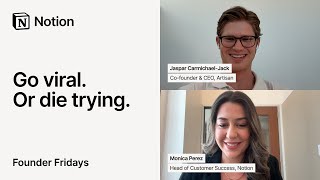
In this Founder Fridays episode, Notion’s Monica Perez interviews Jaspar Carmichael‑Jack, co‑founder and CEO of Artisan, the AI‑powered Business Development Representative (BDR) platform named Ava. Jaspar shares his unconventional founder journey—skipping university, early failed ventures, and a branding agency background—before pivoting to AI‑driven outbound sales after the rise of ChatGPT. He explains Artisan’s product architecture: Ava autonomously discovers and enriches ~500 million leads (both LinkedIn professionals and local businesses), crafts multi‑channel email and LinkedIn sequences, sends them at scale, classifies responses, and optimizes CTA traffic via a data‑driven flywheel. The conversation covers the evolution from a manual approval workflow to a fully autonomous “Copilot” mode, the core success metric of positive response rate and cost‑per‑lead, and the upcoming 2.0 product that will increase autonomy. Jaspar details how Y Combinator provided credibility, networks, and operational guidance, and how a bold “Stop Hiring Humans” billboard campaign—originated as a viral‑bait tactic—generated massive brand momentum, inbound demand, and measurable lead spikes, becoming Artisan’s primary go‑to‑market channel followed by Ava, SEO, and paid ads. He highlights the internal tool stack (Notion for documentation and roadmap, Metabase for data analytics, Superhuman for email, Slack, Linear) and a specific Notion workflow linking PRDs to Figma designs. The interview also touches on the philosophical framing of the billboard tagline, clarifying that Artisan does not aim to replace humans but to automate repetitive outbound tasks, while acknowledging regulatory limits (e.g., cold‑calling). Finally, Jaspar offers founder advice: prioritize a strong technical co‑founder, immerse deeply in the target vertical before building, and consider B2B over consumer for easier traction and retention. The episode ends with reflections on lessons learned and future directions.
Chapters
We knew we wanted to raise and we knew we needed some kind of big catalyzing event to spike interest. So we decided, okay, we need to go viral. And we sat down and brainstormed, like, okay, we need to go viral. What can we do? Because people don't really care about many things. You have to make them feel something for them to actually interact and care.
Brand momentum was very, very strong, and that usually comes after the fact. Yeah, unusual for a company of your stage so early to just have that level of brand recognition.
We don't actually want people to completely stop hiring humans, and we actively have been hiring lots of humans. It's really just an engagement, an engagement bait tactic.
Hey everyone, welcome to Founder Fridays, our recurring series where we sit down with builders who have been in the trenches to talk shop. Product, design, the real lessons that you're not going to see on the slide decks. So I'm Monica Perez. I lead customer success at Notion. And today I'm joined by Jaspar, co-founder and CEO of Artisan. He has built an AI BDR called Ava to automate outbound sales. And you may have seen the numerous provocative billboards around San Francisco. Jaspar skipped college actually to join YC's 24 batch and raised $25 million as his Series A earlier this year. So welcome, Jaspar. We're really excited to have you.
Thank you very much for having me. It's great to, great to be here.
We're going to start from the beginning. We love to hear a founder origin story. So take us back to the beginning before the billboards, before the funding rounds. Where did this journey begin?
Yeah, so I actually didn't apply to any colleges. So when I was in high school in the UK, Um, when all my friends were applying to universities, I just didn't. I was working on some random business at the time. Um, and then after high school, I moved to London, started this app for booking cleaners, and had horrible unit economics. It cost us way more to acquire a customer than they were worth. Uh, didn't really know what any of that meant, so I was just, just going along, uh, without any real knowledge of how to build a company. But I learned a lot Um, after shutting that down, I then did an agency doing branding and go-to-market, which might be why now we focus so heavily on, on those billboards, because we did similar things in the agency. Um, but with the agency, I never really felt fulfilled by what I was doing. I wanted to do something more. Um, so I was always on the lookout for what I would do next. Then ChatGPT came out. It became pretty clear to a lot of people that there was going to be a complete paradigm shift in how software would be interacted with and how work would get done. And I knew that there would be a huge opportunity there and wanted to be a part of it. Um, originally the idea for Artism was just to create these AI employees to do different things without any specific vertical focus. We focused on sales because we originally thought it was going to be easy. Um, little did I know it was a way bigger undertaking than we ever would have expected. Uh, but started with sales in September of 2023, uh, raised some money, got into YC, and yeah.
Was there a specific problem with the BDR, SDR kind of sales world that you obsessed over that and then decided to verticalize there?
Yeah, so I think I thought of the BDR, SDR function in a bit of a reductive way to begin with because my only exposure to doing outbound had been me doing it myself, and I did it in a pretty basic way using like Apollo or something like that. Um, so I didn't really understand the inner workings of a BDR, SCR org and how they actually scaled and how they worked with an AE team. So I went in, uh, blissfully unaware of what I needed to build. And we launched a very basic first version of the product. And I've gotten so much context over the past year and a half, two years on the inner workings of a BDR org. And I've built this world model now where I understand it in a lot of detail, but to begin with, I really had no idea what I was doing. I was just winging it day by day.
It seems like you decided to go deep in a fully autonomous BDR instead of maybe some other stages or admin pieces of the sales role. So I'm curious, like, why bet on the fully autonomous BDR as the first play? Instead of maybe a lighter overall sales Copilot?
Yeah, so when we first started, we gave users the option to either have Ava run autonomously or to approve all of the messages that Ava generates before she sends them. Most users use the approval process. And back then, LLMs were not good at writing emails, so we would just get endless complaints about the copy of the emails. That took a long time to make good. Um, but as the, the models got better and as the quality of the output got better, we now make our customers request specifically from our customer success team to go on Copilot. We push people into the autonomous user journey, um, mostly because otherwise it's very difficult to reach the volume that you need to reach to get a lot of leads. Uh, like when you use Outreach and when you use Salesloft, you're not there approving every sequence step that you're sending. You're sending a sequence to 200 people, you look at the sequence once and you send it off. And we wanted to make sure that we weren't requiring more work from our users to, to work with Ava than they would have to put in to manually create a sequence and send it. And I think inevitably, the more autonomous we can be, the more the product can improve for our users. Because if we're collecting all this data, if we have full control over the inputs of the email, if we control which CTA is being used, if we control which personalization is being used, we're collecting a lot of data that we can then feed into a model to self-improve and to push more traffic towards higher conversion email inputs. So the more autonomous, the easier it is for us to make it even more autonomous, if that makes sense. It's kind of a flywheel.
Okay, so tell me a little bit more about that. What can Ava do today end-to-end autonomously with a high degree of confidence? And then what is your vision for ideal state?
Yeah, so we're doing a huge product update right now, so I'll give some insights into that. But at the moment, Ava finds leads. We have about 500 million leads, um, basically even split between professionals, who are people you would find on LinkedIn, and local businesses, who are people who have Google Maps listings. Like, think anyone brick and mortar. Uh, Ava finds those leads, enriches data from a bunch of sources. Typically for professional data, it's places like LinkedIn, uh, Twitter, their website, anywhere like that. And then for local businesses, it's their Instagram, their Facebook, their Google reviews. Writes a compelling sequence to them, um, over email and LinkedIn. Sends it fully autonomously. Gets the responses, classifies and categorizes them. Does some, uh, direction of, of more traffic to the email inputs that are achieving a higher positive response rate. So if one CTA is doing well, we'll push more outbound traffic to that. And that's kind of where we, where we stop right now. We have built a very basic autoresponder internally, but it's not good enough to take the lead all the way through. We're doing our next product launch coming beginning of Q1 next year. It's going to be a very, very big product shift. And then we're taking every element of Ava and making her more autonomous. I don't want to give away too many details because someone will start building it. But yeah.
I'm gonna throw in a bit of a wildcard question because I'm genuinely curious. You're selling sales to salespeople. And so in some respect, and I'm sure you're also selling to founders and all sorts of personas across the board, but I think probably one thing that comes up is what is that ultimate unit of success? Like what is that ultimate unit of ROI? What is it with Ava today?
Number of positive responses that we generate. So that is the, the ultimate value point is how many responses can we generate for our customers with the amount of, first of all, emails they're sending and second of all, money they're paying us. All of our internal initiatives are around driving up the positive response rate and driving down our customers' cost per lead. And we've made huge strides over the past 6 months and we have some very big plans for the 2.0 product that are going to take it to another level.
I want to go back to YC and the famous billboards that we've seen driving down the 101 here. Let's talk about YC a little bit. What about YC changed the trajectory for Artisan?
Yeah, so early on it gave us a lot of credibility. It made it easier for us to get customers. It made most tier 1 investors come inbound to us and request meetings with us. When before YC, I was sending hundreds of outbound messages to try and try and get responses. Um, it gave us a really strong network, and it gave us a lot of really strong advice and knowledge on how to build and scale a company effectively. Um, and often it's telling you not to do things rather than telling you what to do as well. Uh, like, maybe you don't need a QA engineer, maybe that's not a good idea. Uh, because when we started, we had like 2 engineers and 1 QA engineer, and they were like, you should not have QA engineers that early. Um, so we, we Got taught a lot, got a broader network, made it easier to get funding and made it easier to get customers and made people trust us.
So through YC, we got some funding and then came the Billboard series that sparked the outrage, but also a ton of recognition for y'all. So take me into the room where that happened. What was the brief? What was the discussion like? What were the— what was the plan A, plan B? KPIs that the team discussed before going in for this big campaign?
So we were planning on raising a Series A, um, in Q4 of last year. We knew we wanted to raise and we knew we needed some kind of big catalyzing event to, to spike interest. Um, so we decided, okay, we need to go viral. We need to figure out what we need to do to go viral and make it happen. Um, so Tina, my chief of staff, and I sat down. We have like a house office, um, here in Russian Hill, and we sat down on the kitchen table, which is in the other room there, and we sat down and brainstormed. We're like, okay, we need to go viral. What can we do? Because people don't really care about many things. You have to make them feel something for them to actually interact and care. Um, so we threw out loads of ideas. We decided that billboards were going to be the easiest way to do it because it's easier to get a lot of people to see it and then to spark something than to try and make something go viral on social media without any, any basis. So we were throwing off loads of ideas, eventually had the idea for Stop Hiring Humans. And we were like, okay, yeah, this seems like it could be kind of good. So we just decided to go for it. We put it as the, the header board for our TechCrunch booth. And we got a billboard on the 101 at the same time in the last week of October. and we didn't really know if anything was going to come of it. We're like, okay, maybe some people will find it interesting. Maybe it will go viral in some kind of subreddit or something like that. Um, and the first day of TechCrunch when everything went up, we were in the booth and we were getting a lot of people coming over going like, oh wow, that's, that's crazy, crazy tagline you guys have got there. Um, but nothing really went viral. So we waited for 2 days. I think it was maybe a day or 2 days. And nothing. There was like a few tweets that had like 3 or 4 likes of people talking about the billboard, but nothing major. And then we posted a picture of our TechCrunch booth, which had the Stop Hiring Humans tagline on it with our team in the booth, and we put it on r/modtheinfuriating with the tagline: Hired humans telling you to stop hiring humans. And that went insane. That got like tens of thousands of upvotes. And then pretty quickly after that, it started popping up in loads of different places and people were tweeting it in all different ways. And then we doubled down immediately and we got, I think, another 6 or 7 billboards in the city and then maybe 30 or 40 different bus shelters, all with different variations of the catchphrase. And yeah, we just leant in and decided, okay, this is going to be our path to going viral and getting some brand awareness.
You mentioned you doubled down. And you also expanded to London, New York, some other cities. So like net-net, what was that gain that made you feel like, okay, we can accelerate this?
Yeah, so when I would review the sales calls and look at how our sales team were talking to people, most of the time the reason they were coming inbound was because they had seen a billboard on social media and it had piqued their interest and they looked at the website and, and filled in the demo form. and we looked at the conversion rate of website traffic. So website traffic had spiked loads and the conversion rate from visit to form fill stayed about the same. So we could pretty directly attribute the delta in leads that we were getting to the billboards. Obviously with billboards, it's kind of difficult to actually attribute what was, uh, from the billboard and what's just from general awareness and word of mouth. Um, but I felt pretty confident we hadn't spent that much money on the billboards and we had a lot more leads coming through. So, okay, we should just double down and see if we can scale it. And now it's the, it's the main reason people know who we are. Like, it's from the, from the billboards 90% of the time, from receiving one of our emails 10% of the time, because we can't physically send as many emails as we have people see our billboards.
Brand momentum was very, very strong, and that usually comes after the fact. Yeah, unusual for a company of your stage so early to just have that level of brand recognition. When you were going into the Series A, I'm sure that you highlighted that as a big factor. So, um, brand seemed to be really strong, but what else closed your investors the fastest? What stuck out? What was that aha?
Yeah, so we were still very early. Um, we had only finished YC like a number of months before. Our product was still very early. Um, so we were a pretty immature company in a lot of ways. But we'd managed to carve out a sense of brand leadership in the AI BDR space. And I think that more than anything gave them conviction in our ability to, to win the market. You could also pretty clearly see from a, from a product velocity perspective and from a product direction perspective, we were on the right path to building an amazing product in this space. We weren't there yet, but we were on the right path and we knew what we needed to do to, to get to an amazing product. So just for the direction of the product, direction of the company, brand leadership in the space all converge together into confidence.
I want to see behind the hood. You're in scale mode, like you said. What powers Artisan day to day? Obviously, selfishly, we think we have some good tools, but what single tool would you shout out this year and your tool stack in general?
I mean, I might be biased, but we do use Notion for all of our, all of our product documentation, all of our company documentation. Um, yeah, we use Notion a lot, uh, task management. Yeah. So highly recommend Notion. But, um, other things beyond Notion, Metabase for data. I love Metabase. I live in Metabase. Superhuman. I love Superhuman for email. Obviously Slack. Um, those are my biggest day-to-days. The, the broader team, we use a bunch of things like engineering use Linear for task management. Um, there's a huge stack, but those are, those are my day-to-day drivers.
Is there one tool that you would call out that you think has been the shining star of the year? It's really 10x the output of the team.
I would say right now Metabase, uh, just because being data-driven has enabled us to get so much more done and to actually make sure that the decisions that we're making are having a direct impact on our customer outcomes. Um, before we had pretty weak data and data analytics, so it's been my favorite thing that we've implemented this year. Cool.
And I'm sure you use AVA for your outbound, so that makes sense.
Yeah, of course. I can't really shout ourselves out, but AVA is our number 2 go-to-market channel after the billboards. Um, just because we physically can't reach as many people with, with AVA. That's actually an interesting thing. So our go-to-market stack, billboards are number 1, AVA is number 2. SEO is number 3. Some basic performance marketing like occasional social ads, um, news sites or sponsorships, those kind of things are number 4. Then everything else is below.
How does Artisan use Notion? How do you use it? And is there a workflow that our listeners could steal that maybe we didn't think of?
Yeah, so we use it for our product roadmap planning. So we do, we put all of our bigger product initiatives on Notion. We then have a PRD template pre-built. So when we create a PRD, it fills out a template. Um, I think we then have some automations that hand off the Notion design to designers. Um, and then we link the Notion to the Figma design so we can easily click out, uh, into them and see what the actual design for each PRD is. That's my favorite use case we have.
Jaspar, you mentioned the tagline is stop hiring humans. So I have to get into that. It feels like a very existential philosophical debate. Out on the scene, especially this year. And so as you're pushing stop hiring humans, what are those conversations like with your customers, with your buyers? How are you approaching this topic and how they think about growing their teams or not and headcount?
Yeah, so ironically, we don't actually want people to completely stop hiring humans. And we actively have been hiring lots of humans. It's really just an engagement, an engagement bait tactic. Um, but some customers do use Artisan and hire Ava instead of building a team. But most often that's because they otherwise wouldn't be able to build a team. It's a lot of mid-market companies that haven't been seeing ROI from an SDR team and can't justify expanding the function, but they want to do outbound at scale. Um, so the only answer for them is using an AI product like ours where you can see significantly higher ROI than you would with a human team of BDRs. So usually it's not replacing humans who would be doing the work. It's replacing work that humans otherwise wouldn't be doing. There's a lot of work that humans are doing that AI can't automate. When you're doing outbound, cold calling is illegal for AI to automate. That's always going to be done by humans. That's why we're building a human dialer. There's a lot of things that have regulatory limitations. There's a lot of things that inherently are human and are connection-driven. You're never going to have, for example, an AI teacher because you need to have another human that you're interacting with. And maybe you'll have an AI tutor that supplements a teacher, but there's a lot of work that's inherently human that can never really be automated. We're just trying to take away the mundane, repetitive grunt work that people don't actually enjoy doing and that likely companies couldn't reliably afford to pay them to do. And automating that.
Let's land the plane for the founders listening in today that are trying to learn from your journey directly. If you were starting again, it's 2025, knowing everything that you know now, what would you have done differently?
I think the biggest thing was I, at the beginning, didn't have enough knowledge on the industry and on the vertical that we were targeting. So I did a lot of things wrong. So I probably would have spent a lot more time digging into the existing workflow that salespeople were, were doing. And rather than learning that as an afterthought, I would have immersed myself in that first. Um, I think that'd be the biggest thing, immersing yourself in what you're trying to do before you do it, which sounds obvious retrospectively.
Cool. And then one piece of advice that you'd give to a founder starting their journey today, biggest, biggest thing.
One piece of advice, um, if you're starting a company, find a really strong technical co-founder because that's going to make fundraising, building, everything much easier. And don't rush that process. Um, and if you want an easier journey, build something B2B. It's just easier than consumer, even though I just said I would want to do consumer. It's much easier to build a B2B product.
Why is that?
I think because consumers are so fickle, um, and retention is really difficult in consumer because, like, think about it, what we do, we try new apps, we use them for a day, and they're like, okay, I don't want to use this anymore. And we actually end up concentrating our time into so few apps. And the only real AI app that has had breakout universal success has been ChatGPT, um, which is basically like a a chat search interface, um, and no other products have had that level of success yet. So I'm intrigued to see what people build there. But whereas B2B is having a bunch of different breakout companies exploding across all different product categories.
Yeah, as a person in customer success, the focus on retention really resonates. Yeah, I think we've all felt in the last couple of years these companies come and go, and you really have to look at what do, what do their retention metrics look like.
Exactly.
I really enjoyed our conversation.
Um, same here.
Thanks for the time and thank you to all our listeners, um, today who, who walked away with a bunch of takeaways. Any last words from your side?
I think we're good. Thank you very much, Monica.
More from Jaspar


The pros and cons of using AI agents as early employees | TechCrunch Disrupt 2025