Most thinking comes from the subconscious (88%), but people often know what they don't want, not what they do. A five-question worksheet turns vague desires into concrete goals with sensory details and deadlines, giving your subconscious a target to work toward.
Chapters
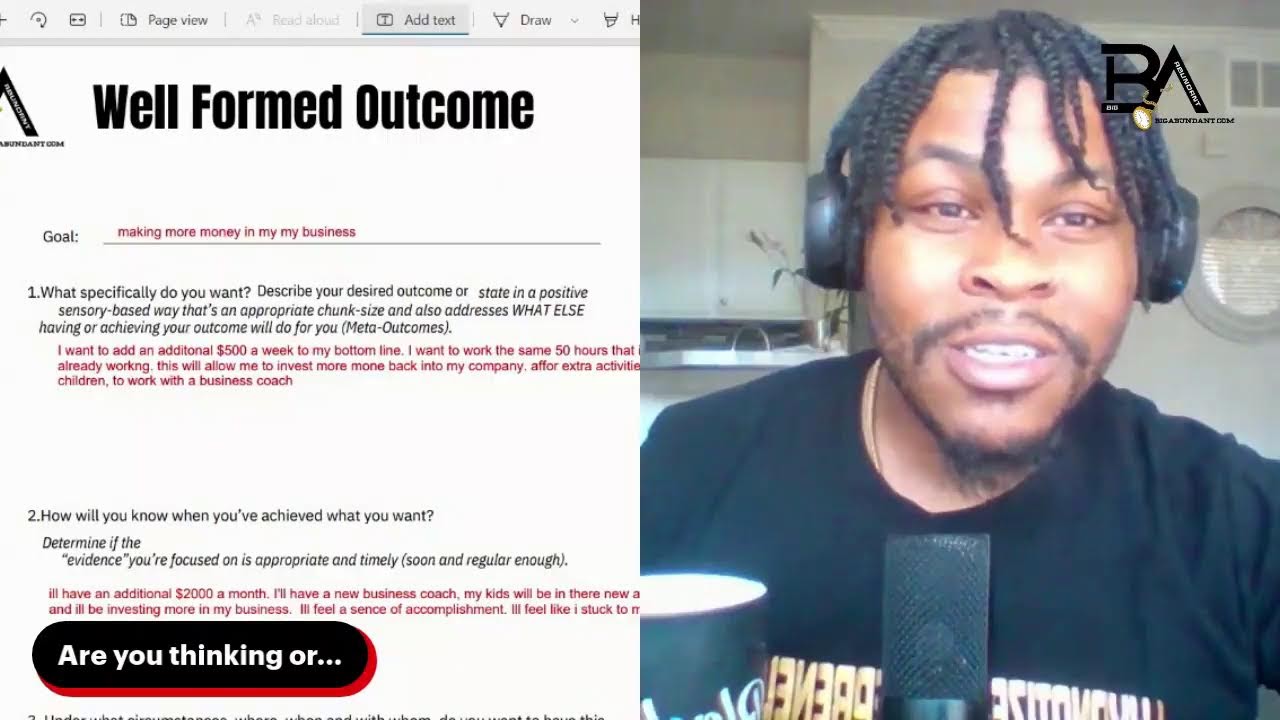
What's good? What's good? What is good? So we streaming to a few places right now. We we streaming to Facebook, the Facebook group, and the YouTube channel. So give me a second. I'm gonna be jumping back and forth, trying to make sure we got everything rolling smoothly here. But what's up, what's up, what's up? How's everybody doing? Our topic for today is, are you thinking, or are you, are you thinking, or just like responding, just running the patterns we've been trained to run? Yesterday we talked about, um, theory of mind. I'm getting right into it, so if, um, y'all could show up late, just catch the replays. It's all there. But yesterday we talked about, um, theory of mind, and we talked about how pretty much for the first 8 years of our life we live in hypnosis, and we make these what we call known associations— some good, some bad, some indifferent. But, um, those associations that we make become 88% of our thinking process. Then later, around age 9, we, we develop what we call the conscious mind. That's why our reasoning, analysis, logic, willpower, all of that stuff lies. But it's only 12% of our thinking ability. So what happens is we'll want to do something in the 12%. We'll want to quit smoking, want to stop eating carbs. We'll want to make a change that we know we should. But in the subconscious mind, in that 88%, we have so many positive associations leaning in that direction that we don't tend to. So That's what we talked about yesterday. That video is up if you would like to catch it. Today we're going to be talking about, are you thinking or, or kind of just going through the motions? And I'm going to be introducing a tool that we call a well-formed outcome. Now, I love the well-formed outcome. It's a tool that I use in pretty much every initial session. And in order to think accurately, I believe you need A definite outcome. You'll be surprised, like, um, we do therapy and so many people, so many people, they can tell you in vivid detail, dot every i, cross every t, about what they don't want. But when you go, okay, what do you want instead, people's eyes glance over. They, they don't, they don't know what they want. They know what they don't want. They can get very descriptive about what they don't want, but when it's time to tell you what they want instead, they, they don't know. So I like to start, um, every first session with doing what we call a well-formed outcome, because I'm a firm believer that you cannot hit a target that doesn't exist. Imagine this. Imagine getting into an Uber and saying, hey, don't take me to the mall. I hate the mall. It's too expensive. The price is too high. It's a bunch of teenagers out there with no money. They not even shopping. They just stealing and fighting. Don't take me to the mall. Then you sit back and shut up. What, what is your Uber driver supposed to do with that information? Now me, if I'm your Uber driver— I used to drive Uber— if I'm your Uber driver, I'ma just start driving. I'ma not take you to the mall. I'ma get on the highway and just drive you in circles. I'ma still get paid. You're not— and all I got to do is not take you where you don't want to go. I'm, I'm gonna be good. But the person in the back seat really getting the short end of the stick. They paying for a ride, but they didn't pick the destination. How many people are going through life like that today? They know what they don't want, but they don't know what they want. But the thing about it is your heart still beating. Your heart ain't getting no younger. Your liver ain't getting no younger. You not getting no younger. You going through life. But you're not picking a destination. So we're gonna go through the well-formed outcome, and I'ma just fill out a mock version on it. We streaming this to my, um, Entrepreneur Secret Weapon group, so we'll pick a— we'll fill it out from an entrepreneur standpoint. And, um, I believe the comments will pop up over here where I can see them, so if you guys got questions and stuff, just chime in. But I'm going to jump over the screens here. We're going to Walk through the well-formed outcome together. So the well-formed outcome is it's five questions, and each question has sub-questions. So we'll look at the sheet as a whole. So the first thing on the sheet is the goal. That's your overarching goal. You don't got to get super specific on here. It's just the overarching goal: lose some weight, make more money, be more outgoing, yada yada ya. Then we get to question one: What specifically do you want? Describe your desired outcome or state in a positive. Sensory-based way that's an appropriate chunk size. When we talk about chunk size, we're just talking about the size of the steps. Like, it's, um, laying bricks versus building a house. Building a house is overwhelming, it's, it's a lot. But laying bricks is a lot simpler, simpler to look at it in terms of laying bricks. And also address what else having or achieving your outcome would do for you. We call that a meta outcome. What's the things that you haven't even thought about? What's the benefits of getting this that you haven't even thought about? How is it going to help the people around you and different things of that nature. Number 2, how will you know when you have achieved it? If you woke up tomorrow and had everything that was in question 1, what would that look like? What would that feel like? How would you know mission complete? Number 3, under what circumstances— where, when, and with whom— do you want to have this result? Reflect on the context in which you want to have this outcome and evaluate the ecology so you can consider how achieving this result may affect other areas, aspects, or people in your life. Have you ever thought you wanted something really, really, really, really bad and then you got it and you're just like, I don't even really want this? I done put 6 months into getting this, a year into getting this, 2 years into getting this. Maybe you got a specific degree, you can put the 4 years in, you're like, man, this thing, I don't even really want this. So this ecology check is kind of help you decide if it's something you really want before you put all the action and effort into it. Number four, what stops you from having your desired outcome already? What stopped you from doing this shit yesterday? Why haven't you already taken the steps? Is it a mindset? Is this a belief without yourself? Is it something physical in a way? Is it money? Not not having a car? Like what what's the thing that's getting in the way stopping you from having it right now? Number five, what resources will you need to help you create what you Determine what resources you already have. I love that it starts with the things that you already have, then it goes on to saying what things will you need. Then this last question, how are you going to get— identify manageable steps to help achieve your result? Consider multiple options to get where you want to go and determine the first step you'll take. Now, at any given time, I'll probably have like 10 of these going in my life. I got one going for the business. I got one going for relationships. I got one going for things I want to see happen with my body. This is not just a sheet that you do once and you never look at again. This is a sheet that you turn to over and over and over again. Every time you get ready to pick up something, start a new project, or set a new goal, I recommend you pick up a Well-Formed Outcome worksheet. I know my clients get tired of me. Hey, all right, you helped me quit smoking. Now I want to lose 20 pounds. Bet. Let's get to the Well-Formed Outcome. We got to do that again. Yeah, we got to do it again. But what the well-formed outcome does is— okay, so we were talking about inferior mind, right? How we got the conscious mind and the subconscious mind. We got that 12% up here where our reasoning, logic, willpower, all of that is going on, right? Then we got the subconscious mind. That's where our feelings are. That's where our emotions are. And that's 88% of who we are. Like when people, people want to go to the gym, but when it's time to go to the gym, they say, I don't feel like going to the gym. And when they don't feel like going to the gym, they don't go to the gym. They feel like watching Netflix, so they watch Netflix. That 88% is what controls us. What the well-formed outcome does, it talks to the conscious mind and the subconscious mind. We start at the top of the sheet with the goal, deciding what we want. We're using our logic, we're using our decision-making, and we're using our willpower. But as we work through the sheet, We, we start to ask questions like, how will you know when you have achieved it? What will be there? Now we pulling the subconscious mind on there. You starting to say stuff like, well, I'll be more patient with my kids. I have more time to spend with my kids. I'll be able to go on vacations. I'll know it's true when I'm laying on the beach and I can feel the sun on my skin. Now we got the conscious mind and the subconscious mind. So now we got 100% of you working on the goal instead of just 12% of you. So that's the one of the like big pluses about the well-formed outcome, and it's starting to make new positive associations towards what you want in the very beginning of the goal-making process. What's up, what's up, what's up? Somebody at the door and they gonna have to wait because I'm busy and this dog gonna have to be quiet. Hold on a second, y'all, let me see who at the store. All right, we back, we back. Some people at the door trying to preach to me. I should have brought them in and told them to come listen to what we got going on over here. But the Well-Formed Outcome— somebody said good morning, good morning. It's not showing me your name, it's just saying Facebook user. About a form, is the form in the group? It will be after we— after I finish, I'll upload a copy into the resources in the group. But, um, we're talking about the well-formed outcome. That's the form we talking about yesterday in the group. We talked about theory of mind. If you're not in the group, you don't got access to the video yesterday. Aha! You want to get in the group, inbox me. I'll send you a link to the group. It's called Entrepreneur Secret Weapon, and we get in there and we teach entrepreneurs how to think. Most people don't think. They run a group of patterns. There's a group of patterns that you learn to run between the ages of 0 and 8. People be 20, 30, 40, 50 years old still operating on the mindset that they developed between the ages of 0 and 8. You got to stretch that mindset every day. You got to challenge that. Other day in the group, I asked the question, when is the last time that you stretched your boundaries? When is the last time that you stretched like your area of possibility? When is the last time you examined how much money should I be making a year? When is the last time you examined The, like, the, the house that you can afford? When's the last time you examined, like, what you can really do? Like, I know you might ask yourself, could I go back to school? You might ask yourself that question 3 years ago and the answer was no. But what's the answer today? And what's the real answer? Like, not the autopilot answer, that first answer to come. That first answer is usually the answer of habit. It's just the answer you've always given. But what's the answer right now, taking everything into account? Okay, the kids, 2 years older. You know what, I'm not doing that anymore, and I do got this time. And if I stop watching Netflix as much as I do, I probably could do that now. But anyway, we getting off topic. Let's get to the well-formed outcome and let's get through this. So since this is streaming to my, um, entrepreneur Facebook group, we're gonna do an entrepreneur goal. So the overarching goal will be, let's say, making more money in my business. I'm spelling some things wrong in here. There we go. Making more money in my business. So that's the goal. Notice it's not specific, it's very vague. It's just the overarching goal. No, question number 1 is where we get specific. What specifically do you want? Describe your desired outcome or state in a positive sensory base. Notice it said in a positive sensory-based way. So when we say positive sensory-based, that means don't tell me what you don't want. Tell me what you do want. I'm telling you, every session that happens, I go, how can I help you today? Well, I'm tired of such, such, such and such, and I don't want to be this, and I, I don't want to be sad anymore. And I say, okay, what do you want instead? I just told you I don't want to be sad no more. Okay, so what, what do you want? It's so many things out there other than sad. Do you want to be Extremely happy? Do you want to just be a little bit happier? Do you want to be mad all the— like, what do you want specifically? Not what you don't want, what you do want. And give it in a way that's in an appropriate chunk size. Don't try to build the whole house. Let's just lay the bricks. And we can do as many of these sheets as we need to. And then it gets into the meta outcome. What else will having or achieving your outcome do for you? So what specifically do I want? Let's say I want to add an additional. I'm not fixing the spelling. Y'all just got to deal with it. Five hundred dollars a week to my bottom line. Wanna add? So now we get now we getting specific. I want to add a five hundred dollars a week to my an additional five hundred dollars a week to my bottom line. I want to work same 50 hours that I'm already working. Okay, so I wanna add an additional $500 a week and I don't wanna add more time. I wanna keep it to the 50 hours a week that I'm already doing. What would this allow me to do? Now we're getting into the meta outcomes. This will allow me to— Invest more money back into my company. My company. This will allow me to afford extra activities for my children. What else would this allow me to do? This will allow me to work with a business coach. It's an extra two grand a month. Okay, so now we did step one. What specifically do you want? Describe your desired outcome or state in a positive sensory-based way. I want to add an additional five hundred dollars a week to my bottom line. Ain't that so much better than I want to make more money in my business? Have you guys ever tried to like move something like an older TV? And it's not necessarily that the TV is heavy, it's like it just don't really got anywhere for you to get a good grip on. If it had like some handles or an easy way to grip it, you could move the TV with no problem. But because it doesn't really have any way for you to get a good hold on it, it's, it's awkward to move. It's the same way with gold. Your subconscious mind is so powerful. Think about it. Your subconscious mind right now is regulating your body temperature, making sure every organ in your body is doing what it's supposed to do. It's a part of you that turns your— it takes, uh, uh, some almonds and turn it into the resources that your body needs to function. This, this is the subconscious mind we're talking about. We're talking about the subconscious mind that took you from a sperm cell to the full-blown adult that you are today. That's the subconscious mind we talking about. You think this subconscious mind can't show you how to make $500 a week, an additional $500 a week? The problem is, if the goal is I want to make more money, the subconscious mind heard you. You might make an extra dollar. Subconscious mind like, did it, gotcha. You want to make more money? Gotcha. You got to tell the subconscious mind exactly what you want. That's one of the things we do as hypnotists. We know how to talk to the subconscious mind. Subconscious mind is childlike. You got to keep in mind, it's the— this is the version of you that you built from the ages of 0 to 8. The child could— the subconscious mind is the version of you that used to believe in Santa Claus. Subconscious mind is the version of you that used to believe in the Tooth Fairy, and it was real as long as you believed it was real. When you believed it was real, you acted like it was real. All right, so we talking to that part of you. When you get really specific with that part of you and you give it a place to really lock in, we call them neural handles, neural pathways. When you, when you really Can let the what you want lock into the neurology. What happens is your subconscious mind starts to move you toward it on accident. That's how we help somebody quit smoking in 45 minutes. We have them paint a very clear picture of what it looks like, and we explain to the subconscious mind. We don't tell the subconscious mind, I don't want to smoke, because the subconscious mind doesn't negate information. When I say it doesn't negate information, what I mean is the subconscious mind doesn't know How not to. Like, for example, whatever you do right now, do not think about a lion. Whatever you do, don't think about a lion. Think about anything else, but don't think about a lion. And the more you try not to think about a lion, the more you think about a lion. Like, you ever been in the house and everybody else sleep and you trying to go in the kitchen and get a little late night snack, and in your mind you're going, don't make noise, don't make noise? Then you start knocking over shit that you typically wouldn't knock over. And you start doing things that you wouldn't typically do because the subconscious mind doesn't know how not to do something. Or your, your baby will be on your white rug with a red cup of juice and they know they're not supposed to be in there, and you go, you better not waste that juice on my carpet. Right after you said it, they— you go, I just told you. Actually, you hypnotized me. The subconscious mind— like, if I'm trying to hypnotize you and you're not relaxing as quickly as I want you to relax, I might say something to you like, don't relax too quickly. The subconscious mind doesn't know how to not relax. So I'm framing it as I'm not telling you what to do, but I'm really telling you what to do. Don't relax too quickly. In a sales situation, I might say, hey, don't decide to buy this product too quickly. Actually hear me out and make a good decision. Don't, don't buy it too quick. Take your time. I'm still saying buy it. I'm just saying don't do it too quick. So the subconscious mind doesn't negate. So we got to stop telling the subconscious mind what we don't want. And tell the subconscious mind what we do want. I'm going way deeper than I intended to. Let's get back to the well-formed outcome. Okay, so how will I know when I have achieved what I want? Well, for one, I'll have an additional $2,000 a month. I have an additional $2,000 a month. I'll have a new business coach. My kids will be in their new activities. What else I put up here? These business code and I'll be investing more in my business. And the dope thing about this sheet is you never have to stop. Let's say I get to the point where I'm ready to start investing in my business. I can make another well-formed outcome for investing in my business. This sheet is going to give birth to more sheets. Like, you will produce micro steps from these macro steps, but I don't want to just stop at the physical things. I want to stop at the— I want to, I want to also include the feelings, because remember, our subconscious mind operates on feeling. We don't do what we want to do, we do like— we do what we feel like doing. People don't say, I don't want to go to the gym. They say, I don't feel like going to the gym. I don't feel like going to the gym. So we gotta, we gotta stir the feeling. So when I accomplish this, when it's done, I know I achieved it. When I feel a sense of accomplishment, so I'll feel a sense of accomplishment. I'll feel like I stuck to my goal, and you can get this descriptive right here if you want. But you take the time on every question and. Take the time to answer what it's asking you and answer from the conscious mind and the subconscious mind, because you want to tie all these things together so you can get 100% of you working on your goal instead of just 12%. Okay, so question number 3: Under what circumstances— where, when, and with whom— do you want to have this result? Reflect on the context in which you want to have this outcome and evaluate the ecology so you can consider how achieving this result may affect other areas, aspects, or people in your life. So under what circumstances? Where? Right here in Dallas, Texas. I don't plan on moving to achieve this goal. With whom? Children. Our same team. I don't plan on adding any other staff. A new coach, maybe. I wanna, I wanna bring on my coach. Is there anybody else on the home? And new customers. I mean, I want to bring in some new customers to, to establish this. And what this helps you do is now I'm taking into consideration I want to do this without taking time away from my children. I want to do this without moving. I want to do this with my same team. I want to include the people that I already got working with me. And I'm bringing in my new coach and new customers. So now I'm understanding that I still got to make the children a priority. priority as I do this. I still got to make my team and my family a priority as I do this, but I'm also bringing in— I'm bringing in a new coach and I'm bringing in my new customers. All right, so where— we did the where. When— oh, when. $500 a week. I believe I could do this in 2 months if I get serious, if I get serious today. So today's date is October 13th, so October, November, December. December 13th would be my win. December 13th. Boy, this spelling ain't fixing none of it neither. Y'all gonna have to thug it out. 2022. December 13th, 2022. So I'm gonna be right here in Dallas. Children, my same team, my new coach, new cusp. Now I just gave this December 13th— I'm gonna fix that because it's important. I just gave my subconscious mind some big information. Now my subconscious mind says, "Oh wait, I need to make this happen in two months." Gotcha. Okay, so you'll make additional five hundred dollars a week, and you want to do it within the next two months. Your subconscious mind already done went to work on the situation now. Your self's mind is already thinking of ways to get it. Oh, and I ain't even put the well-formed outcome up here for y'all. Y'all still looking at theory of mind. My fault. But when you put that specific date on it, now your subconscious mind is, okay, we got 2 months to do it. You want to make $500, an additional $500 a week. Do you understand your subconscious mind? Like, it's a powerful calculator. Like, when you watching like baseball, like somebody standing in the outfield, do you understand the amount of calculations that's happening? The instant that ball leave the bat, subconscious mind go, hey, you need to run. 7 miles per hour at a 45-degree angle. Okay, you need to extend your hand 30 degrees and you need a quarter inch to the left right there. Hold it back, back. Just look, your subconscious mind is a calculator. It's always working under the surface, and when you give it specific details, it knows how to put the, the rest of the stuff in the middle. Like when I decide to pick up this coffee mug, only I use my conscious mind to decide to pick up the coffee mug. My subconscious mind does all the extra stuff. I'm not having to feel around, find my mouth, and say, okay, put the cup right. My subconscious mind take care of all of it. It's the same way when you work on the goal. Tell the subconscious mind exactly what you want. Give it vivid details about what you want, how you'll know when it's working, and the time frame you want to do it in, and it instantly goes to work. Give it a time frame. You want— you got to give it that time frame. Okay. And consider how achieving this result may affect other areas and aspects of your life. Um, I'll have more wiggle room in my budget. I'll be less stressed. Less stressed. Uh, what else, what else, what else? Um, my kids will make new friends because they'll be in their extracurricular activities. They'll make new friends. What else, what else, what else? And I'll learn new tools. My new coach, so I'll be more resourceful. And on a bigger goal, we'll have to, uh, look at some of the negative sides of it. I have less time to spend with my family. What does that look like? What's going to be my plan for that? Will I make it up on the weekends? Am I okay with giving up that time? Like, this is a smaller goal, but on bigger goals, you're gonna have to— like, it's gonna be some give and take. So number four, what stops you from having your desired outcome already? A lot of times on this wealth outcome, you got to be honest. I'm lazy, not motivated. Um, I'm comfortable. Sometimes the only answer is shit. I just ain't took the initiative. I got everything I need to do it right now. I, I just haven't taken the initiative. Is it any beliefs in the way? If I got a belief that I can't do it, that's something I would put right here. I don't feel like I can do it. All right, so that's what that column is for. Number 5, what resources will you need to help you create what you want? Determine what resources you already have that will help you. Okay, so in this instance, I already have a business. I got a business. I already have a team. I got a team. Um, I already got ideas. I already got like a plan about how to do this. I— it's just a matter of putting them in, into place. Um, I have a strong mindset, confident. I got a family that supports me. Um, I got a good friend group. It can serve as accountability partner. So I got accountability. All of this stuff is important. A lot of times when we look at resources, we just thinking about the physical stuff. We thinking about things we can see, touch, taste, and feel. But we got to go inside. Remember, we want the subconscious mind to get involved. So mindset and the thoughts and all of that plays a part in the goal setting process. So we want to put there. So those are the things I already have. What are some things that I need? Um, I need the coach. I gotta find the coach. I need, um, I need to work out more. I need to, because that'll help me build the discipline. I need to, I need to, I need a routine. I need a schedule. That's what I need, a schedule. And you get those wheels turning, and I'm being real vague on these, but you fill this thing up. But sometimes you even go to another sheet of paper and you, you keep it going. And then this last question, how are you going to get there? Identify manageable steps to help achieve your result. Consider multiple options to get where you want to go and determine the first step you'll take. So the first step I'm going to take is I'm gonna make a plan. I'm gonna make a plan. If I want to make $500 a week, I work 5 days a week, so I need to divide that by 5. So that's only an additional $100 a day. So I'm gonna start asking myself, how can I make an additional $100 a day? I could take the services I'm already doing, increase each one of those by $20. I can come out with a new service. I can write a new ebook just by asking myself the right questions, because that's what thinking is at the end of the day. Thinking is asking yourself questions. Now, if you're asking yourself the wrong question, you ask yourself, why am I so stupid? Now you got a list of reasons why you stupid. But if you ask yourself, how can I make an extra $100 a day? That's a good question. If you ask yourself, how could I lose 5 pounds in 2 months? That's a powerful question. Not why am I so fat? How could I lose 5 pounds? You see the difference? So that's another thing that this well-formed out— well-formed outcome worksheet does. It gets you asking the right question. And then you jump down to what is the first step you could take. The first step I'm going to take is I want to make an additional $500 a week. First step I'm going to take is looking at my current pricing, because remember, I want to do this in the same 50 hours. I don't want— I don't want to work an additional 10 hours. So I'm gonna look at my current pricing and And see where it is reasonable to raise cost. Now you got a well-formed outcome. And if you want to get real crazy with the well-formed outcome, the way that I use the well-formed outcome, the information that I get from my clients in the well-formed outcome, I put them in hypnosis, then feed them this information. why they in— and why they in hypnosis. I get them to see the goal being done. Like, because the example I like to use when I'm on like Clubhouse and different things, if I do a competition every month and I give away a million dollars— a few months ago your friend won, they came, they got their money, and you witnessed them get their money and saw them ride off into the sunset with their money. Then this month you win the, the million dollars. And I say, hey, congratulations, you just won a million dollars. The only thing you got to do to collect your money is you got to be at my house in Dallas, Texas by 5 PM tomorrow. Guaranteed million dollars. You got to be in my house in Dallas, Texas by 5 PM tomorrow Central Time. Do you think you're gonna be too tired, too broke, not be able to find a babysitter, have a headache, not feel— you think any of that's gonna get in the way? Or you think you're gonna figure out how to get your, your butt to Dallas, Texas by 5 PM? If you really truly believe it's a guaranteed million dollars waiting on you, you're gonna figure out how to get to Dallas, Texas. It's the same way with any goal. If you really convince yourself that it's possible for you to add that extra $500 a week to your revenue, if you can see it, you can figure it, you got a plan that you can see working, You're not gonna procrastinate. Confusion— procrastination comes from confusion. I don't know where to start. It don't make sense. I don't even know if I can do it. Of course you procrastinate. You don't know if it's possible. But if you know you could do it, if you know that the thing that you want is on the other side of it, you gonna do it. You gonna do it. But that's the well-formed outcome. I went way deeper than I planned on going, and we still could go deeper. We're scheduled to stick to— but hey, thank y'all for listening. Thank y'all for chiming in. If you want to get in the Facebook group where we talk about this type of stuff at length, I'm gonna be doing a lot of presentations. I'm gonna be bringing a lot of my friends in, having them give them presentations. But we at an age where we have to learn how to think. It's one problem in the world— thinking. People have lost the art of thinking. They don't think. They, they run patterns and call it thinking. People mistake mental activity for thinking. Doing what you've always done is not thinking. Doing what you've always done is running a pattern. Right now we can sit right here right now and with 90% accuracy predict What tomorrow will look like. Now, if we can predict what 90% of tomorrow will look like, why are we surprised when the bank account looks the same from month to month? Because we're doing the same thing, bro. I'm working on it. I'm trying to get like you. No, you're not, because you're not in the group. You're not reading the books. You're not— you doing what you always did. And man, if it weren't for this recession, bro, you was You're struggling before the recession. If it wasn't for— I gained so many— I've worked with so many people who blame their weight loss on the COVID on, on the pandemic. Bro, you was, you was always before the pandemic. That's just the easy excuse. You, you was doing what you always did during the pandemic, and during the pandemic you had even more time to do what you always did because your job said they'll pay you to work from home. So now you, now you're not just drinking after 5, you drinking all day long. You, you run the patterns that you always ran. This wellformed.com helps you to get in there and shake up those new patterns and ask yourself the questions to help you to get focused on what you want instead of what you don't want. Because where attention goes, energy flows. And when you put your attention on what you don't want, you manifest a whole lot more of it. People go big. How do I start manifesting? You can't stop manifesting. Your life that you have right now, you manifested it. If you decide, I'm like, even if you go in the kitchen and make a sandwich, like, have you ever looked up the word manifest? That's what we talking about tomorrow. I'm finna end the live tomorrow. When I go live, we're talking about, we're going to talk about what manifesting really is, because people think manifesting mean to hope for, people think manifesting mean to wish for, and that's not what it mean. If you want to know what it mean before tomorrow Go look it up. But that's the discussion we having tomorrow. What does it mean to manifest? Manifesting 101. That's the live stream we doing tomorrow. Look, love y'all and not a damn thing y'all could do about it because it's unconditional love. You don't got to do anything. You don't got to play by any certain rules. I just love you. But if you're not in the Facebook group and you would like to be, shoot me a message. Message me anywhere. It'll come to my phone and I'll get you in the group. I'll send you the link. But I only want people in the group that want to be in the group. I don't want nobody in the group They ended up there on accident or just clicked on it because they saw it. So it's an invisible group because I want people in the group who took the step to get in the group, because I'm, I'm really wanting to build a mastermind where I got a room full of people who think. I don't want a room full of people to just go, yep, you right, yep, you right, yep, you right. I want people who gonna challenge me when they disagree. I want people gonna bring their thoughts because, man, we in some real dangerous times and it's only gonna get worse. Worse if people don't start using their critical faculties. But love y'all, see y'all later, and y'all take it easy.