8/21/20 - Friday's Are For Closers Season 2, Episode 3 - Right Story, Right Time, Right Reason
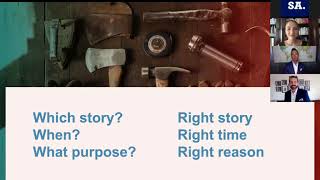
Matt Green, Andrew Sykes, Tia Pappas, and Craig Wortman teach how to pick and tell the right story at the right moment in a sales conversation. They introduce four story types (fun, success, failure, legend) and two tools: a story tree to mine your experiences and a story library to organize them by sales stage. The session includes live examples and exercises on timing and delivery.
Chapters
Hit record. Thank you, everyone for joining us yet again for episode three of our second season of Fridays are Foreclosures. For those of you that I haven't had the pleasure of meeting yet, my name is Matt Green. I'm the Chief Revenue Officer of Sales assembly here in Chicago. As always, we're really excited for today's session today, especially because we're not only joined by Andrew Sykes and Tia Pappas of Habits at Work, but we do have a special celebrity guest in the form of Craig Wortman. I'm going to let Andrew and Craig introduce themselves, respectively. But before we dive into today, I just want to thank, of course, our partners that we're able to make today possible. Showpad, Lessonly and Vidyard. And with that, we have a lot of really great content to cover today. So I'm going to go ahead and turn it over to Andrew to get us started.
Wonderful. Well, welcome everyone to how to Tell the Right Story at the Right Time for the Right Reason. And to situate you on where we are in season two, you'll remember if you joined us. For the first episode, we looked at how to create and specifically how to write a really moving story. But stories are best shared live. It's a conversational act. And so in the second episode, we looked at how to be a great storyteller so that people lean in, want to hear more, and are touched, moved, and inspired by the stories that you tell. Well, of course, you need to have fantastic stories to tell because the art of storytelling for business is a very purposeful act. There's a reason we tell stories, and so it's not just telling a story to be entertaining. It's making sure that you tell the right story at the right time during the sales process for the exactly right reason, so that it helps you to build deep and lasting relationships, close more deals, and keep your customers happy longer. And today, we'll be digging into the art of telling the right story at the right time for the right reason. And if you join us in a couple of weeks, we'll be looking at how to take your existing stories, adopting them and adapting them for use in different circumstances. And we'll end our series with our personal favorite origin stories. But to get us started, some introductions. Thank you for joining me again. My name is Andrew Sykes, the founder and CEO of Habits at Work. But I'm joined by my very good friend, Craig Wortman. Most of you are likely familiar with the name. If you're not, Craig is distinguished by a few things. Number One, he is a clinical professor of entrepreneurship and innovation at the Kellogg School of Management where he founded and I'm here today because he invited me to join the Kellogg Sales Institute. He is also a venture partner at the Venture Partner from the Pritzker Group Venture Partner Group. And last but not least, he is the CEO of Sales Engine, a Chicago business that helps companies to tune, build and tune their sales engines. Two other interesting facts about Craig and one of the reasons I've invited him today. He is the author of the book what's your story? And so he's got a lot to share about the art of collecting and organizing stories as well as telling those stories. And the last fun fact about Craig is that he is the reason that I met my other co host today, Tia Pappas. For those of you who haven't met Tia before, she is a co founder of Habits at Work, a professional speaker and my own speaking coach. So welcome Craig and Tia.
Thank you.
Andrew, thanks so much. And Tia, my friend, great to see you. Great to be with you both. My teaching cart, my teaching colleagues, my partners, my friends. It is always great to be with you. We've been in, we've been in a lot of rooms all over the world together in a lot of zooms now. So it's fantastic to be with you.
Absolutely. So let's get into why we're gathered here together today.
The purpose of today is to review the four story types and the job that each of these story types do. You'll learn a simple way to dig for and unearth stories in various parts of your life using what we call a story tree. We'll introduce a story library, which is a tool for storing and organizing stories in order to scale storytelling at an organization. And finally, you'll have a chance to practice your story between now and in two weeks when we're back for episode four. And what we hope you'll gain from today is the knowledge, skills and tools to help you tell the right story at the right time for the right reason. How does that sound? I can't see your faces. So thumbs up or say yes in the chat. And as always, we aim. Thank you. As always, we aim to make every one of these sessions better than the last. And, and in order to do that for episode four, we will ask you for some feedback at the end of today.
Wonderful. Well, let's get straight into it. Thank you for those thumbs up. We're great and grateful and happy that we're aligned on why we're here. But let's Dig into what exactly is the problem statement that we're trying to solve with today's Masterclass. You'll remember in episode one, the problem we were trying to solve is how best do we change somebody's mind? And we discussed how stories are the vehicle that carries facts and figures safely from one mind to another, enabling people to adopt a new view, choose your point of view, or even invite themselves to make use of the products and services that you offer. They're an entertaining and low risk way of educating your customers on why you and why now. But it depends on how well those stories are told, which was the problem statement that we went to work on in episode two. The problem now is figuring out which story to tell, when to tell it, and why exactly you should tell it. So we have three questions that we're trying to solve for how do we find the right story at the right time for the right reason? So that your sales process accelerates from contact through to closure, and everyone enjoys the process along the way, you close more deals and you leave customers happier, longer. And so the first question we usually ask is, well, which is the right story? But I'm going to challenge you to consider that we should answer those second two questions first. So we may want to look at a particular prospect or customer in process and ask ourselves, where are we in the sales process and what is the time? When should we tell a particular story? If they raise an objection, that's a time to tell a story. If they don't know who we are and how we're differentiated, that's a time to tell a story. So it's useful to think about all those drumbeats almost through the sales process, those times when a story will do the job better than facts and figures alone can do. And when we clear on the time in a relationship when stories are needed, we can ask the question, what exactly do we need the story to do for us? Do we need the story to separate us from our competitors? Do we need the story to guide a customer to make the right choices? Do we need a story to motivate customers when they're feeling a little anxious about choosing our solution or. Or any solution at all? If we're clear about when and why to tell a story and what work that story will do for us, it becomes a lot easier to answer the question which story we should tell. So the place to start is to think about how might we categorize stories by the timing and the reason for why we tell stories. And we like to think of stories in A couple of categories. And these categories we borrowed from my friend Greg Walkman from his book what's yous Story? So you'll find it in there if you read that book. And the first story type that we all love to tell are fun stories. So when might you tell a fun story? Well, they're useful often during the relationship if you want to build connectedness, but in particular early on when perhaps the customer isn't sure that they like or trust you enough because. Because they reveal your personality, they're fun, and people like to be around fun people. Or maybe they're not yet comfortable sharing some of their own stories. And you can share one, maybe revealing some vulnerability about yourself. And that's an invitation for them to share stories about themselves or maybe what they're dealing with in their lives right now. So these stories are wonderful at building connection and relatedness between people. And because they're often fun and have a light feel to them, they can prime your prospects to be in the kind of mood inside of which they're open to listening to what comes next in your sales process. So you want to have a good store of these fun stories. They're just as good for cocktail parties as they are for sales meetings. But remember, they do have a particular purpose, and that is to create relatedness. Now, perhaps the most important type of story in terms of numbers are these stories we call success stories. When would we use these? Well, there's two very good use cases, at least one of which is when you want your customers to see how you differ from or how you're set apart from all your competition. And of course, just saying these are our few features and benefits and these are those of the competition makes you sound a little bit less trustworthy. If you can share success story in which you point to an existing customer who used your product in an interesting and unique way, that story will bring to life how it is that you and your products stand apart from the rest of the industry. There are also times when a customer is clear about what the outcomes are that they're trying to produce, but they're not exactly clear about how to get there or how your piece of technology or your service fits into that pathway to success. Success stories have embedded in them the steps that another customer took to succeed. And in that story, they will see one stepping stone in front of the next that your existing customer took. And from that, if well told, they will see for themselves what pathway might work for them to to unlock those same desired outcomes. Success stories are fun to tell, but Remember, the hero of a success story is your customer, not yourself. You're just the guide, the facilitator to that outcome. Now, I said success stories are perhaps one of the most important ones because we use them so often, but one of the most powerful stories types and one that we use less often, but when we use it, it can completely change the trajectory of a sale. Failure stories and these I like to use whenever I have a customer who is committed to taking a certain pathway. And I don't just mean working with a competitor. Coming from the idea that to sell is to help people make progress in their lives. If I feel like a customer is about to do something that won't serve them, I don't want to be complicit in their failure. But nobody likes being told, greg, what you're about to do here isn't going to serve you. This isn't going to work well. So what I might do instead is share a story of another customer who had a similar situation, who perhaps chose a similar pathway to the one that my current customer sitting in front of me is about to now choose. And inside of the story, I'll reveal the failure that ensued. Told well, I will own that failure because I, as the trusted advisor to my last customer, didn't stop them, didn't guide them, perhaps didn't tell them the right story at the right time to prevent them from taking the wrong action. Those kind of stories have you, in a sense, as not the hero, but the person who learned a lesson in the story. And it empowers you to say, at the end of such stories, I committed that I will never again be complicit in the failure of a customer in this domain. And so it's a safe way to show a customer that what they're thinking about might not be the best answer for them, but they get to see that through the example of another company. And then we have those wonderful stories we call legend stories. These are stories about human beings who have made a mark on the earth, who have done something amazing, whether that's amazing for their own career, for their career prospects in their own business, or in the world at large. And they are fun to tell, but they're doing a very interesting job for you in the sales process. You see, these are the stories that give your current customers motivation, inspiration, that provide them with the confidence they need to act by hearing what other people did to either overcome a barrier or, or to gain internal support. So if you're looking at your customer and you can see from their emotion that they know what to do, they're just afraid to take that first step, or they're not sure they can get everyone else on board, or they see a barrier up ahead and they're not quite sure how to get around it. Again, we could say, let us show you how. Boy, do we have a solution. Or more generously, we can guide them to see for themselves how they might do that by sharing a legend story from another customer. But this time, the hero is the person at that customer rather than the company, which is usually the hero in our success stories. So legend stories are ones you should use often in this scenario. But there's a special case of legend stories where in fact we are the hero and they should be used sparingly for two particular purposes. And we call these subsets the personal origin story and. And the company origin story. When do you use a personal origin story? And we'll be looking at this in episode five at how to show up Share who you are, what you're passionate about, what you believe in, and the privilege that it is to have your role in your organization done well, delivered with panache. Your origin story leaves people feeling like you are trustworthy, passionate, credible, and the kind of person from whom I would like to take advice, with whom I would like to do business. We're of the view that customers decide that they want to do business with you before they decide what they want to buy from you. And origin stories can open up that relationship. We know people judge us in the first two minutes. Origin stories are your choice to decide on the wrapping that you are as a gift to your customer. And similarly, we can do the same thing for our companies, is to share the origin of our companies, why our founders set it up, what was their problem, their irritation, their motivation that had them do this and that has your company land as a business that you want to do business with. Because behind it are people with a passion, with a desire to change the world. Learn to tell their story, and it'll have you enabled to differentiate your company from every other company in a lineup. So the first skill we'd like you to consider is how might I get good at thinking about the different types of stories I will need when I should tell those different stories? And then how do I go and find the right story that fall into these categories? And that brings us to our second tool that we'd like to speak to you about today, which is the idea of a story tree.
Andrew, you and Tia and I for literally years have stood on stages in front of rooms on zooms now and webexs talking about these four types of stories. And just one additional thought for the group here as we move into the story tree. What's so interesting about the placement of fun at the start is, as you and Tia know, one of the things that we often get pushback on on building our story library is people will say, well, you know, fun stories that sort of light and, you know, and they are. They lighten the mood. They lower the intensity. But what Andrew just said, folks, this notion of priming certain moods, we now have very recent research from people like Barbara Fredrickson, who built the broaden and build theory of positivity, that as we tell these fun stories, they have tremendous raw power. And so don't take that category lightly. When we ask audiences, when Tia and Andrew and I are in front of crowds, and we say, okay, here are the four types of stories. Which ones? If you had to choose one, which one would you tell it? Everybody says successful, and that's great. And that success stories, as Andrew outlines, have a real power to them. Of course they do. But don't take fun and don't take failure for granted, because the failure ones are interesting. I mean, we have known for thousands of years, we have told kids and adults and each other fables. The literal definition of a fable is called it's a cautionary tale. And so when Andrew and Tia and we talk with you about telling failure stories, some people will recoil and be like, really? Would I really tell a failure story to a customer, To a prospect in an interview? And the answer is, absolutely, for all the reasons you suggest. So, okay, Andrew, Tia, as we think about how in the heck do we populate the story library, we came across a really interesting way to think about this. We call this a story tree. And Andrew, because you and I have, you know, a couple of legs and a couple of arms, in academia, we have to give credit where credit is due. The woman who initially came up with this idea is a woman named Diane Castile, who's become a friend and is an amazing woman, a multiple moth story hour winner. And one of the things she sort of offers us. And what Andrew and Tia and I have done just sort of take this to its next logical extension, is this notion of a story tree. And so if I may. And Andrew, I'm not seeing the slides, so if you put those up, beautiful. So Andrew mentioned in his wonderful introduction of me as very overly kind introduction, that one of my crazy hats that I wear you all is. I serve as an operating Partner at a group called the Pritzker Group Venture Capital. And so think of this as the trunk of my tree. And so now what are the branches of this tree? This is just a very, very simple way to think about collecting the stories that we can then again attach to our sales process and tell the right story at the right time for the right reason. So if you think about, if I think if I just look at a white piece of paper and I start drawing the trunk of a tree, one of the branches I might draw is. One of my roles at PGVC is to help our portfolio CEOs and Chief Revenue officers conduct what I call sales sprints. So that leads me into portfolio company work. It has bled into my MBA courses and Andrew and my courses at Kellogg. And I, as a consequence of that and a consequence of my portfolio work, I will often hear from the sales teams at the portfolio companies, which is one of the most rewarding things ever. And it makes me think of a leaf on one of these smaller branches sent to me by a powerful saleswoman called Angie. And talking about how she gritted out a sales sprint for a month. Can you imagine all day, every day, cold calling for a month and built herself and transformed her pipeline into tremendous opportunity for herself and for the company. So that becomes a leap. And it's a story that I could then say, Andrew could say, hey Craig, tell Angie's grit. And I could just at a moment's notice, reach back in that quiver of arrows or reach over and pull open the drawer of the story library and, and pull that right out. So that's a branch. And then Andrew, if we keep going, there's client work and those branch to job offers and then there's boot camps that my colleagues, Carter and David, two colleagues of Andrew's and mine at Kellogg, amazing men and professors at Kellogg. They've led me to other professors at Kellogg that we've collaborated with. We've been all over the world and all over the country doing these boot camps and, and where I can now tell about a really fun story about dining on the pier. And so what you notice here just emerging just as we have this sort of blue, green, yellow is Angie's Grit is a success story that we now hope becomes a legend story of that particular portfolio company. The client work, the job offers can be, they are actually both failure and success stories. Dining on the pier is a fun story. And then finally another branch, as you all probably know, a lot of venture capital firms, ours is no exception, does what's called a triple M A Monday morning meeting or a Monday afternoon meeting. And that branches to some of the thinking that we've done as a firm around E Commerce. Which leads me again to my friend. You're seeing this name twice. My friend and colleague Carter, who is an E Commerce, our in house E commerce expert. And that led Carter and me to a situation with a company that, that was starting a new business and business model around cat litter called Pretty Litter, which Andrew, Tia, my friends, you may hear something more about that as we move on. So this is a story tree. Notice the big trunk in the middle, the branches if you will, using the metaphor, branch. From there they become smaller branches, they eventually become leaves where they make contact with the sky or in our parlance, contact with the customer. So that's just a very quick story map or story tree, call it what you want, but it's a really easy five minute way to have you generate four, five, six, seven, a dozen stories in rapid fire motion such that you spread them out on the table and you say to yourself, okay, A, are these worth retelling? B, where would I tell them and when? In my sales process, where would I tell Angie's Grit versus dining on the pier?
Craig, what I love about this is we are so often asked this question, where do you guys come up with all of these stories? And this is an answer to that. Because the more you reflect on your life, the more you will notice that your life really is a succession of stories. Just consider for a moment, in any organization that's got five, ten or a hundred salespeople, every time you make contact with a customer that ends in a deal signed, and every time you have an interaction with a customer where you lose the deal, there's a story about both of those. You're telling those stories. Sometimes you're telling those stories with glee and happiness about the closed deal. Sometimes you're a little embarrassed about the lost cases. But there's always a story. And ideally there's a moral to the story, there's a point to it from which other people could learn. Such that Instead of having 100 sellers with 50 stories each in their head, your organization has 5,000 stories that you can all share from from the collective experience. That's what it looks like to institutionalize the intellectual property of stories. But now we're going to give you a chance to do this little exercise you saw that Craig did out loud. And we're going to do that exercise in two ways. If you have handy pick up a pen and a piece of paper so that you're ready to do this exercise, and I'll talk you through it by using Tia as an example, who did this exercise a couple of months back and generated some stories from doing that. So you start with a blank piece of paper, and as Craig did, pick an area of your life that you will start to create your story tree, what he called the trunk of it. So that might be my current job, it might be when I was at college. It might be friends and family. It could be vacations. There are lots of areas of your life, all of them rich, hanging with the fruit of stories. So don't worry for now about whether they're all business stories, because many personal stories have a business model. But if you want to go to work on your current company and that be the trunk of your tree, that's totally appropriate. If you are choosing your current job, the area that you're looking to find these stories in, think of all the different customers that you've won or lost. Name them if you can. Those will become the branches of the tree. And think about what you tell your manager or another seller about why you won or you lost a particular deal, and you're really wanting to hone in on those ones that made you feel something. You know the ones I'm talking about. When you lost it, boy, did it sting, because you deserved to win it from your point of view and something went wrong. Or the ones where maybe you were a little lucky and you won that deal and you'll take it. But there's a moral in how you got that, and maybe that's worth sharing with everyone else as well. So, Tia, would you like to do this with me?
Yes. Let's do it.
What's the area of your life that you went to work on?
The trunk of my tree is friends and family. So outside of business.
Awesome. So that's a great area of life to explore because all of us have been alive for exactly how long we have been alive. So there's lots to do there. And so if you're on this call with us, pick an area, write it down, put a circle around it, and you now have the trunk of the tree. And what you want to look at is relationships or events or significant moments that happened in this area. So, Teal, who would you think of or what event would you think of?
The first person I think of is my very best friend, Vonna, who was my one and only contact in Chicago when I moved here. Vonna introduced me to Craig and to Andrew, and out of that came an awesome Story about the power of network to land a job, which I categorize as a fun story.
It is a fun story. I've heard you tell it. And from my point of view, it's a success story because here we are in business together. So sometimes they can be both fun and success and take us through it from there. How you thought about building out this tree?
Sure. So next I went to Hercules, which happens to be Vonna's husband. He introduced me to his father, Jim. Hercules also runs an eye clinic in Libertyville and Habits at Work is working with his frontline staff on their customer experience. And out of that came a success story about asking customers for feedback.
And what I love about that story Cheer is how it brings to life the importance of asking customers for feedback in the moment versus in those surveys after you've left the office, which certainly I try and avoid filling in.
Yeah.
Okay, so we've got two leads already. A story about Vara and connecting you to Craig and myself. You've got a fantastic customer success story on feedback.
Well, one thing to note, the branch to gym, there's not a story that has come out of that yet. I hope that there will be one one day, but I don't. I got to gym and there wasn't another branch to make.
Got it. So there's a leaf, a bud.
There's a bud. It's budding.
Awesome.
That's right. Perfect.
Okay, so my next branch is Shelly, who is a friend and my former college basketball coach. I'm always harassing her for candidates to fill jobs at Habits at Work. Coming out of her program, she introduced me to Cicely. And now I have a success story because Cicely joined our Habits at Work team to help us with marketing just two weeks ago.
Got it. And Tia, I know that we're explaining how this goes, but as we've labeled your stories, you've got a story in our story library called Sicily and you've got one called Libertyville Eye.
Yes.
So if you're on the session with us today, I hope you're doing this as we go. Greg and Tia, I'm going to give everyone a minute to sort of doodle on their own piece of paper before we complete your picture and feel what it's like to wreck their memory. So let's do that now. If you have questions in the chat while you're doing that, send them to us. Otherwise, we'll take a quick one minute break, have a sip of water, and resume in a minute.
I just like saying the name Hercules, the best name. And she calls him Herc, which I just love.
Herc. Yeah, he goes by Herc.
It deserves a story name.
Oh yeah, he has a great story behind his name.
And as you do Link Team I see a couple of comments coming in from Dilip about the challenge that in a meeting we don't often feel like we have enough time to share a story. To which I would respond, do you have enough time not to share a story? Because one of the things that stories does for you is accelerate the sales process. Because it could take you perhaps weeks or months to convince someone with facts and figures, with the right story at the right time for the right reason can move someone into action in just a couple of minutes. And you'll notice that most of these stories are just two or three minutes long. Once you've told them and practiced them and really refined them, they don't need to be half an hour or 10 minutes or sometimes even three minutes. You can get some done in a minute flat. I hope you've been working along with us and this is just the beginning of the exercise today. We wanted to show you the tool but not have you stay online with us for 10 minutes while you complete it. I do though want to show you, for those of you who joined us last time and heard one of Tia's stories, how she got to that. So Tia, tell us that story of that last branch.
Yes. And guys, I see questions coming in the chat at the end we'll allocate a little bit of time to answering those questions. So the final branch is my sister Angelique. She introduced me to her brother in law Alexander, who formerly worked at New York Life. I was also the MC at her wedding as some of you heard last two weeks ago, which led me to meet the CEO of New York Life after I gave a speech. And it just so happens that you heard one version of my New York Life story and that was the feedback version. And the purpose of that is to share the power of feedback and practice to help you become a great storyteller. The other version of the New York Life story is shows the power of stories to help you stand out from a crowd and move your audience.
And Tia, I know you don't need much encouragement, so please ignore Alexine's comment to tell us the full story all over again. I would love to hear it, but I'm a hard no to that because we're a little short on time. I want to get to what I think is now the really important question. So a Little bit of a recap of what we've done so far. In our short half an hour, we've thought about the problem that we're trying to solve, which is to tell the right story at the right time for the right reason. And of course, it's those last two things that are critically important. When in the sales process do we need some tool, in this case a story to do a particular job for us such that the sales process moves forward. And now we've seen from Craig a beautiful tool to make map out a tree of your life in all of these areas so that you discover all of these leaves representing amazing stories that you can then take, write and learn to practice based on what we did in episodes one and two. But we don't all have fantastic memories. And if you do this and you're disciplined about it, imagine the hundreds, if not thousands of stories that my friend Greg Wartman has in his story library, this collection. And we don't tell every story every day. So in order to be able to find the right story to tell at the right time, we need some way of thinking about how to collect, then store and categorize and make it easy for us to retrieve, relearn, practice, and then go and tell them so that we can be walking into a sales meeting thinking about what we need for that sales meeting and have a tool that allows us to go and capture just the right story for that meeting. And that tool is what we call a story library. If you read Craig's wonderful book, he calls it a story matrix. It's the same thing. It's a database, a way to collect, and you can use any technology you like to do that. At Habits at work, we have built a website that does exactly this job for us. And what that website does is allows us to think about the ways in which we would like to categorize our particular stories. I'll show you a quick view of that. And it also is something that we want to be visually beautiful so that it's easy to use for our sales team. So as we look at that, we've categorized story types as we were just discussing, because we're in the business of high impact habits, we categorize our story by habits type. And for every one of those stories, you see the name where we use it. And you recognize here tia's New York Life facilitation story, which you used last time. And so let's say that I'm going into a meeting and I really want to talk to a sales leader about the power of giving and receiving feedback and what difference it can make for someone who joins your company and has maybe never given or received feedback before. So if there's an origin story around this particular habit, I might choose this one called Tia's Feedback. And if we go and have a look at that story, what we find there is a video of Tia telling that exact story, which I'm going to decline to play for now, as wonderful as it is. And we know that that story is exactly 3 minutes and 27 seconds when told well. And in a pinch, Tia can tell it in about 2 minutes, 40 seconds. We know where she's used it before. So in this case, when Craig, Tia and I were in Dublin doing a wonderful session together for about 750 people, Tia told that story for the first time. And we have that on video. We know what the intention of the story is, what it's there to do, and a very brief synopsis so you can just quickly see at a moment's glance is this the right story at the right time. And then we have the full story as if it's a storyboard or a script. You'll notice there's times when Tia should pause. There's times when the text is bolded to emphasize certain lines that make it a musical sounding story. You can download the script as another seller so you can learn it for yourself. And then we put it into, if you joined us in sessions one and two, the story arc, the different pieces of a story. And last but not least is if you're inclined to use slides and you need this picture that matches that story. Here it is. You pull it off, you put it in your slideshow and there you go, ready to tell the story. And if you're not feeling like you know enough about the subject, go and look at all this other research that we have that is background to the habit, background or context for the story. So you can organize this in any way you see fit. Craig, you organize your story matrix in a, a different platform. Don't you want to tell us a little bit about that?
Yeah, it's very similar, as you know. I mean, what I do is I have the columns of success, failure, fun and legends. Those are the columns. And the reason I call it a matrix is the rows are where in the sales process I need to tell the story. So it's very, very similar. So it's just, it's one more layer of organization that just takes those and says, okay, I'm early in the sales process, I'm doing lead Generation. Here's a row, an entire row of success, failure, fun and legend stories. I need in lead generation. I'm handling objections. I'm leading sales teams. I'm working with portfolio companies. And on down the rows go. And it's amazing. Andrew, you alluded to this. It's amazing how quickly this library builds once you start to be aware of the stories that are all around you. There is a forest of trees and leaves and stories. And once you become aware, it's like when you buy, you know, when you buy a Toyota, that's all you see are Toyotas. Once you start to pay attention to stories, you see them everywhere.
Yeah, I had several moments of panic in my career at Habits, at Work, when I, you know, saw behind the curtain. And I started like seeing stories come out of every single deal and every interaction that I made. I had panic thinking about all the stories that I've missed in my life that I have not even seen or recorded. It's happened to me many times. But you're right. Now that I know that there's a story inside of every interaction, every single deal, I'm always looking for them. In fact, part of our sales process at Habits at Work, when a customer signs or when a deal or when I lose a deal, one step in my process is to write up a story about that deal before handing it off to CS or brand. Before doing a lose debrief, I write up a story and add it to our story library.
Telling the right story at the right time for the right reason is something that when you see a master storyteller like Craig or Tia just pulling it out, apparently from nowhere, you may tell yourself something, a story yourself, something like, I'm just not a great storyteller or I don't have these stories. And what we'll challenge you to consider is that what looks easy and natural hides a lot of hard work in collecting, refining, categorizing, and organizing stories into these story libraries. I know the first time I saw Craig speak, I was blown away. And the more I got to know him, it didn't take any of the shine away. But as Tia said, I got to see behind the curtain and his story notes behind every professional talk that he gives. And we do the same thing. It's called preparation. And we do it in sales all the time. So given that, let's challenge you to do that yourself. Now, you've seen some tools today. We hope that they're useful, simple to use, and whether you store your stories in a spreadsheet or in A book or in onenote or on a website like ours, or a learning management system, it doesn't matter as long as you're storing them somewhere. So the challenge for you is to complete the story tree that we hope you started today in one area of your life. At least. If you're inspired, do two or three. And really look for those stories at the edges, what Craig called the leaves of your tree, and start to name them. Here's why. It's a lot easier for Tia to recall the story called Sicily than it is for her to recall the story called. This one time I met someone who introduced me to someone else and they ended up working for us. Choose a name that is itself memorable, that brings immediately to mind the situation, the person, or the story that's worth telling. And then I challenge to you is to write up at least one story from today's session that you find at the edges, one story maybe you've never told before. You didn't even consider it was a business story and practice sharing it with someone at work. How do you do that? Well, if you've joined us before, you will know we have a model for asking for giving and receiving the gift of Feed feedback. We'll share that with you in a moment. Again, as a bonus, if you dare record yourself telling that story, share it with your team or your manager so that your story can be borrowed by another person. And if your immediate reaction to that is, hang on, that's my story. How could Craig tell my story? Or how could I borrow Tia's New York life story? Join us next time where we talk about Made to match, how to adopt and adapt other people's stories to your own purposes. So that even though I may be talking about Tia at her sister's wedding, I can still own the story. It's still authentic to me, and it will still do the job that I needed to do in the sales process and to complete this exercise. When you're done with this, you've written it out, you've got some feedback, you've created the video. Bank it in your story library like an investment in your career. So, team, we have some time left, and what I'm hoping you can do with that time is go back to Craig's story tree. And Craig, you hinted at us that we might hear again about Pretty Litter. Would you be prepared to share that story for us to see what happens when you go and collect these stories and how they might show up and give us the context for when and how you might tell this story?
So as you all know, again, thanks to Andrew's kind introduction, I spent a lot of time and a lot of my days and weeks and months teaching and I spent a lot of time in venture capital. And these things come together when I find myself in front of groups teaching a class, a course that I teach at Kellogg called Phase zero and entrepreneurial selling that I share with Professor Sykes here. And one of the things we talk about that course, those courses is how to pitch to venture capital people. And so if you think about that story tree and the trunk being Pritzker Group and you just think about that upper right branch that became the Monday morning meetings, which I routinely do and that linked me here and linked me here and linked me here, there's a story that I tell when I'm teaching to help people get better at pitching venture capital, which of course is a high stakes moment for many entrepreneurs. Here's how the story goes. I was in a Monday morning meeting with my amazing colleagues, one of whom was my friend Carter. He being the E commerce expert on our in house team, was asked to look at and evaluate a new deal that had come across our desk. It was a cat litter business. And Carter, being an e commerce expert, they said, carter, would you talk to you set up a meeting with this young guy, he's in California, would you talk to him and just see if there's a there there? And he said, of course. And so I waited for the meeting to end and I followed my friend Carter out of the room and walked up to him and said, hey guy, you know me, I'm a lifelong learner. It's why I spend time with Tia and Andrew all the time. Can I just sit in on that call? I'd love to hear the questions you ask about E commerce because I'm not an e commerce expert. And Carter, being a close friend and an amazing colleague and an amazing man, said Craig, of course. So two weeks later, the meeting was scheduled. This young man, his name is Daniel, 27 years old, lives in California. Unfortunately, we're all busy people and so the meeting got scheduled at night, Midwest time. It just so happened that it was in a difficult day where I had worked all day and I happened to be at the time of scheduling, sitting home on my couch in my family room sipping a glass of white wine. Carter was driving in Indiana in a downpour rainstorm. Now just stop and imagine this for a second. You're this entrepreneur, you're about to pitch for the first time and probably the only time two venture capital people on the phone. One's drinking wine, unbeknownst to you, and one is driving across the country in a downpour. This is not an ideal situation. We get on the phone. Carter was the lead. I was following his lead. We did the small talk back and forth. Hi, Daniel, this is Craig. I'm Carter, blah, blah, blah. And then Carter said, daniel, tell us about your business. And this is exactly what this young man did. There was a long pause and he
said,
three years ago, my cat died suddenly. And I was devastated. Like any pet owner of a young three year old pet, I was absolutely distraught. And I wandered around in a funk for a couple of weeks. And then I got angry. I went to a bunch of veterinarians inquiring as to how this possibly could have happened to an otherwise perfectly healthy pet. And you know what, you two? I learned something about cats. In fact, I learned a lot. Cats are stoic animals. They're not like dogs. If you're dog lovers, when you get home from work, you know exactly what you're getting. They wear their emotions on the outside. Cats are different. And you know what, you two? I learned that what that means is your cat can have a terribly debilitating disease and you'll never know it unless you go to the vet. Recommended quarterly visit that costs an average of $287. I didn't do that and I regret it. So I resolved to solve this problem so no one has to go through what I went through. And I invented a new cat litter. It's based on a white silica that is mined in only four places in China. I own the exclusive rights to one of those mines. Now, the reason that's important, you two, is that it's four times lighter than clay, which is what every other cat litter in the universe is made out of. Which means I can disrupt this industry and its business model by shipping it. Furthermore, I've treated that white silica with an enzyme that I created, which means that if your cat pees on the cat litter and has any of seven disease states, the cat litter turns red. So now you know. What questions do you have about the business? And there was a long silence. Carter and I had since debriefed after this call, and he had told me he was so gripped by the story, he had pulled off the highway and was gripping his steering wheel. I had long since put down my glass of wine so I could completely focus. And then there was one last funny moment about 10 minutes later where Daniel said something, and I wish I could remember what he Said, but I can't, and I don't want to make it up. But he said something, and he got really intense about cats. And he said, you know what, you two? You know what? I will not rest until cats are afforded the same respect as dogs. And Carter said, you're goddamn right. And it was a hilarious moment, because in that moment, I learned that my friend Carter is actually a cat lover. I, however, am a dog lover. If you stop and think about that story, it is what Andrew and Tia have been sharing with you now through three sessions. Think about what the choice that young man just made. He had one shot. We see these every week. They all look exactly the same. Let me show you my hockey stick, pro forma. And you know what? That's fine. And you have to do that. We're venture capitalists. You have to do that. You have to tell me about the business model. You have to tell me about the subscription method and the exclusive rights. Daniel chose to tell that in a story. And that is what Andrew means, my friend and partner, about transferring facts and figures from one mind into another. Because we were blown away. We were itching to get to know this young person and his business, and we did.
Craig, I have seen you tell that story now 10 times. It gets better every time. It's no less entertaining every time. It's no less moving every time. And that's one of the most beautiful things about stories, is they persist through time as an effective communication technique. Even if someone's heard them before, you still lean in just as much.
Thank you. And you have given me feedback, and I'd love to get feedback on that story.
You know, you can never hang out with TNR without getting a little bit of feedback.
I don't know about you.
I took notes. Are you ready?
I'm ready.
I will be your coach. You will be the performer. Craig, what is one thing you think you did well?
One thing I think I did well that I actually took from Andrew's coaching the last time I told that story in front of Andrew is pausing. I thought that went well. He said, sit down into the pauses, Craig. It'll make the story even more powerful. And I think I got that right.
Yes. One thing that I think you did well is along those same lines. My note that I took is that you allowed me to feel with you. And some of the specific ways you did that was at one point, you said, stop and think about this. And it made me think about me as the founder of Pretty Litter and what he might be thinking in front of you and Carter and also your pauses when you were telling the story of the cat dying. You allowed me to process what was happening. And also you changed your tone and your pace at that time, so you were a little quieter and you were talking more slowly than you were at the start of the story. So all of those things helped me feel. Feel with the story.
Thank you. That's really helpful and specific. Thank you.
You're welcome. What's one thing that you could do differently next time?
One thing I'm working on that I didn't get right yet is the emotional transition at the latter half of that story where I try to. Where I transition to Carter because it's such a funny moment, and it was an authentic moment. But I don't think, Tia, that I've got it quite right yet because it can be jarring to go from sort of, wow, that's too bad to oh, that's hilarious. And that's a big leap to take. And I'm not quite sure I got it right.
Yes. So my do differently for you is somewhat along those lines. My do differently was that I thought there were so many funny lines that you had. Like one is drinking a glass of wine, but he didn't know it. There were several funny lines throughout the story, but you stepped over the pause and kept going without giving me, which I've heard the story and I still laughed. And the rest of the audience time to react and laugh at the humor before moving on. So I would just say add a longer pause after those funny lines because you know what they are.
That's super helpful. Thank you. And it's very consistent with feedback that I've gotten, both watching myself tell it on video and from Andrew and now from you. So thank you. Super helpful. I can and will continue to work on it.
You bet. I am a cat lover. I love that story so much.
I love it.
I'm a food Carter, and I love watching the two of you at work. It's such a beautiful thing to watch someone who's becoming a master of their craft, who is at the top of the game already. As you see, Craig is certainly at that point, who remains humble and coachable, knowing there's always that tiny little edge, that extra half a second of a pause that would make the world of difference to how a story lands. That's what it looks like to get good at getting great. Anything is being open to that kind of feedback. And we would like some from you before we close. But we've got a couple of minutes and we promised Matt last time that would end early such that we could open up for a couple of questions. So let's do that before we ask for your feedback. Tia, I know you've been chat.
I have a few lined up if you'll allow me to just fire them at you. This first one is for Craig. You mentioned to someone who had recently done research on the raw power of fun stories. At the start, I couldn't remember her name.
Yeah, I'm sorry. I went through fast for that. Barbara Fredrickson wrote a book called Positivity, and she is a scholar who has collaborated with Daniel Kahneman, who won the Nobel Prize. I highly recommend Positivity. Positivity is like sales, one of those words that can have kind of a ring to it that. That. That turns some people the other way. And she is one of the foremost, world's foremost scholars in helping us understand the research and the science behind what's actually happening. When, as Andrew says earlier, you prime someone's mood with positivity, and it's why it's how I connect it to fun stories. Because fun stories do just that. And we sort of know this intuitively. But what Barbara Fredrickson adds is the research component, the science behind it, what we know to be true.
Awesome. Thank you.
Now add one into you.
Yes.
See, Ryan asked Craig, did he actually close the round? And great stories sometimes leave you feeling wanting more. So put us out of our misery, Craig.
Well, there are things that I can and can't say. So hopefully I will leave you wanting more. So there's things I can't say. The answer is yes, you can go out to the web and search pretty litter. You will find them. You will find them.
Okay, next question. Some of us are stuck in work mode. Our stories are more about the life and vision we created around our work achievements. Not very personal. How do we navigate it to be more personal?
I'd love to have a go at that. If you were present when that story was unfolding, it's a personal story, and it becomes personal more in the telling than anything else. And if you'll notice and join us next time, because we'll be talking about how to adopt someone else's story and make it your own so that it really is a personal story, even if you were not there at the time when it happened. I now tell Tia's New York life story once or twice a week.
Not as well.
Not as well. I'm getting feedback.
Yes.
And here's the thing. Memories are a strange phenomenon because the More I tell it, the more I almost believe myself that I had the experience of being there that day. And the more you adopt and adapt other people's stories, it just becomes part of your being, part of your body, such that when you tell it, no one is asking, andrew, were you at that wedding? Did you see it happen? Were you there live? They're just so wrapped up in the story. And consider that every movie ever made is someone telling someone else's story, and you're sucked right in by that teller.
Andrew, if I may, Tia, Yes. You know, I've probably told you at least dozens, if not hundreds, of your stories, stories that I've learned from you two. And I wanted to point to something way back in the chat. Lindahl said something, I hope I'm pronouncing that right, about how we're all part of the same community. And when you say something like which, if you came to my MBA class, you would hear me say a thousand times, my friend Andrew says, and then I tell a story. And in a very real way, not only am I giving credit where credit is due, this is not my story. I'm not first person of the story. We're all part of the same community. We're all threads of the same cloth. And why not recognize each other for these great stories and thereby sort of elevate the conversation? It's just great. And I'm so psyched for your next session because that's what it's about is learning these stories, building the story library, and then, of course, practicing and feedback. Got to get good at it.
Speaking of practice, I'd like to handle the last question from Alexi, which is she's fascinated, Craig, by your body language, as are many that watch you, and she's thinking about, you know, what's the ways to improve ours. We have a practice when we are telling stories to each other, of telling the story with your mouth shut, just with your entire body, so mimicking it if you like, or play, acting it such that your hands, your face, the movements of your hands become some kind of verbal punctuation into which you put certain parts of the story. So that if you were to meet someone in a foreign land, maybe they could get the gist of your story without understanding a single word that you say. But practice does make permanent approaches perfect. We would like a little bit of feedback from you so that we can achieve or at least strive for perfection in our next session in the chat. Won't you tell us, please, one thing? You think that Craig or Tia or myself did well to serve you today. And one thing you think we could do differently next time we see you so that next time you're ready to tell the right story at the right time for the right reason. When exactly? On Fridays. Because Fridays are forecloses.
So good.
Fantastic. I always hate closing these things out. I mean, for two reasons. Number one, because I'm so enthralled with everything, I don't want to see them end. And number two, because there's really no conceivable way that I could follow Andrew and Tia with any sort of impact. And now you add corporate Craig on top of that and, you know, I just figured the fewer words spoken by me, the better. So with that said, I mean, I'll keep myself honest in that regard and say thank you to Andrew and Tia and Craig. This was a fantastic session. Really impactful. I mentioned in the chat box it seemed like I forgot my Allegra this morning because my allergies were acting up a little bit earlier when Craig was telling his pretty litter story. But I do want to thank you. This was great. I want to thank all the attendees for showing up again. Third episode in a row. We're going to send a follow up email out later on this afternoon which is going to have a link to RSVP for the next session on September 11th. And again, before I break, I just want to thank our partners that made today possible. Of course, Showpad, Vidyard and lastly, all within the realm of storytelling, which of course is the entire theme of of this series. So thank you again everyone for joining us today. Thank you to our hosts and I hope everyone has a fantastic remainder of their Friday and an even better weekend. Andrew, Tia, Craig, thanks as always.
Thanks, Tia and Andrew. Love you guys. Bye guys. We'll see you.
Bye.










